
 Worksheets
Film Radiography
Total questions: 45
Worksheet time: 23mins
Emulsion in the context of film composition refers to:
The light-sensitive (or x-ray sensitive) layer on photographic film
A type of camera lens
A method of editing film
A style of film lighting
The base of the film is a ______ sheet to support the emulsion and is ______.
Polyester, Translucent
Plastic, Opaque
Glass, Transparent
Paper, Colored
The role of a Developer in film processing is to:
Convert the latent image into a visible image
Fix the image permanently on the film
Remove unexposed silver halide crystals
Add color to the film
The function of a Fixer in film processing is:
to remove unexposed silver halide from the film
to develop the latent image on the film
to stop the development process
to add color to the film
Density in image characteristics refers to:
The degree of darkness or lightness in an image
The sharpness of the image edges
The number of colors in an image
The size of the image file
A Characteristic Curve in imaging is:
a graph showing the relationship between exposure and density in an imaging system
a curve representing the color spectrum of an image
a chart showing the resolution of an imaging system
a diagram of the physical structure of an x-ray tube
Contrast in image characteristics refers to:
The difference in brightness between the light and dark areas of an image.
The sharpness of the edges in an image.
The number of colors present in an image.
The size of the image.
Speed in the context of image characteristics refers to:
The sensitivity of the image sensor or film to light or x-rays
The sharpness of the image
The color accuracy of the image
The resolution of the image
A faster speed film will require _____ radiation than a slower speed film to provide similar optical density.
more
less
the same amount
Latitude in image characteristics refers to:
The range of exposure that produces acceptable results
The sharpness of the image
The color balance of the image
The resolution of the image
Resolution in image characteristics refers to:
The amount of detail an image holds
The color depth of an image
The file size of an image
The brightness of an image
Which of the following is true about the emulsion in film composition?
It is one-sided and sensitive to sound
It is two-sided and sensitive to x-rays and visible light
It is made of polyester
It is opaque
An advantage of double-sided emulsion is:
The image produced is less distorted
The image produced is higher resolution
The film has less sensitivity to radiation
The film requires less radiation exposure to make an image
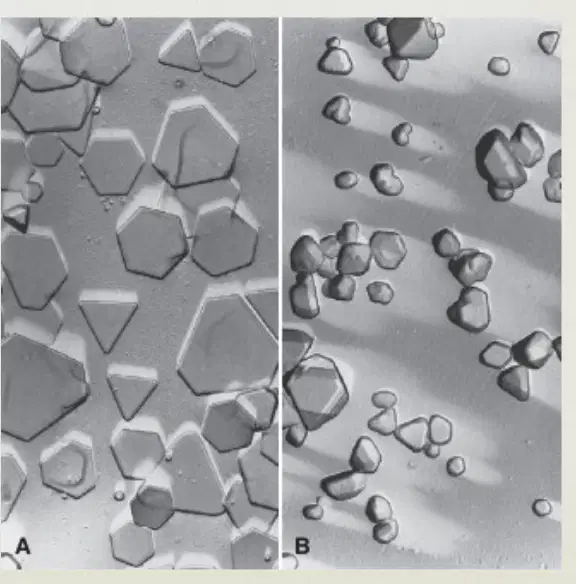
What type of crystals are present in the emulsion?
Silver halide crystals
Sodium chloride crystals
Calcium carbonate crystals
Potassium nitrate crystals
What causes the release of electrons in silver halide crystals?
X-ray radiation or visible light
High temperature only
Strong magnetic fields
Ultrasonic waves
What is formed when X-ray radiation or visible light releases electrons in silver halide crystals?
Latent Image
Visible Image
Photographic Plate
Silver Nitrate
Which of the following equations represents the reaction that occurs in the formation of a latent image in emulsion?
e- + Ag+ → Ag
Ag + e- → Ag+
Ag+ + Ag → e-
Ag → Ag+ + e-
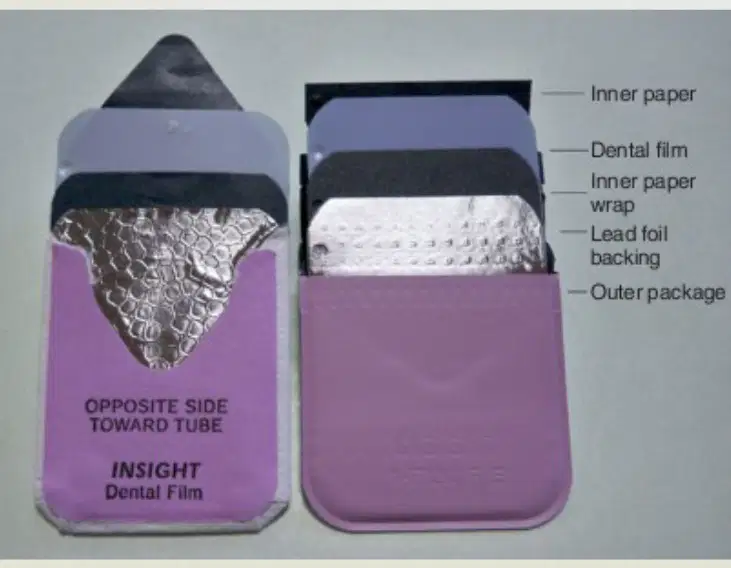
Identify the component of intraoral film packaging that is directly in contact with the dental film.
Lead foil backing
Inner paper
Outer package
Inner paper wrap

Fill in the blank: The ________ in intraoral film packaging serves as a protective barrier against light and moisture.
Outer package
Lead foil sheet
Film emulsion
Black paper wrapper
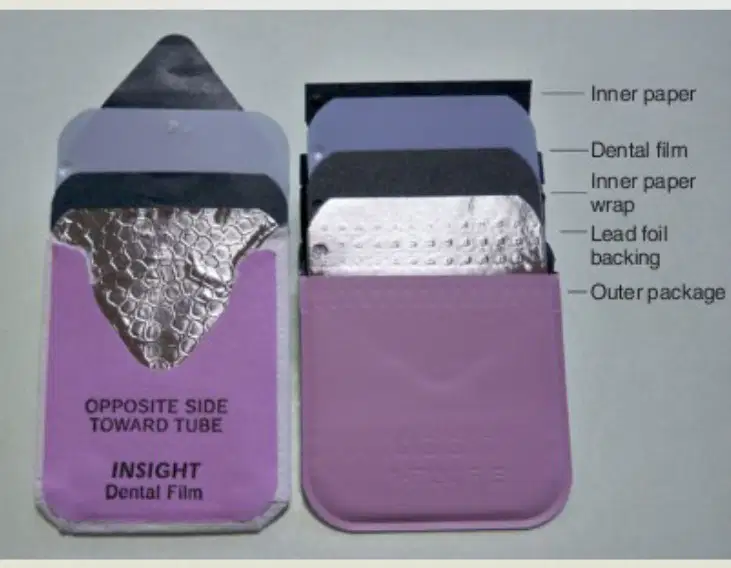
Which component of intraoral film packaging is responsible for preventing backscatter radiation from reaching the film?
Lead foil backing
Inner paper
Dental film
Outer package
What happens to the phosphor in intensifying screens when it absorbs x-rays?
It melts
It fluoresces
It hardens
It evaporates
Screens in the context of film and imaging are:
a material that greatly increases the sensitivity of the imaging system
a material that increases image resolution
specialized camera lenses
methods of film editing
What is one disadvantage of using intensifying screens?
Increases resolution
Reduces resolution
Increases film thickness
Decreases sensitivity to x-rays
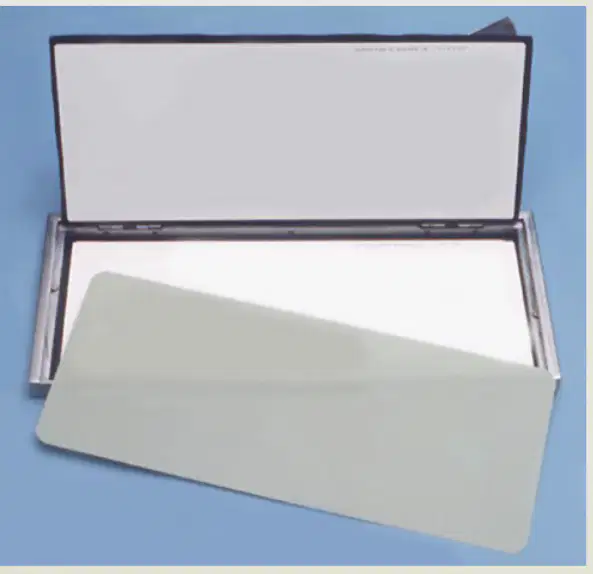
Screen film is used for ______ and cephalometric films.
panoramic
bitewing
periapical
occlusal
Screen film is made to be sensitive to which type of light?
Infrared light
Visible light
X-rays
Gamma rays
The emission characteristics of screens must match the absorption of film. This is known as ______.
Spectral Matching
Quantum Efficiency
Image Intensification
Contrast Resolution
The benefit/drawback to using intensifying screen with film is:
It reduces patient exposure to radiation but may decrease image resolution.
It increases patient exposure to radiation and improves image resolution.
It has no effect on patient exposure or image resolution.
It increases image resolution without affecting patient exposure.
What does a developer do to exposed AgBr crystals in photographic processing?
Converts them to metallic silver grains (dark)
Converts them to gold grains
Dissolves them completely
Turns them into gas
What is reduced by the developer in AgBr crystals?
Ag+ to neutral Ag
Br- to Br2
Ag to Ag+
AgBr to Br-
If left too long in the developer, even unexposed crystals are reduced, causing chemical fogging and making the image too dark.
True
False
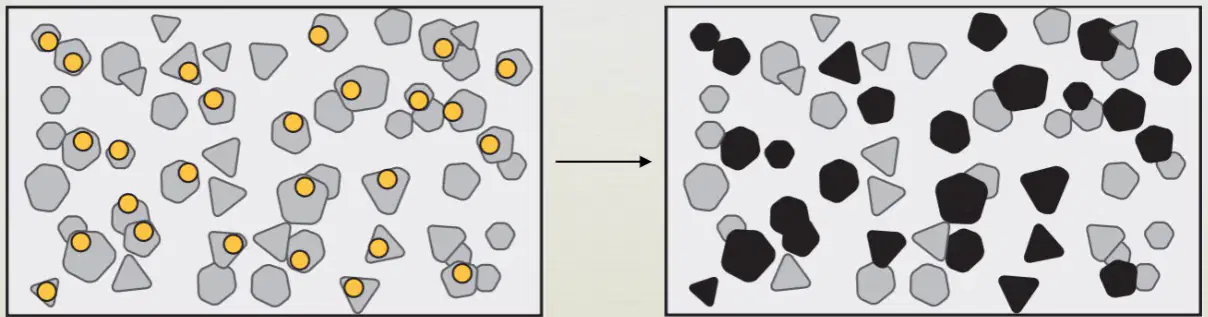
What change occurs to the AgBr crystals after the developer is applied?
The exposed AgBr crystals are converted to dark metallic silver grains, making the image visible.
The AgBr crystals dissolve completely, leaving a transparent film.
The AgBr crystals turn into gold particles, giving a yellowish tint.
The AgBr crystals evaporate, causing the image to disappear.

The yellow dots represent:
Silver (Ag) atoms collected at latent sites
Silver halide crystalizing within solid silver particles
Electrons accumulating in Siver bromide crystals
X-ray photons accumulating in Siver bromide crystals
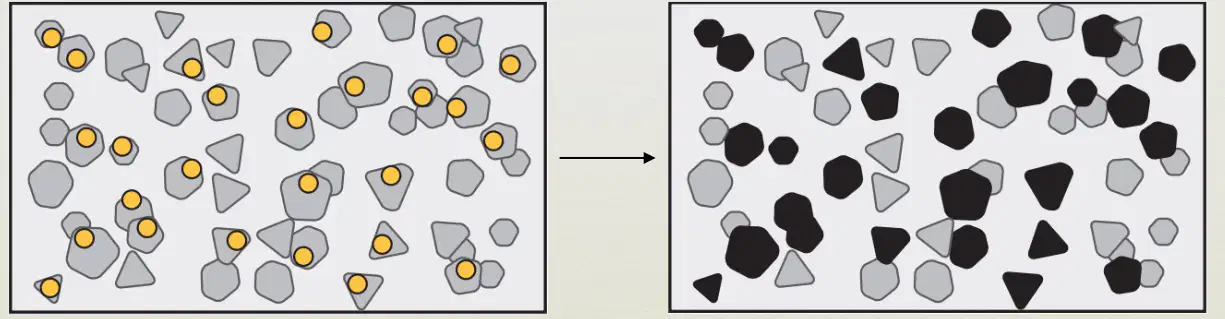
The black and gray polygons represent:
Black: metallic silver grains, Gray: remaining Silver Bromide crystals
Black: remaining Silver Bromide crystals, Gray: metallic silver grains
Black: Silver grains, Gray: Bromide crystals
Black: Bromide crystals, Gray: Silver grains
What does acid do to undeveloped crystals in the emulsion during the fixer process?
Acid dissolves undeveloped crystals from the emulsion.
Acid hardens the undeveloped crystals in the emulsion.
Acid colors the undeveloped crystals in the emulsion.
Acid enlarges the undeveloped crystals in the emulsion.
What happens if the fixer is not left long enough during the photographic process?
Crystals won’t be removed and the image will be too dark.
The image will become too light and fade away.
The photograph will develop a blue tint.
The paper will curl and become brittle.
What is the result if the fixer is left too long during the photographic process?
Even exposed crystals will dissolve and the image will be too light.
The image will become darker and more detailed.
The photograph will develop a blue tint.
The paper will become completely opaque.
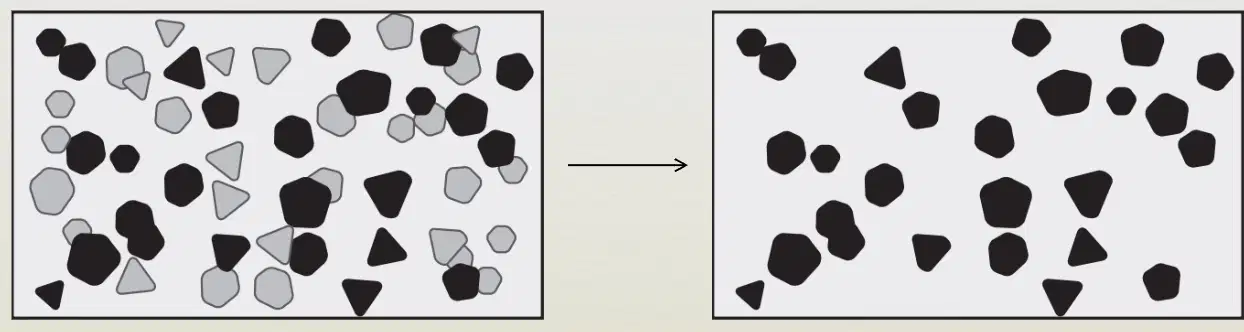
What does the right image represent after the fixer process?
The right image represents only the exposed crystals remaining after the undeveloped crystals have been dissolved by the fixer.
The right image represents all the crystals, both exposed and unexposed, after the fixer process.
The right image represents the undeveloped crystals that have not been affected by the fixer.
The right image represents a completely blank film with no crystals remaining.
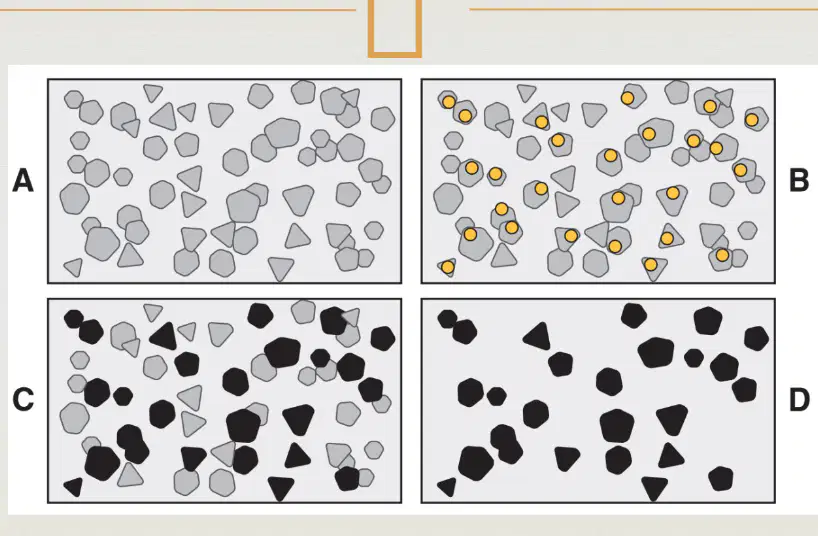
Look at the diagram showing four stages of film processing labeled A, B, C, and D. Match each stage to the correct description: Which stage corresponds to 'After Developer'?
A) A
B) B
C) C
D) D
What is the function of Phenidone in developer chemicals?
Phenidone is the first electron donor that reduces silver ions to metallic silver at latent image sites.
Phenidone acts as a fixing agent to remove unexposed silver halide.
Phenidone is used to harden the gelatin in photographic film.
Phenidone serves as a wetting agent to reduce surface tension.
Which chemical provides electrons to reduce oxidized phenidone to its original active state?
Hydroquinone
Sodium chloride
Potassium bromide
Acetic acid
Fixing time is at least ______ as long as developing in film processing.
twice
half
equal
one-third
What is the likely cause of a yellowish-brown film in dental X-ray processing?
Overexposure
Insufficient fixing or rinsing
Developer cut-off
Outdated film
Spots on a dental X-ray film can be caused by:
Light spots from fixer before processing
Dark spots from developer
Both A and B
None of the above
A white stripe across one side of the dental X-ray film is most likely due to ________.
developer cut-off, low solution level
fixer cut-off, high solution level
overexposure to light
improper film placement
Film fog, which appears as darkening and loss of contrast on a dental X-ray, can be caused by which of the following?
Overexposure
Overdevelopment
Improperly stored or outdated film
All of the above

