
 Worksheets
AU - Module 2 HEENT
Total questions: 44
Worksheet time: 22mins
What is the 1st step in accessing neurological orientation?
Asking the patient to walk
Asking the patient name and date of birth
Checking blood pressure
Checking temperature
A change in orientation or facial droop/asymmetry are both medical emergencies that may indicate what condition?
Stroke
Asthma attack
Appendicitis
Fracture
Which of the following are considered medical emergencies (stroke)?
Change in orientation
Facial droop/asymmetry
Both A and B
None of the above
What does 'normocephalic' refer to in a head and neck assessment?
A) Shape
B) Size
C) Color
D) Movement
Asymmetry of facial features during a head and neck assessment may indicate a possible ________.
stroke
migraine
sinus infection
allergy
Palpating the head or neck for any masses or enlarged lymph nodes is part of the head and neck assessment.
True
False
A full range of motion in the neck should be smooth and without pain.
True
False
During a head and neck assessment, what is an expected variation in facial features?
Slight asymmetry of facial features
Marked facial drooping
Complete facial paralysis
Severe facial swelling

What is an expected variation in the hair of older adults during a head and neck assessment?
Dry, brittle, and overall thinning of hair in older adults
Increased hair growth and oiliness in older adults
Thick, shiny, and rapidly growing hair in older adults
Brightly colored and curly hair in older adults
Inspect ears for alignment. The top of the ear should be in alignment with the outer corner of the _____
eye
mouth
nose
chin
Inspect for drainage/discharge, foreign objects, lesions, or variations in skin tone.
True
False
Palpate for any pain.
True
False
How do you straighten the ear canal in adults during an ear canal assessment with an otoscope?
By pulling the auricle up and back
By pulling the auricle down and back
By pushing the auricle forward
By leaving the auricle in place

How do you straighten the ear canal in young children during an ear canal assessment with an otoscope?
By pulling the auricle up and back
By pulling the auricle down and back
By pushing the auricle forward
By leaving the auricle in place
Ear infections are common in young children due to the eustachian tube being ______ and more horizontal.
shorter
longer
thicker
curved
According to the eye assessment guidelines, the sclera should be ______ or light yellow in patients with dark complexion.
white
red
blue
green
According to the eye assessment guidelines, the conjunctiva should be ______ and moist.
pink
red
yellow
pale
What is the normal range for pupil size in normal lighting according to the eye assessment guidelines?
1 mm to 3 mm
3 mm to 5 mm
5 mm to 7 mm
7 mm to 9 mm
What is the consensual response in an eye assessment?
When both pupils dilate when light is shined in one eye
When both pupils constrict or decrease in size when light is shined in one eye
When only the tested pupil constricts
When neither pupil responds to light
Lack of light response in an eye assessment indicates possible ________ injury.
CNS
Muscular
Skeletal
Respiratory
In the context of eye assessment, what does the 'P' in PERRLA stand for?
pupils clear
pressure normal
peripheral vision
pupil dilation
In the context of eye assessment, what does the 'E' in PERRLA stand for?
Equal and between 3-5 mm in diameter
Eyelids are symmetrical
Eyes are reactive to accommodation
Eversion of the eyelid
In the context of eye assessment, what does the 'R' in PERRLA stand for?
round
reactive
red
refractive
In the context of eye assessment, what does the 'RL' in PERRLA stand for?
reactive to light both directly and consensually when direct light is shone into one pupil and the other
responds to lateral movement
retains light sensitivity in low light
reacts to loud noises
In the context of eye assessment, what does the 'A' in PERRLA stand for?
Accommodation of the pupils when they dilate to look at an object far away and then converge and constrict to focus on a near object
Alignment of the pupils when exposed to light
Adjustment of the retina to varying light conditions
Acuity of vision in both eyes
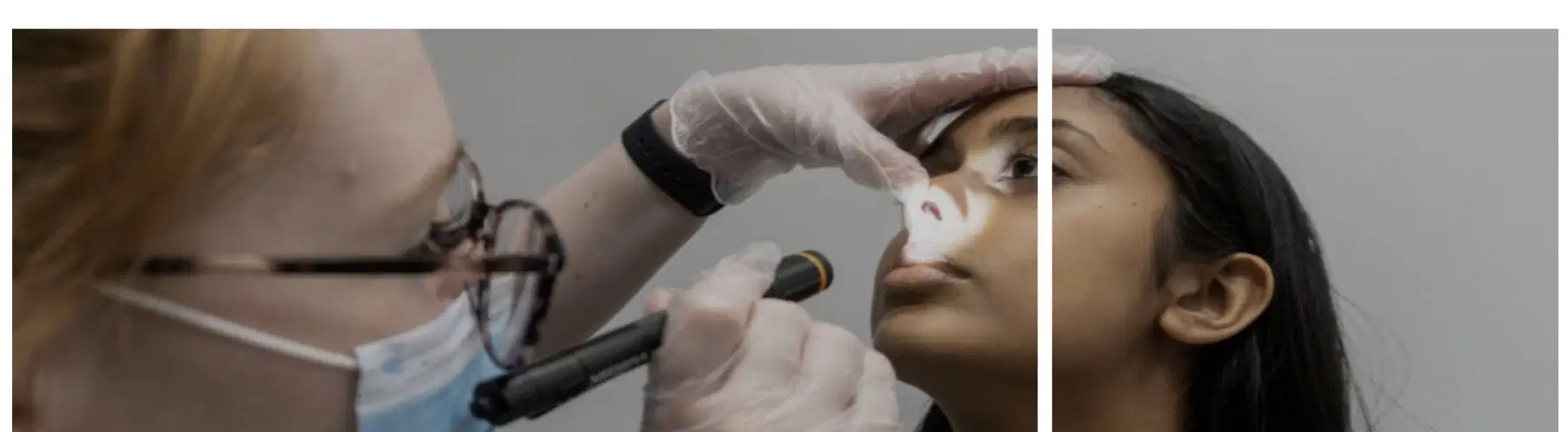
Nose Assessment: Inspect nose is ________, symmetrically, with no swelling or masses.
midline
deviated
swollen
asymmetrical
Nose Assessment: Each nostril is ________.
patent
blocked
swollen
bleeding
Nose Assessment: The mucous membrane is ________ and moist with no discharge or lesions.
pink
pale
yellow
blue
During a mouth/throat assessment, what should you inspect the lips and mouth for?
Color, lesions, missing or damaged teeth
Hair growth
Earwax
Nail color
Mucous membranes should be ______ and moist with no lesions.
pink
blue
yellow
white
If dark or bluish tinge is observed in the oral mucosa, what should be assessed?
Blood pressure
Respirations and oxygen saturation
Heart rate
Temperature
What is one important attitude to maintain when dealing with patients with poor dental hygiene?
Be respectful
Be judgmental
Ignore their concerns
Show impatience
Which of the following is recommended to prevent oral diseases in patients with poor dental hygiene?
Brushing and flossing daily
Annual dental exams
Both A and B
None of the above
What should be provided to patients with poor dental hygiene to help them access care?
Resources for services
Extra toothbrushes only
Sugary snacks
Cosmetic dental products
What should speech be during a mouth/throat assessment?
Speech should be clear and articulate.
Speech should be slurred and mumbled.
Speech should be rapid and incoherent.
Speech should be whispered and weak.
What does NPO stand for in the context of difficulty swallowing?
NPO means nothing by mouth (nil per os).
NPO means no physical obstruction.
NPO means new patient order.
NPO means nutritional protein only.
Mouth/Throat Assessment: True or False: A raspy voice requires further evaluation.
True
False
Mouth/Throat Assessment: What should you do if you observe choking or signs of choking?
Always call for HELP with room number/location.
Offer the person a glass of water to help clear the throat.
Ignore it and continue with the assessment.
Ask the person to lie down and rest.
How do you palpate the frontal sinuses?
Palpate the frontal sinuses by pressing upward with thumbs from just below the eyebrows on either side of nose.
Palpate the frontal sinuses by pressing on the temples with your index fingers.
Palpate the frontal sinuses by tapping gently on the chin with your knuckles.
Palpate the frontal sinuses by pressing downward on the bridge of the nose.
How do you palpate the maxillary sinuses?
Palpate the maxillary sinuses by pressing upward at the skin crevices that run from the sides of the nose to the corner of the mouth.
Palpate the maxillary sinuses by pressing downward on the forehead above the eyebrows.
Palpate the maxillary sinuses by tapping gently on the chin.
Palpate the maxillary sinuses by pressing on the temples.
During a musculoskeletal assessment, gait should be:
Unsteady and slow
Steady, smooth, and coordinated
Fast and erratic
Weak and irregular
What should be assessed bilaterally and simultaneously during a musculoskeletal assessment?
Hand grasp
Pupil reaction
Respiratory rate
Bowel sounds
What should be assessed bilaterally and simultaneously during a musculoskeletal assessment?
Foot strength
Pulse rate
Respiratory rate
Blood pressure
NPO
By mouth
Nothing by mouth
As needed
twice a day

