
 Worksheets
Special Education Supports & Services Part 2
Total questions: 25
Worksheet time: 13mins
Which of the following best describes the primary function of a prereferral team in an educational setting?
To provide direct instruction to students with disabilities
To consult and problem-solve with general education teachers, special services personnel, and an administrator
To create individualized education plans (IEPs) for all students
To conduct standardized testing for all students
What is the main purpose of Response to Intervention (RtI) as mentioned in the material?
To assign grades to students
To analyze learning problems and use research-based interventions
To hire new teachers
To develop new curriculum standards
Which of the following statements about Multi-Tiered Systems of Support (MTSS) is accurate?
MTSS is only used for academic concerns
MTSS uses tiered interventions for both behavior and academic concerns
MTSS is implemented only by special education teachers
MTSS does not involve any interventions
How are RtI and MTSS typically implemented in schools according to the material?
By school counselors only
Largely by general educators
Exclusively by administrators
By students themselves
A student is struggling academically and behaviorally. According to the prereferral process described, what would be the most appropriate initial step for the school team?
Refer the student directly to special education
Consult with the prereferral team to present information and engage in team problem solving
Suspend the student from school
Ignore the problem and wait for improvement
If interventions are recommended after the prereferral team reviews a case, what is the next possible step if the problem persists?
No further action
MDT prepares student IEP
Referral to MDT for full assessment
Disability found
After a full individual assessment, what is the next step if a disability is found and it negatively affects learning?
No further action
MDT prepares student IEP
School representative contacts parents for permission
Interventions recommended
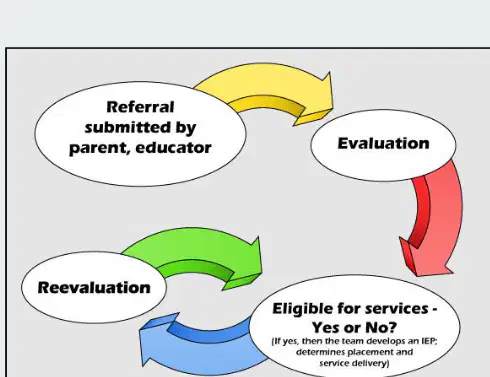
Which of the following is the first step in the Special Education Referral and Assessment Process?
Evaluation
Reevaluation
Referral submitted by parent, educator
Eligible for services - Yes or No?
Why is it important to inform parents of their rights during the special education process?
To ensure parents can make informed decisions and their rights are honored
To reduce paperwork for educators
To speed up the referral process
To avoid reevaluation
Which federal law details parent rights in the special education process?
ADA
IDEA
FERPA
Section 504
Which of the following components may be included when gathering information about a student’s strengths and needs during the assessment process?
Vision, hearing, educational functioning, social and behavior skills
Only academic performance
Only physical health
Only family background
Who must conduct the assessments in the Special Education Referral and Assessment Process?
The student’s friends
Trained professionals
The student’s parents only
Any school staff member
Why is it important to conduct observations of the student in various school situations during the assessment process?
To ensure the student is always supervised
To gather comprehensive information about the student’s functioning in different contexts
To compare the student to their peers
To reduce the workload of teachers
According to North Carolina law, how many days does the school system have to act on a Referral letter for an IEP after it is submitted by a parent?
60 days
90 days
120 days
30 days
What is one of the requirements that must be met before the 90th calendar day after a parent submits a Referral for an IEP?
The school must have held an IEP meeting with the parent(s).
The school must have given the child a standardized test.
The school must have assigned a new teacher to the child.
The school must have changed the child’s grade level.
If a child is determined eligible for an IEP, what must the school do within the 90-day timeline?
Write the IEP
Suspend the child
Transfer the child to another school
Cancel the referral
Which statement best describes the flexibility of the 90-day timeline for IEP referrals in North Carolina?
The timeline can be extended if both the school and parents agree.
The timeline can be shortened by the school.
The timeline cannot be extended, even if both the school and parents want to extend it.
The timeline is only a suggestion and not required by law.
What is the role of the MDT after services and placement have been updated and continued?
MDT monitors for three-year reevaluation and notifies parents
MDT prepares student IEP
Interventions are recommended
No further action
What process is available to resolve disagreements between school district personnel and parents regarding special education services?
Due process
Immediate expulsion
Automatic approval of parent requests
Ignoring the disagreement
Which of the following is a required component of an Individualized Education Program (IEP)?
Present level of performance
Parent-teacher conference notes
List of extracurricular activities
Student's medical history
A student is 17 years old and has an IEP. Which additional component must be included in their IEP?
Transition plan
List of classroom supplies
Parent contact information
Teacher’s lesson plans
Which of the following best describes the value of IEPs for students with disabilities?
They guide the education of students with disabilities
They increase the number of school holidays
They reduce the need for classroom instruction
They eliminate standardized testing
How do IEPs help clarify expectations for students?
By setting goals and short-term objectives
By assigning random homework
By reducing classroom size
By increasing lunch breaks
A student with a disability is struggling with personal care and needs psychological support. Which category of services would best address these needs?
Related Services
Supplemental Aids only
General Education Services
Standardized Testing Services
Explain how supplemental aids and services can help a student with disabilities succeed in a general education classroom. Provide at least two examples from the provided material.
By offering materials at different levels and providing assistive technology
By increasing the number of tests
By reducing classroom participation
By eliminating all homework

