
 Worksheets
Rib Review
Total questions: 35
Worksheet time: 18mins
Which of the following best describes the function of the axial skeleton?
It forms the central "axis" of the body.
It supports only the limbs.
It is responsible for muscle contraction.
It produces red blood cells exclusively.
Explain why the vertebral column is considered part of the axial skeleton and not the appendicular skeleton.
Because it forms the central support structure of the body.
Because it is located in the limbs.
Because it is made of cartilage only.
Because it is not connected to the skull.
Which bones are included in the pectoral (shoulder) girdles of the appendicular skeleton?
Clavicles and scapula
Femur and tibia
Ilium and ischium
Radius and ulna
Which of the following is NOT part of the upper limbs in the appendicular skeleton?
Arms
Forearms
Ankles
Hands
To which vertebrae is the thoracic cage anchored posteriorly?
Cervical vertebrae (C1–C7)
Lumbar vertebrae (L1–L5)
Sacral vertebrae (S1–S5)
Thoracic vertebrae (T1–T12)
Why are the first seven ribs called "true ribs"?
They are directly attached to the sternum via their own costal cartilages.
They are the longest ribs in the body.
They are fused together at the back.
They are not connected to the sternum at all.
Why are the 11th and 12th pairs of ribs called "floating ribs"?
Because they are the longest ribs
Because they do not attach to the sternum at all
Because they are attached to the pelvis
Because they are fused together
Explain the structural difference between floating ribs and other ribs in the rib cage, and discuss the potential functional significance of this difference.
Floating ribs are shorter and do not attach to the sternum, which may allow for greater flexibility and protection of the lower organs.
Floating ribs are fused together, providing extra strength to the rib cage.
Floating ribs are attached to the clavicle, aiding in shoulder movement.
Floating ribs are longer and provide support for the upper limbs.
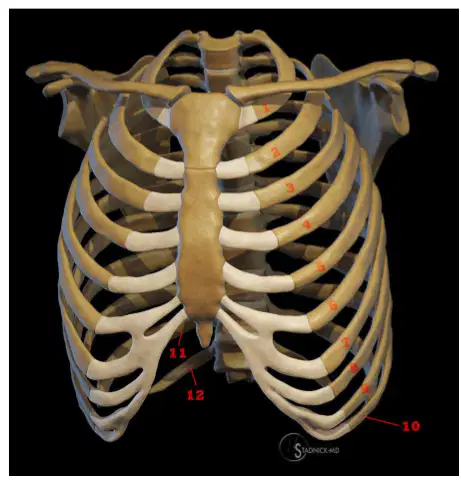
Which structure in the diagram is formed by costal cartilages?
The vertebral column
The scapula
The flexible connections at the front of the rib cage
The clavicle
How does the sternum contribute to respiratory facilitation?
By producing oxygen
Through its cartilage connections, aiding chest wall expansion during breathing
By filtering air entering the lungs
By contracting during inhalation
A patient suffers a direct blow to the chest. Using your understanding of the sternum’s functions, explain how the sternum helps protect vital organs in this scenario.
The sternum absorbs the impact and forms a protective barrier for the heart, lungs, and major blood vessels.
The sternum increases blood flow to the area.
The sternum contracts to push the organs away from the impact.
The sternum releases hormones to reduce pain.
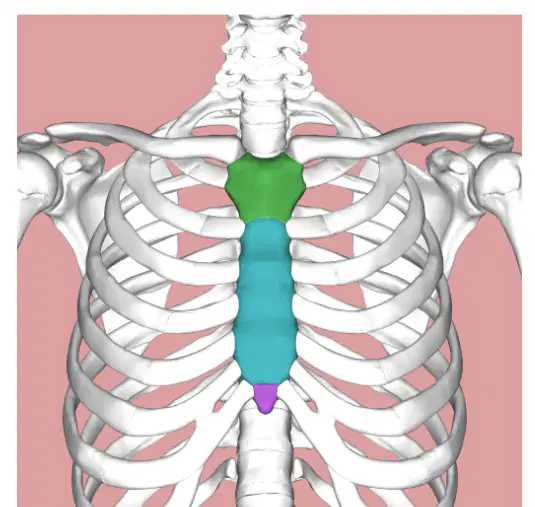
Which of the following is the upper, broader segment of the sternum? (Green)
Manubrium
Body (Gladiolus)
Xiphoid Process
Clavicle
Explain why the xiphoid process is considered unique among the three parts of the sternum.
It is the only part that is cartilaginous in youth and ossifies with age.
It is the broadest segment.
It is the longest portion.
It connects directly to the clavicle.
What is another name for the pectoral girdle?
Shoulder girdle
Pelvic girdle
Rib cage
Vertebral column
Where is the clavicle located in the human body?
Posteriorly across the back
Anteriorly across the top of the thorax
Along the lower limbs
At the base of the skull
Explain the functional importance of the clavicle’s articulation with the manubrium of the sternum.
It allows for movement of the lower limbs
It provides a bony connection anchoring the upper limb to the axial skeleton
It supports the vertebral column
It protects the heart directly
What three bones fuse to form the hip bone?
Ilium, Ischium, Pubis
Femur, Tibia, Fibula
Scapula, Clavicle, Humerus
Radius, Ulna, Carpals
Which vertebra allows your head to nod "yes"? Which allows you to shake "no"?
Atlas (C1) for "yes", Axis (C2) for "no"
Axis (C2) for "yes", Atlas (C1) for "no"
Thoracic for "yes", Lumbar for "no"
Lumbar for "yes", Sacrum for "no"
What three bones make up the shoulder joint?
Clavicle, Scapula, Humerus
Clavicle, Femur, Tibia
Scapula, Radius, Ulna
Clavicle, Sternum, Fibula
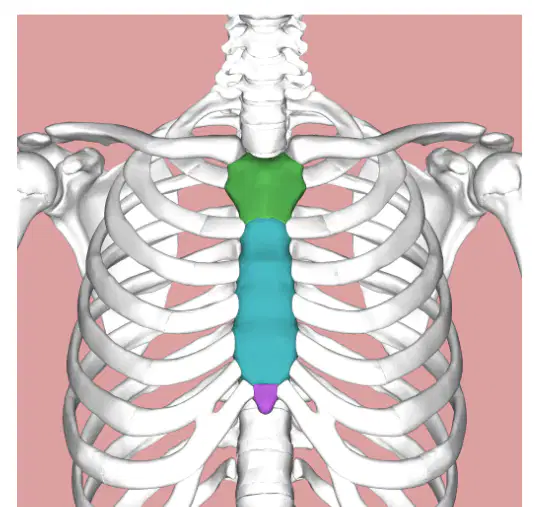
What part of the Sternum is purple in this photo?
Gladiolus
Xiphoid Process
The Femur
Manubrium
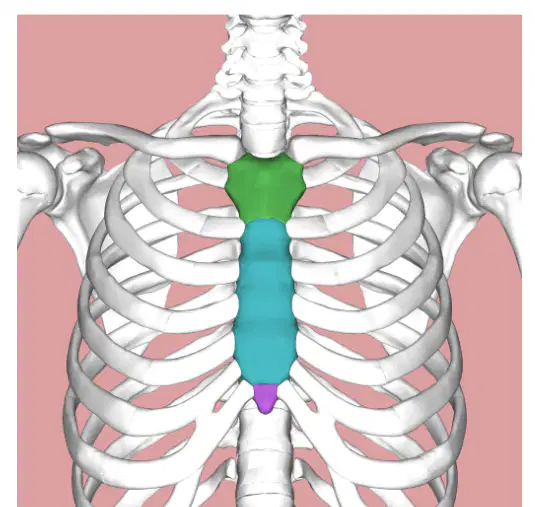
What part of the Sternum is teal in this photo?
Manubrium
Xiphoid Process
Humerus
Gladiolus
Which bone forms the anterior portion of the rib cage and serves as an attachment point for the ribs?
Pelvis
Sternum
Scapula
Femur
What is the main function of costal cartilages in the thoracic cage?
To anchor the vertebral column
To protect the brain
To support the lower limbs
To provide flexibility and connect the ribs to the sternum
Which of the following bones is NOT part of the axial skeleton?
Rib
Sternum
Clavicle
Vertebra
What is the primary function of the scapula in the shoulder girdle?
To provide attachment points for muscles and facilitate arm movement
To produce red blood cells
To protect the brain
To support the lower limbs
Which part of the sternum directly articulates with the first pair of ribs?
Body (Gladiolus)
Clavicle
Manubrium
Xiphoid Process
What is the primary role of the scapula in the pectoral girdle?
To protect the spinal cord
To connect the ribs to the sternum
To anchor the lower limbs
To provide a surface for muscle attachment and facilitate shoulder movement
Which of the following statements about the costal cartilages is correct?
They are made of bone and provide rigidity to the rib cage
They form the vertebral column
They connect the ribs to the sternum and allow flexibility in the thoracic cage
They are only found in the lower limbs
Which part of the rib cage provides direct attachment for most of the ribs?
Pelvis
Clavicle
Sternum
Scapula
Which of the following bones is found in the appendicular skeleton but not in the axial skeleton?
Scapula
Rib
Vertebra
Sternum
Which bone forms the anterior connection between the left and right sides of the pectoral girdle?
Humerus
Clavicle
Scapula
Sternum
What is the main structural difference between true ribs and false ribs?
True ribs attach directly to the sternum, while false ribs do not
False ribs are longer than true ribs
True ribs are made of cartilage, false ribs are made of bone
True ribs are only found in the lower limbs
Which part of the axial skeleton protects the spinal cord?
Scapula
Clavicle
Pelvis
Vertebral column
Which bone serves as the main attachment point for the upper limb to the trunk?
Clavicle
Pelvis
Femur
Scapula
What is the function of the manubrium in the sternum?
It supports the vertebral column
It connects the lower limbs to the pelvis
It provides an attachment for the clavicles and the first pair of ribs
It forms the base of the skull

