
 Worksheets
Chapter 3 practice for exam
Total questions: 76
Worksheet time: 2hrs 57mins
the distance between peaks of electromagnetic waves is called:
wavelength
frequency
energy
Planck's Constant
A light particle is called a(n):
electromagnetic wave
photon
electron
atom
We see a "rainbow of colors" that when perceived together produce:
black light
white light
gamma rays
x-ray images
What is the wavelength of light (nm) that has a frequency of 6.44 × 10¹³ s -1 ?
c =λ×ν
c = speed of light = 3.00×10⁸ ms−1 1 nm = 10−9 m
λ = wavelength ν = frequency
6490 nm
932 nm
4660 nm
6.49 × 10⁻⁸ nm

The number of waves that pass a fixed point in unit time
astronomical unit
frequency
wavelength
A packet "particle" of electromagnetic energy is known as a
neutron
photon
Hertz
proton
Electromagnetic radiation can sometimes behave like _______ and at other times like __________. Choose two.
a wave
a particle
gravity
matter
When an atom absorbs energy, electrons .....
moves up an energy level
goes down an energy level
are removed from the atom
When electrons move down an energy level, the atom ......
releases equal energy as a photon
splits
bonds to another
How many electrons can fit on the 1st energy level (orbital) for any Bohr Model?
2
6
8
10
Mia, Evelyn, and Arjun are studying the Bohr model for their physics class. According to this model, where are electrons allowed to exist in an atom?
Energy levels or orbits
Conduction band
Valence band
Nucleus
Ethan is studying the Bohr model of the atom and wants to understand the significance of the principal quantum number. What does the principal quantum number represent in the Bohr model?
The principal quantum number determines the shape of the electron's orbital.
The principal quantum number indicates the spin of the electron.
The principal quantum number represents the energy level or atomic orbit of an electron in an atom.
The principal quantum number determines the atomic number of an element.
The electrons move around the nucleus based on the (a) they occupy.
What is the shape of an 'S' subshell?


What is the shape of an 'D' subshell?
What is the shape of an 'P' subshell?
What is the shape of an 'F' subshell?

How many orbitals does an S subshell have?
1
2
3

How many orbitals does a P subshell have?
1
3
5

How many orbitals does a D subshell have?
4
5
3
If an orbital can hold 2 electrons, and a D subshell has 5 orbitals. How many electrons can a D Subshell hold?
5
10
2
6
If an orbital can hold 2 electrons, and a 'S' subshell has 1 orbital. How many electrons can a 'S' Subshell hold?
5
10
2
6
Each p subshell contains _____ orbitals
1
3
5
7
Choose the correct electron configuration for Nitrogen:
1s2 2s2 2p6
1s2 2s2 2p8
1s2 2s2 2p1
1s2 2s2 2p3
Choose the s orbital


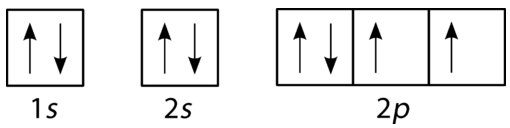
What does the number 1 in "1s" stand for?
energy level
s orbitals
p orbitals
the number of electrons


How many orbitals does an s sublevel have?
1
3
5
7
How many orbitals does a d sublevel have?
1
3
5
7
Electrons fill energy levels and sublevels _____ in energy first.
lower
higher
The maximum number of electrons that can fit into the 2nd energy level is
2
8
18
32

Region of high probability of finding an electron
atomic orbital
ground state
Heisenberg uncertainty principle
electron configuration
Fill in the blank: The number of orbitals in a 3p sublevel is ____.
1
3
5
7
Fill in the blank: The n = 3 energy level contains ____ orbitals.
1
4
9
16
Which sublevel has a cloverleaf shape?
s
p
d
f
Which sublevel has a variable shape?
s
p
d
f
How many orbitals does an s sublevel have?
1
3
5
7
What are the orbitals for n=4
s
s, p
s, p, d
s, p, d, f
How many f orbitals can an f sublevel hold?
1
7
5
14
What are the orbitals that make up the n=1 energy level?
s
s, p
s, p, d
s, p, d, f
Electrons fill energy levels and sublevels _____ in energy first.
lower
higher
The maximum number of electrons that can fit into the 2nd energy level is
2
8
18
32
Theoretically, the fifth energy level of an atom can hold a maximum of ________ sublevels?
2
4
5
6
Of the following sublevels, which is the highest in energy?
4s
3d
4p
5s
A spherical orbital with 3rd energy level
(a)
An orbital that is one of a set of 3 in 4th shell
(a)
subshells in n=5 shell
(a)
Orbitals in 4d subshell
(a)
Maximum number of electrons in 5f subshell
(a)
Maximum number of electrons in n=4 shell
(a)
Maximum electrons in 3dy orbital
(a)

Elements in the same group or column have the same ...
# of valence electrons
# of shells
# of protons
Mass Number
Which atom has the largest atomic radius?
potassium (K)
rubidium (Rb)
francium (Fr)
cesium (Cs)
Ra, Be, Ca, Rb, H
Which of the following elements would be smaller: indium or gallium?
indium
gallium
both atoms are the same size
cannot be determined
the sizes can vary
Which of the following elements would be larger: potassium or cesium?
potassium
cesium
both atoms are the same size
cannot be determined
the sizes can vary

