
 Worksheets
Blood Components
Total questions: 96
Worksheet time: 48mins
What are erythrocytes also known as?
Red blood cells (RBCs)
White blood cells (WBCs)
Platelets
Plasma
What is the main function of erythrocytes?
Carry oxygen and carbon dioxide through hemoglobin (Hgb)
Produce antibodies to fight infections
Regulate blood pressure by releasing hormones
Initiate blood clotting by forming platelets
What are leukocytes also known as?
White blood cells (WBCs)
Red blood cells (RBCs)
Platelets
Plasma
What is the main function of leukocytes?
Infection control and immunological reactions
Oxygen transport in the blood
Blood clotting
Production of hormones
Leukocytes can be classified into which two groups?
Granulocytes and agranulocytes
Erythrocytes and thrombocytes
Plasma and serum
Antibodies and antigens
What are thrombocytes also known as?
Platelets
Red blood cells
White blood cells
Plasma
What is the main function of thrombocytes?
Blood clotting
Oxygen transport
Hormone production
Digestion
What is plasma in blood?
Liquid portion
Red blood cells
White blood cells
Platelets
What does plasma contain besides being the liquid portion of blood?
Other coagulation factors
Red blood cells
Platelets
Bone marrow
Until what age is fetal hemoglobin (Hgb) present in life?
4 to 6 months
1 to 2 years
At birth only
Up to 12 months
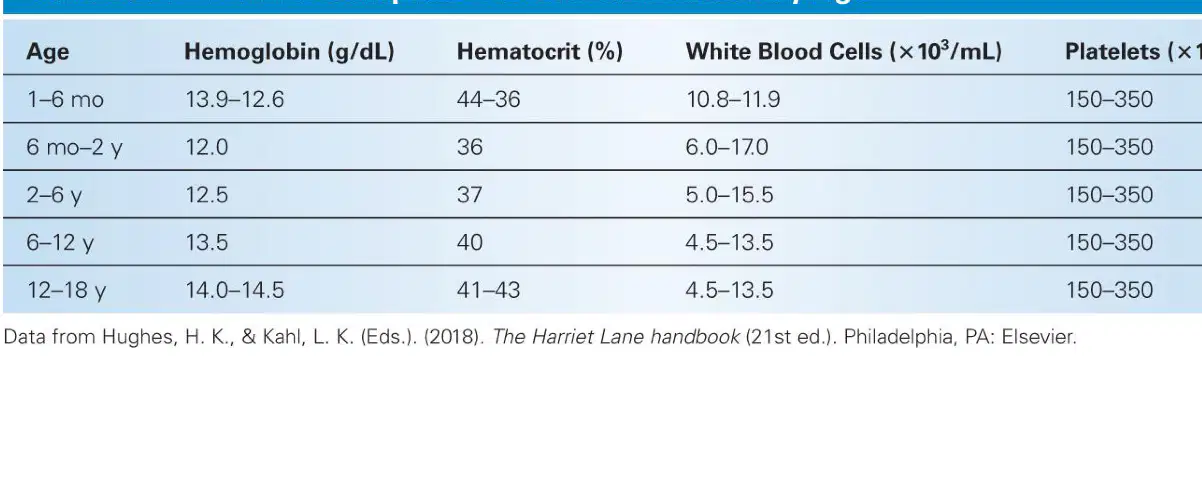
What is the normal hemoglobin (g/dL) range for children aged 1–6 months?
13.9–12.6
10.0–11.0
15.0–16.0
8.5–9.5
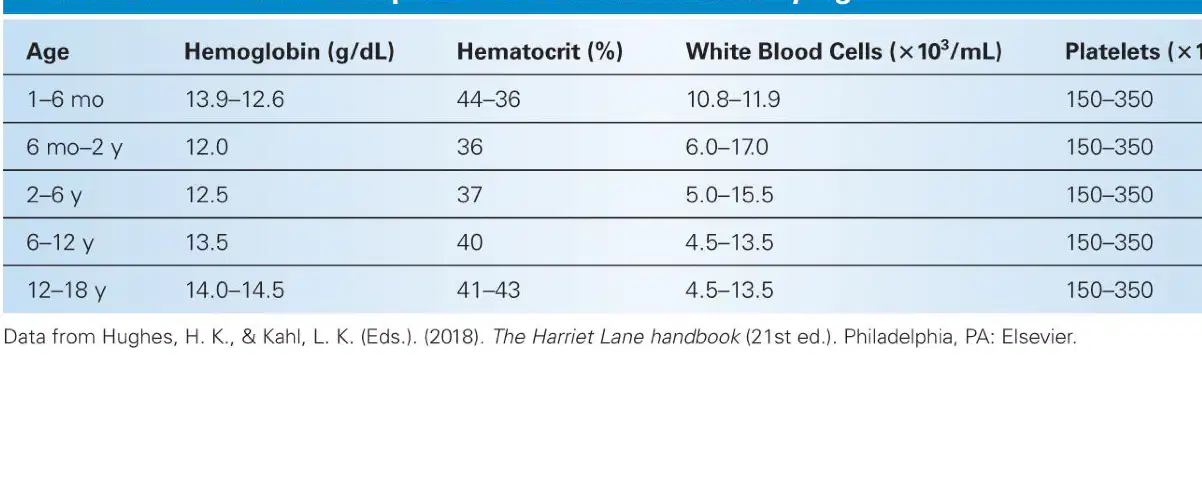
What is the normal hematocrit (%) for children aged 6 months to 2 years?
36
28
42
50
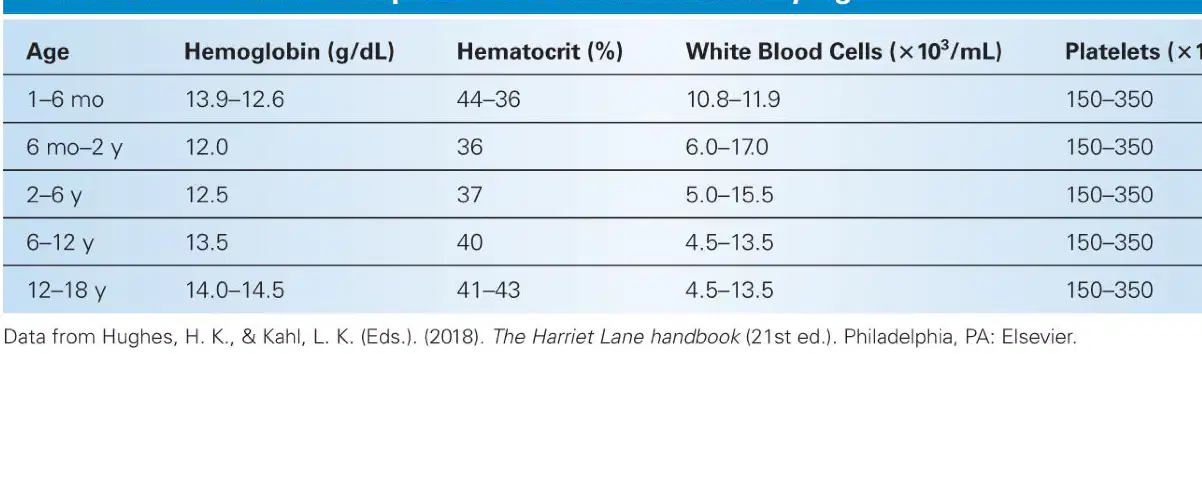
What is the normal range of white blood cells (×10³/mL) for children aged 2–6 years?
5.0–15.5
3.0–9.0
12.0–20.0
1.0–4.5
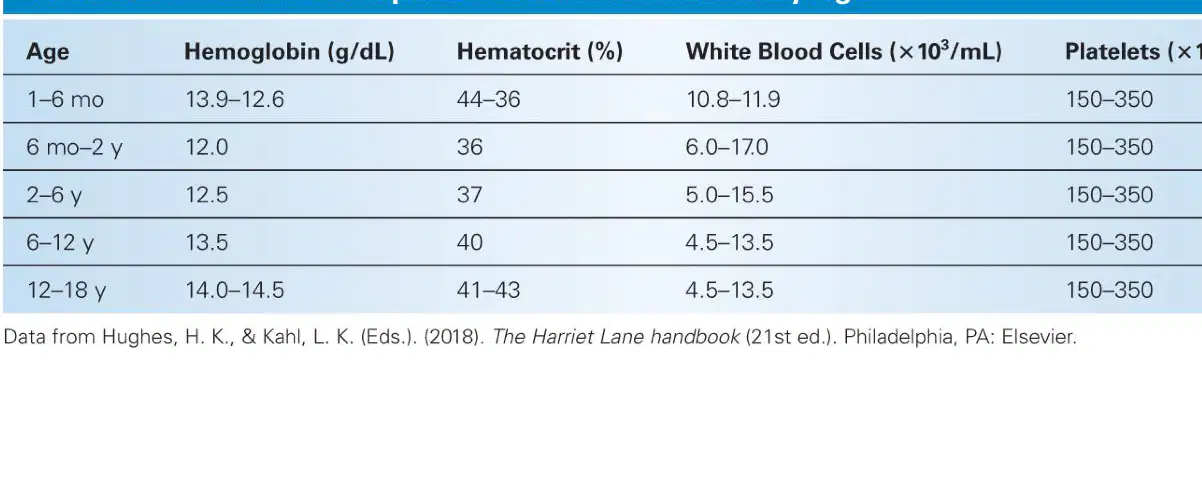
What is the normal platelet count (×10³/μL) for all pediatric age groups listed in the table?
150–350
50–100
400–600
90–140
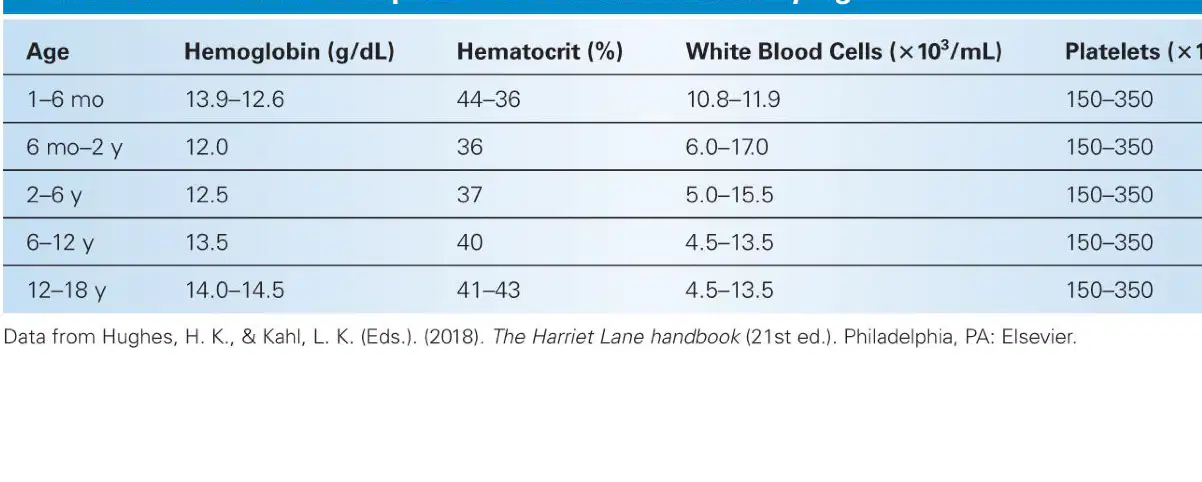
Which age group has the highest normal hemoglobin value according to the table?
12–18 years (14.0–14.5 g/dL)
6–12 years (11.5–15.5 g/dL)
1–6 years (10.5–13.5 g/dL)
Newborn (13.5–20.0 g/dL)
Fill in the blank: One of the steps in hematological assessment is ________ blood count analysis.
complete
partial
random
initial
Which of the following should be assessed for during hematological assessment?
Tachypnea, tachycardia, and hypoxia
Blood glucose levels
Liver enzymes
Renal function
Fill in the blank: Assess the ________ of the complete blood count during hematological assessment.
differential
temperature
pressure
volume
Fill in the blank: Hematological assessment includes coagulation studies and ________ times.
clotting
bleeding
reaction
sedimentation
Which of the following is a nursing intervention to maintain adequate oxygenation in patients with hematological disorders?
Monitor urine output
Administer oxygen if Hgb or oxygen saturation low
Monitor coagulation factors
Adequate circulatory volume
To maintain adequate hydration in patients with hematological disorders, what should be ensured?
WBC alterations
Adequate circulatory volume
Risk for hemorrhage
Monitor coagulation factors
Maintaining adequate tissue perfusion involves monitoring urine output and ________ status.
peripheral vascular
respiratory
neurological
gastrointestinal
Which of the following is important for the prevention or prompt control of infection in hematological disorders?
Monitor coagulation factors
WBC alterations
Adequate circulatory volume
Administer oxygen
Preventing or controlling breathing in hematological disorders includes monitoring coagulation factors and assessing risk for ________.
hemorrhage
infection
dehydration
hypoglycemia
Which of the following should be monitored to prevent or control breathing complications in hematological disorders?
Urine output
Coagulation factors
Oxygen saturation
WBC alterations
Which of the following is a reason to maintain thermoregulation in patients with hematological disorders?
Cold increases metabolic and oxygen demands
Cold decreases metabolic and oxygen demands
Heat increases metabolic and oxygen demands
Heat decreases metabolic and oxygen demands
Educating the patient and family about medication administration is an important nursing intervention for hematological disorders.
True
False
What is an important aspect of educating the patient and family for early detection in hematological disorders?
Identifying crises (early detection)
Encouraging excessive physical activity
Avoiding all medications
Ignoring minor symptoms
Providing appropriate developmental care for patients with hematological disorders includes promoting normal growth and development.
True
False
Oxygenation effects are considered under which nursing intervention for hematological disorders?
Maintain thermoregulation
Provide psychosocial support
Provide appropriate developmental care
Prevent or control pain
Preventing or controlling pain in hematological disorders is especially important in cases of ________.
Sickle cell ischemia
Iron deficiency anemia
Hemophilia A
Polycythemia vera
Providing psychosocial support for patients with hematological disorders includes addressing the demands of care and ________.
Siblings and finances
Dietary restrictions
Physical therapy
Medication schedules
What is the abnormal hemoglobin gene associated with Sickle Cell Disease?
Hgb S
Hgb A
Hgb F
Hgb C
What shape do red blood cells (RBCs) take in Sickle Cell Disease?
Sickle-shaped
Round
Oval
Star-shaped
Sickle Cell Disease is which type of genetic disorder?
Autosomal dominant
Autosomal recessive
X-linked recessive
Mitochondrial
Carriers of the gene for Sickle Cell Disease are usually:
Asymptomatic
Symptomatic with severe pain
Always anemic
Always require blood transfusions
Sickle Cell Disease is ethnically linked to which of the following groups?
African
Mediterranean
Hispanic
Middle Eastern
Asian
Which hemoglobin is protectant for the first 4 to 6 months of life in Sickle Cell Disease?
HgB F
HgB A
HgB S
HgB C
What are two complications of Sickle Cell Disease mentioned in the facts?
Occlusion and hemolysis
Hypertension and diabetes
Asthma and bronchitis
Arthritis and osteoporosis
Premature RBC death in Sickle Cell Disease leads to which two outcomes?
Release free iron
Absorb in spleen and liver
Increase RBC count
None of the above
Refer to the diagram showing genetic transmission of sickle cell anemia: Autosomal recessive inheritance. What is the genotype of a normal male offspring?
NN
Nd
dd
Nn
What is the genotype of an affected female offspring?
NN
Nd
dd
Nn
Refer to the diagram showing genetic transmission of sickle cell anemia: Autosomal recessive inheritance. Fill in the blank: The genotype of a carrier male offspring is ___.
Nd
NN
dd
Nd'
What are the triggers for sickle cell crises?
Hypoxia, acidosis, dehydration, fever, and hypothermia
Hyperglycemia, hypertension, and obesity
Allergies and asthma
None of the above
Which of the following is a symptom of vasoocclusive sickle cell crisis?
Severe pain from ischemia
Increased infections
Pulmonary vessel occlusion
Neuro assessments
Dactylitis is associated with which type of sickle cell crisis?
Vasoocclusive (occluding vascular circulation)
Aplastic crisis
Hemolytic crisis
Sequestration crisis
Splenic sequestration in sickle cell disease can lead to increased infections and may require what surgical procedure?
Splenectomy
Appendectomy
Cholecystectomy
Nephrectomy
Silent cerebral infarct in sickle cell disease requires which type of assessments?
Neuro assessments
Cardiac assessments
Renal assessments
Pulmonary assessments
Stroke or silent cerebral infarct can occur as a complication of sickle cell crises.
True
False
Acute chest syndrome in sickle cell disease is characterized by:
Pulmonary vessel occlusion
Mimics pneumonia but infarcts and not infiltrations
Both A and B
None of the above
Fill in the blank: One way to address the triggers of sickle cell disease is to use ________ fluid for dehydration.
isotonic
hypotonic
hypertonic
colloid
Fill in the blank: To help address the triggers of sickle cell disease, ________ compresses can be used.
warm
cold
wet
dry
Fill in the blank: Preventing infection in sickle cell disease can be achieved through hand washing, antibiotics, and ________.
vaccinations
exercise
sun exposure
fasting
Fill in the blank: It is important to treat ________ quickly in patients with sickle cell disease.
fevers
headaches
rashes
coughs
Fill in the blank: One nonpharmacological pain management strategy for sickle cell disease is ________ interventions.
nonpharmacological
surgical
pharmacological
nutritional
Fill in the blank: Nonsteroidal ________ medications adjunct can be used for pain management in sickle cell disease.
anti-inflammatory
antibiotic
antiviral
antifungal
Fill in the blank: ________ can be used for pain management in sickle cell disease when necessary.
Opioids
Antibiotics
Antivirals
Antifungals
Fill in the blank: Bone marrow transplantation options for sickle cell disease include autologous stem cell therapy with human leukocyte antigen-matched sibling and ________ blood transplants.
cord
arterial
venous
plasma
Hydroxyurea: ________ the level of fetal Hgb.
Increases
Decreases
Does not change
Destroys
Hydroxyurea: Reduces amount of crises and promotes ________ function.
splenic
renal
hepatic
pulmonary
Hydroxyurea: Can cause ________.
neutropenia
hypertension
hyperglycemia
alopecia
Deferoxamine: Used if hemolysis results in high levels of free ________.
iron
calcium
potassium
magnesium
Deferoxamine: Subcutaneous infusion is a chelating agent to bind which substance?
Iron
Calcium
Potassium
Magnesium
Deferoxamine should be used with which vitamin?
Vitamin C
Vitamin D
Vitamin B12
Vitamin K
Deferoxamine: What should be monitored for?
side effects
blood pressure
heart rate
temperature
Transfusions of packed ________ are a treatment for Sickle Cell Disease.
RBCs
Platelets
Plasma
White Blood Cells
Psychosocial support for Sickle Cell Disease includes support from the ________ Foundation and family.
Sickle Cell
Cancer
Diabetes
Heart
Which of the following is NOT a treatment for Sickle Cell Disease?
Hydroxyurea
Deferoxamine
Insulin
Transfusions of packed RBCs
What is hemophilia?
A) A bleeding disorder resulting in deficits of coagulation factors
B) A bone disorder
C) A respiratory disorder
D) A digestive disorder
Hemophilia is typically inherited by sons of mothers who carry the trait.
True
False
Hemophilia A is also known as _________.
Classic hemophilia
Christmas disease
Von Willebrand disease
Sickle cell anemia
Which coagulation factor is deficient in Hemophilia A?
Factor V
Factor VIII
Factor IX
Factor X
Hemophilia A is inherited as which type of genetic disorder?
A) Autosomal dominant
B) Autosomal recessive
C) X-linked recessive
D) Y-linked dominant
Which form of hemophilia is the most common?
Hemophilia A
Hemophilia B
Hemophilia C
Hemophilia D
Hemophilia B is also known as _________.
Christmas disease
Von Willebrand disease
Sickle cell anemia
Hemophilia A
Which coagulation factor is affected in Hemophilia B?
Factor V
Factor VIII
Factor IX
Factor X
Which of the following is a manifestation of Hemophilia #2?
Spontaneous or traumatic bleeding
High blood pressure
Frequent headaches
Skin rash
The severity of Hemophilia #2 ranges from ______ to severe.
mild
acute
chronic
moderate
Bleeding in Hemophilia #2 can be:
Only external
Only internal
Both external and internal after injuries
Only in the brain
Hemophilia #2 can cause bleeding within tissues and joints from normal activities such as throwing a ball or running.
True
False
Which of the following is NOT a treatment for Hemophilia #2?
Monitor clotting times and coagulation studies
Factor replacement
Antibiotic therapy
Desmopressin intranasal
Factor replacement for Hemophilia #2 can be given:
Only after injuries
Prophylactic or on demand
Only to children
Only in hospitals
The dose range for factor replacement in Hemophilia #2 varies by ______.
injury
age
gender
weight
How is factor replacement administered in Hemophilia #2?
Reconstitute and administer IV.
Administer orally with food.
Apply topically to the affected area.
Inject subcutaneously into the abdomen.
RICE stands for Rest, Ice, Compression, and ______.
Elevate
Exercise
Exhale
Energize
Monitoring for signs of internal bleeding, especially intracranial, is important in the treatment of Hemophilia #2.
True
False
What is one expected finding of Iron Deficiency Anemia? Fill in the blank: ________
Tachycardia
Bradycardia
Hypertension
Jaundice
What is one expected finding of Iron Deficiency Anemia? Fill in the blank: ________
Pallor
Jaundice
Hypertension
Polycythemia
What is one expected finding of Iron Deficiency Anemia? Fill in the blank: ________
Brittle, Spoon-Shaped Fingernails
Jaundice
Hyperpigmentation of the skin
Clubbing of the fingers
What is one expected finding of Iron Deficiency Anemia? Fill in the blank: ________
Fatigue, irritability, and muscle weakness
Increased appetite and weight gain
Jaundice and dark urine
Bradycardia and hypertension
What is one expected finding of Iron Deficiency Anemia? Fill in the blank: ________
Cravings for non-nutritive substances
Increased hemoglobin levels
Jaundice
Bradycardia
Epistaxis is also known as _________.
Nosebleeds
Headaches
Earaches
Sore throat
Which of the following is a risk factor for epistaxis?
High humidity
Trauma (picking or rubbing the nose)
Excessive exercise
Overeating
Which of the following is a risk factor for epistaxis?
Low humidity
High blood pressure
Sun exposure
Cold weather
Which of the following medications can increase the risk of epistaxis?
Medications that affect clotting
Painkillers
Antibiotics
Vitamins
One underlying disease that can be a risk factor for epistaxis is:
Hypertension
Asthma
Diabetes
Hypothyroidism

