
 Worksheets
Year 8 Revision
Total questions: 117
Worksheet time: 2hrs 54mins
The formation of magma depends on which set of conditions?
Pressure, Density, and Water Content
Temperature, Density, and Pressure
Temperature, Density, and Water Content
Temperature, Dissolved Gases, and Water Content
Lahar
What type of volcano is Moana Loa, which is located in Hawaii?
Caldera
Cinder Cone
Composite Volcano
Shield Volcano
Which type of volcano is Yellowstone in Wyoming?
Caldera
Cinder Cone
Composite Volcano
Shield Volcano
Which type of volcano is Mount Tabor in Oregon?
Caldera
Cinder Cone
Composite Volcano
Shield Volcano
What type of volcano is Mount St. Helens in Washington?
Caldera
Cinder Cone
Composite Volcano
Shield Volcano
What is magma
small rock
plates that move
pieces of Earth's crust
molten rock inside a volcano
What is lava
Molten rocks inside a volcano
magma that comes out
small rocks
Magma
Which layer of Earth is located above the outer core
crust
inner core
mantle
lithosphere
AS you deeper into the earth, the temperature _________
increases
decreases
goes up and down depending on the layer
stays the same
Which is the correct order of the Earths layers?
inner core, outer core, mantle, crust
crust, inner core, outer core, mantle
crust, mantle, inner core, outercore
crust, mantle, outer core, inner core
When the pressure build up in the volcano,
magma erupts
it gives poisonous gases
smoke is caused
all the above
The lava can cause
ash
rocks
destruction
everything mentioned above
An active volcano is the one which
is sleeping but can burst
is likely to erupt again
is not expected to erupt again
might erupt if climate does not support
Mount Vesuvius is an
silent volcano
dormant volcano
Extinct volcano
active volcano
The opening on top of the mountain from where the magma bursts is called
main vent
throat
magma chamber
crater
What is a tsunami?
A large storm with very high speed winds
A tropical cyclone that occurs in the Pacific Ocean
A large and powerful ocean wave
A type of tornado
An earthquake that causes significant damage
What natural even can cause a tsunami?
earthquake
Volcanic eruption
Landslide
A glacier breaking off into the ocean
All of the above
How far can a tsunami travel?
Less than 1 mile
10 miles
100 miles
500 miles
Over 1,000 miles
True or False: Tsunamis move very slow, typically around 10 miles per hour
TRUE
FALSE
Where do most of the Tsunamis in the world occur?
Great Lakes
Atlantic Ocean
Pacific Ocean
Arctic Ocean
Southern Ocean
Tsunamis are caused by __________
Wind traveling over the surface of the ocean
The rotation of the Earth
The gravitational pull of the Moon
A large displacement of water
Southern Ocean
True or False: Although tsunamis are sometimes called tidal waves, they have nothing to do with the ocean's tides
TRUE
FALSE
Most tsunamis are caused by what natural event?
Earthquake
Volcanic Eruption
Landslide
A glacier breaking off into the ocean
Hurricane
What do we call a series of waves generated by a tsunami?
Tides
Wave train
Wave town
Wave farm
Sets
True or False: Tsunamis can occur in any major body of water.
TRUE
FALSE
As the waves travel through shallow water near land they get ________.
taller
smaller
stay the same
disappear
What should you do if you think a tsunami is coming?
Go to higher ground
Go to the beach
Find a boat
Hide in your house
Before a tsunami the coastal sea depth:
Rises suddenly
falls suddenly
gets really hot
fills with fish
Which country has the longest recorded history of tsunamis
Japan
Indonesia
Italy
Lisbon
1. What is a tsunami?
A large storm with very high speed winds
A tropical cyclone that occurs in the Pacific Ocean
A large and powerful ocean wave
A type of tornado
2. What natural event can cause a tsunami?
Earthquakes and Landslide
Volcanic eruption
A glacier breaking off into the ocean
All of the above

What causes a tsunami
earthquakes
landslide
volcano
all of the above
what are tsunamis
waves
big waves
giant waves
giant waves caused by earthquakes
how fast can tsunamis be
500 mp
200 mp
30 mp
120 mp
what can tsunamis destroy
house
cars
trees
basicly everything
What should you do if you think a tsunami is coming?
Go to higher ground
Go to the beach
Find a boat
Hide in your house
Is it possible for a tsunami to pass under your boat and you not know it is happening?
yes
no
Do all undersea earthquakes trigger a tsunami?
YES
NO
How tall was the tallest tsunami
1720 feet
1834 feet
3590 feet
2497 feet
what should be in your survival kit
flashlight
life jacket
dogs
toys
food
A fault is ____.
a place on Earth where earthquakes cannot occur
a fracture in the Earth where movement has occurred
the place on Earth’s surface where structures move during an earthquake
another name for an earthquake
An earthquake’s epicenter is ____.
the place on the surface directly above the focus
a spot halfway between the focus and the surface
the spot below the focus
any spot along the nearest fault
When an earthquake occurs, energy radiates in all directions from its source, which is called the ____.
epicenter
focus
fault
seismic center
Earthquakes are usually associated with ____.
violent weather
faults
large cities
the east coast of North America
The hypothesis that explains the release of energy during an earthquake is called the ____.
Richter hypothesis
moment magnitude hypothesis
vibration hypothesis
elastic rebound hypothesis
The adjustments of materials that follow a major earthquake often generate smaller earthquakes called ____.
foreshocks
surface waves
aftershocks
body waves
Major earthquakes are sometimes preceded by smaller earthquakes called ____.
Aftershocks
Focus shocks
Surface waves
Foreshocks
Which seismic waves travel most rapidly?
P waves
S waves
surface waves
Tsunamis
What is the minimum number of seismic stations that is needed to determine the location of an earthquake’s epicenter?
two
one
four
Three
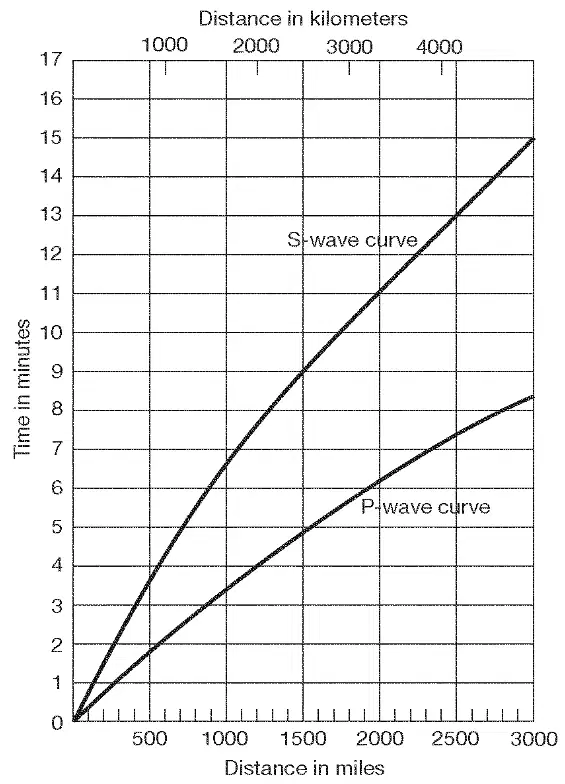
According to Figure 8-1, what is the distance between the seismic station and an earthquake epicenter, if the first S wave arrives 4.0 minutes after the first P wave?
1500 kilometers
2500 kilometers
3000 kilometers
2000 kilometers
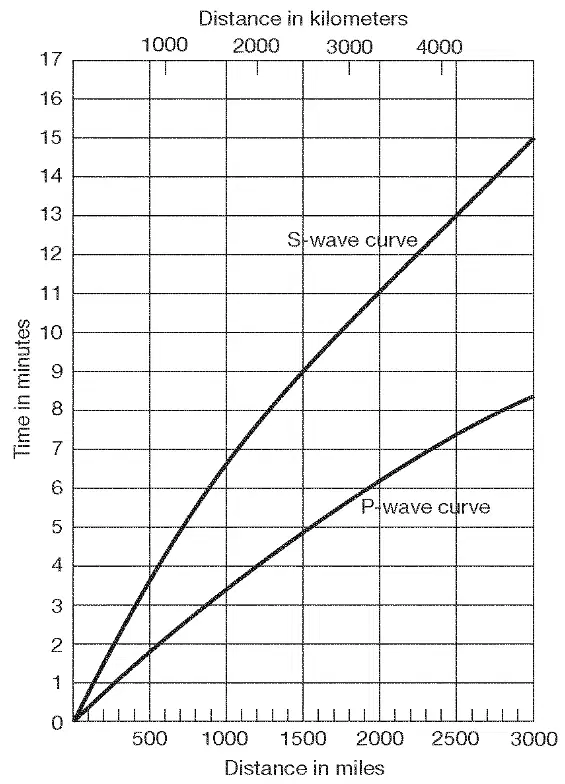
According to Figure 8-1, when will the first P wave be received, if an earthquake epicenter is approximately 1800 kilometers from the seismic station?
3.5 minutes after the earthquake
5.5 minutes after the earthquake
6.6 minutes after the earthquake
10.5 minutes after the earthquake
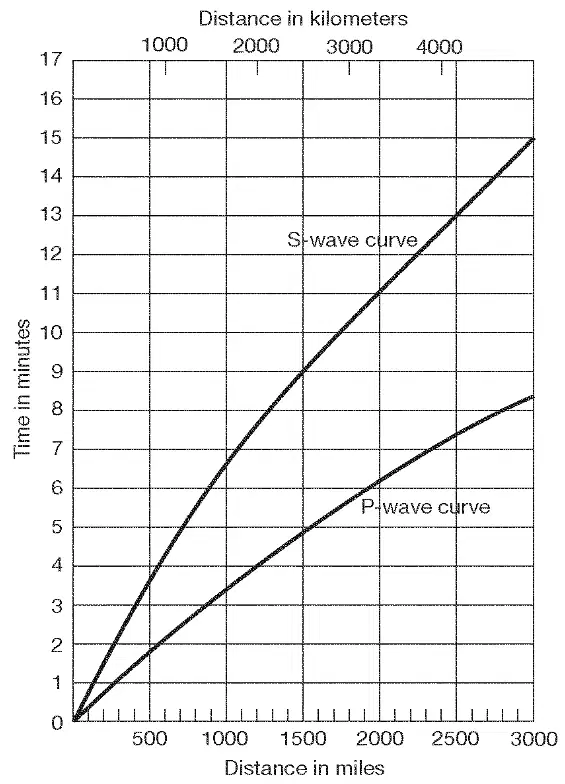
Use the graph in Figure 8-1 to determine the difference in the travel-times between the first P wave and the first S wave, if the seismic station is 4000 kilometers from the epicenter.
10.0 minutes
4.5 minutes
5.2 minutes
4.2 minutes

Where does an earthquake begin?
Epicenter
Fault
Focus

Which of the following statement correctly identifies the focus and epicenter of an earthquake in the given illustration?
Point A is the focus and Point B is the epicenter.
Point A is the epicenter and Point C is the focus
Point A is the epicenter and Point B is the focus.
Point A is the focus and Point C is the epicenter.

What is the instrument used to measure earthquakes?
Seismograph
Seismologist
Scale
Seismogram
Which of the following earthquakes have the highest strength
Magnitude of 1
Magnitude of 20
Magnitude of 10
Magnitude of 5
When the soil turns liquid, this is called
Watering
Soiling
Liquefaction
Liquiding
Which of the following machines is used to measure earthquakes
Siesmograph
Measuring scale
Tuba
Polygraph
Earthquakes happen because of movements in the ____ of the earth
Fault lines
Core
Roads
How many tectonic plates does the earth have
8
19
7
6
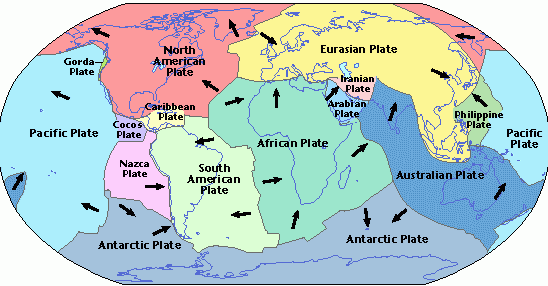
Which state is most likely to record an earthquake ?
Pennsylvania
Florida
Minnesota
California

The place where the earthquake is felt on the Earth's surface is called the...
Epicenter
Hypocenter (focus)
Surface
Crust
What is the instrument used to measure earthquakes?
Seismograph
Sling Psychrometer
Spring Scale
Balance
Anemometer
What does a seismograph measure?
The amount of oil and gas underground.
The amount of damage an earthquake causes.
The temperature of the earth's core.
The amount of shaking of the crust.
Which wave can travel through solids, liquids, and gases?
P-Waves
S-Waves
Surface (L) Waves

Which seismic wave travels the fastest, always being the first detected by seismic stations?
P waves
S waves
Surface waves
Tsunami waves
The most destructive type of wave (also known as an L wave) is a
P-wave
S-wave
Surface wave
transverse wave
Which is the fastest type of seismic wave?
p-waves
s-waves
surface waves
Which wave causes up and down motion in rock ?
P wave
S wave
L wave
Z wave
The time difference between the arrival of a P and S wave as they reach a seismic recording station is called :
lag time
radar
electromagnetic radiation
an era
What is the minimum number of seismograph stations needed to locate an earthquake epicenter?
2
3
4
5
6
Which scale rates earthquakes based on the amount of damage done?
Mercalli Intensity Scale
Richter Magnitude Scale
Seismogram Shakey Scale
Bernoulli Scale
How does the Richter Magnitude Scale calculate its measurements?
Eyewitnesses
Amount of damage caused
The amount of time the earthquake lasted
The strength of the seismic waves recorded by a seismograph machine.
How much bigger is a magnitude 8 earthquake compared to magnitude 6 quake on the Richter Scale?
2 times bigger
20 times bigger
48 times bigger
100 times bigger

Where are the youngest rocks on Earth found?
Along mid-ocean ridges
Along transform boundaries
On the edges of the continents
Near ocean trenches
How far do tectonic plates move each year?
Meters per year
Centimeters per year
Kilometers per year
Feet per year
What is the driving force behind the movement of the tectonic plates?
Gravity
Convection
Wave motion
Seismic activity
What is the process of convection?
The process of hot material rising and cooler material sinking in circular patterns
The process of hot rock solidifying and forming new crust
The process of explaining what goes up must come down
Strong ocean currents moving tremendous amounts of material


Where does seafloor spreading take place?
Convergent boundaries
The continentals shelves
Transform boundary
Mid-ocean ridges
At this boundary, old crust is destroyed and deep earthquakes occur
Transform
Continental-Continental Convergent
Divergent
Oceanic-Continental Convergent
Ocean trenches are found along
Transform boundaries
Continental-Continental boundaries
Divergent boundaries
Oceanic-Continental boundaries
Which of these plates does not bear the name of a continent ?
North American
Antarctic
Eurasian
Pacific
Which two plate are separating
North American and Eurasian
Pacific and Eurasian
Nazca and South American
Which of these volcanic islands was not produced at a plate boundary ?
Japan
Iceland
Hawaii

