
Font size
 Worksheets
Branches of the United States Government and the Constitution
Total questions: 45
Worksheet time: 23mins
Which branch of the United States government was established by Article I of the Constitution?
Legislative branch
Executive branch
Judicial branch
Military branch
How many total members are in the United States Senate?
50
100
435
200
Who is the Commander-in-Chief of the armed forces according to the Constitution?
Speaker of the House
Chief Justice
President
Vice President
Which article of the Constitution established the executive branch?
Article I
Article II
Article III
Article IV
Who appoints the heads of federal agencies?
Congress
The President
The Supreme Court
The Vice President
Which branch of government is responsible for interpreting the law and the constitutionality of laws?
Legislative branch
Executive branch
Judicial branch
Military branch
Who confirms the appointments of members of the judiciary branch?
The President
The Senate
The House of Representatives
The Vice President
Which branch has the power to borrow money on behalf of the U.S. government?
Executive branch
Judicial branch
Legislative branch
State governments
Who serves as the President’s key advisement team?
The Senate
The Cabinet
The Supreme Court
The House of Representatives
Who nominates the members of the Cabinet?
The Senate
The President
The House of Representatives
The Supreme Court
What is the main idea of James Madison’s quote in Federalist #51?
The President should have all the power
Separation of powers is necessary to prevent concentration of power
Congress should control the judiciary
The military should be independent
What is the function of the Vice President in the executive branch?
Head of the Supreme Court
Member of the President’s advisement team
Speaker of the House
Chief Justice
What does the system of checks and balances help to protect?
The liberties granted in the Constitution
The power of the President only
The authority of the military
The rights of the states only
Who has the authority to determine the number of Supreme Court justices?
The President
The Congress
The Supreme Court
The Vice President
What is the main purpose of the separation of powers?
To combine all government powers
To prevent any one branch from becoming too powerful
To give all power to the President
To eliminate the judiciary
What is the legislative authority of Congress related to the budget?
Approving Presidential appointments
Establishment of the annual budget for the United States government
Commanding the military
Interpreting laws
Who approves Presidential appointments and treaties?
Legislative Branch
Executive Branch
Judicial Branch
Military Branch
Which branch can declare war?
Legislative Branch
Executive Branch
Judicial Branch
Treasury Branch
Which branch has the power of impeachment?
Legislative Branch
Executive Branch
Judicial Branch
State Branch
Who can initiate constitutional amendments?
Legislative Branch
Executive Branch
Judicial Branch
State Branch
Who is the President of the Senate?
Vice President
Speaker of the House
Chief Justice
Secretary of State
Who is the Commander-in-Chief of the armed forces?
President
Chief Justice
Speaker of the House
Secretary of Defense
What is the main check of the judicial branch over the other branches?
Judicial review
Veto power
Impeachment
Appointment of judges
Who can call Congress into an emergency session?
Executive Branch
Legislative Branch
Judicial Branch
State Branch
Who has the power to pardon?
Executive Branch
Legislative Branch
Judicial Branch
State Branch
Which branch can appoint federal judges?
Executive Branch
Legislative Branch
Judicial Branch
State Branch
What is the main check of the judicial branch over the legislative and executive branches?
Judicial review
Veto power
Impeachment
Appointment of judges
Who can approve the appointment of federal judges?
Legislative Branch
Executive Branch
Judicial Branch
State Branch
Who is the Commander-in-Chief of the armed forces?
President
Chief Justice
Speaker of the House
Secretary of Defense
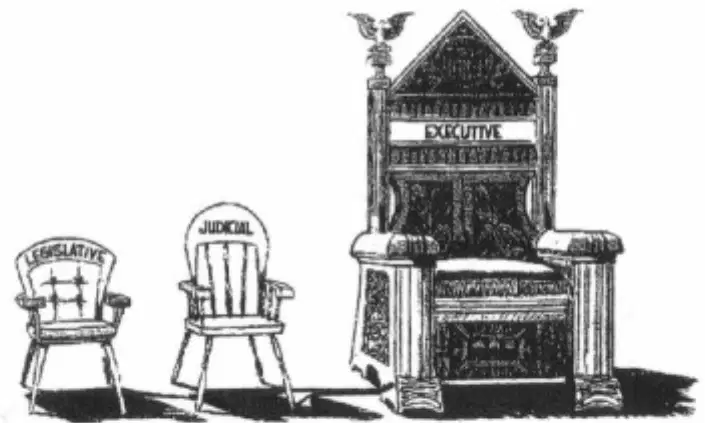
Which three branches of government are represented in the diagram?
Legislative, Executive, Judicial
Legislative, State, Military
Executive, Judicial, Treasury
Judicial, State, Military
. "The ______ shall have Power to dispose of and make all needful Rules and Regulations respecting the Territory or other Property belonging to the United States; and nothing in this Constitution shall be so construed as to Prejudice any Claims of the United States, or of any particular State."
- Article IV, Section 3 of the U.S. Constitution
What word should go in the blank?
senate
States
President
Congress
A government principle by which the legislative, judicial, and executive powers are essentially held by different groups and people is called
A government in which powers are divided between a national government and state governments with the national government being supreme is called
Using your knowledge of governmental powers, which of these would be considered an enumerated power of the federal government only?
Creating an additional year for students to go to school
Creating a new currency
hiring additional people for the fire department
The Supreme Law of the Land is the
Once a national amendment has been proposed, the amendment has to be ratified before it becomes law. Who has the authority to ratify national amendments?
"Powers not delegated to the United States by the Constitution, nor prohibited by it to the states, are _______ to the states respectively, or to the people."
-Tenth Amendment to the United States Constitution
What word BEST completes this principle of the United States government?
The Supremacy Clause of the U.S. Constitution was established to counter weaknesses in the Articles of Confederation. Chose two aspects of the Articles of Confederation that contributed to the creation of the Supremacy Clause.
Congress created the Northwest Ordinance
States could regulate commerce within their borders
States could wage war without Congressional approval if they were invaded
States could send a receive ambassadors from foreign nations
Which power would be classified as an enumerated power according to the US Constitution?
regulate education in the state
maintain armed forces
pass marriage laws
establish Schools
Which part of the Federal government is MOST involved in the amendment process?
The "elastic clause" in the US Constitution
expands the powers of Congress
expanded suffrage in the United States
outlines the powers of the executive branch
established a federal system for the United States

Why does the government have checks and balances?
To stop one branch from getting too powerful.
To prevent the president from acting like a king/queen.
To prevent laws that are unfair/unconstitutional.
All of the above.
.Which of these is a power that the President of the United States can exercise?
overturn an unconstitutional state law
Which BEST illustrates the principle of checks and balances?
Senate confirmation of presidential appointments
the military powers of the president
The structure of the government of the United States allows for the Legislative Branch to write laws, the Executive Branch to enforce laws, and the Judicial Branch to interpret laws. Collectively, this process is called

