
 Worksheets
1st 9 Weeks DA Review
Total questions: 77
Worksheet time: 55mins
What is a scalar quantity?
A) A quantity that has both magnitude and direction
B) A quantity that has magnitude but no direction
C) A quantity that has direction but no magnitude
D) A quantity that has neither magnitude nor direction
Which of the following is NOT a scalar quantity?
Length
Mass
Area
Force
Fill in the blank: Scalar quantities include Length, Mass, Area, Volume, and _________.
Temperature
Force
Velocity
Acceleration
Which of the following is an example of a scalar quantity?
28 meters
10 meters North
5 m/s East
20 Newtons to the right
Fill in the blank: 100 ______ is an example of a scalar quantity.
Liters
Newtons
Meters per second North
Joules per Kelvin
Which of the following represents a scalar quantity?
66 Kg
66 Kg North
66 Kg upward
66 Kg at 30 degrees
Fill in the blank: A vector is a quantity that has _______ and magnitude.
direction
speed
mass
volume
Which of the following is a vector quantity?
Displacement
Mass
Temperature
Time
Which of the following is a vector quantity?
Direction
Energy
Volume
Pressure
Which of the following is a vector quantity?
Acceleration
Area
Density
Length
Which of the following is a vector quantity?
Velocity
Temperature
Mass
Power
Fill in the blank: Scalars have ________, but no direction.
magnitude
velocity
acceleration
force
Fill in the blank: Scalars are only in ________ dimension.
one
two
three
four
Fill in the blank: Any change in scalar quantity is a reflection of change in ________.
magnitude
direction
velocity
position
Fill in the blank: Vectors have both ________ and direction.
magnitude
volume
area
weight
Fill in the blank: Vectors can be 1D, 2D, or ________.
3D
4D
0D
5D
Fill in the blank: Any change in vector quantity can reflect a change in direction, a change in magnitude, or ________.
both
neither
only magnitude
only direction
What does accuracy refer to?
The speed of a measurement
The closeness of a measured value to a standard or known value
The number of measurements taken
The cost of measurement
Fill in the blank: Accuracy refers to the ________ of a measured value to a standard or known value.
closeness
randomness
distance
difference
According to the example, if you obtain a weight measurement of 3.2 kg for a substance, but the actual or known weight is 10 kg, is your measurement accurate?
True
False
Precision refers to the closeness of two or more measurements to ________.
each other
the true value
the average value
zero
If you weigh a given substance five times and get 3.2 kg each time, your measurement is:
Not precise
Very precise
Not accurate
None of the above
Precision is independent of accuracy.
True
False
What is displacement? Displacement is ________.
the distance between an object's initial (starting) position and its final position
the total path length traveled by an object
the speed at which an object moves
the force applied to move an object
Which of the following best defines displacement?
The total path covered by an object
The distance between an object's initial (starting) position and its final position
The speed of an object
The time taken to travel a distance
The standard unit for measuring displacement is ________.
second (s)
meter (m)
kilogram (kg)
liter (L)
Distance is a ______ quantity that measures the total length of the actual path an object travels from a starting point to an ending point.
scalar
vector
complex
imaginary
Distance vs Displacement: Which of the following statements is true about distance?
Distance considers the direction of motion.
Distance is always less than displacement.
Distance is measured in units like meters or kilometers.
Distance is a vector quantity.

Which quantity is a vector?
Displacement
Distance

A vector is a quantity that has both _______ and _________.
Select all that apply.
direction
amplitude
acceleration
magnitude
velocity

Because displacement has a magnitude and direction it is called a ______.
distance
vector
arrow
length

Which choice below describes a vector?
magnitude only
magnitude with direction
direction only
just a measument
Which statement describes a vector?
It has magnitude but no direction
It has direction but no magnitude
It has both direction and magnitude
It has constant magnitude but no
direction
Which of the following quantities does not require direction for its complete description?
Acceleration
Displacement
Speed
Velocity
Fill in the blank: The SI unit of displacement is ______.
newton
meter
second
kilogram
Which of the following is an example of a scalar quantity?
Force
Speed
Velocity
Displacement
Which statement is true about precision?
Precision and accuracy mean the same thing.
Precision is not important in scientific experiments.
Precision refers to how close measurements are to each other.
Precision refers to how close a measurement is to the true value.
Which of the following is NOT a scalar quantity?
Temperature
Displacement
Speed
Mass
Fill in the blank: The SI unit of distance is ______.
meter
kilogram
newton
second
Which of the following is NOT a vector quantity?
Displacement
Mass
Acceleration
Velocity

The rate at which something moves is what?
time
space
sound
speed

Total distance divided by total time, for an object shows:
acceleration
the size of one's toupee
absolute speed
average speed

A change in ________ in a certain amount of time is motion.
speed
appearance
position
weight

The clown walked 27 feet in 9 seconds. what was his velocity?
18 feet/sec
243 feet/sec
36 feet/sec
3 feet/sec

Fonzie flies through the air 24 meters on water skis wearing a leather jacket with swimming trunks over the shark. It takes him 2 seconds to make the jump. How fast was Fonzie flying through the air on water skis in a leather jacket and swimming trunks?
8 m/sec
12 m/sec
22 m/sec
26 m/sec

What is the difference between speed and velocity?
Speed involves a runaway city bus, while Velocity involves motorcycle racing
Speed stars Keanu Reeves and Sandra Bullock, while Velocity stars a bunch of people I have never heard of
speed does not involve a direction, while velocity does
Speed was released in 1994, Velocity in 2007

An old lady rolls down a hill at 3 meters/second. The hill is 36 meters long. How many seconds does it take the old lady to reach the bottom of the hill?
39 seconds
12 seconds
15 seconds
33 seconds
Which TWO of the following are vectors?
Distance
Displacement
Speed
Velocity
Which of the following is an acceptable velocity measurement?
25 m/s North
25 m/s
25 m
25 m North
A runner runs 2 laps around a track with a circumference of 400 m. What is their total distance?
800 m
0
400 m
400 m North
The speedometer in your car measures __________________ speed.
average
instantaneous
light
ludicrous


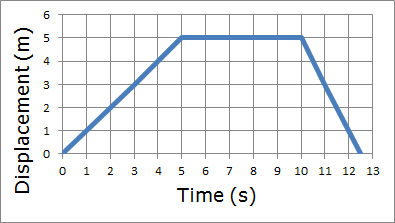
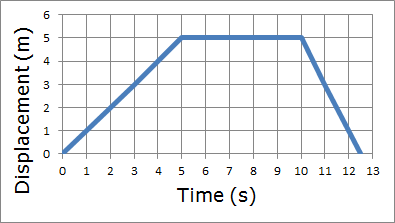

A runner runs 2 laps around a track with a circumference of 400 m. What is their total displacement?
800 m
0
400 m
400 m North
What is the rate of change of velocity known as?
Speed
Acceleration
Displacement
Force
How is the magnitude of average acceleration calculated?
By multiplying the change in velocity by time
By dividing the change in velocity by the time interval
By adding the initial and final velocities
By subtracting the time interval from the change in velocity
What does \( V_i \) represent in the equation for acceleration?
Final velocity
Starting velocity
Final time
Starting time
In the equation for acceleration, what does \( T_2 \) stand for?
Starting velocity
Final velocity
Starting time
Final time
Which of the following is the correct formula for acceleration based on the given variables?
\( V_f + V_i / T_2 + T_1 \)
\( V_f - V_i / T_2 - T_1 \)
\( V_i - V_f / T_1 - T_2 \)
\( T_2 - T_1 / V_f - V_i \)
What is the initial velocity (Vi) if only one velocity is given in a problem?
0
1
10
Undefined
What is the SI unit for average acceleration?
Meters per second (m/s)
Meters per second squared (m/s²)
Kilometers per hour (km/h)
Feet per second squared (ft/s²)
What does acceleration describe when measured in SI units?
The distance traveled in each second
The change in velocity in each second
The time taken to reach a certain speed
The force applied to an object
What happens to the final velocity (V_f) of a train compared to the initial velocity (V_i) when the train picks up speed?
V_f is less than V_i
V_f is equal to V_i
V_f is greater than V_i
V_f is zero
If the change in velocity (Δv) is positive, what can be said about the acceleration?
The acceleration is negative
The acceleration is zero
The acceleration is positive
The acceleration is undefined
What determines whether acceleration is positive or negative?
The direction of the train
The change in velocity
The speed of the train
The distance traveled
If a train is moving in a negative direction and gains speed, what is the sign of its acceleration?
Positive
Negative
Zero
Undefined
What does a negative value for acceleration indicate?
Always a decrease in speed
Always an increase in speed
A change in velocity
No change in speed
What is deceleration?
An increase in speed over time
A decrease in speed over time
A constant speed over time
A change in direction without speed change
How is deceleration related to acceleration?
It is the opposite of acceleration
It is a special case of acceleration
It has no relation to acceleration
It is the same as acceleration
What is constant acceleration?
A change in velocity by different amounts each second
A change in velocity by the same amount each second
No change in velocity
A change in velocity by random amounts
How is average velocity calculated for an object moving with constant acceleration?
\( V_i \times V_f \)
\( V_i - V_f \)
2Vi+Vf
\( V_i + V_f \)
How is average velocity calculated for an object moving with constant acceleration?
\( V_i \times V_f \)
\( V_i - V_f \)
2Vi+Vf
\( V_i + V_f \)

