
 Worksheets
Chapter 3 Test
Total questions: 20
Worksheet time: 10mins
Eye contact is a form of _____ communication.
nonverbal
written
verbal
digital
2. _____ communication hides or does not clearly state a person's needs, wants, and feelings.
Passive
Assertive
Aggressive
Direct
When people _____, they work together to think and talk through a solution to a conflict.
collaborate
compete
ignore
argue
Serious or difficult conflicts can benefit from a neutral _____ to help the conflicting parties reach an agreement.
mediator
observer
participant
adversary
Outside actions, words, and rewards that influence your behavior are called _____ pressure.
peer
internal
family
media
Effective communication requires active listening skills.
True
False
Trying to resolve a conflict will destroy a relationship or make the conflict worse.
True
False
Peer pressure can be both positive and negative.
True
False
Which of the following examples is a form of verbal communication?
A. facial expressions
B. social media posts
C. volume of voice
D. B and C
One way to clearly express your needs and preferences is by _____
dropping subtle hints
assuming others know how you feel
agreeing with something to avoid conflict
showing respect and seeking clarity
When mediators act as neutral third parties, they _____
ensure both party is heard primarily
make the people involved work to find their own solutions
clarify communication
All of the above.
Which of the following is a type of indirect peer pressure?
A. thinking about what will make you seem cool
B. people minimizing the risks
C. people teasing you
D. people making you doubt yourself
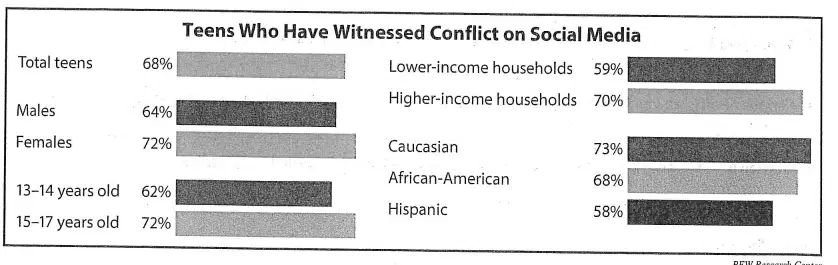
If 5,000 teens took this survey, how many witnessed conflict on social media? How many did not?
3,400 witnessed conflict; 1,600 did not
2,500 witnessed conflict; 2,500 did not
4,000 witnessed conflict; 1,000 did not
1,000 witnessed conflict; 4,000 did not

What percent more of older teens (15 to 17 years old) witness conflict than younger teens (13 to 14 years old)?
10%
5%
20%
15%
Identify three nonverbal elements that can help reduce misunderstandings in online communication.
Emojis, punctuation, and formatting
Spelling, grammar, and vocabulary
Font size, internet speed, and device type
Username, password, and email address
Building healthy, respectful relationships can help you handle peer pressure by:
Giving you support and confidence to make your own choices.
Making you more likely to follow the crowd.
Encouraging you to ignore your feelings.
Pressuring you to fit in with others.
Effective communication involves:
Only speaking
Only listening
Both speaking and listening
Neither speaking nor listening
In conflict resolution, it's important to:
Focus only on your own needs
Refuse to compromise
Understand the other person's viewpoint
Keep bringing up past issues

When you find yourself in disagreement with someone, what is an appropriate and respectful way to respond?
"I hate you"
"I understand your perspective"
"You make no sense"
"You are not intelligent"
Mia and Harper had a disagreement about a group project. What is a good way for them to resolve the conflict?
Yelling at them
Ignoring them
Talking and listening to each other
Blaming them

