
 Worksheets
Wellness and Health Ch 1-3
Total questions: 102
Worksheet time: 55mins
Which of the following best defines "wellness"?
The presence of illness or injury
Optimal health and vitality, encompassing all dimensions of well-being
The ability to run long distances
The absence of physical activity
Which term refers to a disease that can be spread from person to person and is caused by microorganisms?
Chronic disease
Infectious disease
Risk factor
Physical fitness
What does the word "health" typically refer to?
The overall condition of a person’s body or mind and the presence or absence of illness or injury.
The ability to make decisions about your lifestyle.
The ability to communicate with others.
The presence of emotional stability.
Which of the following best describes "wellness"?
The absence of disease only.
The ability to achieve optimal health through conscious decisions.
The ability to memorize facts.
The presence of physical strength.
Why is it important to make conscious decisions regarding wellness?
To control risk factors that contribute to disease or injury.
To memorize more facts.
To increase your physical strength only.
To avoid learning new things.
How is environmental wellness defined?
By the livability of your surroundings
By your ability to save money
By your level of happiness at work
By your physical fitness level
Which of the following best describes occupational wellness?
The level of happiness and fulfillment you gain through your work
The ability to balance your income and expenses
The ability to protect yourself from environmental hazards
The ability to make healthy lifestyle choices
How can lifestyle choices impact health?
They can increase or decrease the risk of chronic disease
They have no effect on health
They only affect financial wellness
They only impact occupational wellness
What is the main difference between life span and health span?
Life span is about how long we live, while health span is about how long we stay healthy.
Life span is about how healthy we are, while health span is about how long we live.
Life span and health span mean the same thing.
Life span is about exercise, while health span is about diet.
What is the main goal of the Healthy People initiative?
To prevent disease and improve Americans’ quality of life
To provide free health insurance
To increase the number of hospitals
To reduce taxes on medical care
Which of the following is a goal of Healthy People 2030?
Eliminate preventable disease, disability, injury, and premature death
Increase the number of fast food restaurants
Reduce the number of doctors
Promote unhealthy behaviors
Which statement best explains the risk of tobacco use as described in the text?
Tobacco use is not linked to any major causes of death
Personal tobacco use and secondhand smoke kill nearly 500,000 Americans each year
Tobacco use only affects lung health
Only excessive tobacco use is harmful
According to the Fall 2022 American College Health Association National College Health Assessment III, which of the following is NOT a commonly reported factor affecting academic performance among college students?
Procrastination
Stress
Anxiety
Physical injury
Why is it important not to be discouraged by the seriousness or extent of a wellness-related problem?
Problems always solve themselves
Many resources are available to help you solve it
It is better to ignore the problem
Only doctors can help
Which of the following is a recommended response when you encounter obstacles while trying to change a behavior?
Ignore the obstacles and continue as planned
Feel free to make some changes before going on
Give up on your plan entirely
Blame others for your difficulties
If commitment is your problem during behavior change, what does the material suggest you may need to do?
Wait until the behavior you’re dealing with makes you unhappier or unhealthier
Ignore your lack of commitment
Change your goal to something easier
Ask someone else to do it for you
In Lab 1.2: Lifestyle Evaluation, what are students asked to compare?
Their favorite sports teams
Their current lifestyle with recommended wellness standards
Their grades with their friends
Their diet with a celebrity's diet
During the suggested group activity, what are students encouraged to discuss?
Their favorite movies
Their exercise habits and goals
Their vacation plans
Their favorite foods
Why might it be important for students to analyze their own level of wellness and identify dimensions of concern?
To win a prize
To better understand areas for personal improvement and maintain or increase wellness
To compare with friends
To complete the assignment quickly
If someone wants to find information and answers to frequently asked questions about women’s health, which resource should they use?
National Wellness Institute
Office on Women’s Health
Surgeon General
MyHealthfinder
When was the hierarchy of needs developed?
1957
1944
1943
1979
True or False. Maslow created the theory to describe levels of human experience.
True
False
What is the fifth layer of the hierarchy of needs?
Esteem Needs
Psychological Needs
Love and Belonging Needs
Safety Needs
True of False. The most essential human needs are the ones that keep us alive.
False
True
True or False. Relationships and how you handle them belong to the 4th layer.
True
False
How many categories are there in esteem needs?
3 Categories
2 Categories
4 Categories
5 Categories
What do safety needs often entail?
Branching Out
Familiar Environments
Structure
Establishment of Routines
There are _______ levels of need in Maslow's pyramid.
3
5
7
9
The first, ground floor level of Maslow's pyramid of needs is ____.
physical
safety
belonging
esteem

Maslow thought that the lower needs had to be realized before people could advance in the pyramid.
True
False
What pyramid?
Maslow didn't have any pyramid!
The 2nd level of Maslow's pyramid is _____.
safety
belonging
esteem
self-actualization

When you feel that you have reached the highest level of achievement, you are at this level.
pysiological
safety
love and acceptance
esteem
self-actualization

Self-actualization has to do with being what you were meant to be and you have lived up to your potential.
True
False

Children have the chance to grow in a healthy, safe environment is an essential definition of ________ _________.
age norm
sequenced steps
children's rights
arrested development
A person who looks out for the well-being of children are called a child ________.
advocate
irreducible
relayer
instigator
_________ observation is when a researcher is in the same room watching the children.
Direct
Indirect
Unscientific
Child-centered
_________ observation is when the researcher talks to parents, teachers or other kids about a child.
Direct
Indirect
Unscientific
Logical
All _________ are responsible for all _______.
teachers....other teachers
researchers.....teachers
people....children
children....other children
MosMost direct observations occur in the home, play groups, child care programs, and public places.
TRUE
FALSE
Developmental acceleration is one of Brazelton and Greenspan’s irreducible needs.
TRUE
FALSE
MosMost direct observations occur in the home, play groups, child care programs, and public places.
TRUE
FALSE
Developmental acceleration is one of Brazelton and Greenspan’s irreducible needs.
TRUE
FALSE
According to Maslow’s Hierarchy of Human Needs, the need for love and acceptance is met when all needs have been fulfilled to some degree.
TRUE
FALSE
Lev Vygotsky believed that some knowledge was a personal construction, but much was a social construction.
TRUE
FALSE
A developmental delay occurs when a child performs like a younger child.
TRUE
FALSE
The principles of growth and development fit every person exactly.
TRUE
FALSE
Sometimes heredity is called nurture.
TRUE
FALSE
The four child development domains are physical growth and development, intellectual development, social development, and emotional development.
TRUE
FALSE
Child development is the scientific study of children from birth to adolescence.
TRUE
FALSE

Thinking about children from the child's perspective or with the child's needs in mind is being _______.
child centered
self-actualized
esteemed
physiological

When things are organized according to how important they are =
roster
observation
norm
hierarchy
The first, ground floor level of Maslow's pyramid of needs is ____.
physical
safety
belonging
esteem

Which Maslow stage is when you feel like you belong in a group?
physiological
safety
love and acceptance
A runner wants to increase their training volume. Which measure should they use to express the total exercise intensity over time?
Calories per session
MET-minute
RPE
Target heart rate zone
A person exposed to cold conditions experiences low body temperature. What is this condition called?
Frostbite
Hypothermia
Dehydration
Heat cramps
What is the function of capillaries in the circulatory system?
To pump blood
To deliver oxygen and nutrients to tissues and pick up waste
To regulate heart rate
To produce white blood cells
What is one way exercise can improve immune function?
By weakening the immune system.
By protecting against diseases such as colds, bacterial infections, and cancer.
By increasing the risk of infections.
By causing chronic inflammation.
Which of the following is a psychological benefit of participating in regular endurance exercise?
Increased risk of heart disease
Improved social, psychological, and emotional well-being
Decreased muscle strength
Reduced flexibility
Which test is best for physically fit people who wish to measure their capacity for high-intensity exercises?
1-Mile Walk Test
3-Minute Step Test
Beep Test
1.5-Mile Run–Walk Test
What is a good technique for taking your pulse?
Use your thumb to press hard on your wrist
Bend your fingers slightly and take your pulse with the tops of your fingers where you have many nerve endings
Use your palm to press on your chest
Count your breaths instead of your pulse
If a student completes the 3-Minute Step Test and their heart rate returns to normal quickly, what does this indicate about their cardiovascular capacity?
Poor cardiovascular capacity
Good cardiovascular capacity
No relation to cardiovascular capacity
High risk of heart disease
Which method can be used as an alternative to calculate the target heart rate zone?
Body mass index
Heart rate reserve
Blood pressure
Respiratory rate
Which of the following best describes the "Talk Test" for monitoring exercise intensity?
You should not workout so intensely that you cannot communicate.
You should be able to sing during intense exercise.
You should not talk at all during exercise.
You should only whisper during exercise.
Which of the following is NOT a recommended way to estimate exercise volume?
Number of hours spent sitting
Calories per session
MET minutes per week
Number of steps per day
Which of the following statements about start-and-stop sports is correct?
They qualify as cardiorespiratory endurance exercises if played continuously and intensely enough.
They are not considered exercise.
They only improve flexibility.
They should be avoided for endurance training.
What is the main risk of excessive training volume?
Injury and overtraining
Improved sleep quality
Increased muscle flexibility
Faster weight gain
What is the main benefit of warming up before exercise?
Increases muscle soreness
Enhances performance and decreases the chance of injury
Reduces heart rate
Increases fatigue
Why is it important to keep an exercise log or training diary?
To compare with friends
To monitor your workouts and progress
To reduce exercise time
To avoid all injuries
According to Canadian researchers, what is a benefit of practicing HIIT for three minutes per week (not counting rest, warm-up, and cool down) for 12 weeks?
It produces the same changes in cardiorespiratory fitness as continuous moderate exercise.
It leads to significant muscle loss.
It is less effective than moderate exercise.
It causes more injuries than moderate exercise.
Why is it important to set new goals and make adjustments when you reach the maintenance stage of fitness?
To maintain motivation and continue progress
To avoid all types of exercise
To decrease your fitness level
To stop exercising completely
Which approach can help boost enjoyment and prevent some types of injuries in endurance activities?
Cross-training
Only running
Never changing your routine
Exercising once a month
Which of the following is NOT a recommended way to avoid significant heat stress during exercise?
Staying fit
Wearing clothes that allow heat to dissipate
Drinking adequate fluids before and during exercise
Exercising intensely without preparation
Which of the following is NOT a symptom of heat exhaustion?
Rapid, weak pulse
Profuse sweating
Hot, flushed skin
Headache
Maximal oxygen consumption (VO2max) is:
The body’s maximum ability to take in and utilize oxygen
The velocity of oxygen flowing through the blood
Solely determined by genetics
Very difficult to predict
Adenosine triphosphate (ATP) is defined as:
The building block of proteins
The stored form of sugar
The simplest form of carbohydrate in the blood
The basic form of energy used by the cells.
The primary function of the cardiovascular system is to transport oxygen and nutrients to the tissues/cells of the body and to remove (a) and other waste products.
Vessels that return the oxygen-depleted blood back to the heart.
Arteries
Veins
Capillaries
Vessels that carry the oxygen-rich blood to the vital organs and working muscles.
Arteries
Veins
Capillaries
The total volume of blood that is pumped by the heart per minute.
Heart Rate (HR)
Stroke Volume (SV)
Cardiac Output (Q)
The number of beats of the heart per minute.
Heart Rate (HR)
Cardiac Output (Q)
Stroke Volume (SV)
The amount of blood ejected from the left ventricle of the heart with each beat.
Heart Rate (HR)
Stroke Volume (SV)
Cardiac Output (Q)
The measure of the pressure, or resistance to blood flow, within the arterial vascular system. Expressed in mmHG
Stroke Volume
Blood Pressure
Oxygen Extraction
The energy for all biological work is provided by this chemical
Phosphagen System (ATP-CP)
Adenosine Triphosphate (ATP)
Anaerobic Glycolysis (Lactic Acid System)
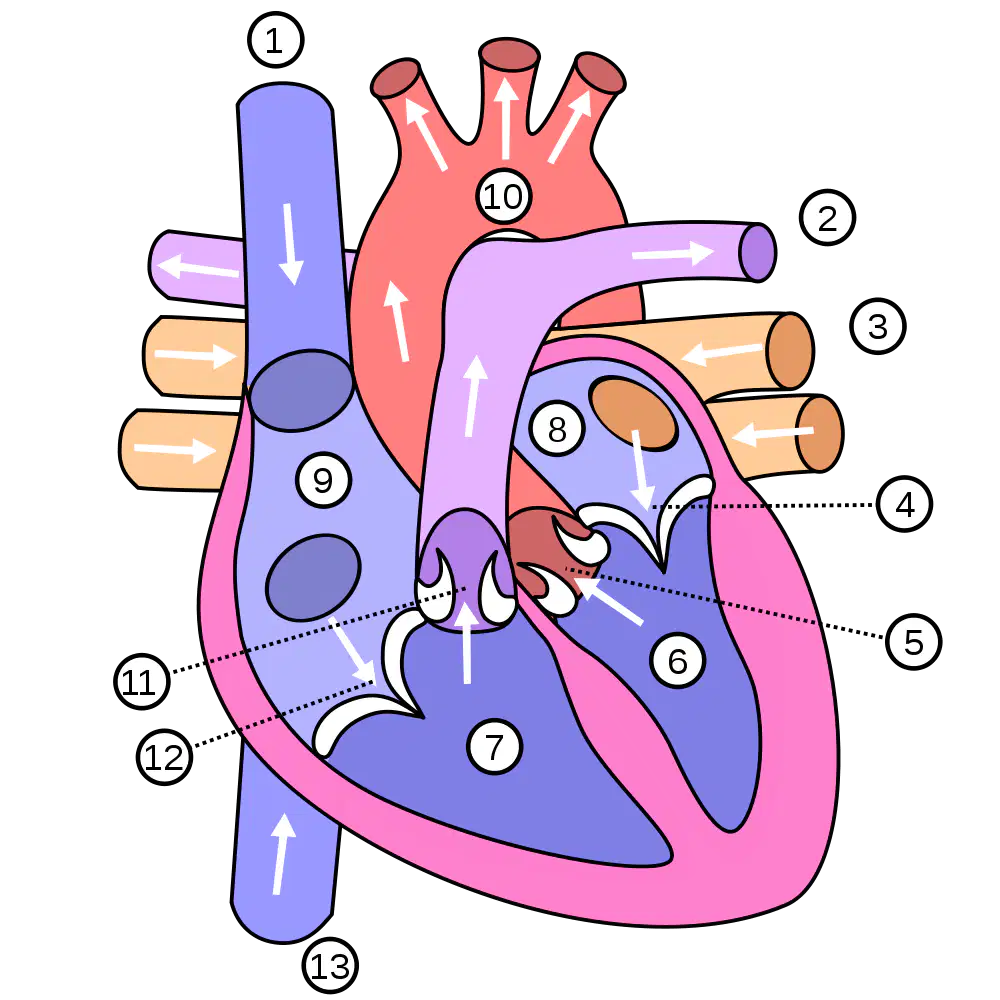
What is #1?
Superior Vena Cava
Aorta
Pulmonary Artery
Pulmonary Vein
What is #3?
Superior Vena Cava
Aorta
Pulmonary Artery
Pulmonary Vein
What is #10?
Superior Vena Cava
Aorta
Pulmonary Artery
Pulmonary Vein
What is #7?
Right Atrium
Right Ventricle
Left Atrium
Left Ventricle
What is #6?
Right Atrium
Right Ventricle
Left Atrium
Left Ventricle
What does the "F" in FITT stand for?
Fun
Fantastic
Fitness
Frequency
What does the "I" in FITT stand for?
Interval
Intensity
Ice
Incomplete

What type of blood vessel returns blood back to the heart?
vein
artery
capillary
none of the above

What type of blood vessels brings blood AWAY from the heart?
Vein
Artery
Capillary
None of the above
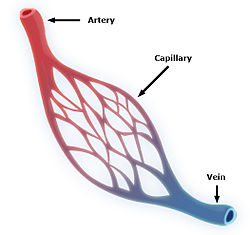

How many chambers (rooms) are in a human heart?
1
2
3
4
The sound of your heart beat is from the closure of the _________
capillaries
ventricles
valves
atria

What are the parts of the lungs that exchange gases (oxygen for carbon dioxide)?
capillary
bronchi
alveoli
bronchiole
Label the chambers of the heart.
During a biology class, Rohan was asked to identify the type of cells that make up the wall of a capillary. What type of cells should he choose?
Muscle cells
Nerve cells
Endothelial cells
Epithelial cells
label the 4 valves of the human heart
mitral valve
tricuspid valve
pulmonary valve
aortic valve

The purpose of heart valves is __________
set the pace at which the heart beats
prevent blood from flowing backwards
oxygenate the blood as it passes through the valve
add minerals to the blood
The upper and receiving chambers of the heart are called (a) .
The lower pumping chambers of the heart are called (a) .

