
 Worksheets
Honors Unit 1 Quiz 1
Total questions: 34
Worksheet time: 17mins
Name
Class
Date
1.
The monomer of this biomolecule is glucose, a monosaccharide.
a)
Carbohydrate
b)
Lipids
c)
Proteins
d)
Nucleic Acids
2.
The monomer of this biomolecule is an amino acid
a)
Carbohydrate
b)
Lipids
c)
Proteins
d)
Nucleic Acids
3.
This biomolecule is made of fatty acids and glycerol
a)
Carbohydrate
b)
Lipids
c)
Proteins
d)
Nucleic Acids
4.
The function of this biomolecule is to store genetic information.
a)
Carbohydrate
b)
Lipids
c)
Proteins
d)
Nucleic Acids
5.
DNA and RNA are examples of which biomolecule?
a)
Carbohydrate
b)
Lipids
c)
Proteins
d)
Nucleic Acids
6.
ALL cells have the following structures:
a)
Cell Membrane
b)
DNA
c)
Cytoplasm
d)
All of these are corret
7.
What is the smallest living unit?
a)
Organisms
b)
Atom
c)
Cells
d)
Tissue
8.
Which of the following does NOT have a nucleus?
a)
Prokaryote
b)
Eukaryote
c)
Plant Cells
d)
Animal cells
9.
Prokaryotes _____ in their cells.
a)
have no nucleus or membrane bound organelles
b)
have membrane bound organelles
c)
have a nucleus
d)
have mitochondria
10.
Which of the following HAS a nucleus?
a)
Virus
b)
Prokaryotes
c)
Eukaryote
d)
Bacteria
11.
What word describes when water is attracted to other substances?
a)
cohesion
b)
adhesion
c)
capillary action
d)
surface tension
e)
polarity
12.
he tightness across the surface of water that enables paper clips to float is ____________.
a)
capillary action
b)
adhesion
c)
polarity
d)
surface tension
e)
cohesion
13.
When a molecule has an opposite electrical charge on each end, it is known as what?
a)
cohesion
b)
hydrogen bond
c)
polar molecule
d)
capillary action
e)
adhesion
14.
When water molecules stick easily to other water molecules, this is called what?
a)
cohesion
b)
hydrogen bond
c)
polar molecule
d)
capillary action
e)
adhesion
15.
Water is polar because...
a)
The molecule has two poles, at which the it is colder than other regions of the molecule.
b)
The unequal sharing of electrons gives the water molecule a slight negative charge near its hydrogen atoms and a slight positive charge near its oxygen atom.
c)
The water molecule is neutral.
d)
The unequal sharing of electrons gives the water molecule a slight negative charge near its oxygen atom and a slight positive charge near its hydrogen atoms.
16.
The plasma (cell) membrane's function in a cell will...
a)
Makes Proteins
b)
Regulates material that enter and leave the cell
c)
Has DNA
d)
Converts glucose into usable energy (ATP)
17.

Which description below best describes the phospholipids that make up the cell membrane?
a)
Hydrophilic Head and Hydrophilic Tail
b)
Hydrophilic Head and Hydrophobic Tail
c)
Hydrophobic Head and Hydrophilic Tail
d)
Hydrophobic Head and Hydrophobic Tail
18.

Which part of a phospholipid is being identified by the arrow?
a)
Hydrophilic tail
b)
Hydrophilic head
c)
Hydrophobic head
d)
Hydrophobic tail
19.
What is the name of the process by which water moves through a membrane?
a)
Photosynthesis
b)
Meiosis
c)
Mitosis
d)
Osmosis
20.

Which term describes the movement of molecules and ions across a membrane without using additional energy?
a)
Active Transport
b)
Passive Transport
c)
Hypotonic Transport
d)
Hypertonic Transport
21.

Which diagram below shows active transport?
a)
Diagram A
b)
Diagram B
c)
Diagram C
d)
Both A and C
22.
Which scenario below would be an example of active transport?
a)
A higher concentration of potassium ions exists outside of the cell. Potassium ions continue to move out of the cell.
b)
There is an equal concentration of potassium ions inside and outside of the cell. Potassium ions are transported evenly in both directions.
c)
A higher concentration of potassium ions exists inside of the cell. Potassium ions move out of the cell.
d)
A higher concentration of potassium ions exists outside of the cell. Potassium ions move into the cell.
23.
Prokaryotes include the following:
a)
Bacteria, Plants & Animals
b)
Plants & Animals
c)
Bacteria
24.

Choose the description that best describes the cell organelle/structure shown above.
a)
This cell structure provides support to the cell and is not found in animal cells.
b)
This cell structure is a protective barrier that encloses a cell and controls the movement of materials into and out of the cell.
c)
This cell organelle contains the cell’s DNA and is the control center of the cell.
d)
This cell organelle breaks down food molecules to make ATP.
25.

Choose the description that best describes the cell organelle/structure shown above.
a)
This cell structure provides support to the cell and is not found in animal cells.
b)
This cell organelle is a series of folded membranes in which proteins, lips, and other materials are made.
c)
This cell organelle contains digestive enzymes, gets rid of waste materials, and protects against foreign invaders.
d)
This cell organelle is found in plant cells and harnesses and uses the energy of the sun to make sugar.
26.

Choose the description that best describes the cell organelle/structure shown above.
a)
This cell organelle contains the cell’s DNA and is the control center of the cell.
b)
The fluid within the cell and its contents.
c)
This cell organelle breaks down food molecules to make ATP.
d)
This cell organelle is found in plant cells and harnesses and uses the energy of the sun to make sugar.
27.

Choose the description that best describes the cell organelle/structure shown above.
a)
This organelle stores water and aids in digestion within the cell.
b)
This organelle packages and distributes materials to be transported out of the cell.
c)
This cell organelle contains the cell’s DNA and is the control center of the cell.
d)
This cell organelle is a series of folded membranes in which proteins, lipids, and other materials are made.
28.

Choose the description that best describes the cell organelle/structure shown above.
a)
This cell structure is a protective barrier that encloses a cell and controls the movement of materials into and out of the cell.
b)
This cell structure provides support to the cell and is not found in animal cells.
c)
This organelle stores digestive enzymes and aids in digestion within the cell.
d)
This cell organelle makes proteins and are the smallest of all organelles.
29.

Choose the description that best describes the cell organelle/structure shown above.
a)
This cell organelle contains digestive enzymes, gets rid of waste materials, and protects against foreign invaders.
b)
This cell organelle breaks down food molecules to make ATP.
c)
This cell organelle contains the cell’s DNA and is the control center of the cell.
d)
This cell organelle is a series of folded membranes in which proteins, lipids, and other materials are made.
30.

Choose the description that best describes the cell organelle/structure shown above.
a)
This organelle packages and distributes materials to be transported out of the cell.
b)
This cell organelle contains digestive enzymes, gets rid of waste materials, and protects against foreign invaders.
c)
This cell organelle contains the cell’s DNA and is the control center of the cell.
d)
This cell organelle breaks down food molecules to make ATP.
31.

Choose the description that best describes the cell organelle/structure shown above.
a)
This organelle stores digestive enzymes and aids in digestion within the cell.
b)
This cell organelle makes proteins and are the smallest of all organelles.
c)
This type of eukaryotic cell lacks a cell wall and does not contain chloroplasts.
d)
This cell organelle contains the cell’s DNA and is the control center of the cell.
32.

Choose the description that best describes the cell organelle/structure shown above.
a)
This cell structure provides support to the cell and is not found in animal cells.
b)
This cell organelle contains the cell’s DNA and is the control center of the cell.
c)
This cell organelle makes proteins and are the smallest of all organelles.
d)
This cell structure is a protective barrier that encloses a cell and controls the movement of materials into and out of the cell.
33.
Which cell organelles/structures does the animal cell NOT have that a plant cell does have? (Select all that apply.)
a)
Cell Wall
b)
Ribosomes
c)
Cytoplasm
d)
Chloroplasts
34.
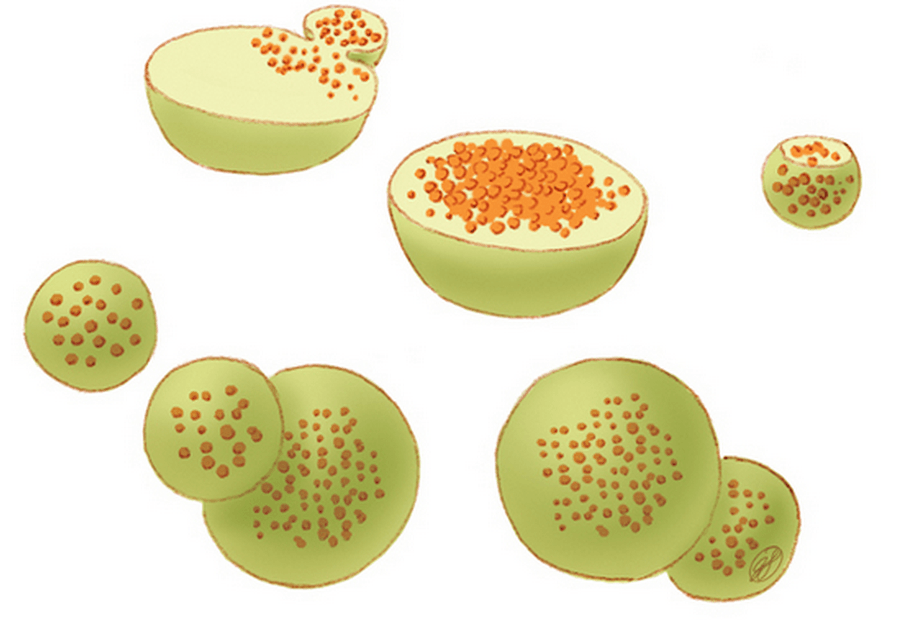
You might think of me as the trash collector, but recycler is maybe more accurate. What am I?
a)
mitochondria
b)
lysosome
c)
vacuole
d)
ribosome
100 %

