
 Worksheets
Unit: 1 Review Packet - The Universe, Stars, Energy, and the Sun
Total questions: 75
Worksheet time: 38mins
What is the most widely accepted explanation for how the universe began?
Steady State Theory
Big Bang Theory
Oscillating Universe Theory
Multiverse Theory
The universe started about ________ years ago from an extremely small, hot, and dense point. (Fill in the blank)
13.8 billion
4.5 billion
100 million
500 thousand
Before the Big Bang, there was no space or time.
True
False
The universe expanded rapidly and created space and time itself.
True
False
During the first second after the Big Bang, which of the following formed?
Planets
Four fundamental forces (gravity, strong nuclear, weak nuclear, electromagnetic)
Stars
Galaxies
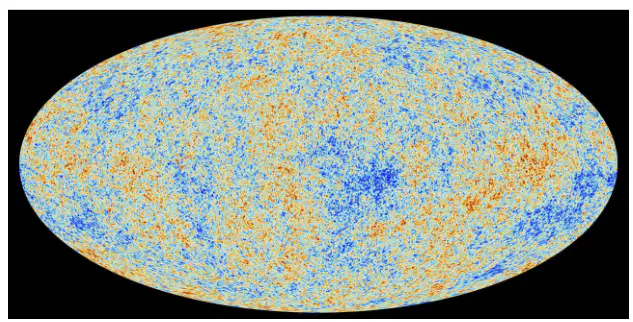
What is the Cosmic Microwave Background (CMB)?
The oldest light we can detect, strong evidence for the Big Bang
The first star formed
The first planet formed
The first galaxy formed
The universe is still expanding.
True
False
Nucleosynthesis during the Big Bang created mostly ________ and ________.
hydrogen and helium
carbon and oxygen
lithium and beryllium
neon and argon
What are stars? Fill in the blank: Stars are massive, glowing spheres of ______ held together by gravity.
plasma
rock
ice
gas
Where do stars form?
In planets
In nebulae
In comets
In asteroids
What is the process called when gravity pulls gas together to form a new star? Fill in the blank: Gravity pulls the gas together, forming a ______.
protostar
nebula
black hole
comet
What begins when the protostar heats up?
Nuclear fission
Nuclear fusion
Chemical reaction
Evaporation
Where do most stars, including our Sun, spend most of their lives? Fill in the blank: Most stars spend most of their lives in the ______ phase.
Main Sequence
Red Giant
White Dwarf
Neutron Star
What do stars fuse in their core during the main sequence?
Hydrogen into helium
Helium into hydrogen
Oxygen into carbon
Carbon into oxygen
Match the star color to its temperature:
Hottest
Blue
Very hot
White
Medium (like our Sun)
Yellow
Coolest
Red
Which type of star is the smallest?
Dwarf Stars
Giant Stars
Supergiant Stars
Red Giants
Which type of star is the largest? Fill in the blank: ______/Supergiant Stars are the largest.
Giant
Dwarf
Neutron
Main Sequence
What happens when a star uses up its hydrogen?
It becomes a white dwarf
It becomes a red giant
It explodes as a supernova
It turns into a planet
What do small/medium (average) stars leave behind after shedding their outer layers? Small/medium stars leave behind a ______.
white dwarf
black hole
neutron star
red giant
What do massive stars form after exploding as supernovas?
White dwarfs
Neutron stars or black holes
Red giants
Planets
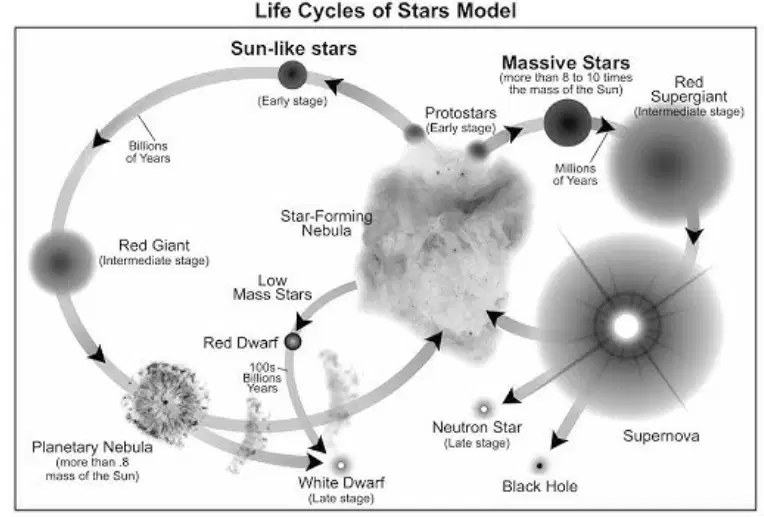
Which stage comes after the Red Giant stage for Sun-like stars?
Protostars
Planetary Nebula
Neutron Star
Black Hole
The Sun is a medium-sized, yellow star, about ___% hydrogen and ___% helium.
75% hydrogen and 24% helium
60% hydrogen and 39% helium
90% hydrogen and 9% helium
50% hydrogen and 49% helium
Which part of the Sun is where nuclear fusion happens and is the hottest part (15 million °C)?
Core
Radiative Zone
Convective Zone
Photosphere
What is the function of the Radiative Zone in the Sun?
Energy moves outward by radiation.
It is where nuclear fusion occurs.
It is the outermost layer of the Sun.
It is responsible for generating the Sun's magnetic field.
Which zone in the Sun is responsible for hot gas rising, cooling, and sinking, moving energy to the surface?
Core
Convective Zone
Chromosphere
Corona
The Photosphere is the 'surface' we see on the Sun.
True
False
The Corona is hotter than the photosphere and is visible during total solar eclipses.
True
False
What causes sunspots on the Sun?
Cooler, darker regions caused by magnetic fields.
Areas where the Sun is burning hotter than usual.
Impacts from asteroids hitting the Sun's surface.
Reflections of planets passing in front of the Sun.
Solar flares are bursts of energy and particles from the Sun that can affect Earth's technology.
True
False
What is the Solar Wind?
Stream of charged particles flowing from the corona; causes auroras on Earth.
The process of photosynthesis.
The visible light from the sun.
The sun's gravitational pull.
What is one impact of the Sun on Earth?
Drives weather
Powers photosynthesis
Affects technology
All of the above
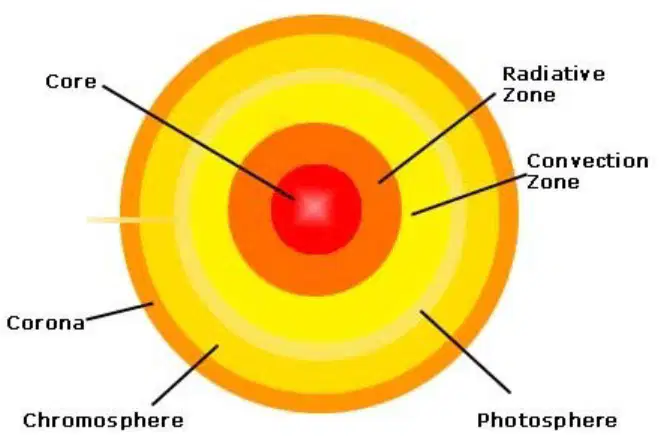
Label the parts of the Sun in the diagram:
Core, Radiative Zone, Convection Zone, Photosphere, Chromosphere, Corona
Core, Mantle, Crust, Troposphere, Stratosphere, Mesosphere
Nucleus, Cytoplasm, Membrane, Chloroplast, Mitochondria, Ribosome
Inner Core, Outer Core, Mantle, Crust, Lithosphere, Asthenosphere
Energy can’t be created or destroyed, only ________.
transformed
measured
multiplied
divided
The Sun produces ________—energy that travels in waves.
electromagnetic radiation
chemical energy
mechanical energy
nuclear fission
Which of the following is the only part of the electromagnetic spectrum that humans can see?
Infrared Radiation
Visible Light
Ultraviolet (UV)
Microwaves
Arrange the following types of electromagnetic radiation from lowest to highest energy:
Radio Waves, Microwaves, Infrared Radiation, Visible Light, Ultraviolet (UV), X-rays, Gamma Rays.
Gamma Rays, X-rays, Ultraviolet (UV), Visible Light, Infrared Radiation, Microwaves, Radio Waves.
Visible Light, Infrared Radiation, Microwaves, Radio Waves, Ultraviolet (UV), X-rays, Gamma Rays.
Microwaves, Radio Waves, Infrared Radiation, Visible Light, Ultraviolet (UV), X-rays, Gamma Rays.
What is the definition of wavelength? Fill in the blank: Wavelength is the distance between _______ of a wave; shorter wavelength = more energy.
peaks
troughs
sides
centers
What is the definition of frequency? Fill in the blank: Frequency is the number of _______ passing a point per second; higher frequency = more energy.
waves
particles
seconds
meters
Which of the following is a use of radio waves?
Cooking and cell phones
Broadcasting and communication
Medical imaging
Cancer treatment
Which type of EM radiation is used for cooking and cell phones?
Infrared
Microwaves
X-rays
Gamma Rays
Which type of EM radiation is used for medical imaging?
UV
X-rays
Infrared
Visible Light
Which type of EM radiation is used for cancer treatment?
Gamma Rays
Radio
Visible Light
Microwaves
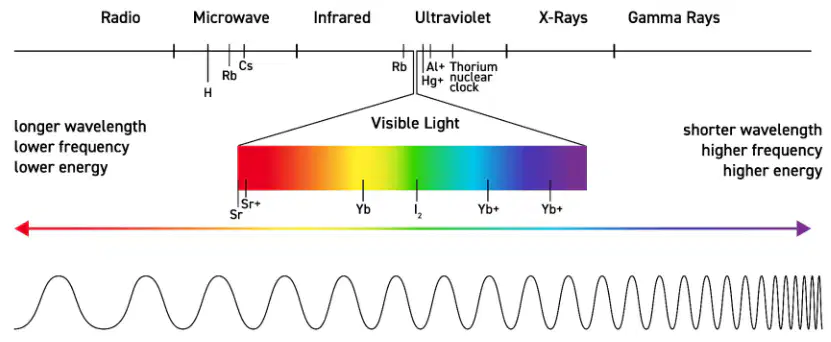
Refer to the diagram. Which side of the electromagnetic spectrum has higher energy and shorter wavelength?
Radio
Gamma Rays
On the H-R Diagram, which side represents hotter stars?
Left
Right
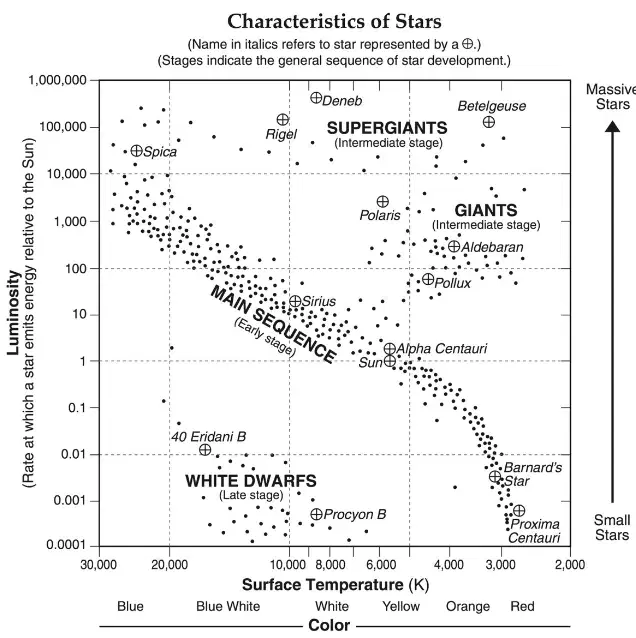
Which axis on the H-R diagram represents luminosity?
X-axis
Y-axis
Z-axis
None of the above
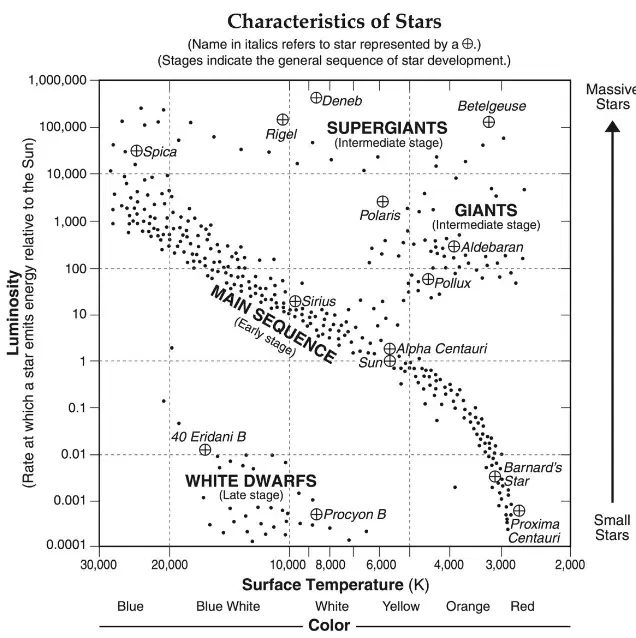
Where are most stars, including the Sun, found on the H-R diagram?
Main Sequence
Giants
White Dwarfs
Supergiants
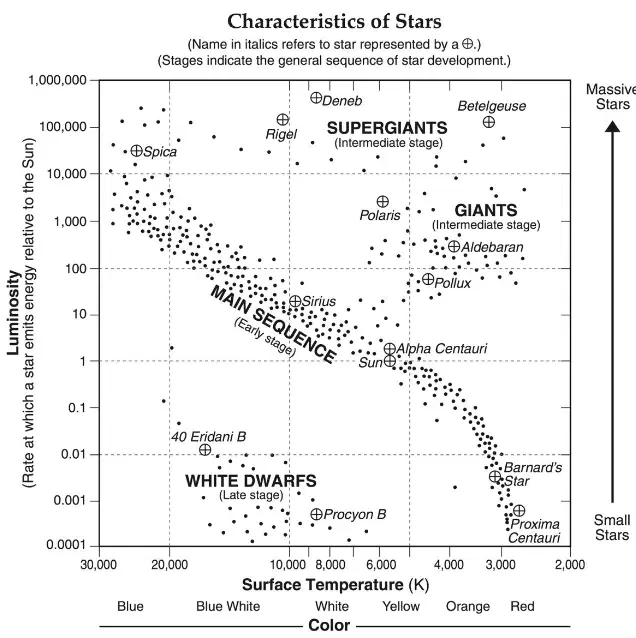
Fill in the blank: The Main Sequence is a diagonal band on the H-R diagram that runs from the _______ to the _______.
top left; bottom right
top right; bottom left
bottom left; top right
center; edge
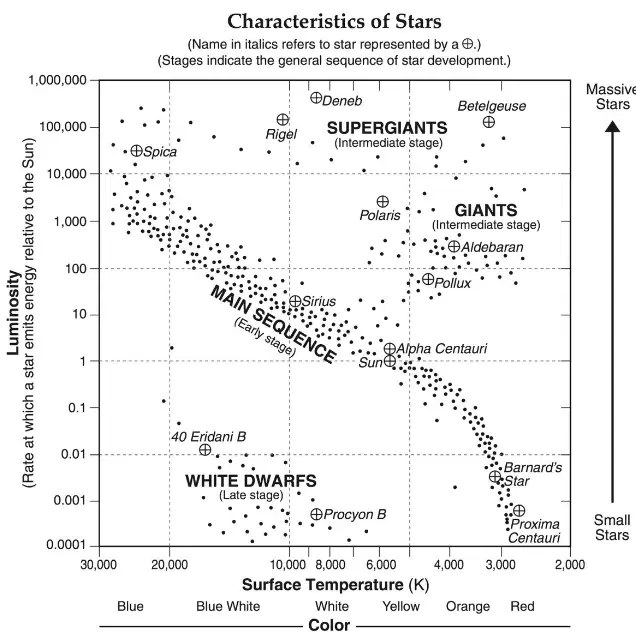
Which region of the H-R diagram contains cool but bright and large stars?
Main Sequence
Giants/Supergiants
White Dwarfs
None of the above
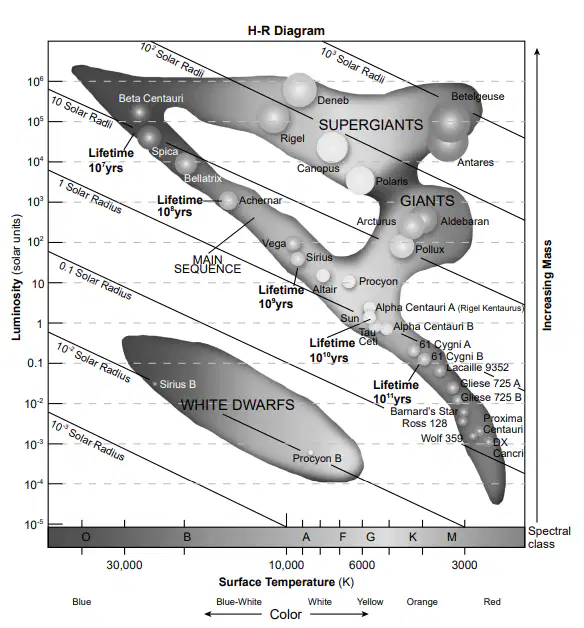
Match the spectral class with its description:
Like our Sun
G
Coolest, red
M
Hottest, blue
O
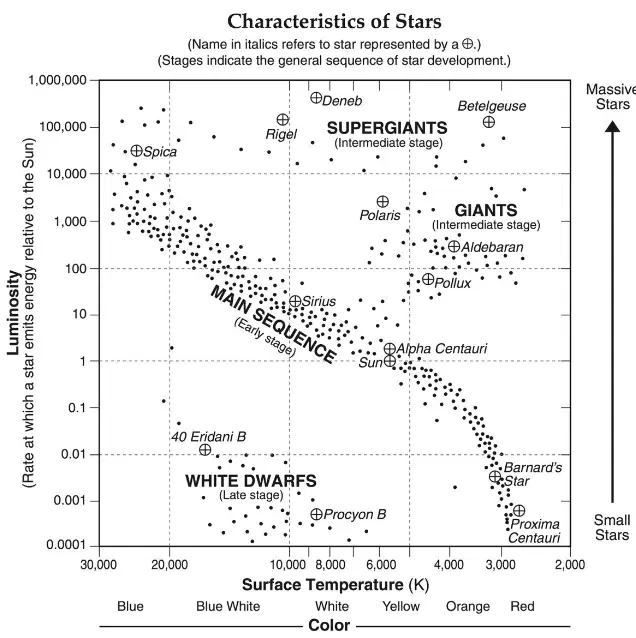
The H-R diagram shows a star’s stage of life, temperature, color, and size.
True
False
Fill in the blank: Nucleosynthesis is the process of making new _______ in the universe.
elements
planets
galaxies
stars
Fill in the blank: Big Bang Nucleosynthesis formed hydrogen (75%) and _______ (25%) right after the Big Bang.
helium
carbon
oxygen
lithium
Fill in the blank: Inside stars, fusion creates elements up to _______.
iron
gold
helium
uranium
Fill in the blank: In supernova explosions, extremely high temperatures and neutron numbers create elements heavier than iron, like _______ and uranium.
gold
oxygen
carbon
helium
Fill in the blank: The idea that the universe began as a rapid expansion from a single, tiny, hot, dense point is called the _______.
Big Bang Theory
Steady State Theory
String Theory
Quantum Leap
Fill in the blank: A huge cloud of gas and dust in space where new stars are born is called a _______.
Nebula
Comet
Asteroid
Black hole
Fill in the blank: A developing star before nuclear fusion starts is called a _______.
Protostar
White Dwarf
Neutron Star
Red Giant
Fill in the blank: The process by which stars create energy by fusing smaller atoms into larger atoms is called _______.
Nuclear Fusion
Nuclear Fission
Photosynthesis
Combustion
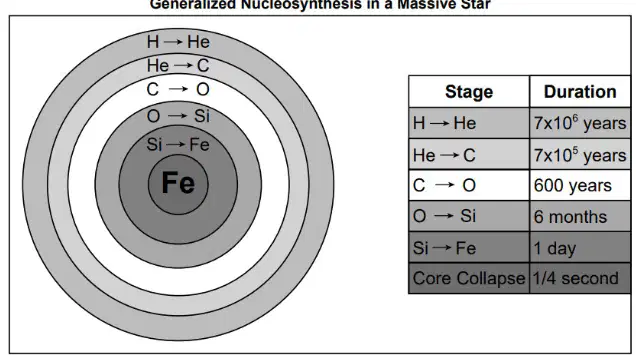
According to the diagram 'Generalized Nucleosynthesis in a Massive Star', what is the duration of the stage where Si turns into Fe?
1 day
1 year
1 million years
1 hour
Fill in the blank: The stable, longest phase in a star’s life where it fuses hydrogen into helium is called ________.
Main Sequence
Red Giant
White Dwarf
Supernova
Fill in the blank: A late stage in a star’s life when it expands and cools after using up its hydrogen fuel is called ________.
Red Giant
White Dwarf
Neutron Star
Main Sequence
Fill in the blank: The small, hot core left after a medium-sized star dies is called a ________.
White Dwarf
Red Giant
Neutron Star
Black Hole
Fill in the blank: A powerful explosion of a massive star at the end of its life is called a ________.
Supernova
Nebula
Black Hole
Comet
Fill in the blank: An extremely dense star left after a supernova, made mostly of neutrons, is called a ________.
Neutron Star
White Dwarf
Red Giant
Black Hole
Fill in the blank: An object with gravity so strong that not even light can escape is called a ________.
Black Hole
Neutron Star
White Dwarf
Red Giant
Fill in the blank: The visible surface of the Sun is called the ________.
Photosphere
Chromosphere
Corona
Core
Fill in the blank: The outermost layer of the Sun’s atmosphere, seen during a total solar eclipse, is called the ________.
Corona
Photosphere
Chromosphere
Radiative Zone
Fill in the blank: A cooler, darker spot on the Sun caused by magnetic activity is called a ________.
Sunspot
Solar Flare
Corona
Prominence
Fill in the blank: A sudden burst of energy and particles from the Sun’s surface is called a ________.
Solar Flare
Sunspot
Aurora
Comet
Fill in the blank: A stream of charged particles released from the Sun’s corona is called ________.
Solar Wind
Aurora Borealis
Comet Tail
Magnetosphere
Fill in the blank: The full range of electromagnetic radiation (radio waves to gamma rays) is called the ________.
Electromagnetic Spectrum
Visible Light
Sound Spectrum
Infrared Range
Fill in the blank: The distance between two peaks of a wave; shorter means higher frequency, is called ________.
Wavelength
Amplitude
Velocity
Period
Fill in the blank: How often a wave passes a point in one second; higher frequency means more energy is called ________.
Frequency
Amplitude
Wavelength
Velocity
Fill in the blank: The faint “afterglow” light left over from the Big Bang is called ________.
Cosmic Microwave Background
Solar Wind Radiation
Gamma Ray Burst
Stellar Nucleosynthesis
Fill in the blank: The process of forming new elements from smaller particles, especially in stars and supernovas, is called ________.
Nucleosynthesis
Photosynthesis
Ionization
Evaporation

