
Font size
 Worksheets
Geology 105 Exploring Earth
Total questions: 100
Worksheet time: 50mins
What is the location for the Geology 105 Exploring Earth class?
Reed-Curie Hall 244
Reed-Curie Hall 210
Science Building 101
Library Room 5
Who is the instructor for Geology 105 Exploring Earth?
Viktoras A. Liogys
Tarbuck Lutgens
Linneman Tasa
John Smith
What is the email address of the instructor for Geology 105 Exploring Earth?
vliogys@radford.edu
geology@radford.edu
instructor@radford.edu
vliogys@earth.edu
Fill in the blank: The office for the instructor of Geology 105 Exploring Earth is located in _________.
Reed-Curie Hall 210
Science Building 101
Library Annex 305
Engineering Hall 112
Which textbook is required for Geology 105 Exploring Earth?
Earth: An Introduction to Physical Geology
Introduction to Chemistry
Exploring Biology
Physics for Scientists
What edition of the textbook 'Earth: An Introduction to Physical Geology' is required for Geology 105 Exploring Earth?
10th Edition
12th Edition
13th Edition
15th Edition
On which days and times does the lecture for Geology 105 Exploring Earth take place?
T Th 2:00 PM – 3:15 PM
M W 9:00 AM – 10:15 AM
F 1:00 PM – 2:15 PM
T Th 11:00 AM – 12:50 PM
What is the location for Geology 105 Exploring Earth?
Reed-Curie Hall 244
Science Building 101
Library Auditorium
Engineering Hall 302
Who is the instructor for Geology 105 Exploring Earth?
Viktoras A. Liogys
Sarah J. Thompson
Michael R. Evans
Linda K. Carter
What is the email address of the instructor for Geology 105 Exploring Earth?
vliogys@radford.edu
geology105@radford.edu
earthscience@radford.edu
prof.smith@radford.edu
On which days and at what time is the lecture for Geology 105 Exploring Earth held?
T Th 2:00 PM – 3:15 PM
M W F 10:00 AM – 11:00 AM
W F 1:00 PM – 2:15 PM
M Th 3:30 PM – 4:45 PM
When is the lab for Geology 105 Exploring Earth scheduled?
Th 11:00 AM – 12:50 PM
Mo 2:00 PM – 3:50 PM
We 9:00 AM – 10:50 AM
Fr 1:00 PM – 2:50 PM
What is the office location of the instructor for Geology 105 Exploring Earth?
Reed-Curie Hall 210
Science Building 101
Library Annex 305
Engineering Hall 112
What is the required laboratory manual for Geology 105 Exploring Earth?
Laboratory Manual in Physical Geology, 12th Edition
Earth Science Laboratory Manual, 10th Edition
Introduction to Geology Lab Manual, 3rd Edition
Exploring Geology Lab Manual, 5th Edition
How many points are the 3 Lecture exams worth in total?
72 points
216 points
240 points
600 points
What percentage of the total grade is the Laboratory worth?
12%
36%
40%
100%
How many points is the Final lecture exam worth?
72 points
50 points
100 points
60 points
You must take all 4 exams for your highest score to be ________.
doubled
reduced
ignored
halved
Missing 6 or more lectures will result in how many points being deducted from your total course points?
6 points
30 points
72 points
240 points
What is the percentage of your overall course grade that is deducted if you miss 6 or more lectures?
1%
5%
12%
40%
Absences will be excused and make-ups given ONLY with proper ________ for legitimate reasons.
documentation
attendance
permission
explanation
Questions of the Day will also be used as ________ credit.
extra
homework
attendance
participation
When is the Cumulative Final Exam scheduled?
Monday, December 8th
Tuesday, December 9th, 2:45 PM – 4:45 PM
Wednesday, December 10th
Friday, December 12th
Geology is the study of the _______.
Earth
Stars
Oceans
Plants
What does the Greek root 'geo-' mean?
Water
Earth
Fire
Air
What does the Greek root '-logia' mean?
A) To speak of or science of
B) Earth
C) Water
D) Air
The Earth is approximately how many years old?
4.5 billion years
1 billion years
10 million years
500 million years
Life first appeared on Earth around:
3.5 billion years ago
500 million years ago
65 million years ago
1 million years ago
Dinosaurs appeared and disappeared during which periods?
Dinosaurs appeared in the Mesozoic Era and disappeared at the end of the Cretaceous period.
Dinosaurs appeared in the Paleozoic Era and disappeared at the end of the Triassic period.
Dinosaurs appeared in the Cenozoic Era and disappeared at the end of the Jurassic period.
Dinosaurs appeared in the Precambrian Era and disappeared at the end of the Permian period.
The first plants appeared during which period?
Cambrian Period
Devonian Period
Jurassic Period
Cretaceous Period
The Appalachian Mountains rose up during which period, and how long did it take?
During the Paleozoic Era, over hundreds of millions of years
During the Mesozoic Era, in less than a million years
During the Cenozoic Era, in a few thousand years
During the Precambrian Era, over a few decades
The Grand Canyon formed millions of years ago and took how long to form?
It formed about 5-6 million years ago and took millions of years to form.
It formed about 500,000 years ago and took a few thousand years to form.
It formed about 50 million years ago and took a few hundred years to form.
It formed about 1,000 years ago and took a decade to form.
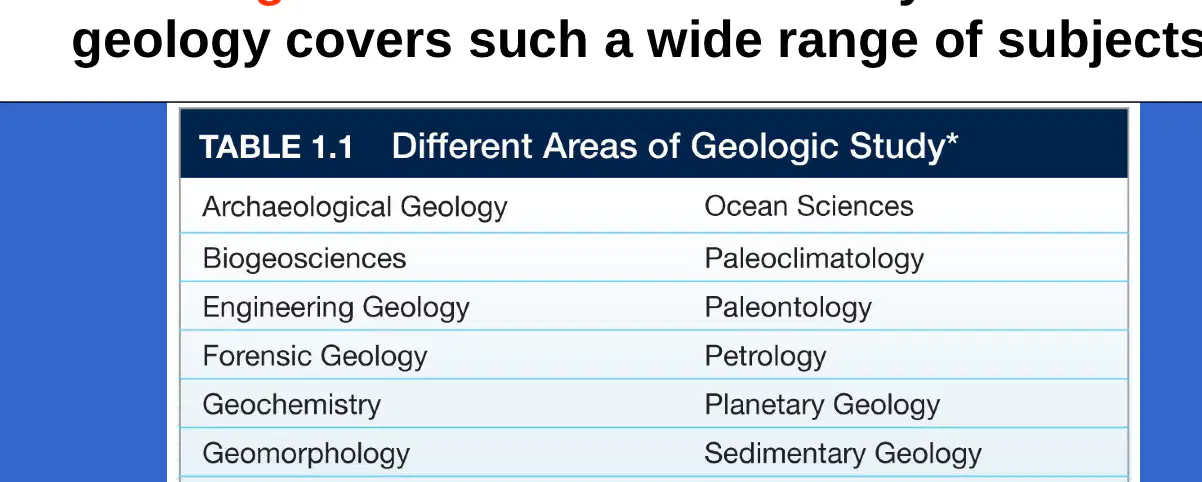
According to Table 1.1, name one area of geologic study that involves the study of ancient human activity and artifacts.
Archaeological Geology
Volcanology
Petrology
Seismology
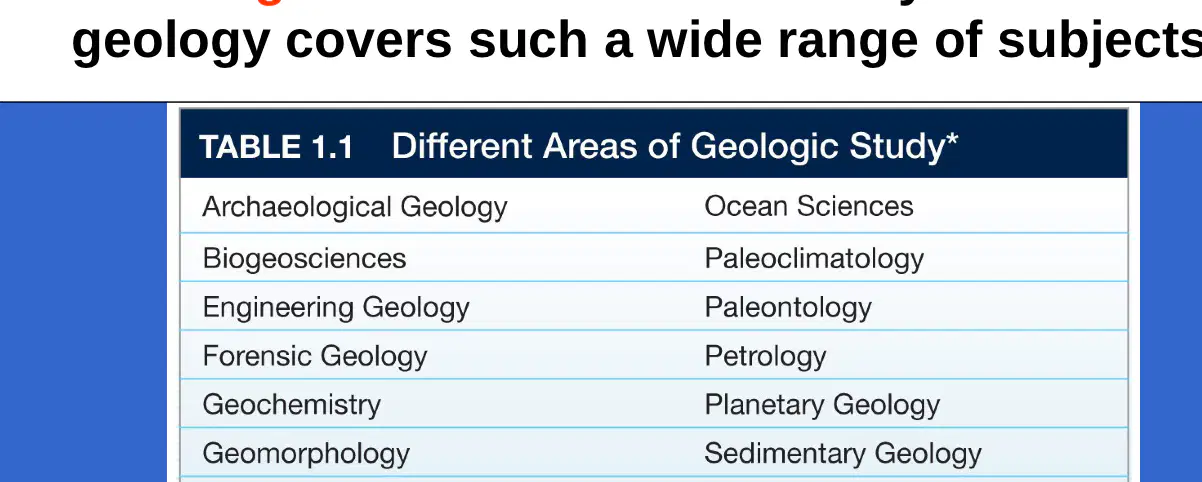
According to Table 1.1, name the area of geologic study that focuses on the intersection of biology and earth sciences.
Biogeosciences
Petrology
Seismology
Mineralogy
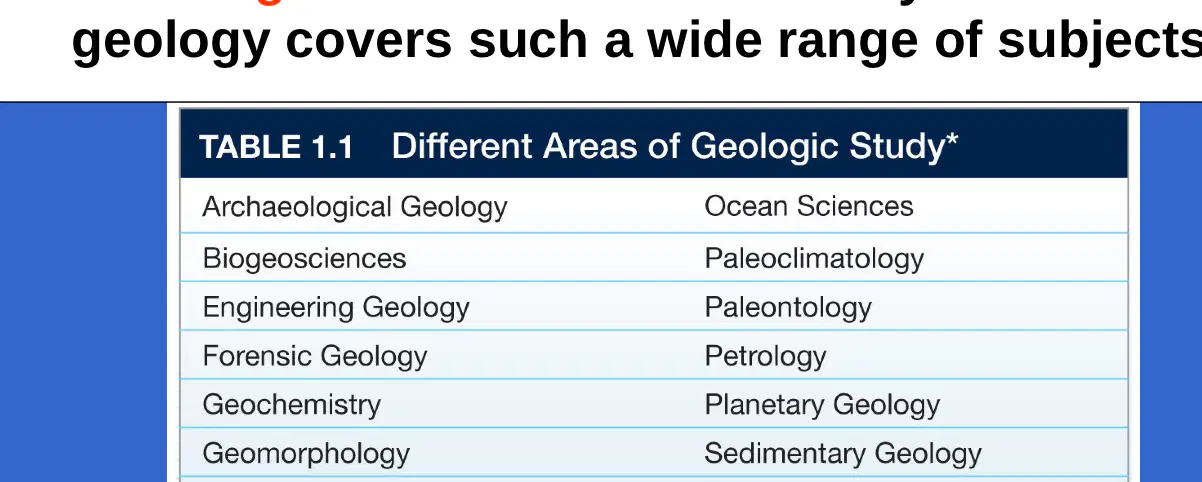
According to Table 1.1, what is the area of geologic study that applies geological knowledge to engineering work?
Engineering Geology
Petrology
Paleontology
Hydrogeology
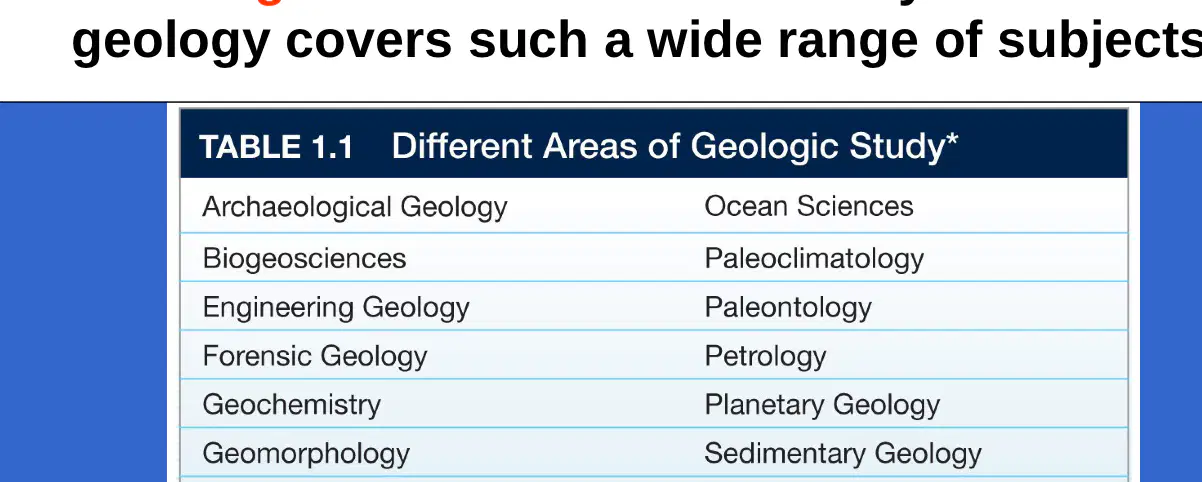
According to Table 1.1, which area of geologic study deals with the application of geology to criminal investigations?
Forensic Geology
Petrology
Paleontology
Seismology
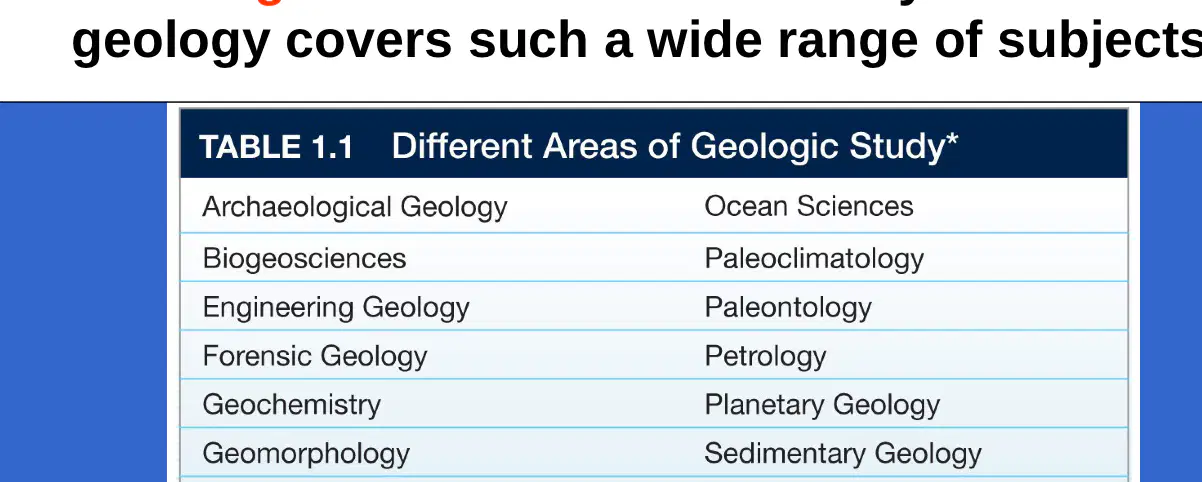
According to Table 1.1, what is the area of geologic study that focuses on the chemical composition of earth materials?
Geochemistry
Geophysics
Paleontology
Mineralogy
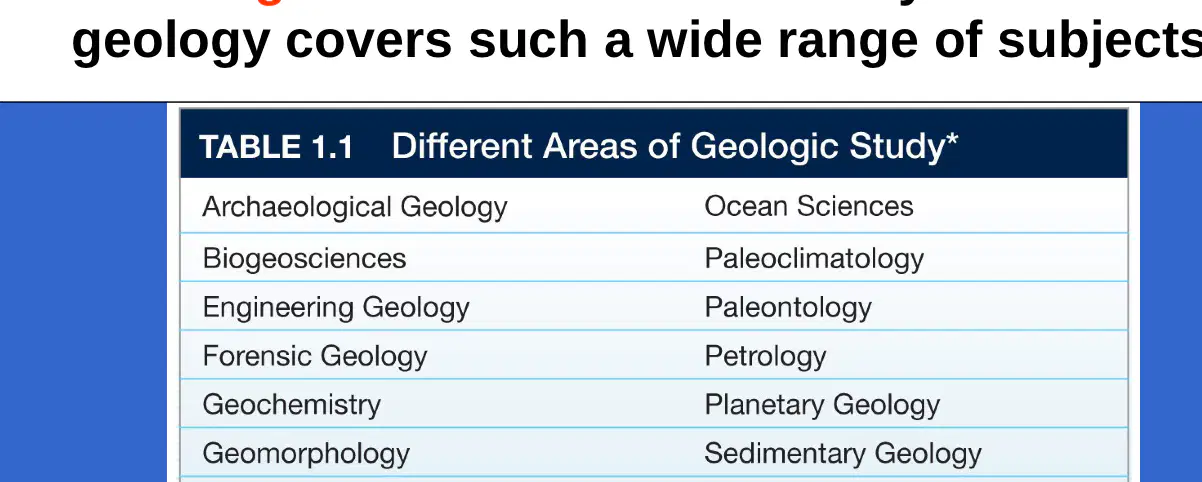
According to Table 1.1, which area of geologic study examines the formation and evolution of landforms?
Geomorphology
Petrology
Seismology
Paleontology
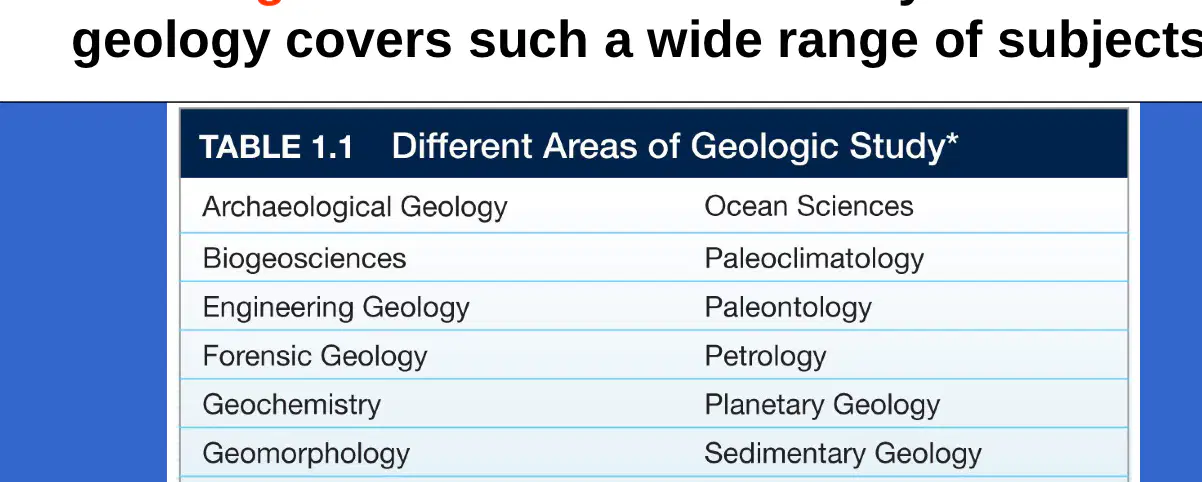
According to Table 1.1, what is the area of geologic study that uses physics to study the Earth?
Geophysics
Petrology
Paleontology
Mineralogy
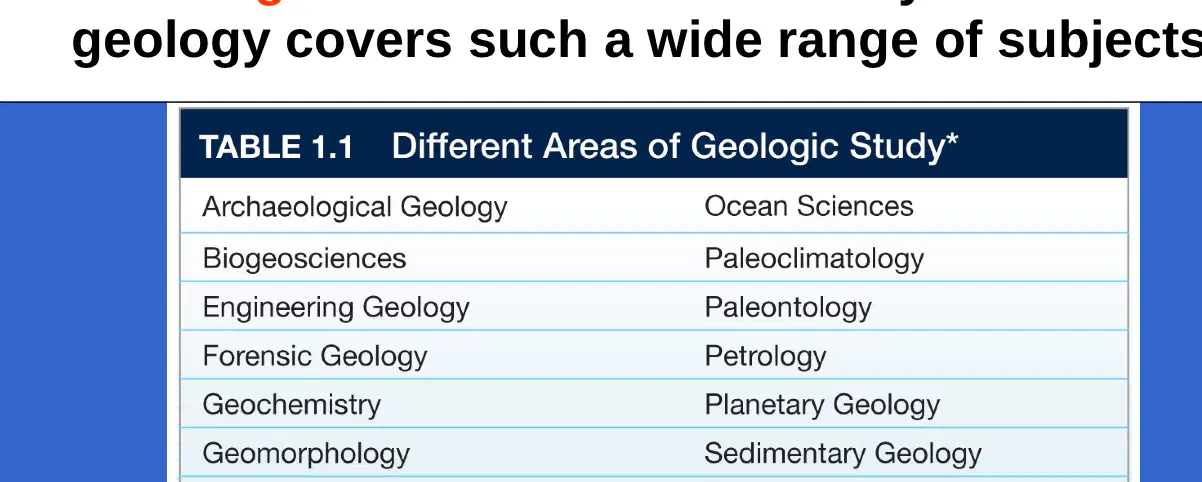
According to Table 1.1, which area of geologic study focuses on the development and history of geology as a science?
History of Geology
Mineralogy
Petrology
Structural Geology
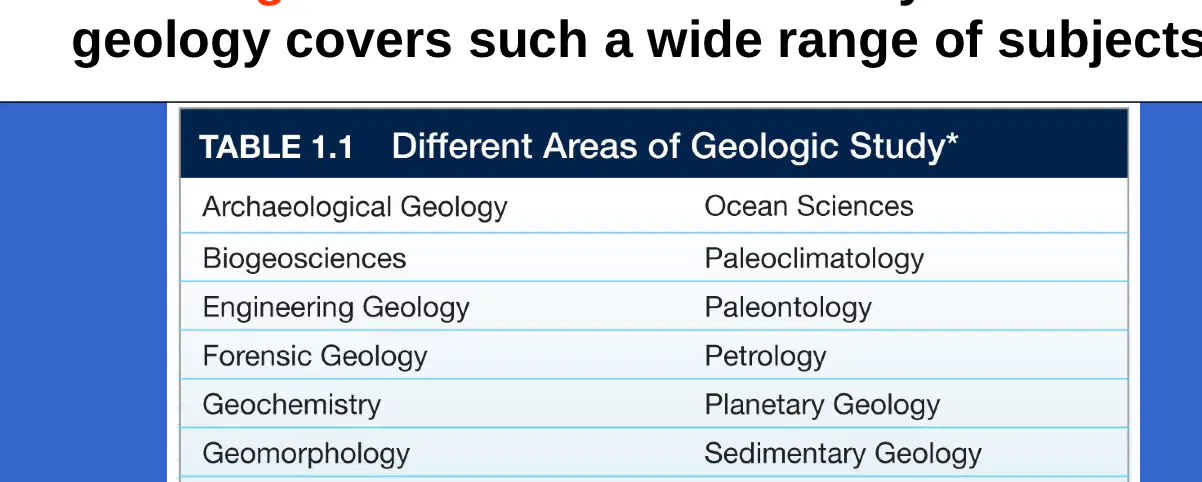
According to Table 1.1, what is the area of geologic study that deals with the distribution and movement of groundwater?
Hydrogeology
Petrology
Seismology
Volcanology
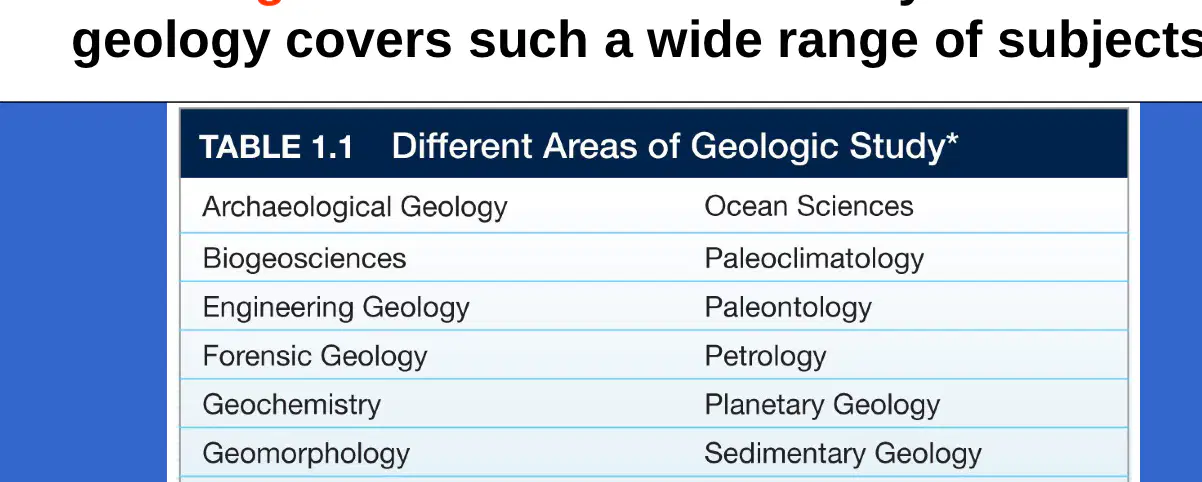
According to Table 1.1, which area of geologic study focuses on the effects of geological factors on health?
Medical Geology
Petrology
Paleontology
Seismology
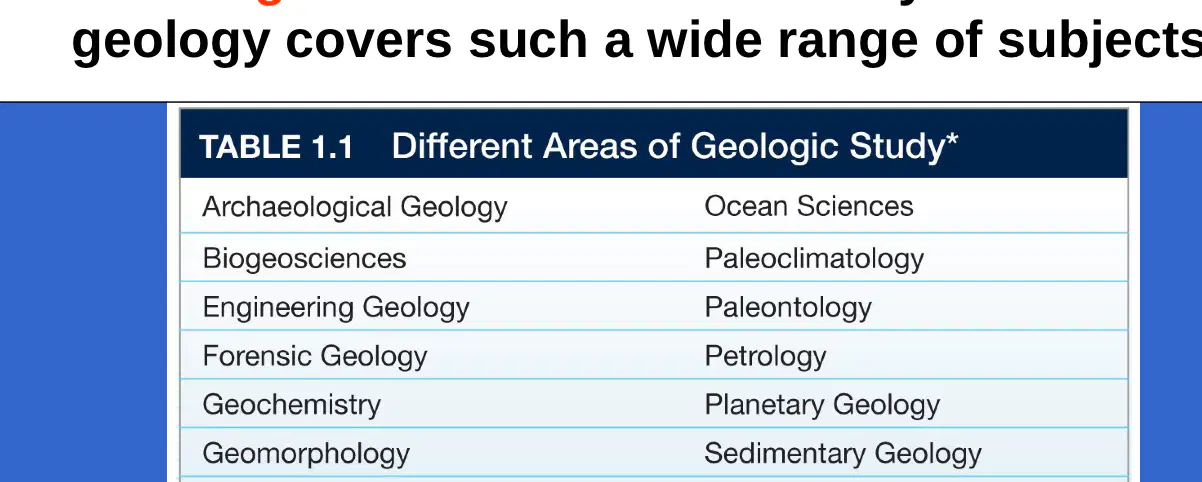
According to Table 1.1, what is the area of geologic study that focuses on minerals and their properties?
Mineralogy
Petrology
Paleontology
Seismology
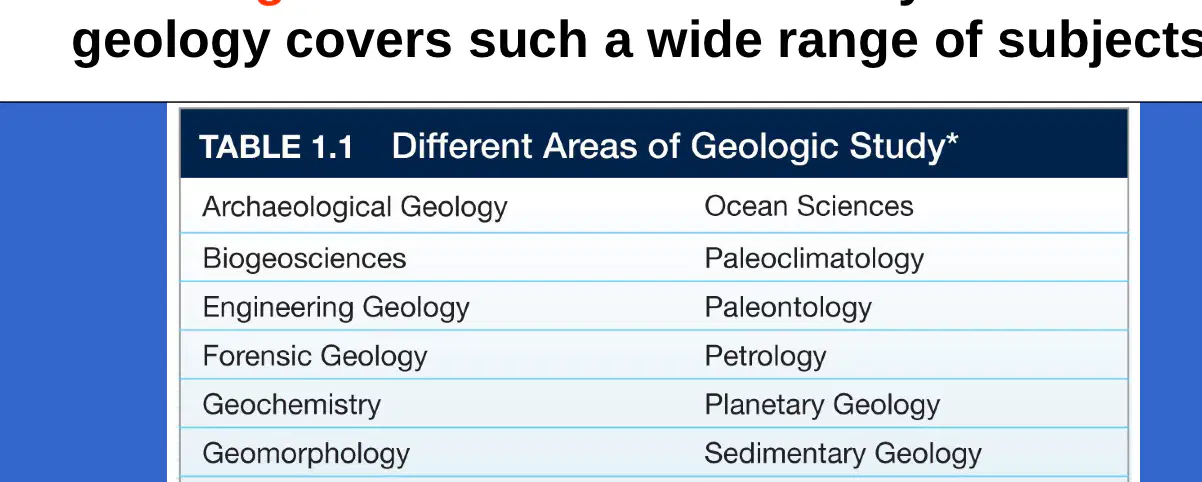
According to Table 1.1, name the area of geologic study that focuses on the study of oceans.
Ocean Sciences
Petrology
Paleontology
Seismology
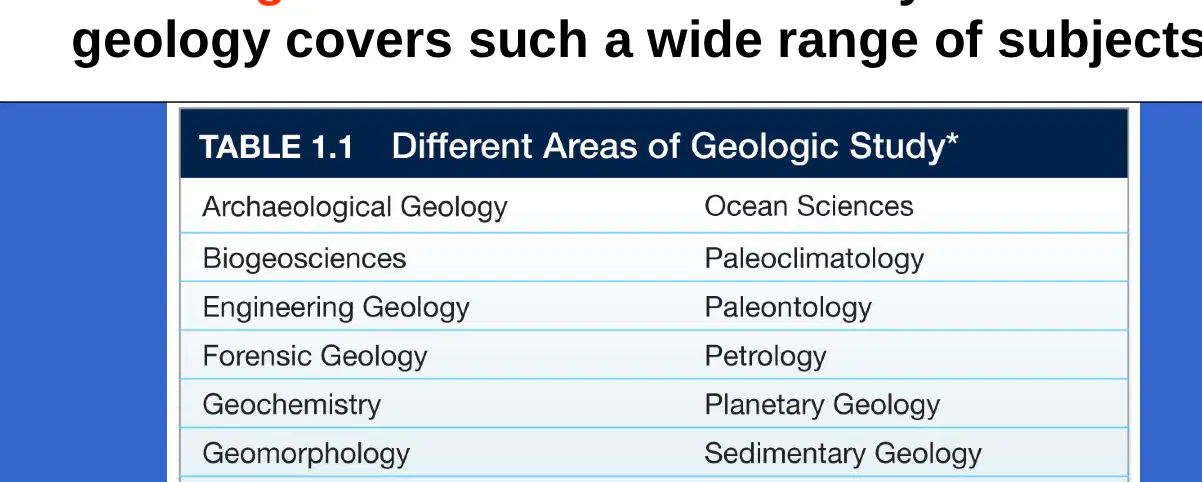
According to Table 1.1, which area of geologic study examines past climates?
Paleoclimatology
Seismology
Petrology
Volcanology
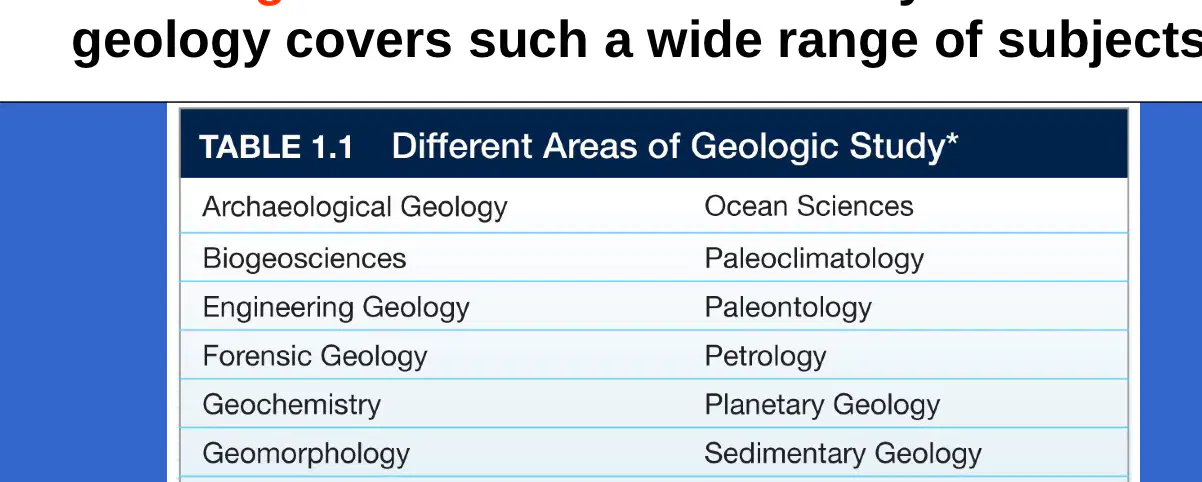
According to Table 1.1, what is the area of geologic study that focuses on fossils and ancient life?
Paleontology
Mineralogy
Seismology
Volcanology
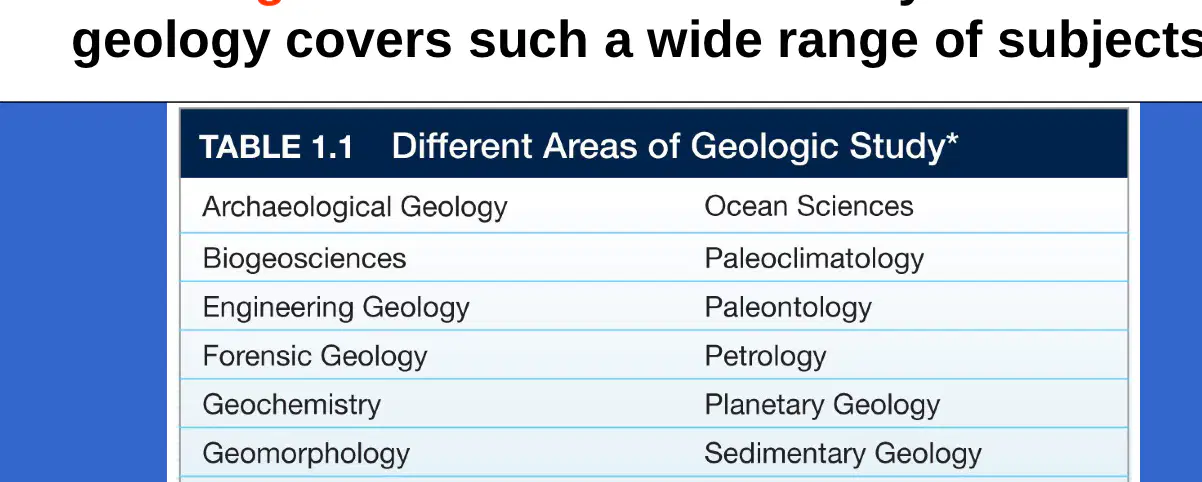
According to Table 1.1, which area of geologic study is concerned with the origin, composition, and structure of rocks?
Petrology
Seismology
Paleontology
Geomorphology
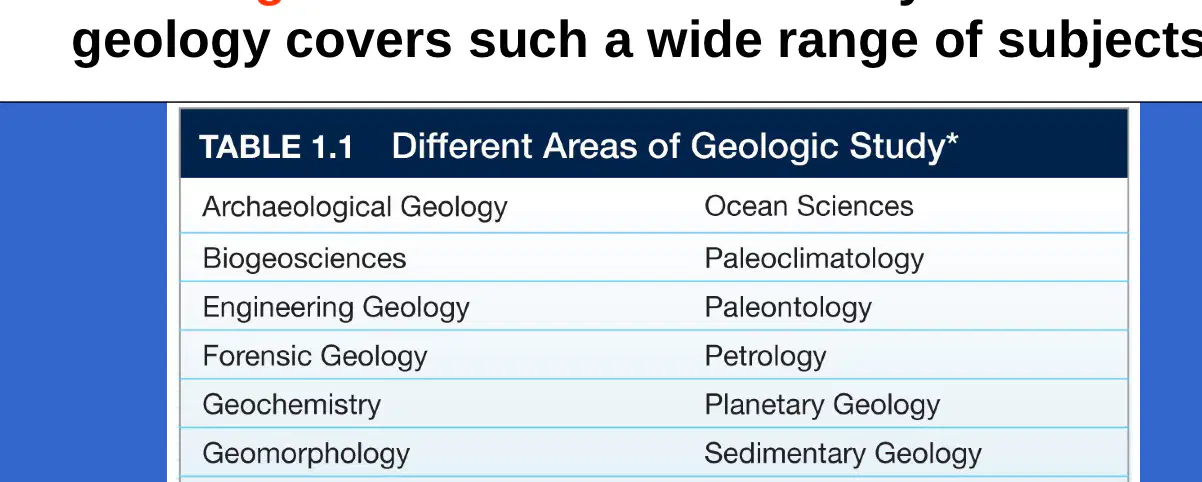
According to Table 1.1, what is the area of geologic study that focuses on the geology of other planets?
Planetary Geology
Structural Geology
Paleontology
Mineralogy
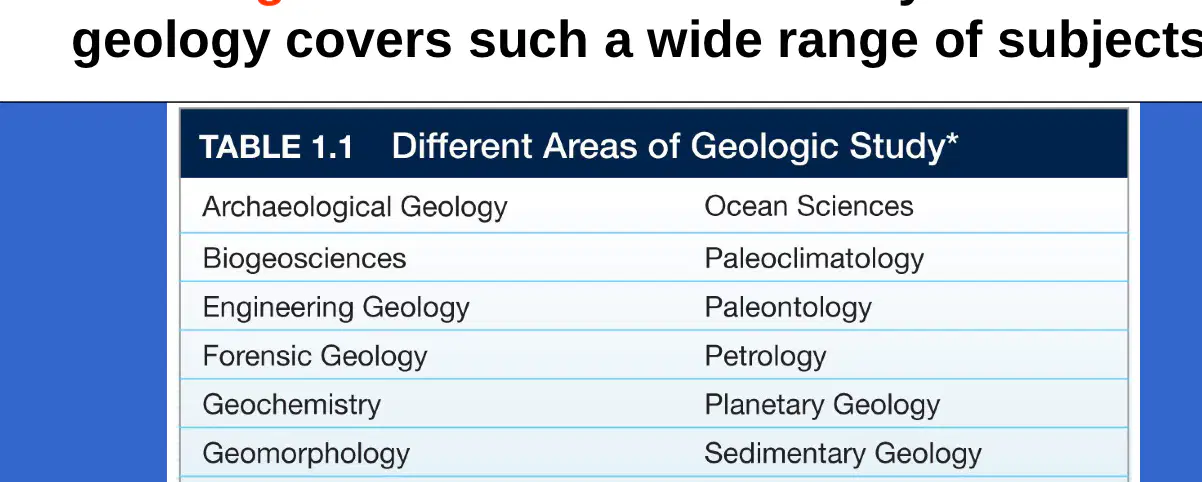
According to Table 1.1, which area of geologic study examines the processes and materials involved in the formation of sedimentary rocks?
Sedimentary Geology
Igneous Petrology
Structural Geology
Paleontology
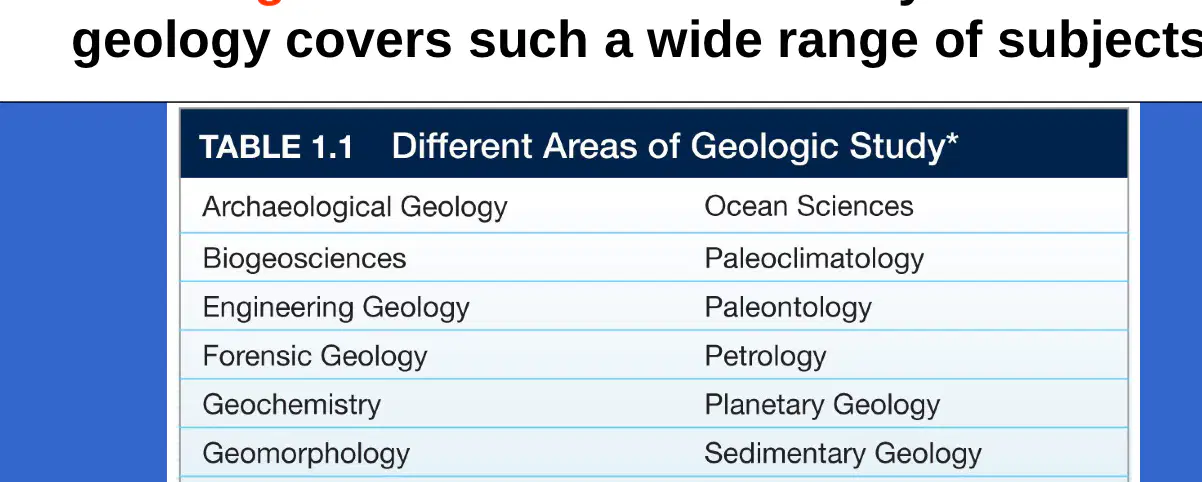
According to Table 1.1, what is the area of geologic study that focuses on earthquakes and the propagation of seismic waves?
Seismology
Petrology
Mineralogy
Paleontology
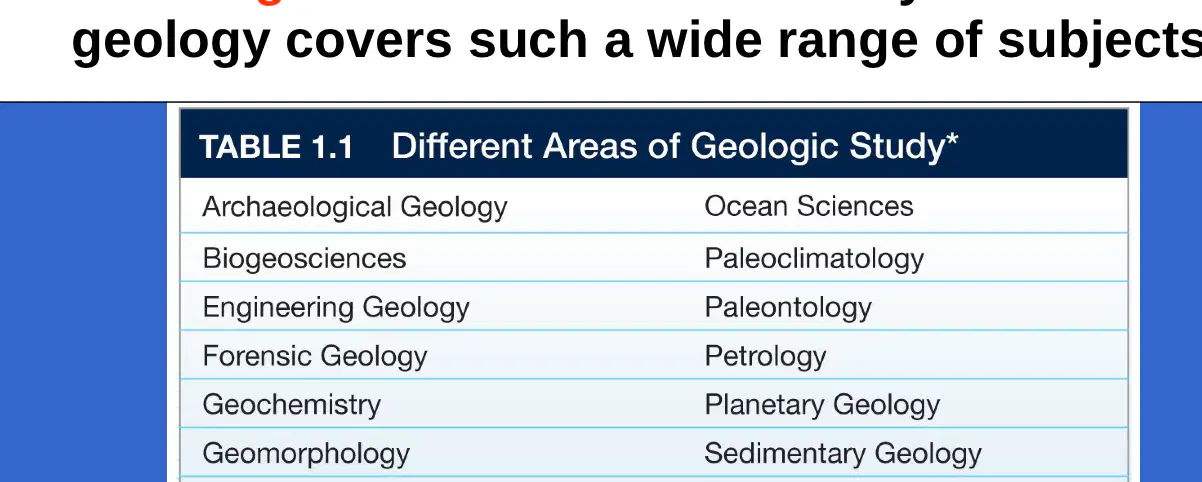
According to Table 1.1, which area of geologic study examines the arrangement and deformation of rocks within the Earth's crust?
Structural Geology
Petrology
Paleontology
Mineralogy
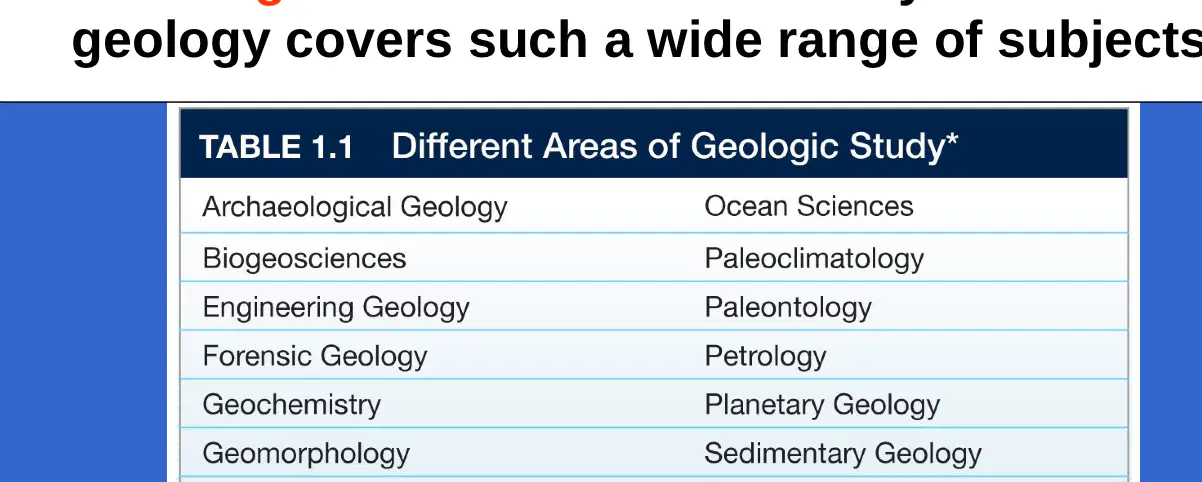
According to Table 1.1, what is the area of geologic study that focuses on the movement and deformation of the Earth's lithosphere?
Tectonics
Paleontology
Petrology
Mineralogy
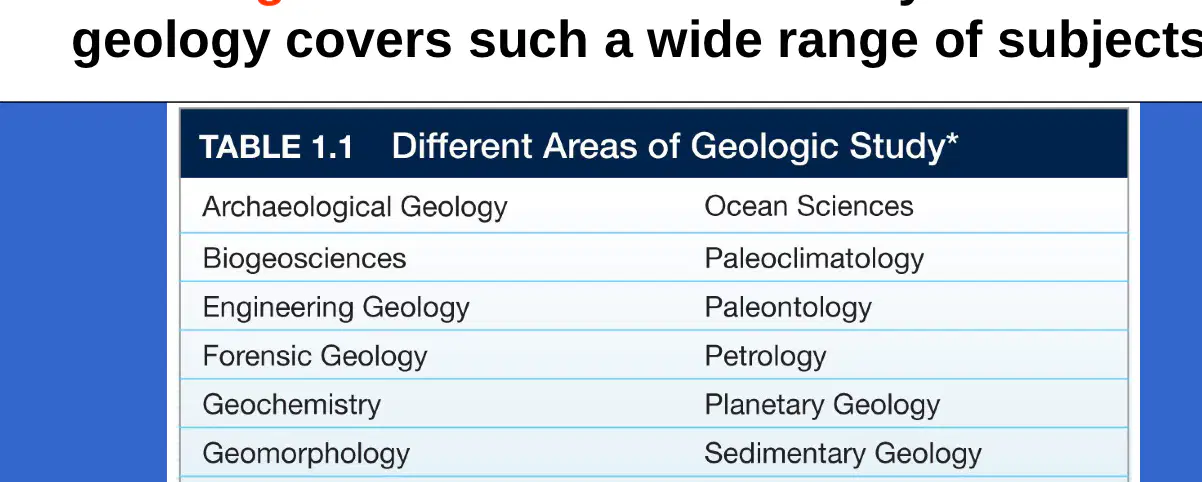
According to Table 1.1, which area of geologic study focuses on volcanoes and volcanic phenomena?
Volcanology
Seismology
Petrology
Paleontology
Which of the following is a natural hazard studied in geology?
A) Earthquakes
B) Photosynthesis
C) Photosynthesis
D) Photosynthesis
Which of the following is a natural hazard studied in geology?
Volcanoes
Photosynthesis
Photosynthesis
Photosynthesis
Which of the following is a natural hazard studied in geology?
Landslides
Photosynthesis
Photosynthesis
Photosynthesis
Which of the following is a natural hazard studied in geology?
Floods
Photosynthesis
Photosynthesis
Photosynthesis
Which of the following is a natural hazard studied in geology?
A) Tsunamis
B) Photosynthesis
C) Photosynthesis
D) Photosynthesis
Which of the following is a natural hazard studied in geology?
Asteroid Impacts
Photosynthesis
Photosynthesis
Photosynthesis
Which of the following is an environmental issue studied in geology?
Groundwater pollution
Photosynthesis
Photosynthesis
Photosynthesis
Which of the following is an environmental issue studied in geology?
Soil erosion
Photosynthesis
Photosynthesis
Photosynthesis
Which of the following is an environmental issue studied in geology?
A) Acid rain and air pollution
B) Photosynthesis
C) Photosynthesis
D) Photosynthesis
Which of the following is an environmental issue studied in geology?
Global climate – greenhouse effect
Photosynthesis
Photosynthesis
Photosynthesis
Why study Geology? Fill in the blank: One reason to study geology is for Natural Resources – Economic Geology, which includes ______ resources and ______ resources.
energy; material
water; air
solar; wind
organic; synthetic
Why study Geology? Which of the following is NOT a type of resource mentioned under Natural Resources – Economic Geology?
A) Energy resources
B) Material resources
C) Water resources
D) None of the above
Why study Geology? An academic reason to study geology is the explanation of ______ phenomena.
natural
artificial
fictional
mythical
Why study Geology? Which scientific principles are applied in the academic study of geology?
Chemistry
Physics
Biology
All of the above
Science is a ______. It is NOT a BELIEF. It is a way of producing knowledge.
PROCESS
OPINION
GUESS
ASSUMPTION
Which of the following is NOT true about science?
A) Science is a process
B) Science is a belief
C) Science is a way of producing knowledge
D) Science has basic assumptions
One of the basic assumptions of science is that nature behaves in a ______ and ______ manner.
logical, predictable
random, chaotic
unusual, mysterious
illogical, unpredictable
Careful and organized ______ of our surroundings lead to coherent descriptions of natural processes.
observations
guesses
predictions
assumptions
Observations and logical thought lead to recognizing ______ in the natural world.
PATTERNS
NOISES
COLORS
SHAPES
The key to science is _______ and reproducibility.
testability
creativity
luck
popularity
Science does not always lead immediately to the correct explanations of natural phenomenon.
True
False
It is not uncommon for widely accepted theories to be modified or even refuted if or when new information becomes available.
True
False
Changes to widely accepted hypotheses mean that science has failed.
True
False
Science is a _______ process.
creative
random
destructive
passive
What is the first step geologists take when studying the Earth according to the process shown in Figure 1.10?
Raise a question about the natural world
Collect rock samples from the field
Draw conclusions based on data
Publish findings in a scientific journal
Using data and observations, geologists formulate a ________.
hypothesis
experiment
theory
measurement
A hypothesis is a tentative explanation or educated guess that ________.
needs further evaluation
is always correct
cannot be tested
is a proven fact
A hypothesis is ALWAYS testable.
True
False
Which of the following is NOT a step in the process geologists use to study the Earth?
A) Raise a question about the natural world
B) Construct a hypothesis
C) Ignore data
D) Analyze data
What should geologists do if the results partially support or do not support the hypothesis according to Figure 1.10?
Try again (revise the hypothesis or experiment)
Ignore the results and move on
Publish the results without changes
Repeat the experiment without any modifications
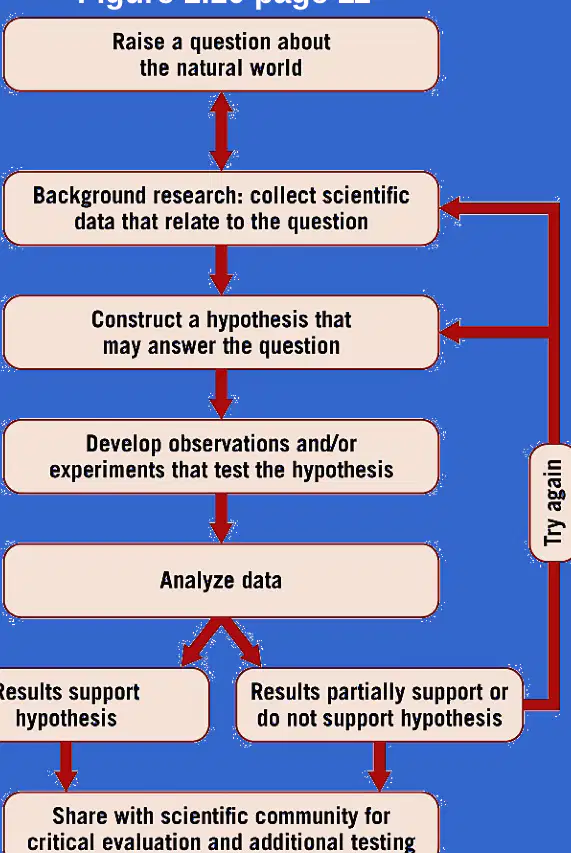
According to the diagram in Figure 1.10, what is the first step geologists take to study the Earth?
Analyze data
Raise a question about the natural world
Share with the scientific community
Construct a hypothesis
What is the goal of science according to the passage?
To memorize facts
To look for patterns in nature and use that knowledge to make predictions
To ignore data
To avoid making predictions
Fill in the blank: How do we find patterns? We use ______!
DATA
MUSIC
PAINT
SHOES
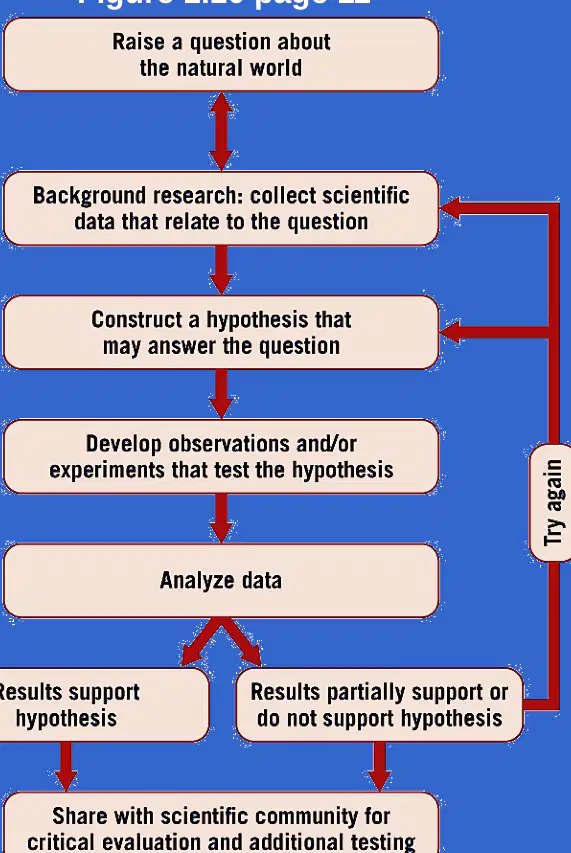
According to Figure 1.10, what should scientists do if the results partially support or do not support the hypothesis?
Try again (repeat the process or revise the hypothesis and test again)
Ignore the results and move on to a new experiment
Publish the results without further testing
Conclude that the hypothesis is always incorrect
True or False: There is only one fixed path that scientists follow to gain scientific knowledge.
True
False
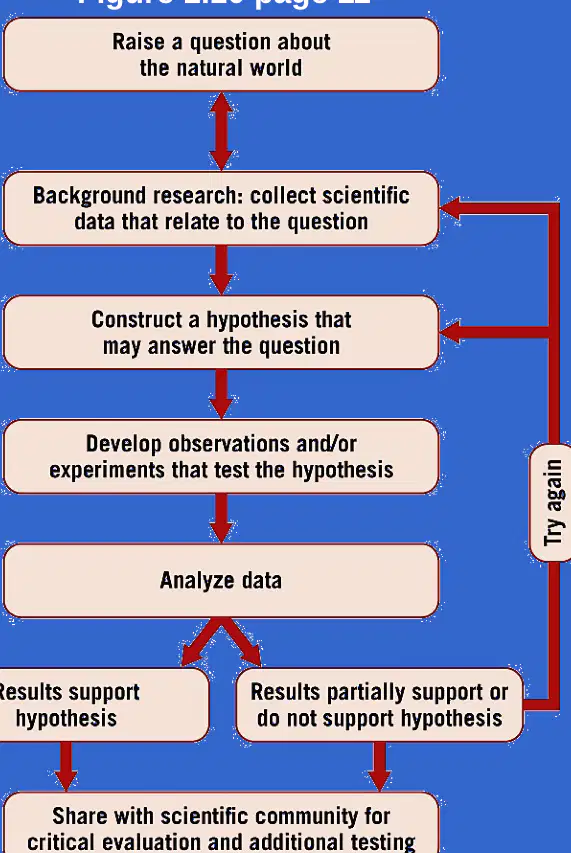
Identify the correct sequence of steps in the scientific process as shown in Figure 1.10.
Observation, Hypothesis, Experiment, Analysis, Conclusion
Conclusion, Experiment, Hypothesis, Observation, Analysis
Experiment, Observation, Analysis, Hypothesis, Conclusion
Analysis, Observation, Conclusion, Hypothesis, Experiment
What is a Theory? Fill in the blank: A Theory is a certain or nearly certain, widely accepted scientific idea. Supported by an abundance of _______ and has withstood testing.
evidence
opinions
guesses
rumors
Which of the following best describes a Law or Principle?
A widely accepted scientific idea supported by evidence
A concise but general statement about how nature behaves (something that occurs over and over in the same way)
A hypothesis that is not testable
An untested idea
A hypothesis that is not testable, or that cannot be disproved if a test fails, is not scientific and cannot lead to a scientific theory.
True
False
According to Catastrophism, who was the biblical scholar in the mid-1600s that contributed to the idea?
Charles Lyell
James Usher
Isaac Newton
Alfred Wegener
According to Catastrophism, in what year was the Earth created?
4004 b.c.e.
3000 b.c.e.
10000 b.c.e.
2000 b.c.e.
According to Catastrophism, the landscapes we see today were formed by very rapid and catastrophic events.
True
False
Who is often considered to be the 'Father of modern geology'?
Charles Darwin
James Hutton
Isaac Newton
Albert Einstein
Fill in the blank: The present is the key to the _____
past
future
present
moment
According to the principle of Uniformitarianism, the physical, chemical, and biological processes that operate today have also operated in the _____
past
future
laboratory
universe
Long periods of time are needed to create, alter, and destroy much of the landscapes we see on Earth today.
True
False
In what year did James Hutton publish 'The Theory of Earth'?
1795
1788
1801
1776

