
 Worksheets
District 1 Review
Total questions: 105
Worksheet time: 1hrs 19mins
Why might someone use prefixes in measurements?
To make numbers larger
To avoid very large or very small numbers
To confuse others
To change the unit type
What is the dependent variable (DV) in an experiment?
The variable that is purposely changed.
The variable that is measured in response to the IV.
The variable that is kept constant.
The variable that is not recorded.
Why is it important to have controlled variables (constants) in an experiment?
To make the experiment more interesting.
To ensure that any effects seen are due solely to the independent variable.
To reduce the number of trials needed.
To make the experiment easier to perform.
Which unit would make the most sense for measuring the mass of a mouse?
g
kg
m
mm
Which unit would you use to measure the length of a basketball court?
mm
m
km
g
Why is it important to use the correct unit when making scientific measurements?
It makes the measurement easier to remember
It ensures accuracy and clear communication
It makes the measurement look bigger
It is required by law
Which of the following numbers has exactly four significant figures?
0.601
1,049
0.3333
10,900
If you start with a number greater than 1 in scientific notation, what sign will the exponent have?
Positive
Negative
Zero
Fractional
Why is scientific notation useful in chemistry?
It makes it easier to work with very large or very small numbers.
It helps convert between different units.
It is required for all chemical equations.
It is used to balance chemical reactions.
Given a mixture of saltwater, how could you separate the salt from the water?
By using a magnet
By chemical reaction
By physical means such as evaporation
By adding more water
Which of the following is an example of an extensive property?
Density
Mass
Melting point
Specific heat
What is a key difference between physical and chemical properties?
Physical properties can only be observed by changing the substance’s identity.
Chemical properties can be observed without changing the substance’s identity.
Physical properties can be observed without changing the substance’s identity.
Chemical properties do not involve any change in energy.
According to the Law of Conservation of Matter, what happens during a chemical change?
Matter is destroyed
Matter is created
Matter changes forms but is neither created nor destroyed
Matter disappears
Which of the following is a compound (C)?
Mercury
Water
Iron
Aluminum
Which of the following mixtures is homogeneous (HO)?
Pizza
Sand
Saltwater
Air
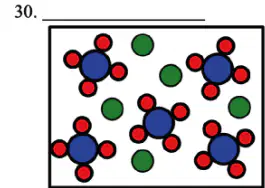
Given a diagram with different types of atoms, some bonded in pairs and some single, which classification fits best?
Element
Compound
Mixture of elements and compounds
Mixture of compounds
Why do wires, like your phone charger, have materials like metal on the inside and materials like rubber on the outside?
To provide color
To improve taste
To combine different properties for function and safety
To make them heavier
Would you classify conductivity as an extensive or intensive property?
Extensive
Intensive
Both
Neither
If 95.0 g of water (c of water = 4.18J/goC) increases in temperature from 23.1oC to 36.5oC, the water...
absorbs 5320 J of heat
releases 5320 J of heat
absorbs 14500 J of heat
releases 1273 J of heat
absorbs 1273 J of heat
Q= m c ∆T
The units for specific heat are:
If the specific heat of water is 4.184 J/g∙°C, how much heat is required to increase the temperature of 1200.0 g of water from 23.00 °C to 39.00 °C?
-80,330 J
+115,400 J
+80,330 J
+195,800 J
What does "ΔT" mean?
A change in time
A change in heat
A change in energy
A change in temperature
In an exothermic reaction …….
heat energy is given out
heat energy is taken in
nothing happens
don't know????
In an Endothermic Reaction.....
nothing happens
I don't know!!!
Heat Energy is given out
Heat Energy is taken in
100.00
100000000
4004
9009.00
0.00400
5.00000008
27000000
4000.
0.000008
How many significant figures: 450 m
3
2
1
0
A balance is used to measure (a)
If you spill chemicals on yourself, you should use the _____ ______
(a)
Used to transfer liquids in SMALL, PRECISE amounts.
(a)
NOT the place for broken glass.
(a)

This is used to (a) chemicals

A beaker is used to (a) liquids
Best approach for putting out a fire on a person
Safety Shower
Fire Blanket

What does this hold? (1 thing, 2 words )
(a)

Who should wear these during a lab?
everyone
anyone who doesn't wear glasses
anyone who wants to
anyone who doesn't wear either glasses or contacts
To use a fire extinguisher you should
p____, a___, s____, s_____
(a)
If you need to smell a chemical in a lab, the correct procedure is to (a)
When something goes wrong, especially if there is any accidents, the first person you should tell is the (a)
Used to measure length. (1 thing, two words)
(a)
Used to heat chemicals, and is powered by gas, not electricity.
(a)
No excuses! At the end of a lab, you should always _________ __
(a)
Used to measure temperature.
(a)
1001
in scientific notation?
.000457
If the exponent is a positive number...
If the exponent is a negative number...
8.317 x 10⁶
in standard form?
23,948
A block has a mass of 20.0 g and a volume of 40.0 cm3. What is its density?
2.0 g/cm3
1.2 g/cm3
0.5 g/cm3
4.0 g/cm3
3 g/cm
8 g
263.5 g/cm3
2.804 g
Jack has a rock. The rock has a mass of 14g and a volume of 2cm3. What is the density of the rock?
9 mL
7 g/cm3
28 g/cm3
1/7 g/cm3
A piece of copper has a mass of 89g and a volume of 10.0 cm3. What would be the density of the copper?
0.89 g/cm3
89 g/cm3
8.9 g/cm3
890 g/cm3

Use the density chart to identify the substance. If the substance has a volume of 5 cm3 and a mass of 52.5.
lead
aluminum
silver
water

As part of a classifying elements lab Joe was finding the density of different samples. One sample had a mass of 26.4 and a volume of 12 mL. What element is it?
Sulfur
Carbon
Boron
Krypton
Find the density of a 2 cm x 2 cm x 2 cm cube with a mass of 64 g.
(Hint: find the volume first!)
13 g/cm3
2 g/cm3
10 g/cm3
8 g/cm3
If a block of wood has a density of 0.6 g/cm3 and a mass of 120 g, what is its volume?
300 cm3
200 cm3
100 mL
150 cm3

Which box has a higher density?
A
B
They both have the same density.
What is matter?
All objects, people, and animals
All living and nonliving things in the universe.
anything that has mass and takes up space
All of the above.

What state of matter is pictured above?
solid
liquid
gas

What state of matter is pictured above
solid
liquid
gas

What state of matter is pictured above?
solid
liquid
gas
What is the process that turns a liquid into a solid?
melting
freezing
evaporation
condensation
Is a change in a substance's states of matter a physical change or chemical change?
Chemical
Physical
Select all of the following images that show a physical change:


In which state of matter are the particles the moving the fastest?
solid
liquid
gas
What is the process that turns a solid into a liquid?
melting
freezing
evaporation
condensation
What is the process that turns a gas into a liquid?
melting
freezing
evaporation
condensation
What is the process that turns a liquid into a gas?
melting
freezing
evaporation
condensation
Water is an example of what state of matter?
solid
liquid
matter
melting
Helium is an example of what state of matter?
solid
liquid
gas
evaporation
A desk is which of the following states of matter?
solid
liquid
gas
evaporation
Volume is the amount of space an item takes up.
True
False
Which of the following describes a chemical change?
melting butter
milk spoiling
cutting paper
water evaporating
An ice cream melting on a counter is an example of a
physical change
chemical change
no change
both a physical and a chemical change
Which statement is true?
A chemical change can be reversed
A physical change cannot be reversed
Physical changes create a new substance
Chemical changes create a new substance
Which state of matter has a definite shape and volume?
solid
liquid
gas
plasma
Which of the following is an example of a physical change?
burning wood
rusting iron
dissolving sugar in water
digesting food

