
 Worksheets
Cosmos
Total questions: 83
Worksheet time: 2hrs 24mins
The point in a planets orbit where it is FARTHEST away from the sun
The point in a planets orbit where it is CLOSEST to the sun
Kepler's 1st Law says this about the orbits of planets
they are elliptical.
they are perfect circles.
they are always perfect polygons (square, pentagon, hexagon, etc.,)
they are parabolic.
Kepler's 3rd Law states that the farther away a planet is from the sun, the _______ it takes it to orbit the sun once (year).
longer
shorter
According to Kepler's 2nd Law when do planets move the fastest?
A new planet is discovered orbiting a single star. The planet has one moon. According to Kepler’s first law, what do scientists know about the orbit of the planet around the star?
The orbit is circular
The orbit is elliptical
A scientist is searching for areas where new solar systems might form. What feature is the scientist looking for?
a star similar to the Sun
a cloud of dust and gas
an oxygen-rich atmosphere
a gravitational acceleration of 9.8 m/sec2
If a planet's eccentricity is closer to zero it more like a(n)
circle
highly eccentric ellipse
Which scientist came up up with the three laws of planetary motion?
Newton
Kepler
Einstein
Hawking

The diagram below shows a moon revolving around a planet in an elliptical orbit. Using your knowledge of Kepler's Law, at which position is the moon traveling fastest?
location 1
location 2
location 3
location 4

The diagram below shows a moon revolving around a planet in an elliptical orbit. Using your knowledge of Kepler's Law, at which position is the moon traveling slowest?
location 1
location 2
location 3
location 4

Which planet will take the most amount of time to revolve around the Sun (longest year)?
Mercury
Venus
Earth
Mars
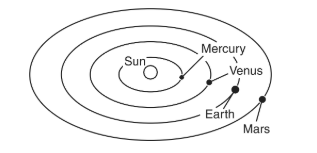
Which planet will take the least amount of time to revolve around the Sun (shortest year)?
Mercury
Venus
Earth
Mars

Which Law is it?
This Law states that a planets path around the sun is elliptical.
Kepler's 1st Law
Kepler's 2nd Law
Kepler's 3rd Law

Which Law is it?
This Law states that a planets distance from the sun impacts its time to complete 1 orbital revolution (year).
Kepler's 1st Law
Kepler's 2nd Law
Kepler's 3rd Law

Which Law is it?
This Law states that planets move faster closer to the sun and slower farther away from the sun. The planets cover the same area and take the same amount of time.
Kepler's 1st Law
Kepler's 2nd Law
Kepler's 3rd Law
Kepler's 2nd Law states that planets move faster closer to the sun and slower farther away from the sun. What force is causing this to happen?
inertia
gravity
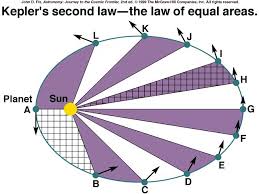
Kepler's 2nd Law deals with
the shape of the planets' orbits
the area the planet travels
the length of time/period it takes the planet to orbit the sun
What does Kepler's 1st Law state?
all planets move in elliptical shaped orbits around the sun
all ellipses have one foci
the area that a planet revolves around the sun is equal
the speed that a planet revolves around the sun changes

What is the formula for eccentricity?
e = d / L
e = L * d
e = L / d
e*d=L
The eccentricity formula is:
change in value/distance
mass/volume
distance between foci/length of major axis
change in value/time
Which type of galaxy is a flat, rotating disk of billions of stars, gas and dust with a central concentration of stars?
Spiral
Elliptical
Irregular
Triangular
Everything that exists, including planets, stars, galaxies and all forms of matter and energy
Solar System
Universe
Alien Galaxy
Universal
This consists of the sun and all the objects that revolve around it.
Universe System
Galaxy System
Solar System
Gravity System
A group of stars, gas, and dust held together by gravity is called
System
Circular
Elliptical
Galaxy
The name of our galaxy is ...
The Milky Way Galaxy
The Snickers Galaxy
The Andromeda Galaxy
The Triangular Galaxy
Any of the elongated and curved spiral sections that are connected to the center of a spiral galaxy.
Nuclear Bulge
Spiral Arms
Galaxy Disc
Compact Disc
A galaxy with an overall round or football shape and no arms or internal structure
Spiral
Irregular
Elliptical
Triangular
The plate-shaped part of a spiral galaxy in which the spiral arms are found is called...
Irregular Disc
Compact Disc
Galaxy Disc
Elliptical Disc
A galaxy that doesn't have a specific shape
Elliptical Galaxy
Milky Way Galaxy
Triangulum Galaxy
Irregular Galaxy
Which is a not a characteristic of a Spiral Galaxy?
Disc-shaped
Spiral Arms
Central nuclear bulge
Does not make new stars
Which is not a characteristic of an Irregular Galaxy
No particular shape
No particular pattern
Has a central bulge
May form after 2 galaxies hit each other
Which one is not a characteristic of an Elliptical Galaxy?
Disc-shaped
Round or football shaped
Dense collection of stars that are evenly spaced
What a spiral galaxy may turn into as it ages
Which one is NOT a characteristic of all galaxies?
All have dark matter
All have planets
All have stars
All have enough hydrogen gas to have new stars form

What part of the spiral galaxy is the arrow pointing at?
Central nuclear bulge
The face
The galaxy disc
The middle

What part of the spiral galaxy is the arrow pointing at?
Spiral arms
Central bulge
Face-on edge
Back side

What part of the spiral galaxy is the arrow pointing at?
Spiral arms
Central bulge
Side of it
Back of it

What type of galaxy is this?
Spiral
Elliptical
Regular
Irregular

What type of galaxy is this?
Regular
Spiral
Elliptical
Irregular

What type of galaxy is this?
Spiral
Elliptical
Regular
Irregular

Our view of this spiral galaxy is called ...
Slip-on
Head-on
Face-on
Side-on
A huge system of millions or billions of stars, together with gas and dust, held together by gravity.
galaxy
solar system
nebula
asteroid
A random scattered type of galaxy that does not form a distinct shape or pattern.
irregular galaxy
spiral galaxy
elliptical galaxy
random galaxy
A flat, disk-shaped galaxy with a central bulge and winding "arms" that extend outward.
irregular galaxy
spiral galaxy
elliptical galaxy
random galaxy
The most abundant type of galaxy that has a smooth circular or oval shape.
irregular galaxy
spiral galaxy
elliptical galaxy
random galaxy
A light year is the measurement of ________ light travels in one year.
time
distance
A scientist that studies stars, planets, and other objects in space.
astrologist
zoologist
astronomer
plantologist
All of space and everything in it.
planet
solar system
galaxy
universe
The milky way is the ______ galaxy in which we live in.
irregular
spiral
elliptical
This type of galaxy contains a lot of dust and gas.
irregular
spiral
elliptical
all galaxies
This type of galaxy contains very little dust and gas.
irregular
spiral
elliptical
all galaxies
This type of galaxy contains only young stars.
irregular
spiral
elliptical
all galaxies
This type of galaxy contains only old stars.
irregular
spiral
elliptical
all galaxies
This type of galaxy contains a mixture of all ages of stars.
irregular
spiral
elliptical
all galaxies

Identify the galaxy in the image.
irregular
spiral
elliptical
none listed

Identify the galaxy in the image.
irregular
spiral
elliptical
none listed

Identify the galaxy in the image.
irregular
spiral
elliptical
none listed

Identify the galaxy in the image.
irregular
spiral
elliptical
none listed

Identify the galaxy in the image.
irregular
spiral
elliptical
none listed

Identify the galaxy in the image.
irregular
spiral
elliptical
none listed

Identify the galaxy in the image.
irregular
spiral
elliptical
none listed
Why would we put a telescope in space?
Because the Earth's atmosphere makes the pictures blurry
Because it's dangerous to keep telescopes on Earth
They have better resolution when they are closer to the stars
So that scientists from around the world can share them more easily
A spectroscope allows us to investigate which 2 things:
The elements that make up stars
The motion of objects in space
The age of objects in space
Whether life exists on other planets
(a) are used to take samples and investigate distant objects that we cannot travel to.
A _____ telescope uses a mirror to capture light.
Refracting
Reflecting
Diffracting
Absorption
A _____ telescope uses a lens to capture light.
Reflecting
Refracting
Diffracting
Absorption
What kind of telescope allowed scientists to start making bigger and bigger telescopes to capture more light? This is also how our modern telescopes are still made.
Refracting
Reflecting
Absorption
Diffracting
What is white light?
The absence of color
All colors combined
A really bright light
Artificial, has to be made by humans
Satellites use what kind of waves to communicate with Earth?
They send out mechanical waves using high pitch sound.
They code information with different wavelengths of electromagnetic waves.
They flash messages in light, using morse code
They don't, we have to take them down & read their microchips
What's the big difference between a satellite and a space probe?
Satellites can't orbit without being remote controlled, space probes can function on their own.
Satellites can go farther than space probes
Neither requires a human on board to investigate space
Satellites are generally for localized data collection, and space probes are physically sent deep into space to collect data.
Which instrument can collect light as a form of data? Select all that are true.
Space Probe
Spectroscope
Satellite
Telescope

