Worksheets
Unit 1 Test Review
Total questions: 48
Worksheet time: 31mins
Conductivity is ___________
the way light is reflected off a surface.
how well a piece of matter conducts heat and electricity.
the capability of being hammered out thin
A. the capability of being drawn out into thin wires or threads.
What is the smallest unit of an element that has all of the properties of that element?
Molecule
Atom
Compound
Mixture
What is the temperature at which a substance changes from liquid to gas?
Melting Point
Freezing Point
Boiling Point
Sublimation Point
What is the amount of mass in a given amount of space, measured in a unit of mass per unit of volume?
Mass
Volume
Density
Weight
What type of mixture has parts that are easy to see and separate?
Homogeneous Mixture
Heterogeneous Mixture
Solution
Colloid
What is a substance so evenly mixed that it is difficult to see the parts and is uniform in composition?
Heterogeneous Mixture
Homogeneous Mixture
Suspension
Colloid
What is the temperature at which a substance changes from solid to liquid?
Boiling Point
Freezing Point
Melting Point
Sublimation Point
What is made of two or more substances that are combined but whose atoms are not chemically bonded?
Compound
Element
Mixture
Solution
What is a characteristic of a substance that can be observed or measured without changing the identity of the substance?
Chemical Property
Physical Property
Density
Mass
What consists of just one type of particle and has the same physical properties throughout?
Mixture
Compound
Element
Pure Substance
What is a way to measure the volume of a solid by placing it in a known amount of liquid?
Displacement
Density
Mass
Volume
Particles move quickest in:
Solid
Liquid
Gas
Volume
In which state of matter are the atoms or molecules packed tightly together in
a fixed position?
liquid
gas
solid
all of the above
What happens to the atoms or molecules in a liquid as it gets warmer?
They move slower and come closer together.
They move faster and spread out more.
They stop moving.
They change into a solid state of matter.
If you were to cool down a gas, what would you expect to happen to the
kinetic energy of its atoms or molecules?
The kinetic energy would increase.
The kinetic energy would decrease.
The kinetic energy would stay the same.
The kinetic energy would become zero.
What characteristic is common to atoms and molecules in both liquids and
gases but not in solids?
They have a definite shape.
They are tightly packed.
They can flow and take the shape of their container.
They are always cold.
How does the kinetic energy of atoms and molecules in solids compare to the
kinetic energy of atoms and molecules in gases?
The kinetic energy is higher in the solid.
The kinetic energy is lower in the solid.
The kinetic energy is the same in both.
Solids do not have kinetic energy.
Which statement is true about the atoms and molecules in gases compared to
the atoms and molecules in liquids?
Atoms and molecules in gases are closer together.
Atoms and molecules in gases move slower.
Atoms and molecules in gases are further apart and move faster.
Atoms and molecules in gases and liquids are the same.
Which of the following is NOT a physical property?
boiling point
color
reactivity
shape
A substance has a fixed volume and no definite shape. This substance is ________.
gas
solid
liquid
not possible
In this state of matter the particles are "tightly packed" together and don't move
Liquid
Solid
Gas
This is the only state of matter that has a "Definite Shape"
Liquids
Solids
Gases
In which state of matter do particles have the highest kinetic energy?
Solid
Liquid
Gas
Water is an example of which state of matter?
Solid
Liquid
Gas
Plasma
Particles move quickest in:
Solid
Liquid
Gas
Volume
a state of matter in which the substance expands to take both the shape and volume of its container
(a)
How are molecules in a gas different from molecules in a liquid?
Molecules in a gas can move but molecules in a liquid cannot.
Molecules in a gas are more tightly packed than molecules in a liquid.
Molecules in a gas are in a similar arrangement as molecules in a liquid.
Molecules in a gas can move more than molecules in a liquid.
a state of matter in which the substance takes the shape of the container and has an unchanged volume when poured from one container to another
(a)
Which of the following is a property of both gases and liquids?
Fixed shape
Fixed volume
Ability to flow
Incompressibility
Which of the following is NOT a physical state of matter?
Solid
Liquid
Gas
Heat

Which state of matter has particles arranged like this?
solid
liquid
gas
Which state of matter has particles that vibrate in place and maintain a fixed shape and volume?
Liquid
Gas
Solid
Plasma
Select the two statements that correctly describe the motion and arrangement of gas particles.
Particles are tightly packed in an orderly pattern
Particles move freely and collide often
Particles move slowly in fixed positions
Particles are far apart and have high kinetic energy
Which best compares the shape and volume of liquids to gases?
Liquids and gases both have definite shape and volume
Liquids have a definite volume, gases do not
Gases have a definite shape, liquids do not
Both take the shape and volume of the container
Which two characteristics are true for liquids?
Definite shape
Definite volume
Particles flow past each other
Particles are far apart with high energy
Which statement best compares the kinetic energy of solids, liquids, and gases?
A. Solids have the highest energy, gases the lowest
B. Liquids have more kinetic energy than gases
C. Gases have the most kinetic energy, solids the least
D. All states have the same average energy
Select two reasons why a gas fills any container it is placed in.
It has low energy
It has no definite shape
Its particles move quickly in all directions
Its particles are tightly packed
What happens to the particles of a solid when thermal energy is added and it becomes a liquid?
The particles slow down and move closer together
The particles speed up and break free from fixed positions
The particles stop moving entirely
The particles disappear and turn into energy
Which two characteristics make solids different from liquids?
A. Solids have a definite shape
B. Solids flow easily
C. Solids have closely packed particles in fixed positions
D. Solids have no definite volume
In which state of matter are particles able to move past one another but still stay relatively close together?
Solid
Gas
Liquid
Plasma
Which two statements describe changes in particle behavior as a solid turns into a gas?
Particles slow down and vibrate more
Particle spacing increases significantly
Kinetic energy increases
Particles become more tightly packed

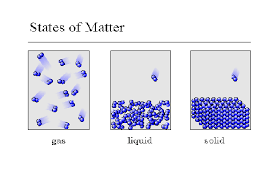

What state of matter is pictured?
Solid
Liquid
Gas
Plasma