
 Worksheets
Medical Terminology and Nursing Competency Quiz
Total questions: 83
Worksheet time: 42mins

What does CHF stand for in medical terminology?
Chronic Hepatic Failure
Congestive Heart Failure
Cardiac Health Function
Cerebral Hemorrhage Factor
Which competency is highlighted in the provided material?
Plan nursing care for patients with respiratory disorders
Plan nursing care for patients with alterations in cardiovascular system
Plan nursing care for patients with digestive issues
Plan nursing care for patients with neurological disorders
What does CHF stand for in medical terminology?
Congestive Heart Failure
Chronic Hepatic Fibrosis
Cardiac Hypertrophy Factor
Cerebral Hemorrhage Failure
Which of the following best describes the main problem in Congestive Heart Failure (CHF)?
Impaired cardiac pumping and/or filling of the heart
Increased blood clotting in the heart
Excessive heart rate
Decreased blood pressure only
Which of the following is NOT a common cause of Congestive Heart Failure (CHF)?
Diabetes Mellitus
Hypertension (HTN)
Coronary Artery Disease (CAD)
Myocardial Infarction (MI)
Why is it important to remember that chronic CHF can turn acute?
Because acute CHF can develop suddenly and may require immediate intervention
Because chronic CHF is always less severe
Because acute CHF is not related to heart function
Because chronic CHF cannot be managed
Which statement best explains why CHF is considered a symptom of a bigger problem?
It often results from underlying conditions such as hypertension or coronary artery disease
It is always caused by infections
It only affects the lungs
It is unrelated to other health issues
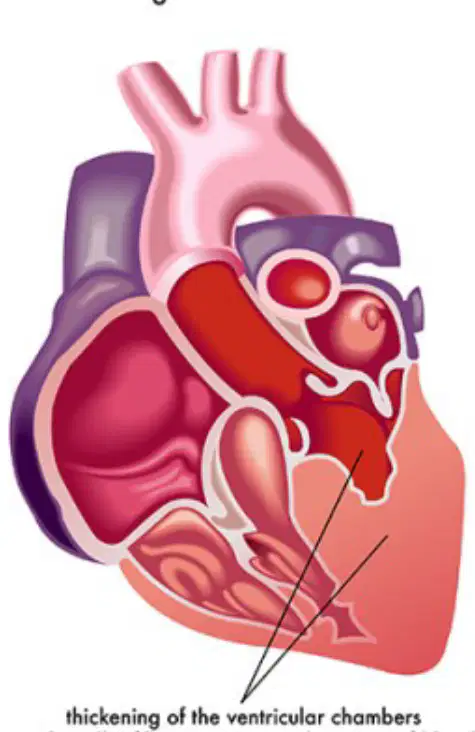
What is the primary issue in ventricular dysfunction as described in the context of congestive heart failure?
Inability of the ventricle to pump blood effectively
Overproduction of blood in the ventricles
Increased relaxation of the ventricles
Excessive blood filling the chambers
Which of the following best describes systolic failure in the context of heart function?
Inability of the ventricle to pump blood effectively
Inability of the ventricles to relax and fill properly
Overfilling of the heart chambers
Increased blood pressure in the arteries
What is a direct consequence of diastolic failure in the heart?
Decreased amount of blood that fills the chambers
Increased ejection of blood from the heart
Enhanced relaxation of the ventricles
Higher blood circulation throughout the body
Which statement best explains the effect of ventricular dysfunction on blood circulation?
It decreases the amount of blood circulated throughout the body.
It increases the amount of blood in the lungs.
It causes the heart to beat faster.
It improves oxygen delivery to tissues.
A patient is diagnosed with thickening of the ventricular chambers and reduced filling capacity. Which type of heart failure is most likely present?
Diastolic failure
Systolic failure
Pulmonary failure
Atrial failure
What is cardiac output?
The amount of blood the heart can pump out each minute.
The number of times the heart beats in an hour.
The pressure of blood in the arteries.
The amount of oxygen in the blood.
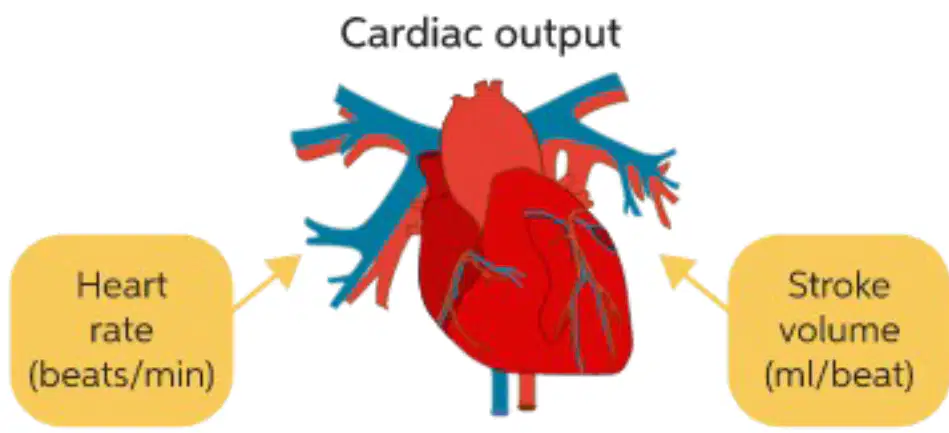
Which two factors are used to determine cardiac output?
Heart rate and stroke volume
Blood pressure and oxygen level
Heart size and blood type
Blood sugar and cholesterol
If a person's heart rate increases but their stroke volume remains the same, what will happen to their cardiac output?
It will increase.
It will decrease.
It will stay the same.
It will stop.
What is stroke volume?
The amount of blood the heart pumps out during each beat
The pressure in the arteries during a heartbeat
The rate at which the heart beats per minute
The amount of oxygen in the blood
Which term refers to the contraction of the heart muscle?
Diastole
Systole
Preload
Afterload
Which of the following best describes diastole?
Contraction of heart muscle
Relaxation of heart muscle
Increase in blood pressure
Decrease in heart rate
Which factors affect stroke volume?
Blood pressure, heart rate, and oxygen level
Contractility, preload, and afterload
Temperature, humidity, and altitude
Age, gender, and weight
If a patient has decreased contractility, how might this affect their stroke volume?
Stroke volume would increase
Stroke volume would decrease
Stroke volume would remain unchanged
Stroke volume would double
What does preload refer to in the context of cardiac physiology?
The contraction of the ventricles during systole
The stretch of the ventricles after diastole (relaxation)
The pressure in the arteries after blood is ejected
The closing of the heart valves
Which analogy is used to describe preload in the provided material?
The "spring" compressing
The "slingshot" pulling back
The "door" opening
The "engine" starting
Does hypervolemia increase or decrease preload?
Increase
Decrease
No effect
Only affects afterload
What is afterload in the context of cardiovascular physiology?
The amount of pressure that must be overcome to enter the next part of the body
The volume of blood returning to the heart
The rate at which the heart beats
The amount of oxygen in the blood
Which condition increases afterload?
Hypertension (HTN)
Hypotension
Bradycardia
Anemia
What effect would giving medications that lower blood pressure have on afterload?
Decrease afterload
Increase afterload
No effect on afterload
Cause arrhythmia
How would you measure afterload in a clinical setting?
By taking a blood pressure (BP)
By measuring heart rate
By checking oxygen saturation
By performing an ECG
A patient with hypertension is prescribed medication to lower their blood pressure. Explain how this intervention affects afterload and why it is beneficial for the patient.
It decreases afterload, making it easier for the heart to pump blood, which is beneficial in reducing cardiac workload.
It increases afterload, making it harder for the heart to pump blood, which is harmful for the patient.
It has no effect on afterload, so there is no benefit for the patient.
It increases heart rate, which is the main benefit for the patient.
Which of the following best describes how a rapid heart rate (HR) affects cardiac output?
It increases the time for diastolic filling and perfusion.
It decreases the time for diastolic filling and perfusion.
It has no effect on diastolic filling and perfusion.
It only affects systolic filling.
Which of the following is NOT a factor that increases the work of the heart and can decrease cardiac output?
Hypertension (HTN)
Aortic valve disease (aortic stenosis)
Hypervolemia (fluid overload)
Decreased preload
A patient’s heart rate increases from 70 to 140 beats per minute. Based on your understanding, what is the most likely effect on cardiac output?
Cardiac output will increase due to more frequent contractions.
Cardiac output will remain unchanged.
Cardiac output may decrease due to less time for diastolic filling.
Cardiac output will double.
Explain why increased preload, contractility, and afterload can decrease cardiac output, using evidence from the provided information.
They decrease the work of the heart, leading to less output.
They increase the work of the heart, which can overwhelm the heart and decrease output.
They have no effect on the heart’s workload.
They only affect the lungs, not the heart.
A patient is receiving a drug that decreases afterload. To evaluate the patient’s response to this drug, what is most important for the nurse to assess?
Heart rate
Lung sounds
Blood pressure
Jugular venous distention
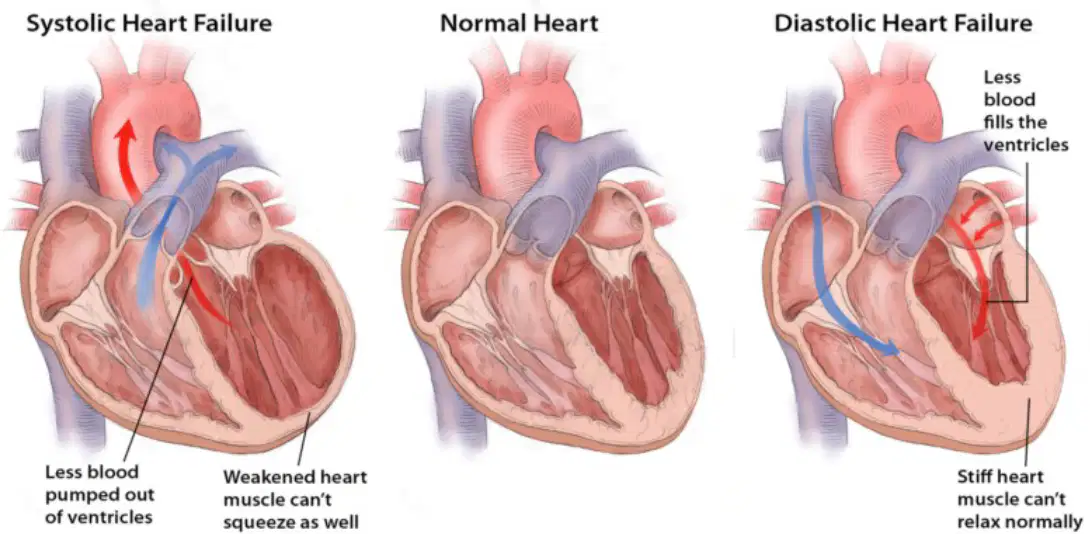
Which of the following best describes systolic heart failure?
The heart muscle is stiff and cannot relax normally.
The heart muscle is weakened and cannot squeeze as well.
The heart pumps more blood than normal.
The ventricles are overfilled with blood.
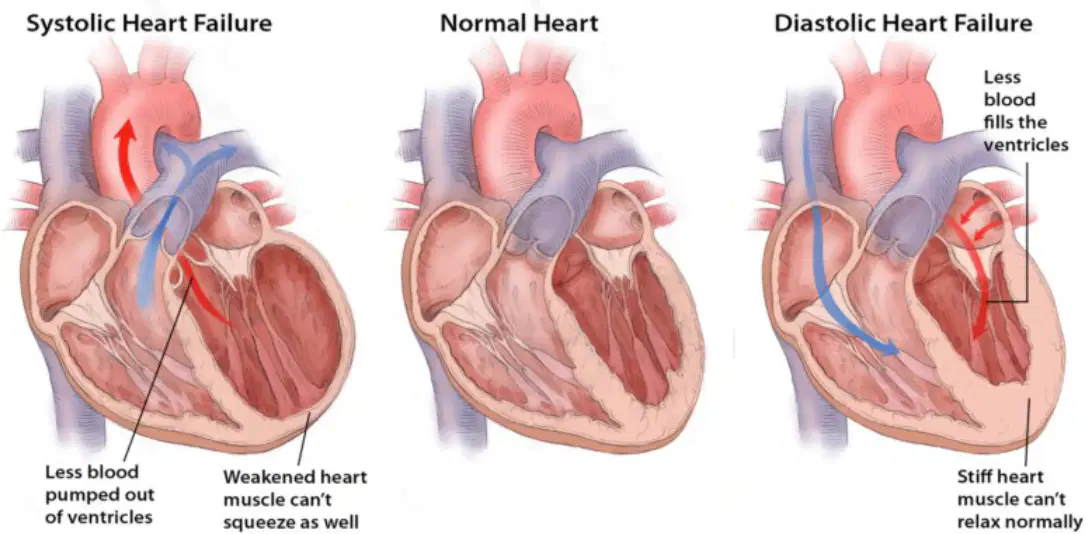
What is a key characteristic of diastolic heart failure?
Less blood is pumped out of the ventricles.
The heart muscle cannot squeeze as well.
The heart muscle is stiff and cannot relax normally.
The heart muscle is enlarged and overactive.
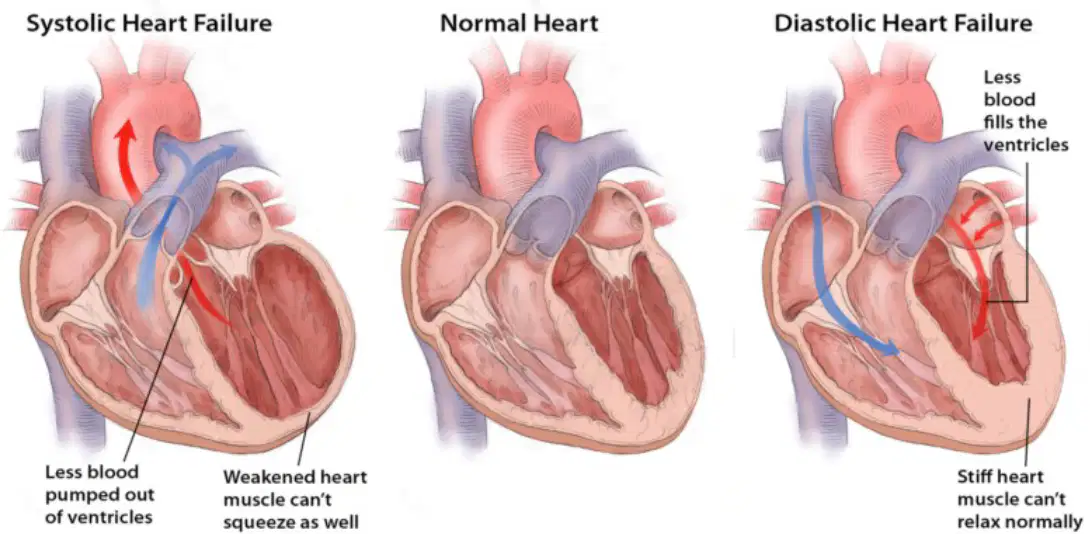
In a normal heart, how does the muscle function compared to systolic and diastolic heart failure?
The muscle is weakened and cannot squeeze as well.
The muscle is stiff and cannot relax normally.
The muscle contracts and relaxes normally.
The muscle does not pump any blood.
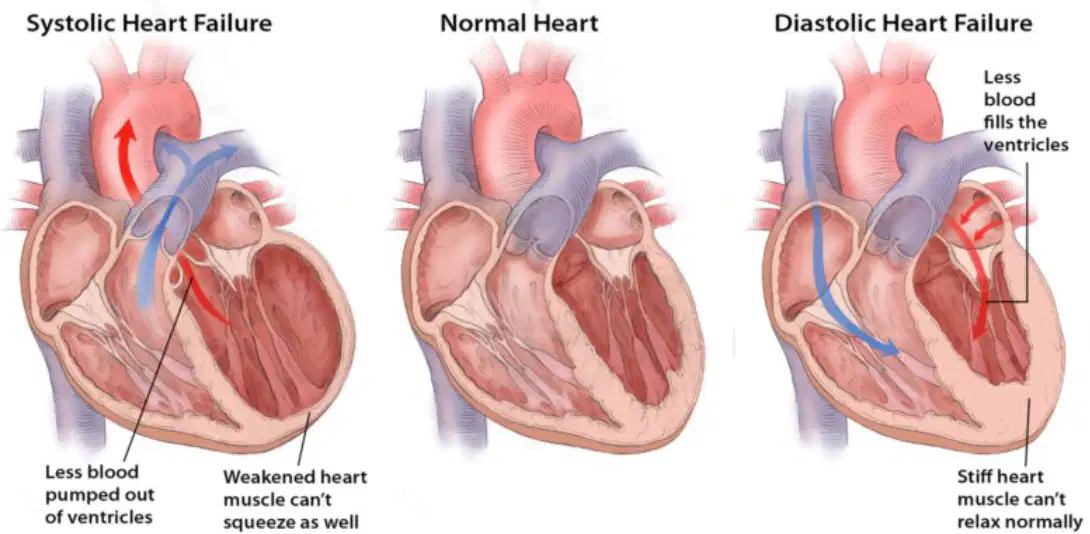
Which of the following statements is true regarding the amount of blood in the ventricles during diastolic heart failure?
More blood fills the ventricles than normal.
Less blood fills the ventricles than normal.
The same amount of blood fills the ventricles as in a normal heart.
The ventricles are empty.
Which side of heart failure is described as the most common and is associated with pulmonary congestion due to backup of blood into the left atrium and pulmonary veins?
Right-side heart failure
Left-side heart failure
Biventricular heart failure
Diastolic heart failure
Which of the following is NOT listed as a cause or risk factor for left-side heart failure?
Myocardial infarction (MI)
Hypertension (HTN)
Coronary artery disease (CAD)
Diabetes mellitus (DM)
What is an early sign of left-side heart failure?
Edema in the legs
Fatigue
Chest pain
Bradycardia
Which symptom is most specifically associated with paroxysmal nocturnal dyspnea in left-side heart failure?
Waking up suddenly due to shortness of breath
Persistent chest pain at rest
Swelling of the ankles
Loss of appetite
A patient presents with crackles, cough, and generalized shortness of breath. Based on these symptoms, which condition should be considered?
Right-side heart failure
Left-side heart failure
Pericarditis
Atrial fibrillation
Explain why left-side heart failure leads to pulmonary congestion. Use evidence from the symptoms and pathophysiology described.
Because blood backs up into the left atrium and pulmonary veins, increasing pressure and causing fluid to leak into the lungs, resulting in symptoms like crackles, cough, and shortness of breath.
Because the right ventricle pumps too much blood to the lungs, overwhelming the pulmonary circulation.
Because the heart rate slows down, reducing oxygen delivery to the lungs.
Because the aorta becomes blocked, preventing blood from reaching the lungs.
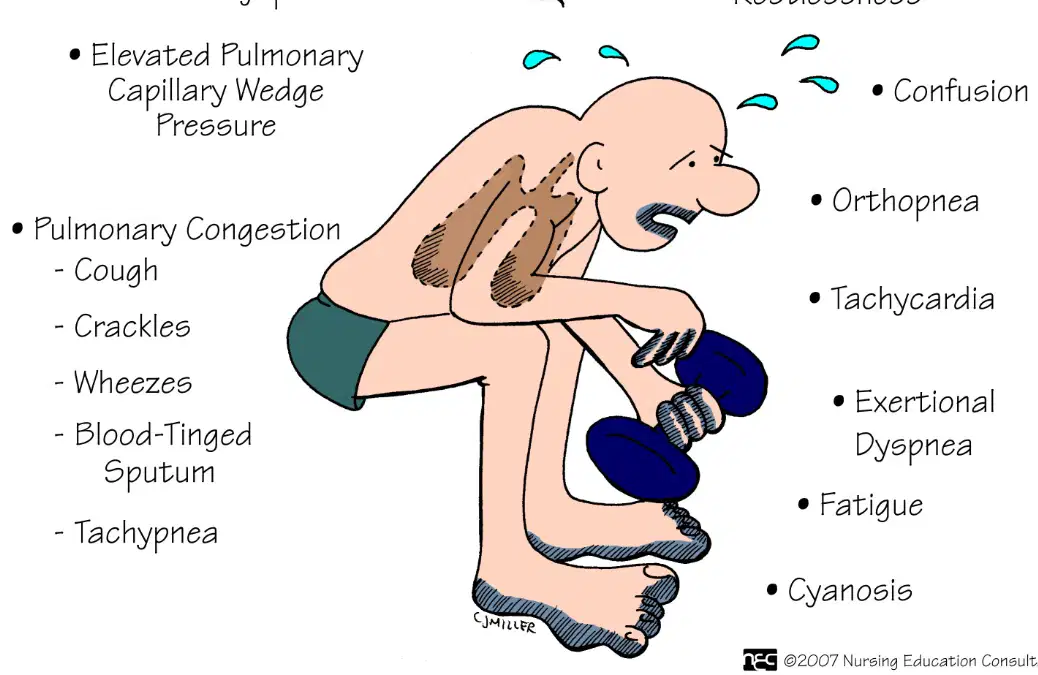
Which of the following is a common symptom of left-sided heart failure?
Paroxysmal nocturnal dyspnea
Swollen ankles
Abdominal pain
Jaundice
Which of the following best describes pulmonary congestion as seen in left-sided heart failure?
Cough, crackles, wheezes, blood-tinged sputum, tachypnea
Abdominal swelling, jaundice, and ascites
Headache, blurred vision, and dizziness
Nausea, vomiting, and diarrhea
A patient with left-sided heart failure is most likely to experience which of the following when lying flat?
Orthopnea
Edema
Polyuria
Hyperactivity
Which symptom would most likely require immediate medical attention in a patient with left-sided heart failure?
Blood-tinged sputum
Mild fatigue
Occasional cough
Slight restlessness
Explain why cyanosis may develop in a patient with left-sided heart failure.
Due to decreased oxygenation of blood resulting from poor cardiac output
Due to increased red blood cell production
Due to excessive sweating
Due to liver dysfunction
Which of the following is a primary cause or risk factor for right-sided heart failure?
Left-side failure
High cholesterol
Diabetes mellitus
Hyperthyroidism
Which symptom is commonly associated with right-sided heart failure?
JVD (Jugular Venous Distention)
Pulmonary crackles
Cyanosis of lips
Bradycardia
What does the term "ascites" refer to in the context of right-sided heart failure?
Vascular congestion around the GI tract
Fluid in the lungs
Swelling of the hands
Increased heart rate
A patient presents with hepatomegaly, peripheral edema, and dusky skin color. Based on these symptoms, what condition should be suspected?
Right-sided heart failure
Left-sided heart failure
Myocardial infarction
Hypertensive crisis
Explain why weight changes may occur in a patient with right-sided heart failure.
Due to edema accumulation
Due to increased appetite
Due to muscle wasting
Due to dehydration
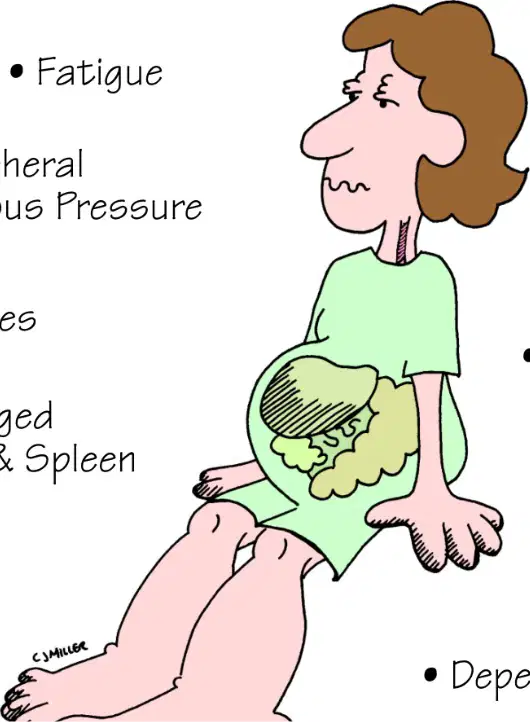
Which of the following is NOT a common symptom of right-sided heart failure (Cor Pulmonale)?
Fatigue
Increased peripheral venous pressure
Coughing up blood
Ascites
What organ(s) are commonly enlarged in patients with right-sided heart failure?
Heart and lungs
Liver and spleen
Kidneys and pancreas
Brain and spinal cord
Which of the following conditions may right-sided heart failure be secondary to?
Chronic pulmonary problems
Acute kidney injury
Diabetes mellitus
Liver cirrhosis
A patient presents with distended jugular veins, swelling in the hands and fingers, and dependent edema. What is the most likely underlying cardiac condition?
Left-sided heart failure
Right-sided heart failure
Myocardial infarction
Aortic stenosis
Explain why patients with right-sided heart failure may experience anorexia and complaints of gastrointestinal (GI) distress.
Due to increased blood flow to the GI tract
Due to decreased oxygen supply to the GI tract
Due to congestion and impaired venous return from the GI organs
Due to increased metabolic rate
What does the acronym BNP stand for in the context of heart diagnostics?
B-type Natriuretic Peptide
Blood Nutrient Protein
Basic Neuronal Peptide
Beta Nucleic Protein
Which diagnostic test may show an enlarged heart?
CXR
EKG
Metabolic panel
Stress Test
What is the significance of a BNP value less than 100 WNL?
It indicates normal levels and is released from ventricles in response to increased blood volume in the heart.
It indicates a heart attack.
It shows high potassium levels.
It means the heart is not functioning at all.
Which of the following is NOT typically included in the metabolic panel for heart diagnostics?
Calcium (Ca2+)
Sodium (Na+)
Potassium (K+)
None of the above
A patient is suspected of having heart failure. Which combination of tests would most likely be ordered to confirm the diagnosis?
BNP, CXR, Echocardiogram, EKG, Stress Test, Metabolic panel
Blood glucose, Urinalysis, Liver function test
Thyroid panel, Blood culture, Chest CT
Urine sodium, Blood urea nitrogen, MRI
Why is BNP released from the ventricles?
In response to increased blood volume in the heart
To regulate blood sugar levels
To increase oxygen in the blood
To decrease potassium levels

What does the image of the heart and the phrase "Breathing Near Impossible" most likely represent?
Symptoms of heart failure or difficulty in breathing due to heart problems
A healthy heart after exercise
A heart during sleep
A heart with high blood sugar
Which class of drugs is primarily used to decrease fluid in the body?
Diuretics
Beta Blockers
ACE inhibitors
Inotropic Drugs
What is the main function of ACE inhibitors and ARBs in drug therapy?
Improve cardiac output
Decrease fluid
Increase contractility
Relieve pain
Which suffix is commonly associated with ACE inhibitors?
-olol
-prils
-statin
-sartan
Why should caution be used when administering digoxin with thiazide diuretics?
Risk of increased blood pressure
Risk of digoxin toxicity
Risk of dehydration
Risk of bradycardia
Which of the following drugs is NOT classified as a vasodilator?
Hydralazine
Enalapril
Losartan
Digoxin
How do beta blockers improve heart function?
By increasing fluid retention
By improving the heart’s ability to relax
By increasing contractility
By increasing oxygen supply
A patient with heart failure is prescribed a medication ending in "-olol." What is the likely purpose of this medication?
To decrease fluid
To improve the heart’s ability to relax
To increase contractility
To relieve pain
Which of the following best explains the role of vasodilators in drug therapy for heart conditions?
They decrease fluid in the body.
They improve the heart’s ability to relax.
They increase oxygen supply and relieve dyspnea.
They increase contractility.
Which of the following is an important aspect of respiratory assessment in nursing care?
Checking blood sugar levels
Assessing lungs and oxygenation
Measuring blood pressure only
Monitoring vision changes
What should a nurse do if a patient has increased shortness of breath (SOB)?
Ignore it if the patient is resting
Determine what is causing the SOB
Give more fluids immediately
Lower the head of the bed
Which intervention is recommended for managing edema in patients?
Administering diuretics
Increasing sodium intake
Encouraging bed rest only
Giving high-calorie foods
Why is it important to weigh patients at the same time each day in nursing care?
To ensure accurate monitoring of weight changes
To make the patient feel comfortable
To check for dehydration only
To monitor blood pressure
A patient gains 4 lbs in one week. According to nursing care guidelines, what should be done?
Ignore the weight gain
Report the weight gain
Increase sodium in the diet
Reduce fluid intake without consulting a doctor
Which position is recommended for patients to improve breathing in nursing care?
Supine position
Prone position
High-fowlers position
Trendelenburg position
What is the recommended daily sodium intake for patients on a low sodium diet?
5 gm/day
4 gm/day
2 gm/day
1 gm/day
Which of the following is a preventive measure mentioned in nursing care?
Daily exercise only
Influenza/pneumococcal vaccines
High protein diet
Increased caffeine intake
A nurse is balancing periods of rest and activity for a patient. What is the main purpose of this intervention?
To prevent boredom
To promote optimal recovery and prevent fatigue
To increase appetite
To monitor blood pressure
If a patient is being monitored for input and output (I/O’s), what is the nurse primarily assessing?
Blood pressure changes
Fluid balance in the body
Heart rate
Oxygen saturation

