wayground logo

Free Printable Worksheets

Font size

S
M
L
XL
Worksheets

Adv. Alg. Ch. 2 Extra Practice

Total questions: 131

Worksheet time: 6hrs 5mins

Name
Class
Date
1.

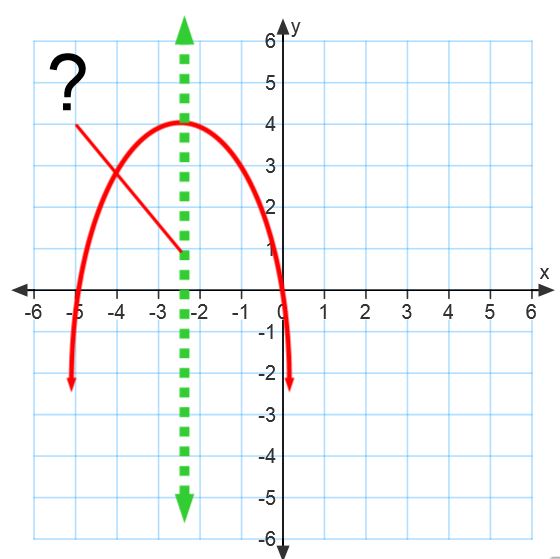
Which equation is graphed above?

a)

y=(x1)2+4y=-\left(x-1\right)^2+4

b)

y=(x1)2+4y=\left(x-1\right)^2+4

c)

y=(x4)2+1y=-\left(x-4\right)^2+1

d)

y=(x4)2+1y=\left(x-4\right)^2+1

2.

f(x)=(x4)2+1f\left(x\right)=-\left(x-4\right)^2+1  

Choose the correct graph of the equation.

a)
b)
c)
d)
3.

Which way does the following equation open? f(x)=12(x5)2+6f\left(x\right)=-\frac{1}{2}\left(x-5\right)^2+6  

a)

upward

b)

downward

4.

What is the vertex of the following equation? f(x)=12(x5)2+6f\left(x\right)=-\frac{1}{2}\left(x-5\right)^2+6  

a)

(5,6)\left(-5,-6\right)  

b)

(5,6)\left(-5,6\right)  

c)

(5,6)\left(5,-6\right)  

d)

(5,6)\left(5,6\right)  

5.
What is the vertex of y = 2(x - 3)2 + 6
a)
(-3, -6)
b)
(3, -6)
c)
(-3, 6)
d)
(3, 6)
6.
Write y = x2 + 4x - 1 in vertex form.
a)
y = (x - 2)2 + 5
b)
y = (x + 2)2 - 5
c)
y = (x + 2)2 - 1
d)
y = (x +2)2 + 3
7.
Write y = x2 - 18x + 52 in vertex form.
a)
y = (x - 9)2 + 113
b)
y = (x + 9)2 - 29
c)
y = (x - 9)2 + 52
d)
y = (x - 9)2 - 29
8.
The axis of symmetry line passes through which point?
a)
y-intercept
b)
any random point
c)
vertex
d)
symmetrical point for the vertex
9.
What is the green dashed line called?
a)
roots or x-intercepts
b)
parabola
c)
axis of symmetry
d)
line of dashes
10.
A parabola has a vertex at (-3,2).
Where is the axis of symmetry?
a)
y = -2
b)
x = 3
c)
x = -3
d)
y = 2
11.
The graph of a quadratic function is called a
a)
Parabola
b)
Vertex
c)
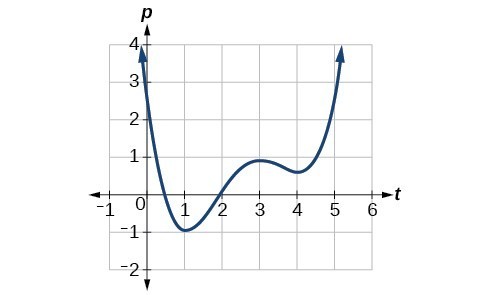
Axis of Symmetry 
d)
Vertex Form
12.
Factor
3v2 - 4v - 7
a)
(3v-7)(v+1)
b)
3(v-7)(v-1)
c)
(3v+1)(v-9)
d)
(3v+1)(v-10)
13.
What is the axis of symmetry for this graph?
a)
y=2
b)
x=2
c)
x=0
d)
y=0
14.

Does the following quadratic equation have a maximum or minimum value? How can you tell?

y=x²+2x-3

a)

Minimum value, because the value of a is positive

b)

Maximum value, because the value of b is positive

c)

Maximum value, because the value of a is positive

d)

Minimum value, because the value of c is negative

15.
In the equation f(x)=5(x+3)2-10 what does the 5 do?
a)
Vertical stretch by 5
b)
Horizontal compress by 5
c)
Reflect
d)
Move up 5
16.
How did we transform from the parent function?
g(x) = -1/5(x - 1)2 + 7
a)
reflection, vertical compression, horizontal right, vertical up
b)
vertical compression, horizontal shift left, vertical shift up
c)
reflection, horizontal shift right, vertical shift down
d)
no changes were made to y = x2
17.
What transformations have occurred? 
a)
Right 2 and up 2
b)
Left 2 and up 2
c)
Right 2 and down 2
d)
Left 2 and down 2
18.

Identify ALL of the transformations performed on f(x)=x2f\left(x\right)=x^2 to create the graph of  g(x)=2(x5)2+10g\left(x\right)=-2\left(x-5\right)^2+10  

a)

reflection

b)

stretch

c)

shrink

d)

left 5, up 10

e)

right 5, up 10

19.

Identify ALL of the transformations performed on f(x)=x2f\left(x\right)=x^2 to create the graph of  g(x)=(x4)2+2g\left(x\right)=-\left(x-4\right)^2+2  

a)

reflection

b)

stretch

c)

shrink

d)

left 4, up 2

e)

right 4, up 2

20.

Which transformations were applied to form the red graph from the blue graph?

a)

shrink

b)

stretch

c)

reflection, stretch

d)

reflection, shrink

21.
What is the domain of the function?
a)
(3, ∞)
b)
[-3, ∞)
c)
(-∞, 4]
d)
(-∞, 4)
22.
What is the domain of the graph?
a)
[1,∞)
b)
(-∞,1]
c)
(-∞,∞)
d)
[-∞,∞]
23.
What is the range of the graph?
a)
(-∞,∞)
b)
[0,∞)
c)
(0,5)
d)
[-1,∞)
24.

In interval notation, positive and negative ∞ are always closed in by ______.

a)

( ) Parentheses

b)

[ ] Square Brackets

c)

{ } Curly Brackets

25.

DOMAIN is found by reading the ends of a graph from ___ to ___.

a)

Right to left

b)

Left to right

c)

Bottom to top

d)

Top to bottom

26.

RANGE is found by reading the ends of a graph from ___ to ___.

a)

Right to left

b)

Left to right

c)

Bottom to top

d)

Top to bottom

27.

What is the range of the graph?

a)

[-7, 5)

b)

(-3, 1]

c)

[-3, 1)

d)

(-7, 5]

28.

What is the range?

a)

(, 3]\left(-\infty,\ -3\right]

b)

[3, )\left[3,\ -\infty\right)

c)

(,3]\left(-\infty,3\right]

d)

None of the answer choices

e)

[3, )\left[-3,\ \infty\right)  

29.

What is the domain?

a)

(, 3]\left(-\infty,\ -3\right]

b)

[3, )\left[3,\ -\infty\right)

c)

(,3]\left(-\infty,3\right]

d)

(,)\left(-\infty,\infty\right)

e)

None of the answer choices

30.

What is the range?

a)

[-3, 4]

b)

(-3, 4)

c)

(-3, 4]

d)

(-2, 3]

e)

[4, -3]

31.
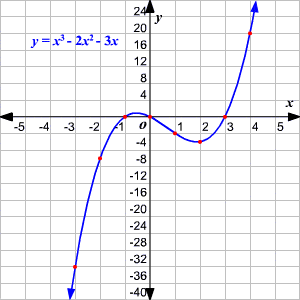
The function shown in the graph is:
a)
even
b)
odd
c)
neither even nor odd
d)
both even and odd
32.
The function in the graph is:
a)
even
b)
odd
c)
neither even nor odd
d)
both even and odd
33.
Is the graph an even, odd, or neither function.
a)
Even
b)
Odd
c)
Neither
34.
Is the graph an even, odd, or neither function
a)
Even
b)
Odd
c)
Neither
35.
Is the graph an even, odd, or neither function?
a)
Even
b)
Odd
c)
Neither
36.

Even, odd, or neither?

a)

Even

b)

Odd

c)

Neither

37.

How do you read f(x)?

a)

f x

b)

f parenthesis x

c)

f of x

d)

f with an x inside parenthesis

38.

Given f(x) = 4x - 10 and f(x) = 10. Find x

a)

x = 14

b)

x = -6

c)

x = -50

d)

x = 5

39.

f(x) = x+8 find f(-4)

a)

-2

b)

6

c)

2

d)

4

40.
Which parent function matches the graph?
a)
f(x) = √(x)
b)
f(x) = ∛(x)
c)
f(x) = |x|
d)
f(x) = a⋅bx
41.
What type of function is shown?
a)
absolute value
b)
quadratic
c)
linear
d)
exponential
42.
Which parent function matches the graph?
a)
y = |x|
b)
y = ∛(x)
c)
y = x2
d)
y = a⋅bx
43.
What type of function is shown?
a)
linear
b)
quadratic
c)
square root
d)
absolute value
44.
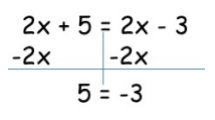
What is the solution to this equation?
a)
one solution
b)
no solution
c)
infinite solutions
d)
none of these
45.

Solve.

3y + 6 + 4y - 7 = -8

a)

y=-1

b)

y=-8

c)

y=1

d)

No solution

46.

3(x-8)=3x-24

a)

No Solution

b)

x=3

c)

Infinite Solutions

47.

6(m+3)=2(m+5)

a)

No solution

b)

m=-2

c)

Infinite Solutions

48.
Solve:
2x + 1 = 2x - 1
a)
No Solution
b)
x = 0
c)
Infinitely Many Solutions
49.
Solve:
3x + 15 = 3(x + 5)
a)
No Solution
b)
x = 15
c)
Infinitely Many Solutions
50.

14 - 2 ( 3p + 1) = 6 ( 4 + p)

a)

No Solution

b)

p=-1

c)

Infinite Solutions

51.
A parabola is upside-down when a is:
a)
negative
b)
positive
c)
0
d)
infinite
52.
What is the vertex?
a)
(2, 4)
b)
(3, -1)
c)
(0, 8)
d)
(4, 2)
53.
What are the coordinates of the y-intercept?
a)
(-3, 0)
b)
(0, -3)
c)
(2, 1)
d)
y=-3
54.

Given the equation y = 3(x + 5)2 - 4,

what is the vertex of the parabola?

a)

(5, -4)

b)

(-5, -4)

c)

(-15, -4)

d)

(15, -4)

55.
Does the parabola
f(x)=4(x-2)2 + 3
open up or down?
a)
up
b)
down
56.

What steps transform the graph y = x2 to y = 2(x+2)2 - 5?

a)

shrink by 2, shifted 2 units left and 5 down

b)

Stretch by 5, shifted 5 units left and 2 down

c)

Stretch by 2, shifted 2 units left and 5 down

d)

shrink by 5, shifted 2 units left and 2 down

57.

What steps transform the graph y = x2 to y = x2 + 8

a)

shifted up 8 units

b)

shifted down 8 units

c)

shifted left 8 units

d)

shifted right 8 units

58.

Which transformations were applied to form the red graph from the blue graph?

a)

shrink

b)

stretch

c)

reflection, stretch

d)

reflection, shrink

59.

Which transformations were applied to form the red graph from the blue graph?

a)

shrink, left 4, down 5

b)

stretch, left 4, down 5

c)

reflection, left 4, down 5

d)

reflection, shrink, left 4, down 5

60.

Identify ALL of the transformations performed on f(x)=x2f\left(x\right)=x^2 to create the graph of  g(x)=(x4)2+2g\left(x\right)=-\left(x-4\right)^2+2  

a)

reflection

b)

stretch

c)

shrink

d)

left 4, up 2

e)

right 4, up 2

61.

Identify ALL of the transformations performed on f(x)=x2f\left(x\right)=x^2 to create the graph of  g(x)=2(x5)2+10g\left(x\right)=-2\left(x-5\right)^2+10  

a)

reflection

b)

stretch

c)

shrink

d)

left 5, up 10

e)

right 5, up 10

62.

What is the green dashed line called?

a)

roots or x-intercepts

b)

parabola

c)

axis of symmetry

d)

y intercept

63.
What transformations have occurred? 
a)
Right 2 and up 2
b)
Left 2 and up 2
c)
Right 2 and down 2
d)
Left 2 and down 2
64.
How did we transform from the parent function?
g(x) = -1/5(x - 1)2 + 7
a)
reflection, vertical compression, horizontal right, vertical up
b)
vertical compression, horizontal shift left, vertical shift up
c)
reflection, horizontal shift right, vertical shift down
d)
no changes were made to y = x2
65.
In the equation f(x)=5(x+3)2-10 what does the 5 do?
a)
Vertical stretch by 5
b)
Horizontal compress by 5
c)
Reflect
d)
Move up 5
66.

Graph y=x2y=x^2  first.  Find the equation of the parabola that has moved...

5 units to the right

a)

y=x2+5y=x^2+5

b)

y=x25y=x^2-5

c)

y=(x+5)2y=\left(x+5\right)^2

d)

y=(x5)2y=\left(x-5\right)^2

67.

What is the quadratic parent function?

a)

 f(x)=x2\ f\left(x\right)=x^2

b)

  f(x)=x\ \ f\left(x\right)=x

c)

Ax+By=CAx+By=C

d)

Ax2+Bx+CAx^2+Bx+C

68.

Given f(x) = -x² , how did we transform from the parent function?

a)

Moved left

b)

Reflection over the x-axis

c)

Moved down

d)

got wider

69.
If given the equation
y = 3(x + 5)2 - 4,
what is the vertex of the parabola?
a)
(5, -4)
b)
(-5, -4)
c)
(-15, -4)
d)
(15, -4)
70.
Given the equation for this parabola:
 y=-(x-4)2-3,
does this parabola have a maximum or minimum value?
a)
Maximum
b)
Minimum
71.
The axis of symmetry line passes through which point?
a)
y-intercept
b)
any random point
c)
vertex
d)
symmetrical point for the vertex
72.
Identify the vertex and whether the graph opens up or down.
a)
(5, 2); opens up
b)
(5, 2); opens down
c)
(-5, 2); opens up
d)
(-5, 2); opens down
73.

What does the quadratic function that has a vertex of (3,4) look like?

a)

y = a(x+3)2 + 4

b)

y = a(x-3)2 + 4

c)

y = -a(x+3) - 4

d)

y = a(x-3)2 - 4

74.
What causes the graph of y = x2 to open downward?
a)
multiply the x2 by a fraction
b)
multiply the x2 by a decimal
c)
multiply the x2 by a negative number
d)
multiply the x2 by a number greater than 1
75.
What is the vertex for
f(x)=4(x-2)2 + 3
a)
(-2, 3)
b)
(2,-3)
c)
(4,3)
d)
(2,3)
76.

What is the vertex of f(x)=(x+4)2f\left(x\right)=\left(x+4\right)^2  

a)

(0,4)

b)

(4,0)

c)

(-4,0)

d)

(0,-4)

77.

f(x)=(x+2)22f\left(x\right)=\left(x+2\right)^2-2  What is the vertex of

a)

(-2,-2)

b)

(-2,2)

c)

(2,-2)

d)

(2,2)

78.

f(x)=(x5)2+3f\left(x\right)=\left(x-5\right)^2+3  What is the vertex of

a)

(5,3)

b)

(3,5)

c)

(-5,-3)

d)

(-3,-5)

79.
The graph of a quadratic function is called a
a)
Parabola
b)
Vertex
c)
Axis of Symmetry 
d)
Vertex Form
80.

y = 3(x + 5)2 - 4, what is the vertex of the parabola?

a)

(5, -4)

b)

(-5, -4)

c)

(-15, -4)

d)

(15, -4)

81.

Does this parabola have a minimum or maximum and what is its value?

a)

minimum: 2

b)

maximum: 2

c)

minimum: 5

d)

maximum: 5

82.
Convert the equation y= x2-2x-5 into vertex form. 
a)
y= (x-1)2-6
b)
y= -(x-1)2-6
c)
y= (x+1)2-6
d)
y= -(x+6)2-1
83.

Does the following quadratic equation have a maximum or minimum value? How can you tell?

y=x²+2x-3

a)

Minimum value, because the value of a is positive

b)

Maximum value, because the value of b is positive

c)

Maximum value, because the value of a is positive

d)

Minimum value, because the value of c is negative

84.

Convert to vertex form:
f(x) = x2 + 10x + 24

a)

f(x) = ( x - 5 )2 + 1

b)

f(x) = ( x + 5 )2 - 1

c)

f(x) = ( x - 5 )2 - 1

d)

f(x) = ( x + 5 )2 + 1

85.
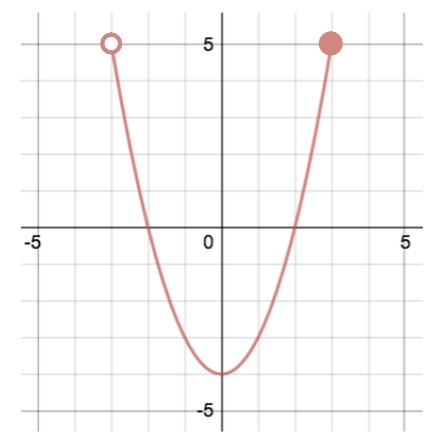
What is the domain?
a)
(-3 , 3)
b)
[-4, 5]
c)
(-4, 5)
d)
(-3, 3]
86.
What is the range?
a)
(-3, 3)
b)
[-4, 5)
c)
[-4 , 5]
d)
(-3 , 3]
87.
What is the domain of the graph?
a)
[1,∞)
b)
(-∞,1]
c)
(-∞,∞)
d)
[-∞,∞]
88.
What is the range of the graph?
a)
[1, ∞)
b)
(1, ∞)
c)
(-∞, ∞)
d)
none of these
89.

What is the range of the graph?

a)

[-15, 9]

b)

(-∞, ∞)

c)

(-15, ∞)

d)

[-15, ∞)

90.
What is the domain of the graph?
a)
[ -∞, ∞]
b)
(-∞,∞)
c)
[-3 , 3]
d)
[-15, 9]
91.
What is the range of the graph?
a)
(-∞,∞)
b)
[0,∞)
c)
(0,5)
d)
[-1,∞)
92.
If given the equation
y = 3(x + 5)2 - 4,
what is the vertex of the parabola?
a)
(5, -4)
b)
(-5, -4)
c)
(-15, -4)
d)
(15, -4)
93.
The axis of symmetry line passes through which point?
a)
y-intercept
b)
any random point
c)
vertex
d)
symmetrical point for the vertex
94.
Identify the vertex and whether the graph opens up or down.
a)
(5, 2); opens up
b)
(5, 2); opens down
c)
(-5, 2); opens up
d)
(-5, 2); opens down
95.
What is the green dashed line called?
a)
roots or x-intercepts
b)
parabola
c)
axis of symmetry
d)
line of dashes
96.

What does the quadratic function that has a vertex of (3,4) look like?

a)

y = a(x+3)2 + 4

b)

y = a(x-3)2 + 4

c)

y = -a(x+3) - 4

d)

y = a(x-3)2 - 4

97.
What is the vertex for
f(x)=4(x-2)2 + 3
a)
(-2, 3)
b)
(2,-3)
c)
(4,3)
d)
(2,3)
98.

What is the vertex of f(x)=(x+4)2f\left(x\right)=\left(x+4\right)^2  

a)

(0,4)

b)

(4,0)

c)

(-4,0)

d)

(0,-4)

99.

f(x)=(x+2)22f\left(x\right)=\left(x+2\right)^2-2  What is the vertex of

a)

(-2,-2)

b)

(-2,2)

c)

(2,-2)

d)

(2,2)

100.

f(x)=(x5)2+3f\left(x\right)=\left(x-5\right)^2+3  What is the vertex of

a)

(5,3)

b)

(3,5)

c)

(-5,-3)

d)

(-3,-5)

101.
Is this a function? Explain.
a)
Yes; it passes the horizontal line test.
b)
No; it is not a straight line.
c)
Yes; it passes the vertical line test.
d)
No; it does not pass the vertical line test
102.

What is the domain?

a)

the set of all x-values

b)

the set of all y-values

103.

What is the range?

a)

the set of all x-values

b)

the set of all y-values

104.
Is this graph a function or not a function? 
a)
Function 
b)
Not a Function 
105.
Is this graph a function or not a function? 
a)
Function
b)
Not a Function
106.

Is y a function of x?

a)

function

b)

not a function

107.

What is the range of the graph?

a)

[-7, 5)

b)

(-3, 1]

c)

[-3, 1)

d)

(-7, 5]

108.

What is the domain?

a)

[-2, 3]

b)

[-2, 3)

c)

(-2, 3]

d)

[-3, 4]

e)

(-3, 4]

109.

What is the range?

a)

[-3, 4]

b)

(-3, 4)

c)

(-3, 4]

d)

(-2, 3]

e)

[4, -3]

110.

What is the domain?

a)

(, 3]\left(-\infty,\ -3\right]

b)

[3, )\left[3,\ -\infty\right)

c)

(,3]\left(-\infty,3\right]

d)

(,)\left(-\infty,\infty\right)

e)

None of the answer choices

111.

What is the range?

a)

(, 3]\left(-\infty,\ -3\right]

b)

[3, )\left[3,\ -\infty\right)

c)

(,3]\left(-\infty,3\right]

d)

None of the answer choices

e)

[3, )\left[-3,\ \infty\right)  

112.

What is the domain?

a)

(,2]\left(\infty,-2\right]

b)

[2, )\left[-2,\ \infty\right)


c)

[-2,3]

d)

(, 2]\left(-\infty,\ -2\right]

e)

None of the answer choices

113.

What is the domain?

a)

(-8, 4]

b)

(-8,-3) U [-1, 4]

c)

[-8,-3) U [-1, 4]

d)

(-8,-4] U [-1, 4]

e)

(-2, 6]

114.
Which graph does NOT pass the vertical line test?
a)
Graph 1
b)
Graph 2
c)
Graph 3
d)
Graph 4
115.
What is the range of the graph?
a)
(-∞,∞)
b)
[-1,0]
c)
[-1,3]
d)
[3,∞)
116.

f(x) = x+7 find f(4)

a)

11

b)

12

c)

9

d)

10

117.

Given f(x) = 4x - 10 and f(x) = 10. Find x

a)

x = 14

b)

x = -6

c)

x = -50

d)

x = 5

118.
What is the GCF of 18k and 15k3
a)
3k2
b)
3k3
c)
3k
d)
5k
119.
GCF stands for...
a)
great calculator festival
b)
giant circumference fact
c)
grouped calculation finder
d)
greatest common factor
120.
Name the parent function.
a)
linear
b)
quadratic
c)
absolute value
d)
cubic
121.
Name the parent function.
a)
linear
b)
quadratic
c)
cubic
d)
logarithmic
122.
Name the parent function.
a)
cube root
b)
quadratic
c)
cubic
d)
square root
123.
Name the parent function.
a)
linear
b)
quadratic
c)
cube root
d)
cubic
124.
Name the parent function.
a)
linear
b)
constant
c)
absolute value
d)
quadratic
125.
Name the parent function.
a)
square root
b)
quadratic
c)
cubic
d)
exponential
126.
Which parent function matches the graph?
a)
f(x) = x
b)
f(x)= x2
c)
f(x) = |x|
d)
f(x) = abx
127.
Which parent function matches the graph?
a)
y = |x|
b)
y = ∛(x)
c)
y = x2
d)
y = a⋅bx
128.
Which parent function matches the graph? 
a)
f(x) = x
b)
f(x) = x2
c)
f(x) =√(x)
d)
f(x) =∛(x)
129.
Which parent function matches the graph?
a)
f(x) = √(x)
b)
f(x) = ∛(x)
c)
f(x) = |x|
d)
f(x) = a⋅bx
130.

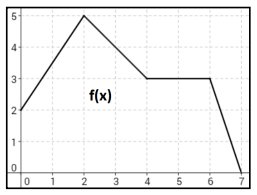
Find f(4)

a)

5

b)

4

c)

3

d)

0

131.

What are the names of these people?

a)

The Malfoys

b)

The Weasleys

c)

The Lovegoods

d)

The Potters