
 Worksheets
1st Internal Practice Quiz
Total questions: 86
Worksheet time: 1hrs 26mins

The pixel matrix of an image is
The transpose is:


A+B=


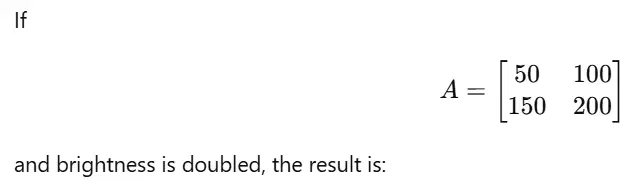


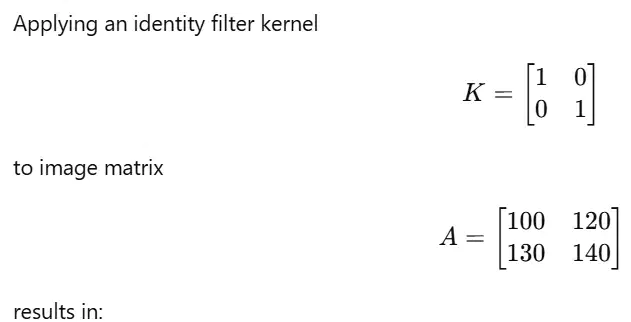


220
180
230
140


-2,-3
2,3
0,0
-5,0
If the trace of a matrix A is 10 and the determinant is 21, then the sum and product of eigenvalues are (a) .
For a symmetric matrix, all eigenvalues are always ________.
Real
Complex
Zero
Pure imaginary

2,3
5,-1
6,0
1,1

The sum of eigenvalues equals
7
6
5
4

The product of eigenvalues equals
-1
1
0
2

A−1
A^2
0
AT

1,8
1,4
1,2
2,3

1/2, 1/5
2,5
0,0
-2,-5
The effect of increasing pixel values using matrix addition is _________ in the image.
Brightening
Darkening
Color inversion
no effect
The effect of multiplying all pixel values by a scalar greater than 1 is _________.
Increasing contrast
Decreasing contrast
Brightening only
No change
The effect of applying a transpose operation to a pixel matrix before rotation is _________.
Preparing the image for rotation
Increasing brightness
Blurring the image
Removing noise
If eigenvalues of a transformation are λ, then the eigenvalues of its inverse are _________.
1/λ
λ^2
−λ
-1
In Principal Component Analysis, eigenvalues are used to _______
Measure variance captured by each component
Find the mean of the dataset
Remove duplicate rows
In image compression, the largest eigenvalues correspond to _______
Most significant features of the image
Random noise in the image
Minimum pixel intensity
Irrelevant background data
In Principal component analysis, eigenvectors are used to ______
identify principal directions
find mean of data
shrink matrix size
eliminate noise
In PCA, the eigenvectors of the covariance matrix represent ______
directions of maximum variance
the mean of the dataset
the diagonal entries only
random noise directions
In PCA, reducing the dimensionality means selecting eigenvectors corresponding to the ______
largest eigenvalues
smallest eigenvalues
zero eigenvalues
random eigenvalues
If a matrix A has eigenvalues λ₁, λ₂,…, λₙ, then the eigenvalues of Aᵀ (transpose of A) are ______
the same as those of A
the negatives of those of A
always zero
double those of A
In PCA, after centering the data, the commonly used matrix is the ______ matrix
covariance
transition
Laplacian
adjacency
In PCA, the eigenvalue corresponding to an eigenvector indicates the ______
variance captured along that direction
average of the data points
number of clusters in data
scaling factor of features
The product of all eigenvalues of a square matrix equals its ______
determinant
trace
rank
inverse
The operation that enhances contrast in image processing is ___
scalar multiplication
trace calculation
matrix inversion
transpose

5,6
4,3
6,5
3,2

7,10
6,12
5,8
8,9

4,-5
5,-4
2,9
5,4

4,5,6
0,5,-1
2,5,0
-1,3,6

7,8,-1
3,8,0
7,-2,3
0,0,-1
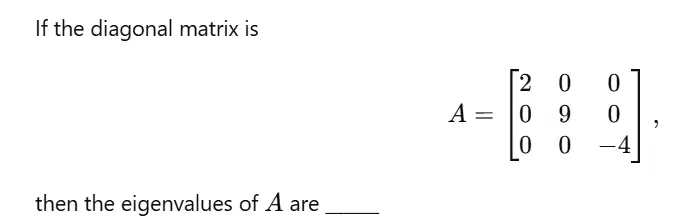
2,9,-4
0,9,0
2,0,0
0,0,-4

4
2
-1
5

5
2
4
1
If the eigenvalues of matrix A are 1,2,3, then the eigenvalues of A^2 are ______
1, 4, 9
2, 3, 4
0, 1, 2
−1, −2, −3
If the eigenvalues of A are 2,3,4 then the eigenvalues of A−1 (inverse of A) are ______
1/2, 1/3, 1/4
2, 3, 4
−2, −3, −4
0, 1, 2
If the eigenvalues of a covariance matrix A are 5,6,7 then the eigenvalues of 2A are ______
10, 12, 14
5, 6, 7
25, 36, 49
−5, −6, −7
If the eigenvalues of A are −1,2,3 then the eigenvalues of A^T (transpose of A) are ______
−1, 2, 3
1, −2, −3
0, 2, 3
−1, −2, −3

λ2−9λ+14
λ2−7λ+11
λ2−8λ+12
λ2−5λ+13

λ2−9λ+10
λ2−8λ+12
λ2−6λ+8
λ2−7λ+9
User A is followed by User B and User C. User B is followed by User A. User C is followed by User A.
The link matrix for this network is ______


In a web network, Page A is linked from Page B only. Page B is linked from both Page A and Page C. Page C is linked from Page B.
The link matrix is ______


In a citation network, Paper A cites Paper B, Paper B cites Paper C, and Paper C cites Paper A.
The link matrix is ______
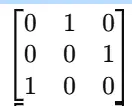


0
1
2
3

1
0
2
3

3
2
1
0

2
1
0
3

B2−7B+10I=0
B2+7B+10I=0
B2−10B+7I=0
B2+10B−7I=0
A key application of the Cayley–Hamilton theorem is to ______.
express higher powers of a matrix in terms of lower powers
compute the determinant of a matrix
perform Gaussian elimination
calculate eigenvectors directly
Cayley–Hamilton theorem can be primarily used to ______.
calculate the inverse of a non-singular matrix
find the nullity of a matrix
determine the dimension of a vector space
perform Cholesky decomposition
The Cayley–Hamilton theorem states that ______.
Every square matrix satisfies its own characteristic equation
Every matrix is diagonalizable.
The determinant of a matrix equals the sum of its eigenvalues.
Every square matrix is invertible.
The bilinear form of vectors u,v and a matrix B is represented by ____________
uTBv
u+v
u×v
uBvT
The bilinear form for vectors x and y with symmetric matrix M is ____________
xTMy
x+y
x⋅y
xTyM

36
18
22
24

-1
2
-2
4

1.5
2.1
1.9
2.0

5
6
7
3
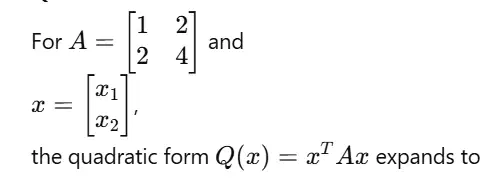


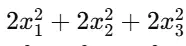

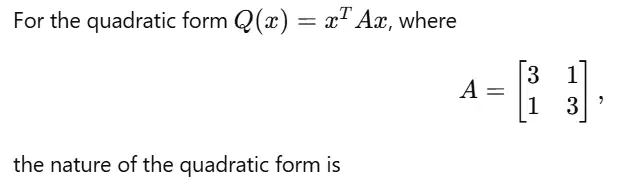
Positive definite
Negative definite
Indefinite
Semi-definite
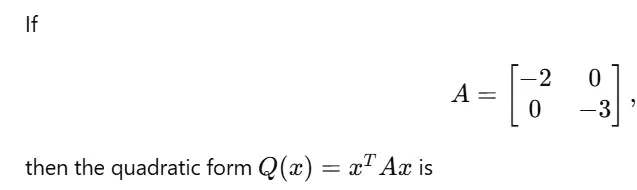
Negative definite
Positive definite
Positive semi definite
negative semi definite
The purpose of applying orthogonal transformation to quadratic forms in data analysis is to _____
reduce cross-product terms and identify independent directions
increase redundancy of features
remove eigenvalues
force data into random directions
In computer graphics, LU decomposition is used primarily for ____
solving systems of linear equations for transformations
reducing image noise
finding shortest paths in graphs
encrypting pixel data
In Google’s Page-rank algorithm, eigen decomposition is primarily applied to ___
find the dominant eigenvector showing the importance of web pages
compress text documents
encrypt user passwords
improve image contrast
In face recognition, eigen decomposition is applied to _______.
extract principal face features
generate random pixel noise
encrypt face images
remove all redundant features completel
In Principal component analysis, eigen decomposition of the covariance matrix is used to _______
identify uncorrelated principal components
increase image resolution
encrypt pixel values
add Gaussian noise
In Principal Component Analysis (PCA), eigenvectors are primarily used to _______.
form new axes along directions of maximum variance
shrink data value
randomize data points
remove outlier
LU decomposition of a square matrix A involves decomposing A into _______.
product of a lower triangular and an upper triangular matrix
diagonal and symmetric matrices
orthogonal matrices
eigenvectors and eigenvalues
In image reconstruction, Cayley–Hamilton theorem can be applied to _________
calculate matrix powers efficiently
remove all eigenvectors
avoid using basis vectors
reduce pixel size artificially

0
1
2
-1

1
0
2
-1

1
0
-1
2

2
1
3
0

0
1
2
3

0
1
2
3

-1
0
1
2

Rank = 3, Index = 2, Signature = 1, Nature = Indefinite
Rank = 2, Index = 1, Signature = 0, Nature = Positive Definite
Rank = 3, Index = 1, Signature = -1, Nature = Negative Definite
Rank = 3, Index = 3, Signature = 3, Nature = Positive Definite
The LU decomposition of a matrix A expresses it as:
A=U+L
A=L⋅U
A=U⋅L
A=L−U
Eigenvalue decomposition of a square matrix A is written as:
A=PDP−1
A=P+D
A=DP
A=P−1DP

