
Font size
 Worksheets
CRASHCOURSE QUIZ BLOCK 5
Total questions: 86
Worksheet time: 43mins
An atom consists of a positively charged nucleus and negatively charged electrons in orbit around the nucleus. Which of the following best describes this structure?
A positively charged nucleus with negatively charged electrons orbiting it.
A negatively charged nucleus with positively charged electrons orbiting it.
A neutral nucleus with neutral electrons orbiting it.
A positively charged nucleus with neutral electrons orbiting it.
Know how atoms may form positive ions by losing electrons or form negative ions by gaining electrons.
Atoms may form positive ions by losing electrons or form negative ions by gaining electrons.
Atoms may form positive ions by gaining electrons or form negative ions by losing electrons.
Atoms may form positive ions by sharing electrons or form negative ions by splitting electrons.
Atoms may form positive ions by splitting electrons or form negative ions by sharing electrons.
The scattering of alpha (α) particles by a thin metal sheet provides evidence for which of the following features of the nuclear model of the atom?
A very small, positively charged nucleus containing most of the atom's mass, surrounded by mostly empty space
A large, negatively charged nucleus surrounded by dense electrons
A nucleus made entirely of electrons with no empty space in the atom
A uniform distribution of mass and charge throughout the atom
The composition of the nucleus in terms of protons and neutrons is:
It consists of protons and neutrons.
It consists of electrons and protons.
It consists of electrons and neutrons.
It consists of only protons.
State the relative charges of protons, neutrons and electrons as +1, 0 and -1 respectively.
Proton: +1, Neutron: 0, Electron: -1
Proton: 0, Neutron: -1, Electron: +1
Proton: -1, Neutron: +1, Electron: 0
Proton: +1, Neutron: -1, Electron: 0
The proton number (atomic number) Z is the number of protons in a nucleus, and the nucleon number (mass number) A is the total number of protons and neutrons. The number of neutrons in a nucleus can be calculated by:
A - Z
Z - A
A + Z
Z / A
Use the nuclide notation.
^A_ZX represents a nuclide with mass number A and atomic number Z.
^Z_AX represents a nuclide with atomic number A and mass number Z.
ZXA represents a nuclide with atomic number Z and mass number A.
^A_XZ represents a nuclide with mass number Z and atomic number A.
An isotope is defined as atoms of the same element with different numbers of neutrons, and an element may have more than one isotope. Which of the following best describes an isotope?
Atoms of the same element with different numbers of neutrons
Atoms of different elements with the same number of neutrons
Atoms of the same element with the same number of neutrons
Atoms of different elements with different numbers of protons
Nuclear fission and nuclear fusion can be described as the splitting or joining of nuclei, including the nuclide equation and qualitative description of mass and energy changes without values. Which statement best summarizes these processes?
Nuclear fission is the splitting of a heavy nucleus into lighter nuclei, releasing energy, while nuclear fusion is the joining of light nuclei to form a heavier nucleus, also releasing energy, with both involving changes in mass and energy as shown in nuclide equations.
Nuclear fission and fusion both involve only the joining of nuclei, with no change in mass or energy.
Nuclear fission is the joining of light nuclei, and nuclear fusion is the splitting of heavy nuclei, both without energy release.
Both nuclear fission and fusion do not involve any change in nuclei or energy.
Know the relationship between the proton number and the relative charge on a nucleus.
The proton number determines the relative charge of the nucleus.
The neutron number determines the relative charge of the nucleus.
The mass number determines the relative charge of the nucleus.
The electron number determines the relative charge of the nucleus.
Know the relationship between the nucleon number and the relative mass of a nucleus.
The nucleon number is equal to the relative mass of the nucleus.
The nucleon number is always less than the relative mass of the nucleus.
The nucleon number is always greater than the relative mass of the nucleus.
The nucleon number and the relative mass of the nucleus are not related.
Almost all the mass of an atom is concentrated in the ________.
nucleus
electron cloud
proton
neutron
The nucleus consists of ________ and ________.
protons; neutrons
electrons; protons
electrons; neutrons
protons; electrons
Total number of protons and neutrons is called the ________ number.
nucleon
atomic
mass
isotope
What are isotopes?
Atoms with the same number of protons but different nucleon numbers
Atoms with the same number of neutrons but different proton numbers
Atoms with the same number of electrons but different proton numbers
Atoms with the same nucleon and proton numbers
Isotopes have the same chemical properties but different physical quantities.
True
False
Protons can be thought of as atomic _____. (Fill in the blank)
DNA
engines
batteries
clocks
anchors
What happens when an atom gains or loses electrons?
It becomes an isotope
It becomes an ion
It becomes a proton
It becomes a neutron
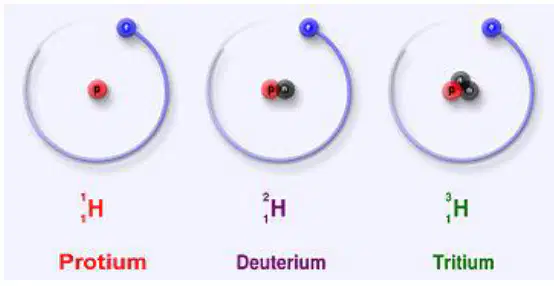
Match the following isotopes of hydrogen with their correct names:
Protium
1-A
Deuterium
2-B
Tritium
3-C
Alpha particles are ______ charged particles.
positively
negatively
neutrally
doubly
Who performed the gold foil experiment in 1909 to determine the structure of the atom?
Ernest Rutherford
Niels Bohr
J.J. Thomson
Marie Curie
The results of Rutherford's experiment showed that most of the mass of an atom is concentrated in a small, dense ______. (Fill in the blank)
nucleus
electron
proton
shell
A few alpha particles were deflected at large angles in the gold foil experiment, indicating that they had encountered something ______ in the gold foil.
massive
liquid
radioactive
transparent
According to Rutherford, the atom consists of a positively charged nucleus surrounded by ______.
electrons
protons
neutrons
positrons
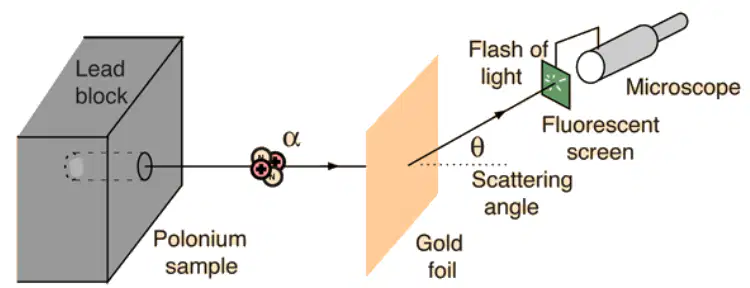
What did the gold foil experiment help to confirm about the atomic model?
The atom is a solid sphere
The atom has a central nucleus with electrons in orbit around it
The atom is made only of electrons
The atom has no nucleus
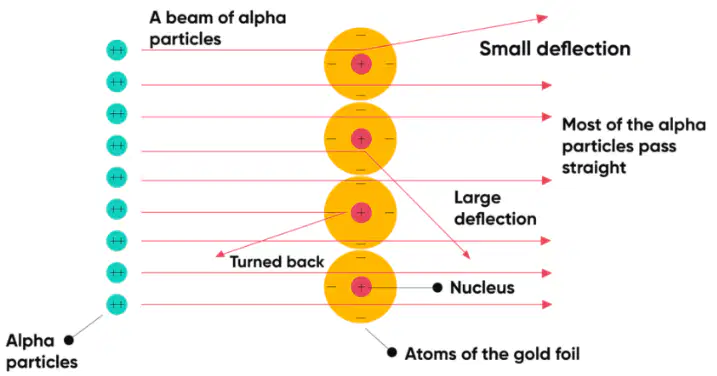
Fill in the blank: The majority of alpha particles passed through the gold foil without being _______.
deflected
absorbed
accelerated
split
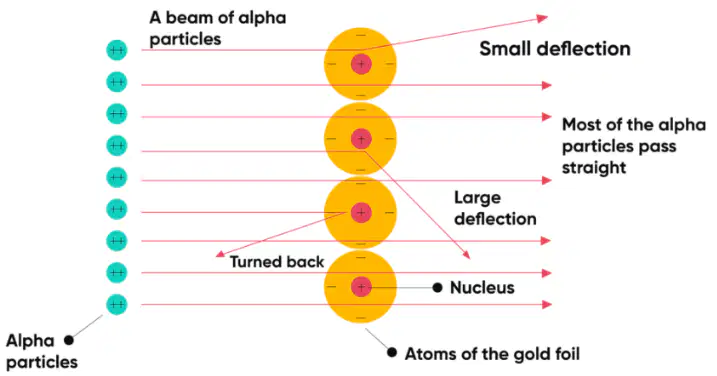
Which of the following is NOT a finding from the scattering of alpha particles by gold foil experiment?
A) Most alpha particles passed straight through the foil
B) All alpha particles were absorbed by the foil
C) Some alpha particles were slightly deflected
D) A small number of alpha particles were greatly deflected or bounced back
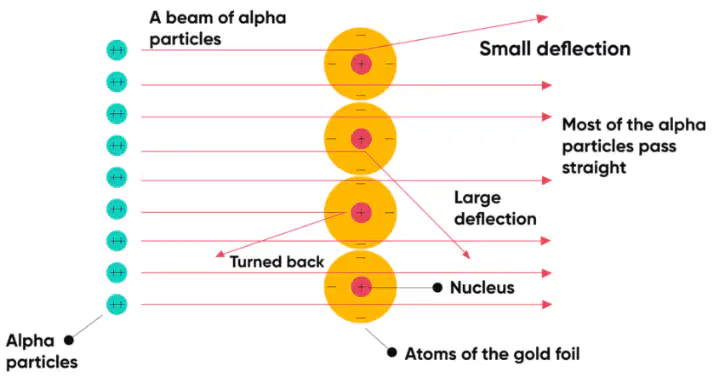
What does the large deflection or bouncing back of a small number of alpha particles suggest about the gold foil?
The foil is made of only electrons
The presence of dense, positively charged objects within the foil
The foil is empty
The foil is negatively charged
Nuclear fission involves the splitting of a heavy nucleus into two or more ______ nuclei.
smaller
larger
identical
unstable
What typically causes the nucleus to become unstable in nuclear fission?
Bombardment by a proton
Bombardment by a neutron
Absorption of an electron
Loss of energy
When the nucleus splits during nuclear fission, it releases a large amount of energy and additional free neutrons.
True
False
Fill in the blank: The free neutrons can then go on to collide with other nuclei, leading to a ________ reaction.
chain
fusion
thermal
endothermic
Which of the following can be harnessed to produce nuclear energy or used in nuclear weapons?
Chemical reaction
Chain reaction
Photosynthesis
Combustion
Fill in the blank: An example of a nuclear fission reaction is the fission of uranium-235 (U-235): U-235 + neutron -> Ba-141 + Kr-92 + ___ neutrons.
3
1
2
4
What does nuclear fusion involve?
The splitting of a heavy nucleus into lighter nuclei
The joining of two or more lighter nuclei to form a heavier nucleus
The decay of radioactive elements
The emission of alpha particles
Nuclear fusion requires high temperatures and pressures to overcome the repulsive forces between the positively charged nuclei.
True
False
What happens when nuclei are joined during nuclear fusion?
They form a single, heavier nucleus.
They split into smaller nuclei.
They lose all their energy and disappear.
They become unstable and decay immediately.
Fill in the blank: During the process of fusion, a small amount of mass is transformed into a large amount of energy, according to the famous equation _______.
E=mc2
F=ma
V=IR
P=IV
The total energy released in fusion is much greater than the decrease in total mass of the system because:
the energy released is related to the binding energy difference, not just the mass loss.
fusion does not actually lose any mass.
the energy released is always equal to the mass lost.
the decrease in mass is unrelated to the energy released.
What is radioactivity? Fill in the blank: Radioactivity refers to the spontaneous emission of ________ from an unstable nucleus.
radioactive particles
light waves
sound waves
electrons
Which of the following is NOT a source of background radiation?
Radon gas in the air
Rocks and buildings
Food and drink
Distilled water
Cosmic rays
Fill in the blank: The emission of radiation from a nucleus is a way for the nucleus to become more ________ by reducing its energy.
stable
radioactive
energetic
unstable
There are three types of radioactive emission: alpha, beta, and ________.
gamma
delta
neutron
proton
Alpha emission involves the release of alpha particles, which are ________ nuclei.
helium
hydrogen
carbon
oxygen
Beta emission involves the release of beta particles, which are high-energy ________.
electrons
protons
neutrons
photons
Gamma emission involves the release of gamma rays, which are high-energy ________.
photons
electrons
protons
neutrons
The instability of the nucleus can be due to an imbalance of ________ and ________, known as isotopes.
protons, neutrons
electrons, photons
quarks, leptons
protons, electrons
What is the charge of an alpha (α) particle?
Positive
Negative
No charge
Which type of radiation has the strongest ionization?
Alpha (α)
Beta (β)
Gamma (γ)
Which type of radiation is most penetrating?
Alpha (α)
Beta (β)
Gamma (γ)
What material can protect you from gamma (γ) radiation?
A thick sheet of paper
A few millimetres of Perspex or aluminium
Several centimetres of lead
Alpha particles can be deflected in an electric field.
True
False
Gamma rays can be deflected in a magnetic field.
True
False
Fill in the blank: Beta (β) particles have _______ charge.
Negative
Positive
Neutral
No
Fill in the blank: The process of radioactivity can result in the nucleus changing into another element through a _______ process.
decay
fusion
oxidation
condensation
Which type of radiation is not deflected in either electric or magnetic fields?
Gamma (γ) radiation
Alpha (α) radiation
Beta (β) radiation
Neutron radiation
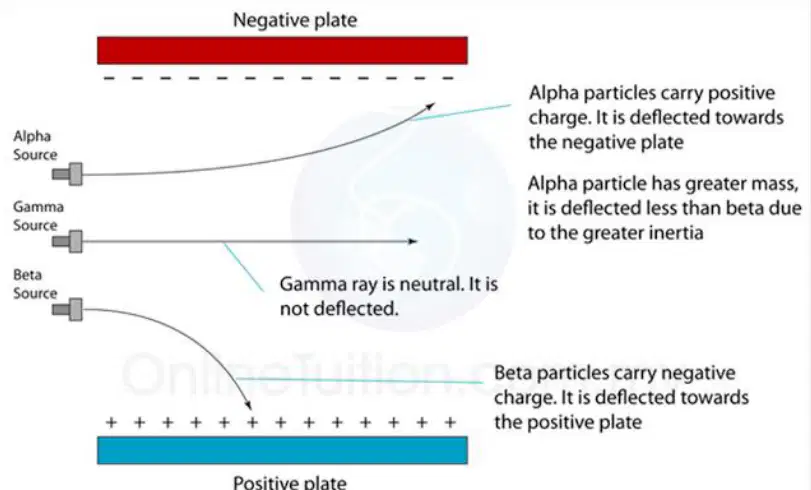
Which type of particle is deflected towards the negative plate?
Alpha (α) particle
Beta (β) particle
Gamma (γ) ray
Neutron
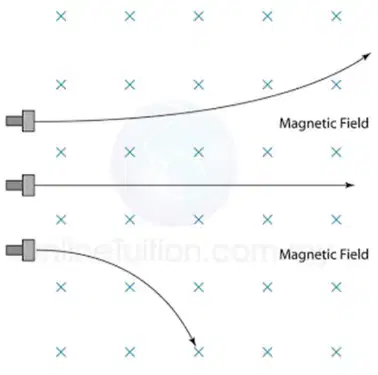
Determine which of the following emissions are alpha, beta, and gamma emissions based on the diagram showing their paths in a magnetic field.
Top: Alpha, Middle: Beta, Bottom: Gamma
Top: Beta, Middle: Gamma, Bottom: Alpha
Top: Gamma, Middle: Alpha, Bottom: Beta
Top: Beta, Middle: Alpha, Bottom: Gamma
What is radioactive decay?
Radioactive decay is a change in an unstable nucleus that can result in the emission of α-particles or β-particles and/or γ-radiation. These changes are spontaneous and random.
Radioactive decay is the process by which stable nuclei absorb energy and become unstable.
Radioactive decay is the fusion of two stable nuclei to form a heavier nucleus.
Radioactive decay is the process of electrons moving from higher to lower energy levels in an atom.
State what happens to the nucleus during α-decay or β-decay.
During α-decay or β-decay, the nucleus changes to that of a different element.
During α-decay or β-decay, the nucleus remains unchanged.
During α-decay or β-decay, the nucleus splits into two equal parts.
During α-decay or β-decay, the nucleus disappears completely.
Know that isotopes of an element may be radioactive due to an excess of neutrons in the nucleus and/or the nucleus being too heavy.
True
False
Describe the effect of α-decay, β-decay and γ-emissions on the nucleus, including an increase in stability and a reduction in the number of excess neutrons; the following change in the nucleus occurs during β-emission: neutron → proton + electron.
α-decay, β-decay, and γ-emissions increase the stability of the nucleus and reduce the number of excess neutrons. During β-emission, a neutron changes into a proton and an electron.
α-decay, β-decay, and γ-emissions decrease the stability of the nucleus and increase the number of excess neutrons. During β-emission, a proton changes into a neutron and an electron.
α-decay, β-decay, and γ-emissions have no effect on the stability of the nucleus or the number of excess neutrons. During β-emission, a neutron changes into a proton and a positron.
α-decay, β-decay, and γ-emissions increase the number of excess neutrons and decrease the stability of the nucleus. During β-emission, a neutron changes into a proton and a neutrino.
Which of the following correctly shows the emission of α-particles, β-particles, and γ-radiation using decay equations with nuclide notation?
α: ZAX→Z−2A−4Y+24He; β: ZAX→Z+1AY+−10e; γ: ZAX∗→ZAX+γ
α: ZAX→Z−4A−2Y+42He; β: ZAX→Z−1AY+10e; γ: ZAX∗→ZAX+β
α: ZAX→Z−1A−1Y+11H; β: ZAX→Z+2AY+−10e; γ: ZAX∗→ZAX+α
α: ZAX→Z−1A−3Y+13H; β: ZAX→ZAY+−10e; γ: ZAX∗→ZAX+γ
Define the half-life of a particular isotope as the time taken for half the nuclei of that isotope in any sample to decay; recall and use this definition in simple calculations, which might involve information in tables or decay curves (calculations will not include background radiation).
The half-life of a particular isotope is the time taken for half the nuclei of that isotope in any sample to decay.
The half-life of a particular isotope is the time taken for all the nuclei of that isotope in any sample to decay.
The half-life of a particular isotope is the time taken for the sample to double in mass.
The half-life of a particular isotope is the time taken for the nuclei to stop decaying completely.
Calculate half-life from data or decay curves from which background radiation has not been subtracted.
Determine the time taken for the count rate to fall to half its initial value, including background radiation.
Subtract the background radiation before calculating the half-life.
Ignore the background radiation and use the total count rate as the decay rate.
Double the measured count rate to find the half-life.
Explain how the type of radiation emitted and the half-life of an isotope determine which isotope is used for applications including: (a) household fire (smoke) alarms, (b) irradiating food to kill bacteria, (c) sterilisation of equipment using gamma rays, (d) measuring and controlling thicknesses of materials with the choice of radiations used linked to penetration and absorption, (e) diagnosis and treatment of cancer using gamma rays.
The type of radiation emitted and the half-life of an isotope determine its suitability for specific applications based on penetration, absorption, and duration of activity. For example, smoke alarms use isotopes with suitable half-lives and radiation types for detection, while gamma rays are used for sterilisation and cancer treatment due to their high penetration.
The type of radiation emitted and the half-life of an isotope are not important in determining its use in different applications, as all isotopes can be used interchangeably.
Only the cost of the isotope determines its use in applications, regardless of the type of radiation or half-life.
The colour of the isotope and its physical state are the main factors in choosing isotopes for different applications.
The nucleus of an unstable isotope emits nuclear radiation, including α, β, and γ rays, to become stable.
True
False
The process of emitting nuclear radiation is called _________.
radioactive decay
nuclear fusion
ionization
electrolysis
Radioactive decay occurs spontaneously and randomly.
True
False
The unstable nucleus before decay is called the ________ nuclide.
parent
daughter
stable
product
The stable nucleus produced after decay is called the ________ nuclide.
daughter
parent
isotope
proton
What is emitted during an alpha decay?
A beta particle
An alpha particle (⁴₂He)
A gamma ray
A neutron
During an alpha decay, a radioactive atom X loses 2 neutrons and 2 protons and becomes atom Y.
True
False
Write the nuclear equation for the alpha decay of uranium-238 (²³⁸₉₂U).
²³⁸₉₂U → ²³⁴₉₀Th + ⁴₂He
²³⁸₉₂U → ²³⁶₉₁Pa + ²₁H
²³⁸₉₂U → ²³⁸₉₁Pa + ⁰₋₁e
²³⁸₉₂U → ²³⁴₉₂U + ⁴₂He
A beta particle is an ______ emitted from a nucleus.
electron
proton
neutron
positron
During a beta decay, a radioactive atom X decays and emits a beta particle (⁰₋₁e).
True
False
What happens to the proton number during beta decay?
It decreases by 1
It increases by 1
It remains unchanged
It increases by 2
Write the nuclear equation for the beta decay of thorium-234 (²³⁴₉₀Th).
²³⁴₉₀Th → ²³⁴₉₁Pa + ⁰₋₁e
²³⁴₉₀Th → ²³⁴₈₉Ac + ⁰₁e
²³⁴₉₀Th → ²³⁴₉₀Pa + ⁰₋₁e
²³⁴₉₀Th → ²³⁴₉₁Pa + ⁰₁e
Gamma emission causes a change in nucleon or proton number.
True
False
What is emitted during gamma emission?
Alpha particle
Beta particle
Gamma ray
Neutron
What is the process called when an unstable nucleus undergoes a series of radioactive decays until a stable nuclide is reached?
Series decay
Nuclear fusion
Electron capture
Isotope formation
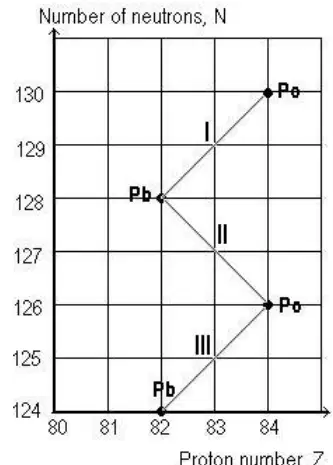
State the radioactive decays that the element has gone through.
Alpha and beta decays
Only alpha decay
Only gamma decay
Beta and gamma decays
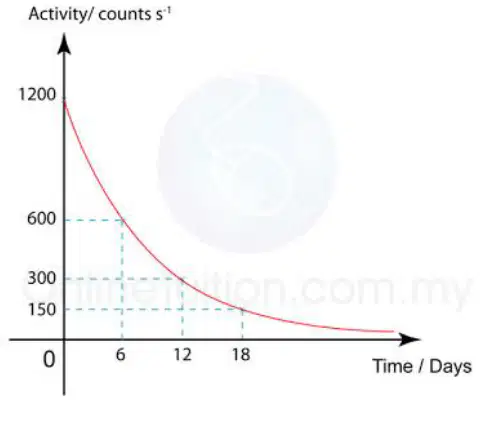
The diagram shows the graph of the activity of a radioisotope, X, against time. What is the half-life of the radioisotope substance?
6 days
3 days
9 days
12 days
The effects of ionising nuclear radiations on living things include:
Causing mutations and cell damage
Improving immune system function
Enhancing growth and development
Increasing resistance to diseases
Radioactive materials are moved, used, and stored in a safe way by:
Using lead containers, remote handling tools, and secure storage areas.
Leaving them in open areas for easy access.
Handling them with bare hands and storing in plastic bags.
Transporting them without any shielding or precautions.
Safety precautions for all ionising radiation include reducing exposure time, increasing distance between source and living tissue, and using shielding to absorb radiation.
Reducing exposure time, increasing distance, and using shielding
Increasing exposure time, decreasing distance, and avoiding shielding
Reducing exposure time, decreasing distance, and not using shielding
Increasing exposure time, increasing distance, and not using shielding

