
 Worksheets
BIO2251-02N: Week 4 - Bones
Total questions: 92
Worksheet time: 46mins
Fill in the blank: ________ supports ends of bones.
Cartilage
Muscle
Ligament
Tendon
Fill in the blank: ________ are growth plates in long bones.
Epiphyseal Plates
Diaphyseal Tuberosities
Medullary Cavities
Articular Cartilages
Fill in the blank: ________ are the top and bottom sections of long bones.
Epiphysis
Diaphysis
Metaphysis
Periosteum
Fill in the blank: ________ is the long shaft of bone.
Diaphysis
Epiphysis
Metaphysis
Periosteum
Fill in the blank: ________ is the outer layer of bone.
Periosteum
Marrow
Cartilage
Ligament
Fill in the blank: ________ is responsible for blood cells and fat storage.
Medullary Cavity
Epiphysis
Periosteum
Articular Cartilage
Fill in the blank: ________ is the hard bone.
Compact Bone
Spongy Bone
Cartilage
Bone Marrow
Fill in the blank: ________ is spongy bone or has a honeycomb appearance.
Cancellous Bone
Compact Bone
Cartilage
Periosteum
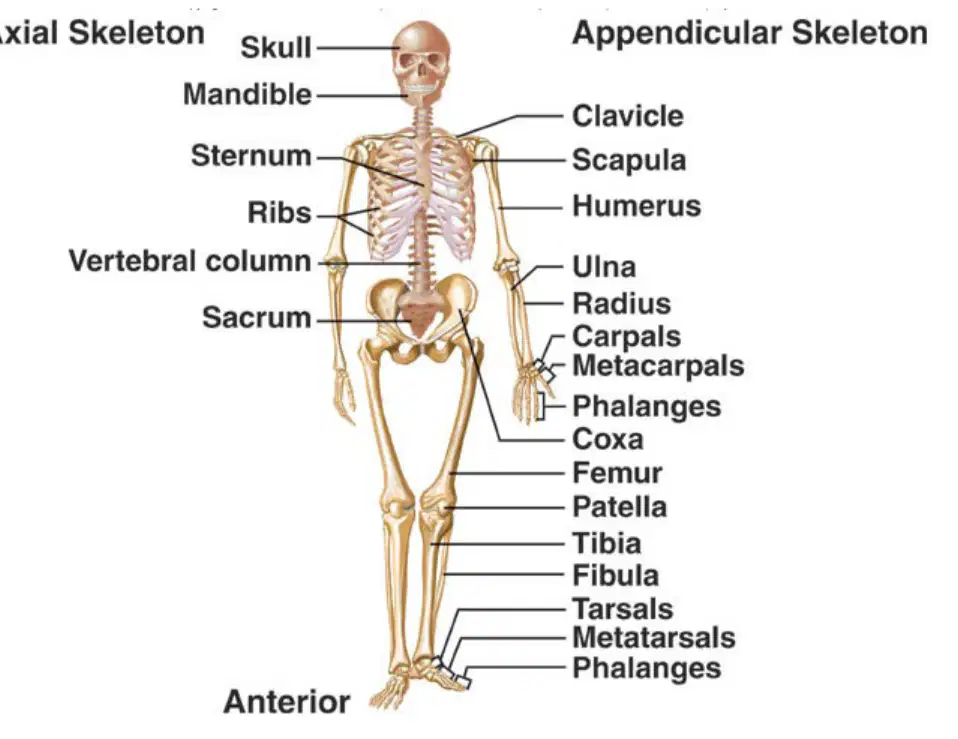
Which of the following is NOT a part of the Axial Skeleton?
Skull
Vertebral Column
Thoracic Cage
Clavicle
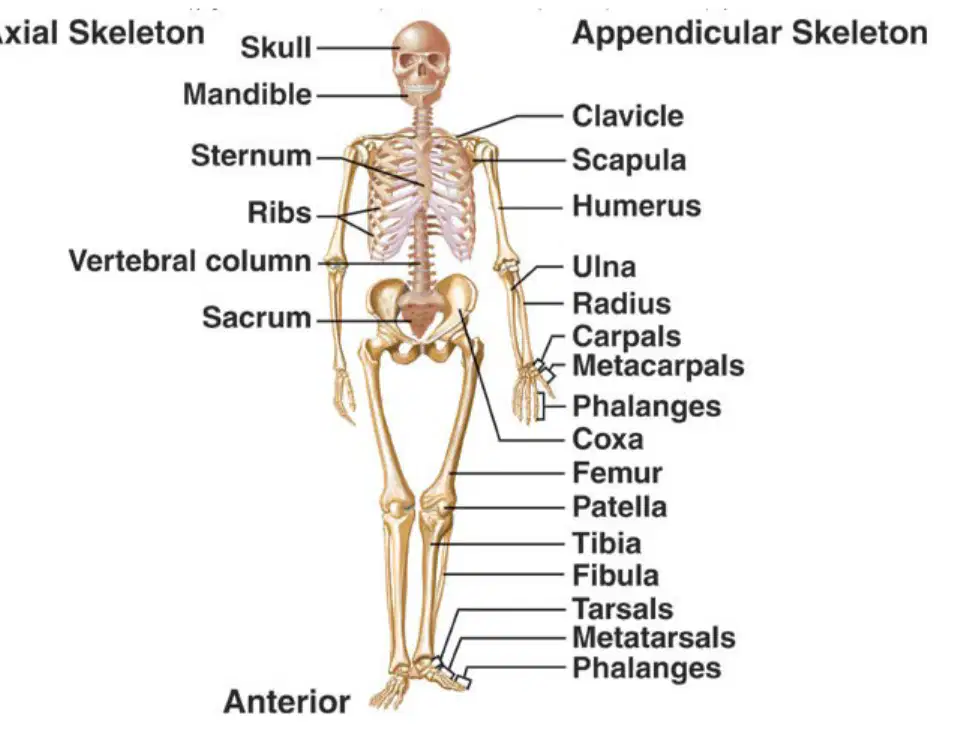
Which bones are included in the Appendicular Skeleton?
Skull and Vertebral Column
Pectoral Girdle and Pelvic Girdle
Ribs and Sternum
Sacrum and Coccyx
Fill in the blank: The human skeleton has ______ named bones and several small unnamed ones.
206
201
210
180
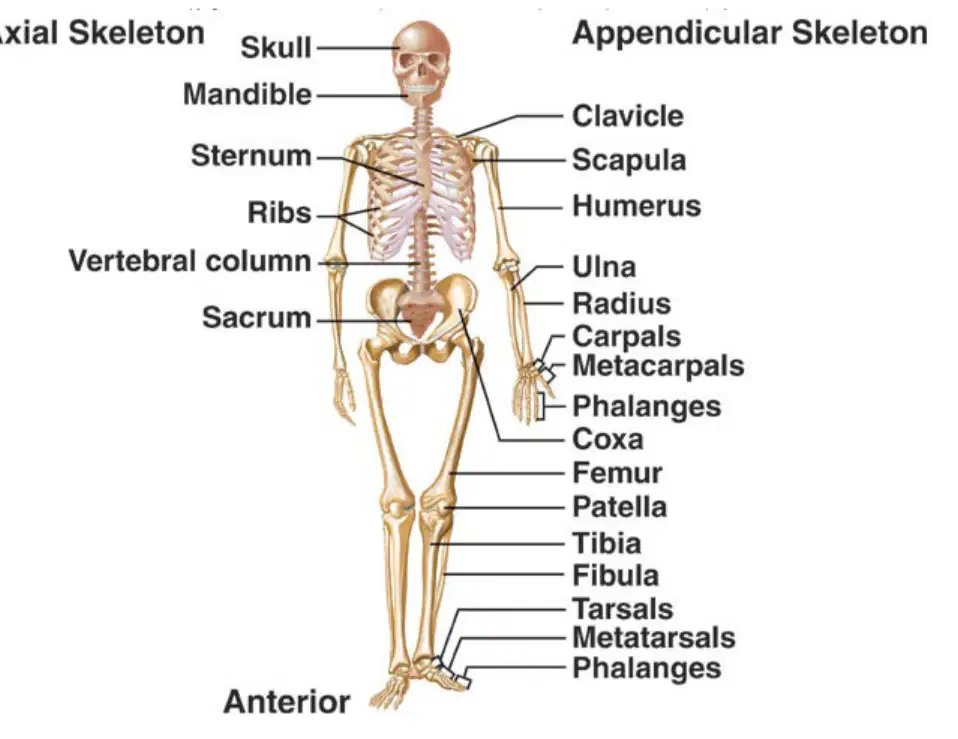
Which bone is part of the axial skeleton?
Femur
Mandible
Scapula
Humerus
True or False: The pectoral girdle is part of the axial skeleton.
True
False
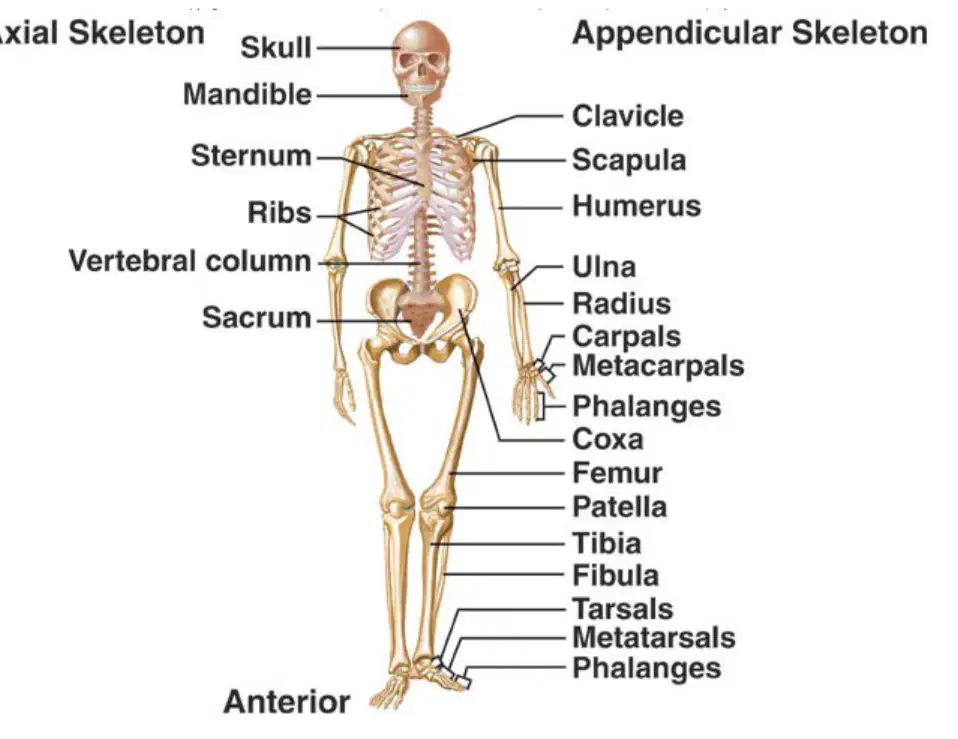
Name two bones that are part of the appendicular skeleton.
Clavicle, Femur
Frontal, Occipital
Mandible, Vomer
Sternum, Sacrum
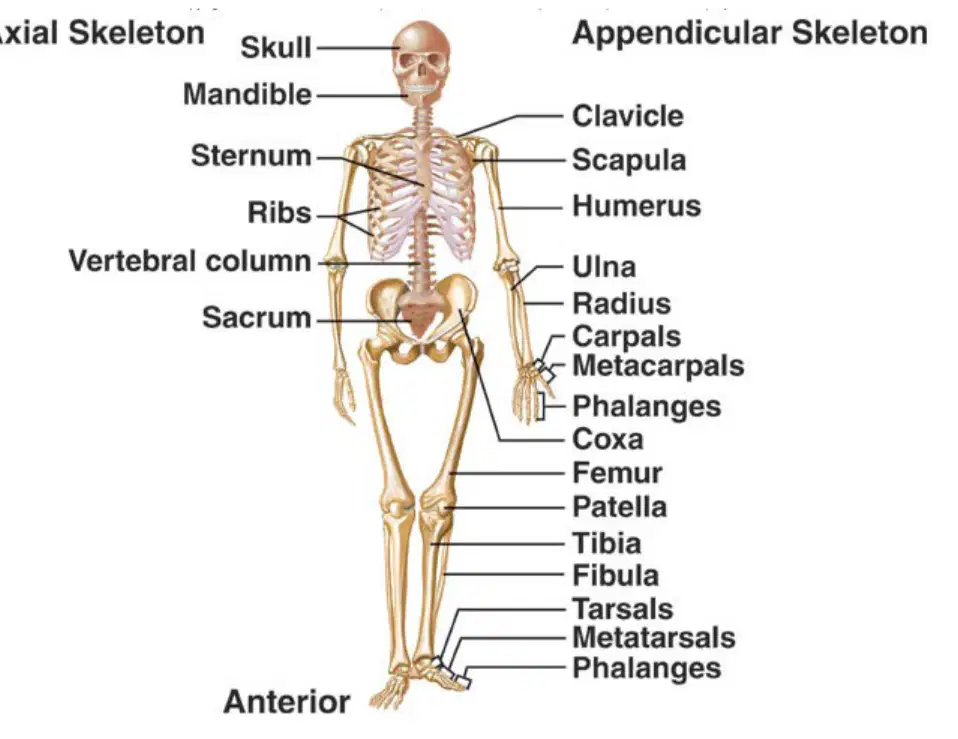
Which of the following is found in the lower limb?
Humerus
Femur
Clavicle
Scapula
What is the term for a 'Narrow slit' in the context of surface features of bones?
Fissure
Foramen
Tubercle
Condyle
What is the term for an 'Opening that is a passageway for blood vessels and nerves' in the context of surface features of bones?
Foramen
Condyle
Tuberosity
Crest
What is the term for a 'Shallow depression' in the context of surface features of bones?
Fossa
Condyle
Tubercle
Crest
What is the term for a 'Large canal or passageway' in the context of surface features of bones?
Meatus
Fossa
Tubercle
Crest
What is the term for an 'Air-filled cavity' in the context of surface features of bones?
Sinus
Fossa
Foramen
Condyle
What is the term for a 'Groove or furrow' in the context of surface features of bones?
Sulcus
Tubercle
Condyle
Spine
What is the term for a 'Rounded knucklelike process that articulates with another bone' in the context of surface features of bones?
Condyle
Tuberosity
Spine
Fossa
What is the term for a 'Narrow ridge' in the context of surface features of bones?
Crest
Fossa
Foramen
Spine
What is the term for an 'Enlarged end of a bone supported by a narrow neck' in the context of surface features of bones?
Head
Spine
Crest
Fossa
What is the term for a 'Sharp, slender process' in the context of surface features of bones?
Spine
Tuberosity
Condyle
Fossa
What is the term for a 'Very large process' in the context of surface features of bones?
Trochanter
Tubercle
Spine
Crest
What is the term for a 'Small rounded process' in the context of surface features of bones?
Tubercle
Trochanter
Crest
Spine
What is the term for a 'Low, roughened process serving as an attachment site for a muscle' in the context of surface features of bones?
Tuberosity
Fossa
Crest
Foramen
A compound fracture ______ the skin.
breaks
touches
heals
avoids
A simple fracture ______ break the skin.
doesn't
always
might
must
Which type of fracture breaks the skin?
Simple Fracture
Compound Fracture
Which type of fracture does not break the skin?
Simple Fracture
Compound Fracture
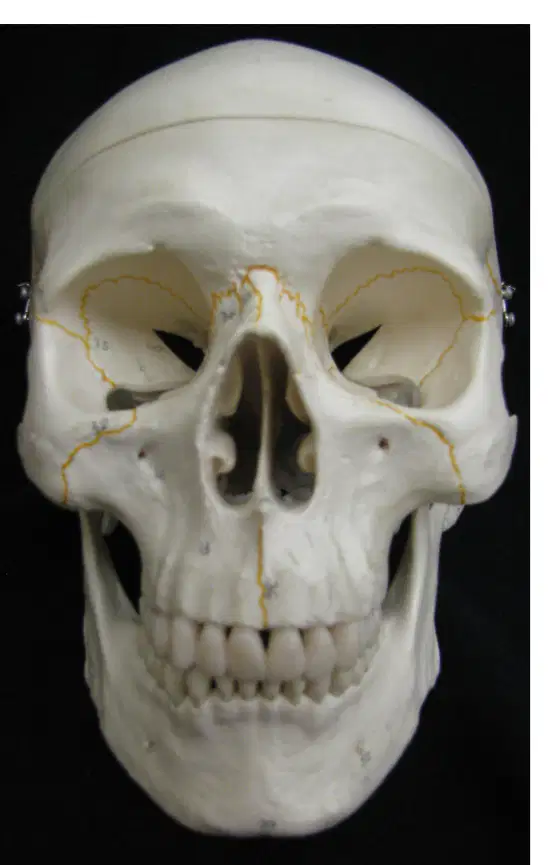
How many bones are joined together by sutures in the cranium?
22
14
18
26
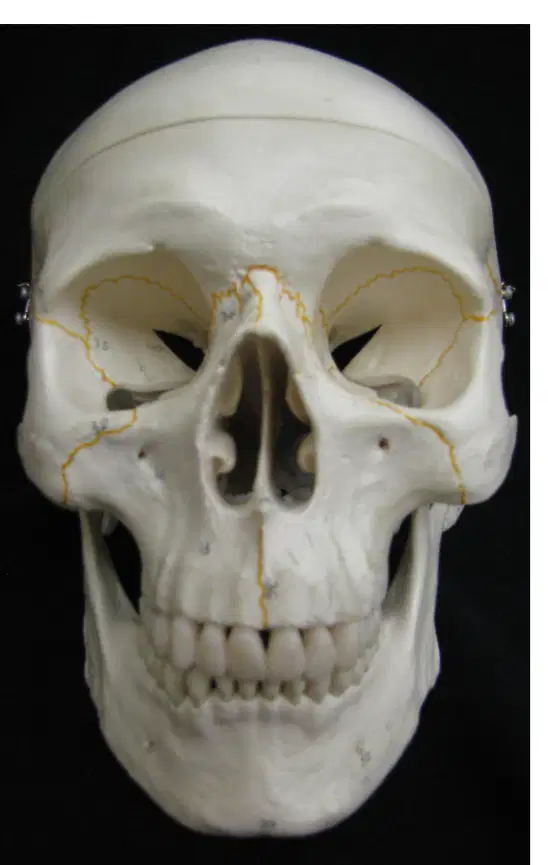
What joins the 22 bones of the cranium together?
Sutures
Ligaments
Tendons
Cartilage
Which of the following is NOT a cranial bone?
Frontal
Parietal
Femur
Occipital
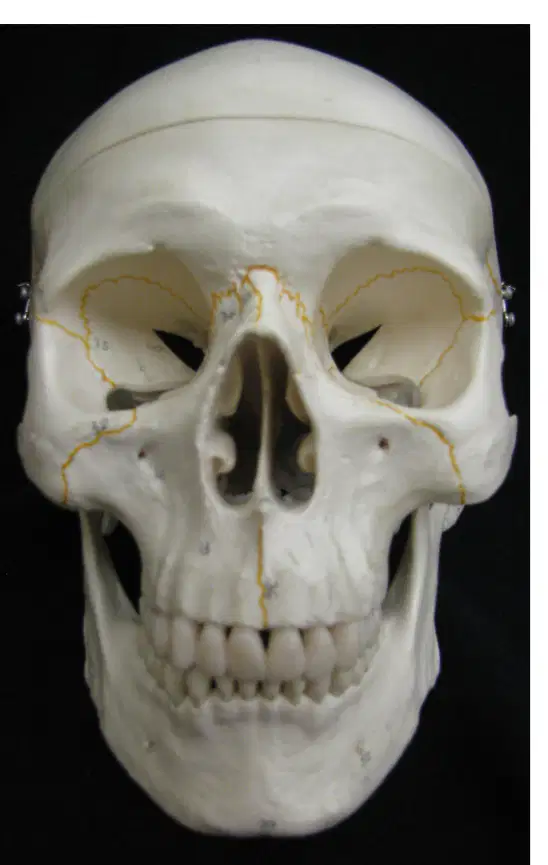
Name one function of the facial bones.
Facial bones support teeth and form nasal cavity and orbit.
Facial bones produce red blood cells.
Facial bones regulate body temperature.
Facial bones store fat.
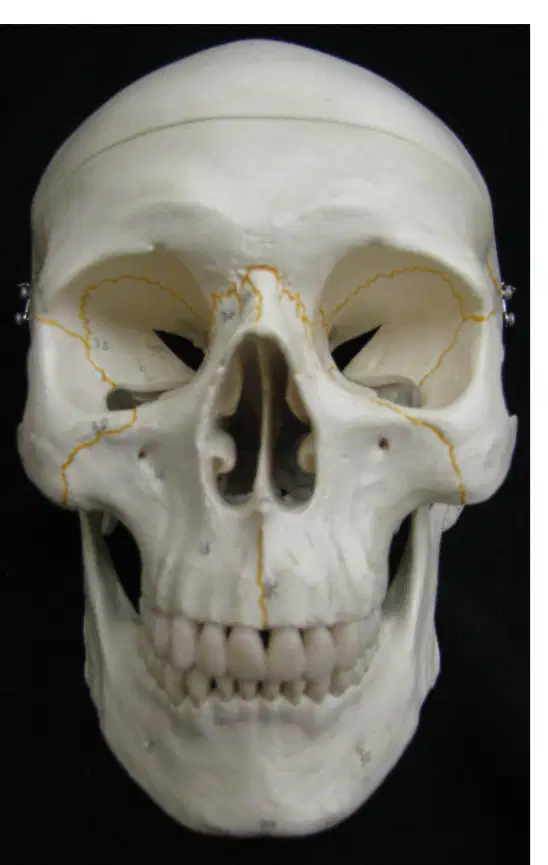
Which cranial bone surrounds the cranial cavity?
Frontal
Parietal
Occipital
All of the above
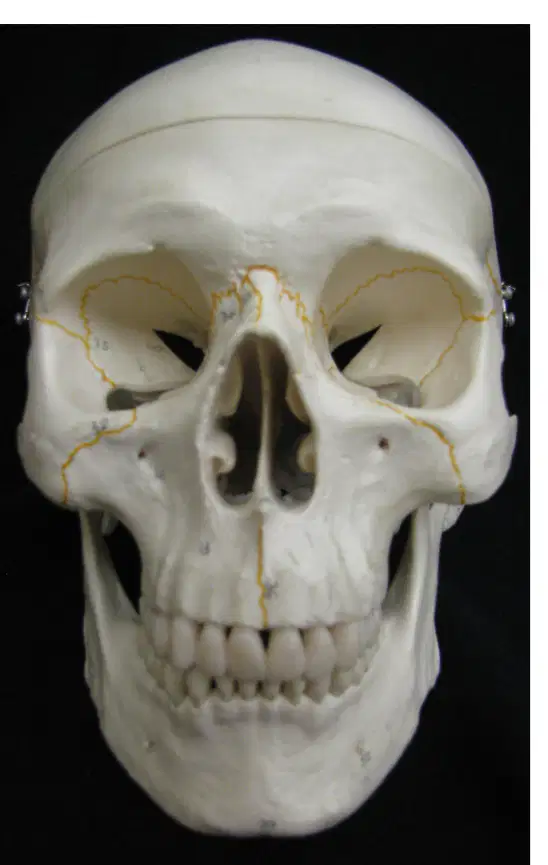
List any one cranial bone.
Frontal
Femur
Scapula
Tibia
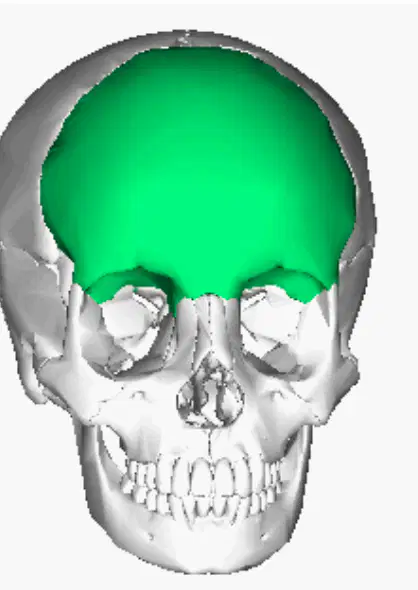
What part of the skull forms the forehead and part of the roof of the cranium?
Frontal bone
Parietal bone
Temporal bone
Occipital bone
What is the function of the supraorbital foramen?
Forms the jaw
Forms roof of the orbit
Forms the cheekbone
Forms the nasal cavity
What is the supraorbital notch?
A) A large hole in the jaw
B) A small indentation of the roof of the orbit
C) The back of the skull
D) The lower part of the cranium
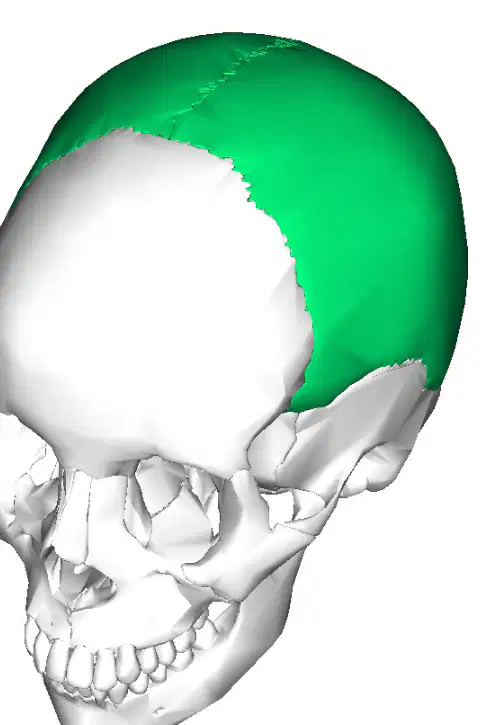
Which bones form the cranial roof and parts of its lateral wall?
Parietal bones
Temporal bones
Occipital bones
Frontal bones
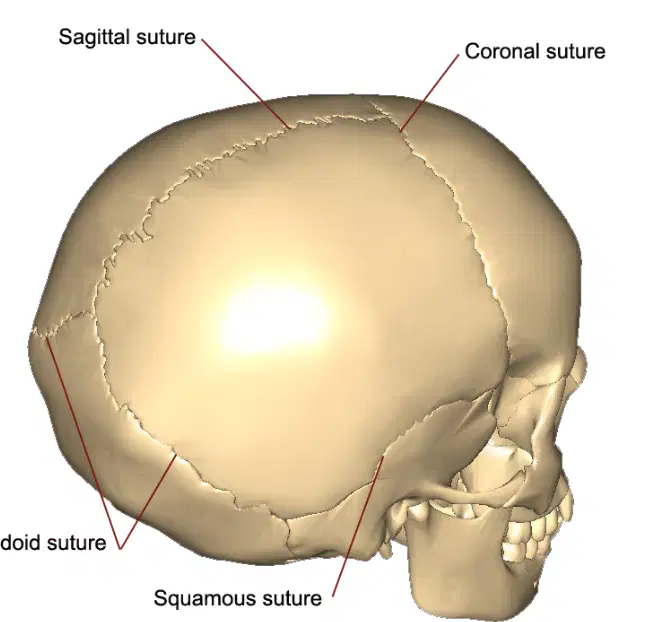
The parietal bones are bordered by how many sutures?
4
2
3
5
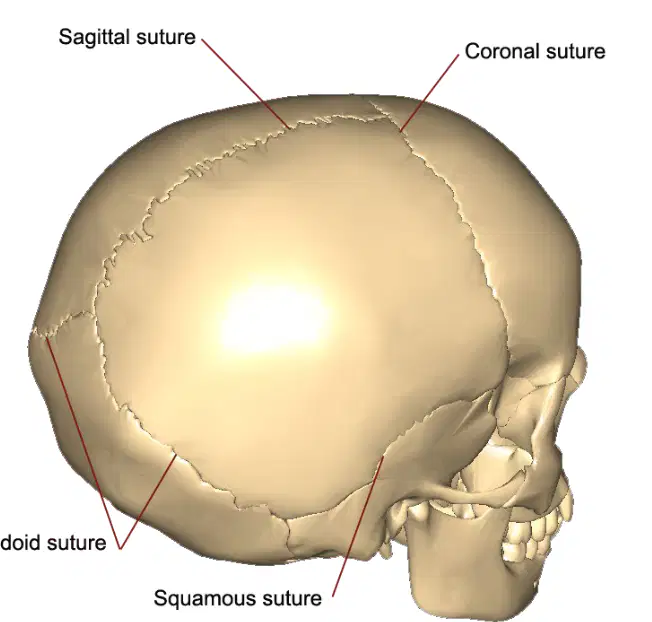
Which of the following is NOT a suture bordering the parietal bones?
Coronal
Sagittal
Lambdoid
Zygomatic
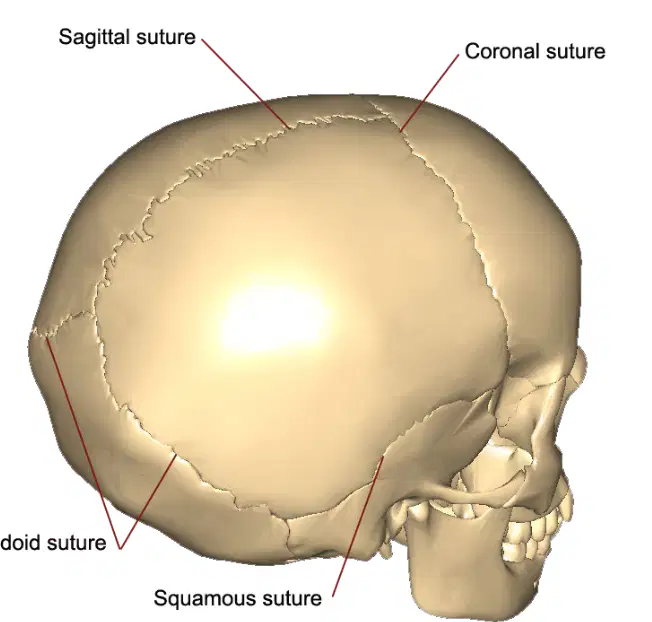
Name any one suture that borders the parietal bones.
Coronal (or Sagittal, Lambdoid, Squamous)
Zygomaticomaxillary
Intermaxillary
Pterygopalatine
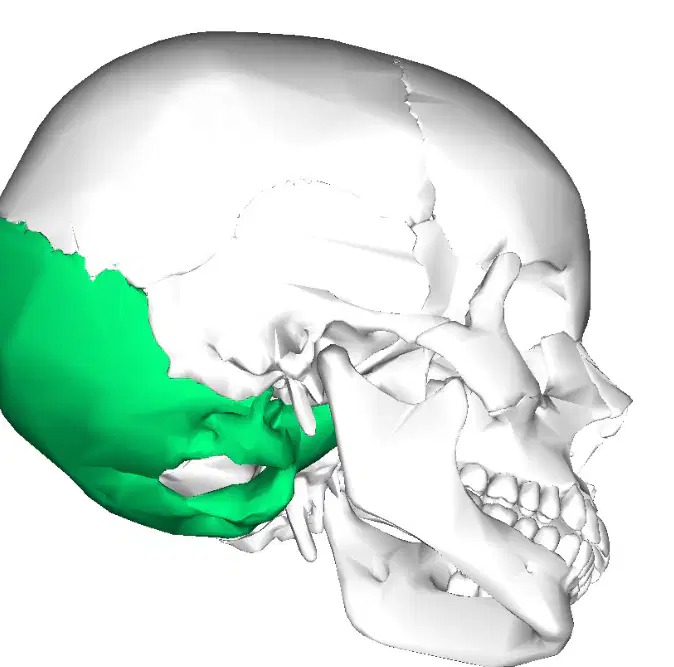
What part of the skull does the occipital bone form?
Rear and base of Skull
Top of Skull
Sides of Skull
Front of Skull
What structure holds the spinal cord in the occipital bone?
Foramen magnum
Cribriform plate
Sella turcica
Jugular foramen
The skull rests on the atlas at which part of the occipital bone?
Occipital condyles
External occipital protuberance
Superior nuchal line
Foramen magnum
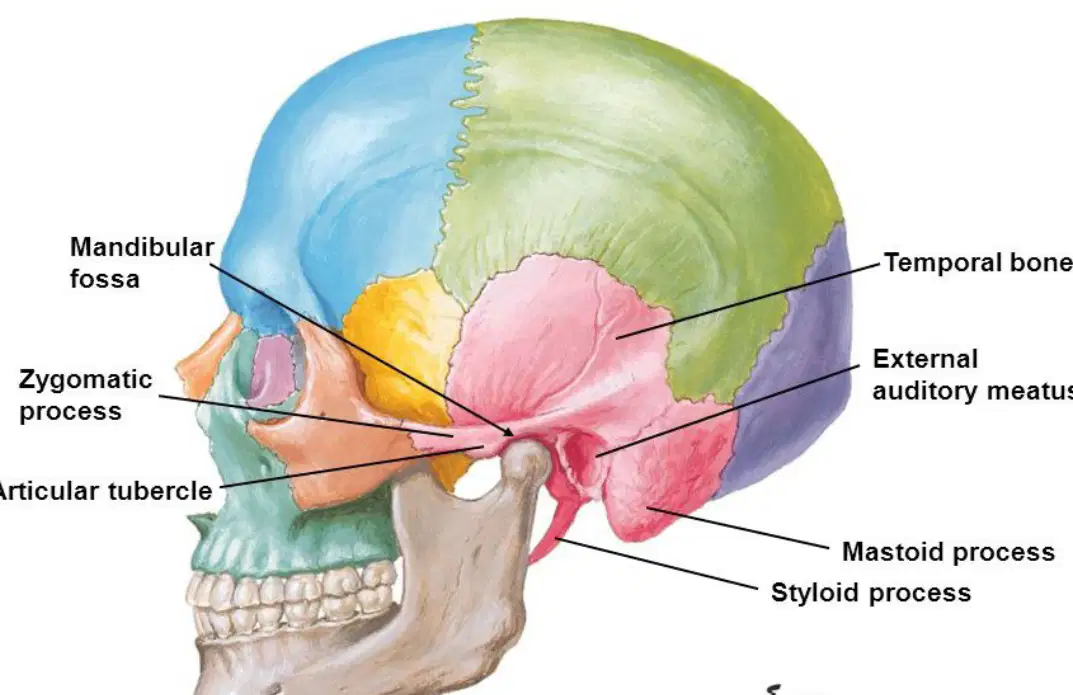
Which anatomical feature leads inward toward the middle ear?
External Auditory Meatus
Cochlea
Eustachian Tube
Semicircular Canals
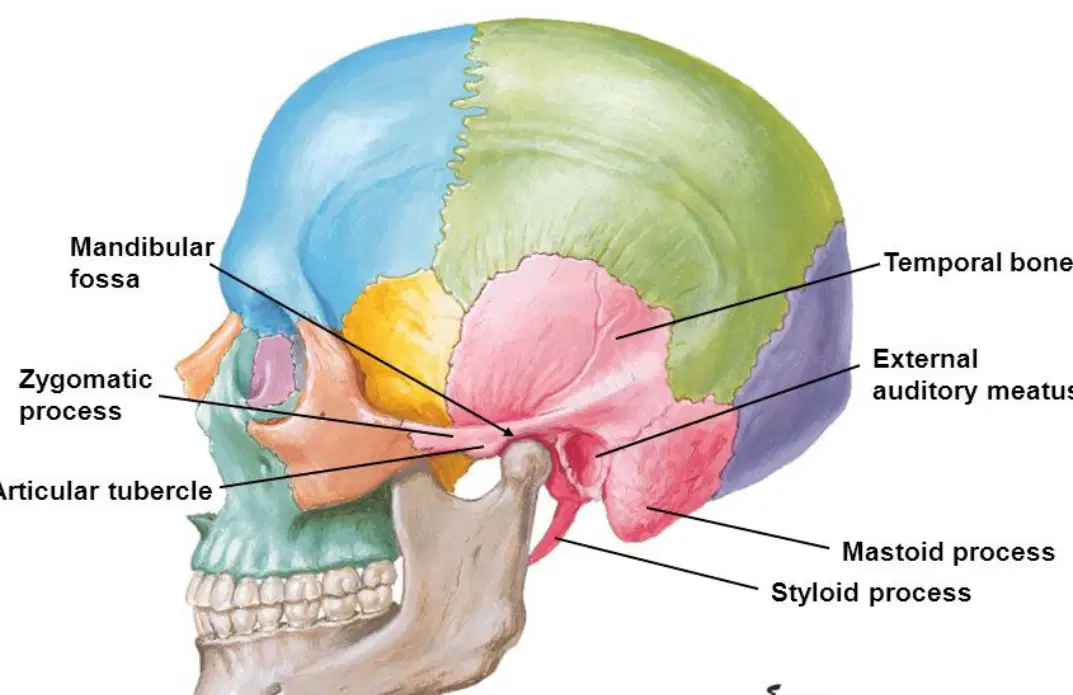
Which anatomical feature is a depression and site that forms the Temporomandibular joint?
Mandibular Fossa
Coronoid Process
Mastoid Process
Zygomatic Arch
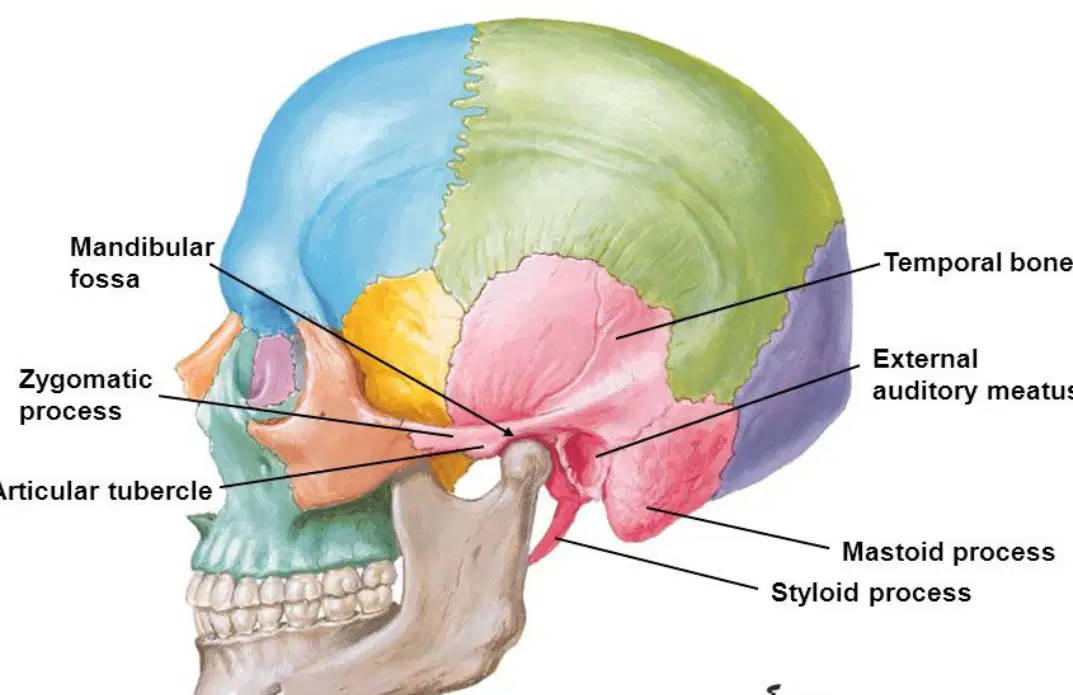
Which anatomical feature articulates with the cheekbone?
Zygomatic Process
Coronoid Process
Mastoid Process
Styloid Process
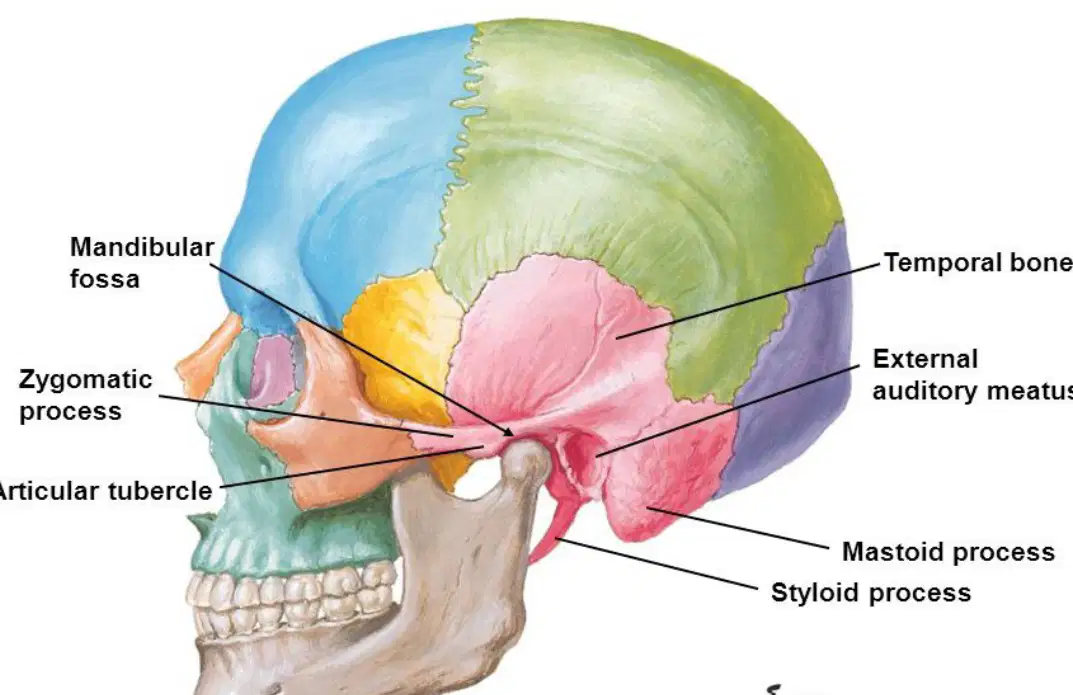
Which anatomical feature is an attachment site for some tongue muscles?
Styloid Process
Mastoid Process
Coronoid Process
Zygomatic Arch
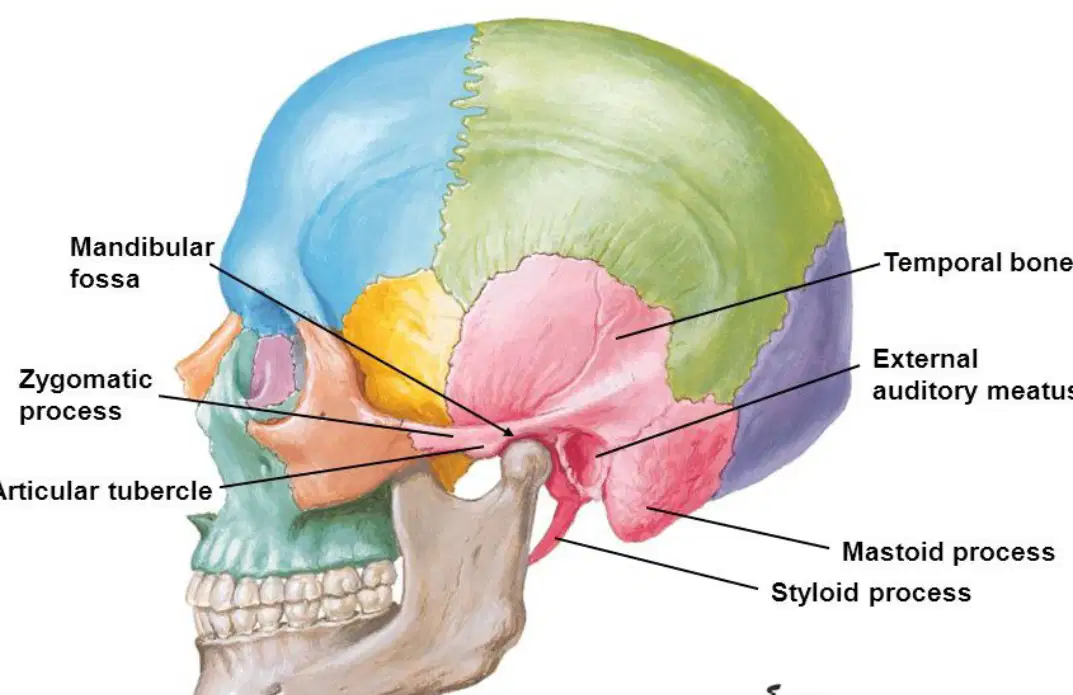
Which anatomical feature is an attachment site for certain neck muscles?
Mastoid Process
Coracoid Process
Acromion
Olecranon
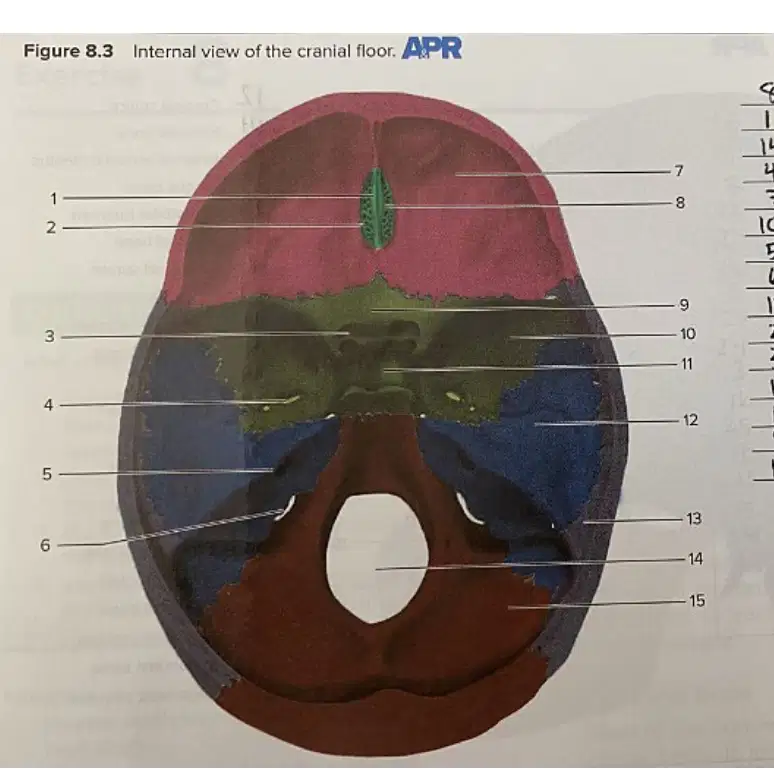
In the internal view of the cranial floor (Figure 8.3), label 1 corresponds to which anatomical
structure?
Crista galli
Sella turcica of sphenoid bone.
Foramen magnum of occipital bone.
Petrous part of temporal bone.
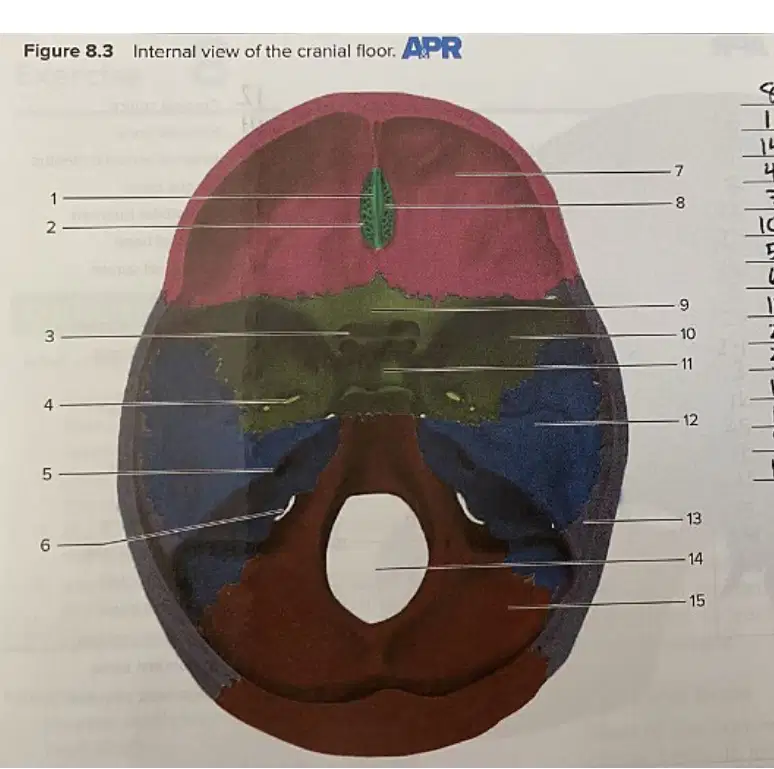
In the internal view of the cranial floor, label 2 corresponds to which anatomical structure?
Olfactory foramen
Sella turcica
Foramen magnum
Petrous part of temporal bone
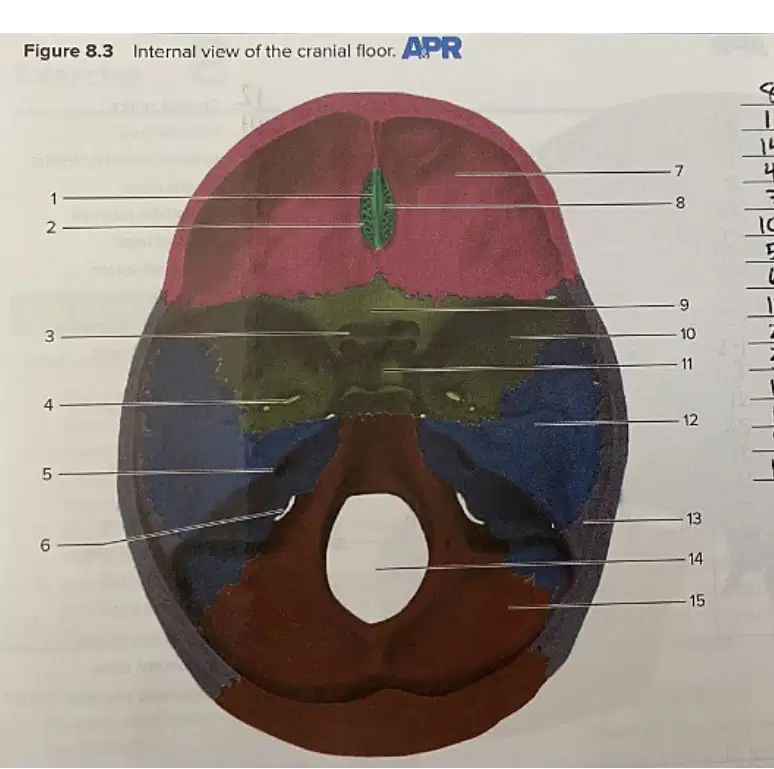
In the internal view of the cranial floor (Figure 8.3), label 3 corresponds to which anatomical structure?
Optic canal
Cribriform plate.
Sella turcica.
Jugular foramen.
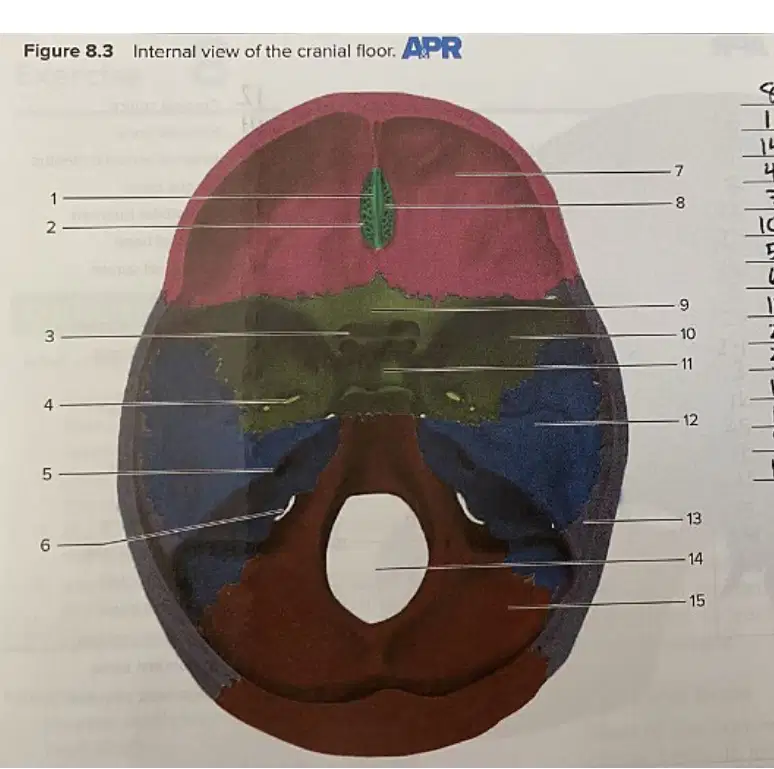
In the internal view of the cranial floor (Figure 8.3), label 4 corresponds to which anatomical structure?
Foramen ovale.
Foramen spinosum.
Jugular foramen.
Foramen lacerum.

In the internal view of the cranial floor (Figure 8.3), label 5 corresponds to which anatomical structure?
Internal acoustic meatus
Occipital bone
Temporal bone
Sphenoid bone
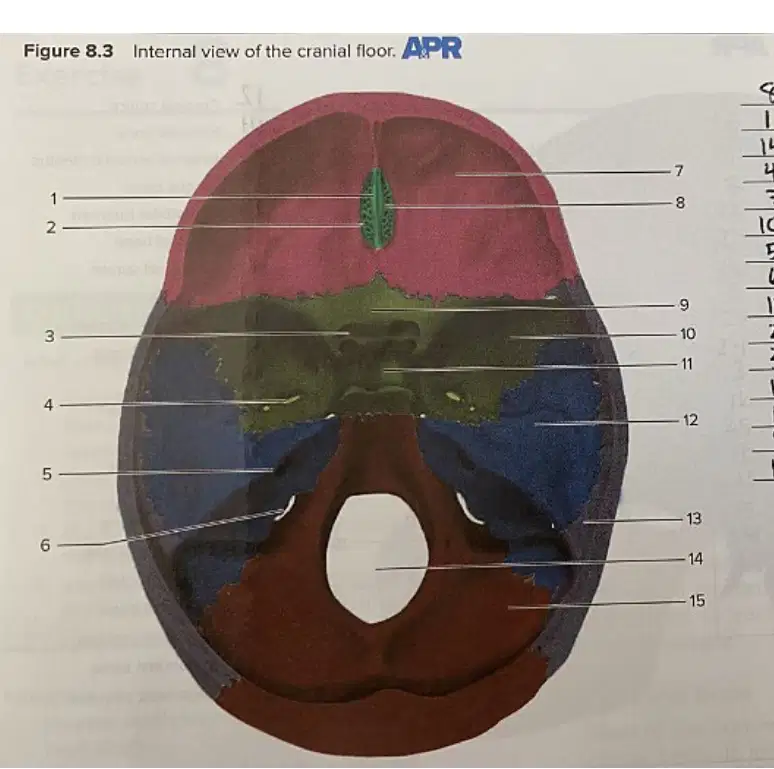
In the internal view of the cranial floor (Figure 8.3), label 6 corresponds to which anatomical structure?
Jugular foramen
Cribriform plate of the ethmoid bone.
Petrous part of the temporal bone.
Foramen magnum of the occipital bone.
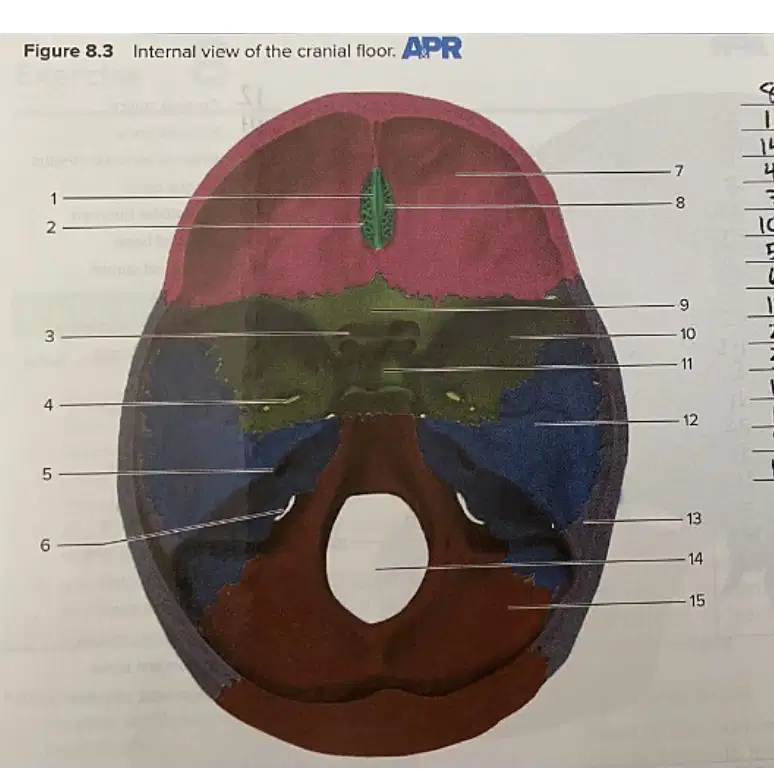
In the internal view of the cranial floor (Figure 8.3), label 7 corresponds to which anatomical structure?
Frontal bone
Foramen ovale
Jugular foramen
Hypoglossal canal
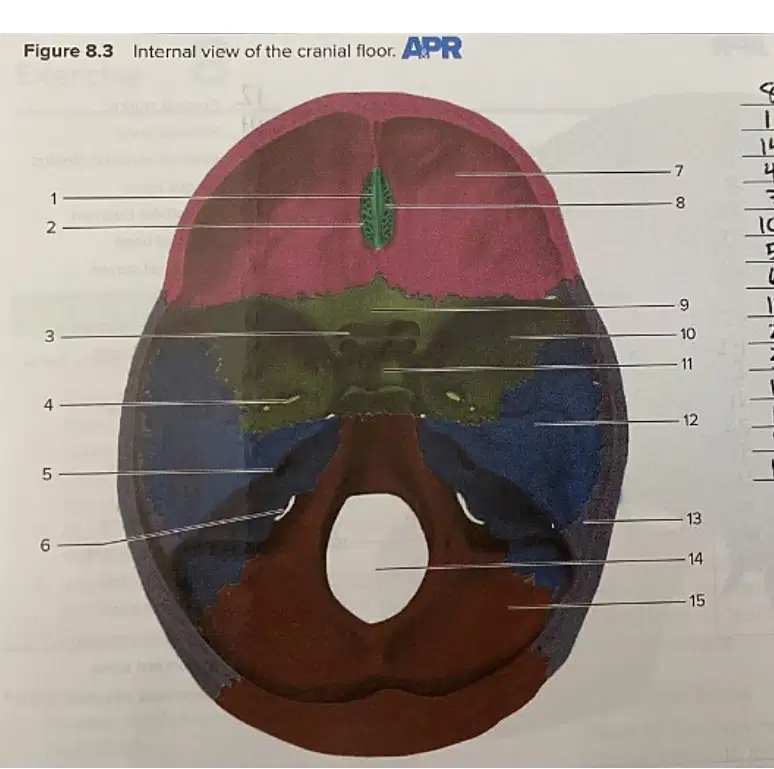
In the internal view of the cranial floor (Figure 8.3), label 8 corresponds to which anatomical structure?
Cribiform plate of ethimoid bone
Foramen ovale
Optic canal
Cribriform plate
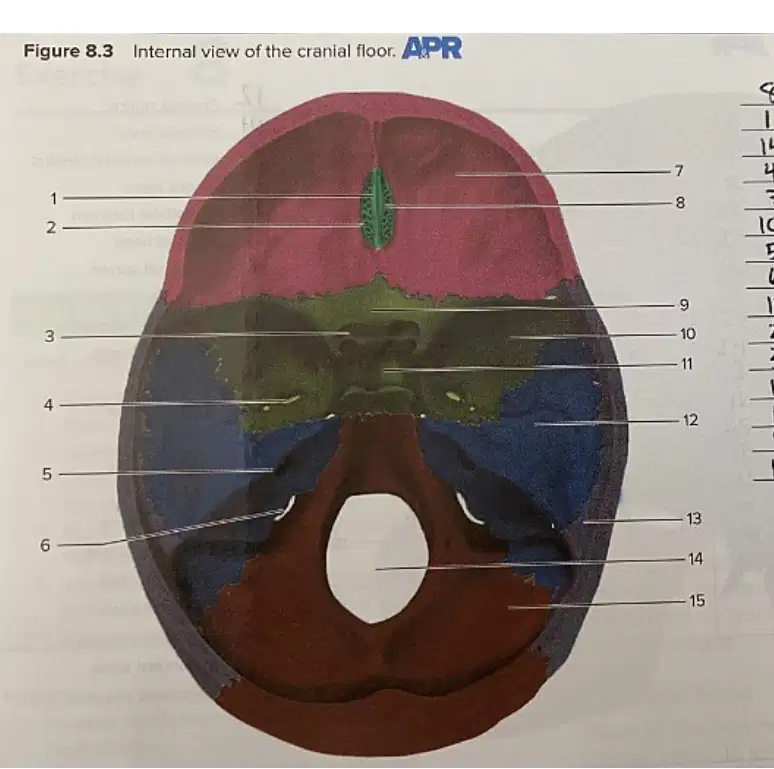
In the internal view of the cranial floor (Figure 8.3), label 9 corresponds to which anatomical structure?
Sphenoid bone
Parietal bone
Temporal bone
Ethmoid bone
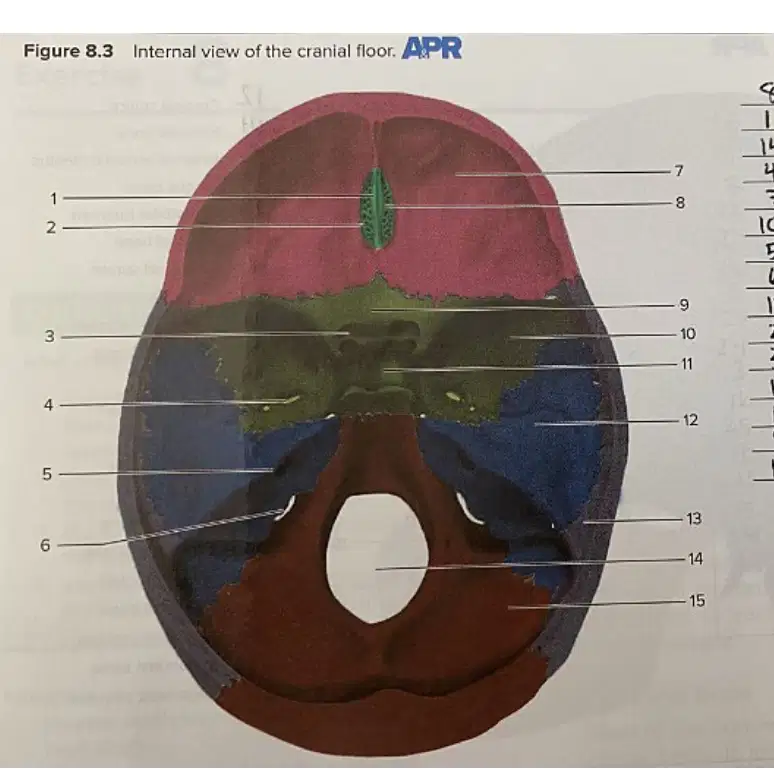
In the internal view of the cranial floor, label 10 corresponds to which anatomical structure?
Greater wing of the sphenoid bone
Foramen magnum
Sella turcica
Cribriform plate
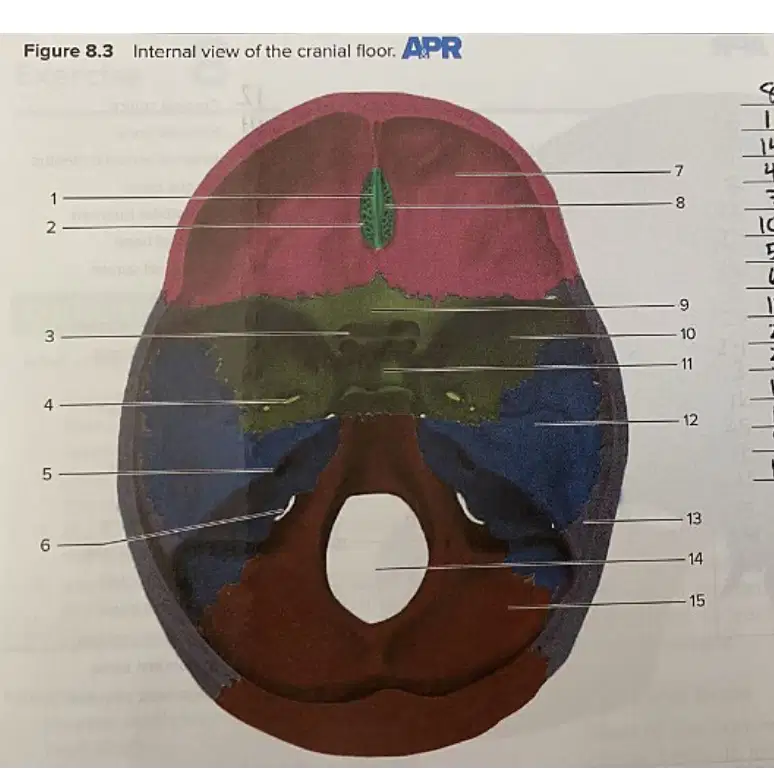
In the internal view of the cranial floor (Figure 8.3), label 11 corresponds to which anatomical structure?
Sella turcica
Foramen magnum.
Cribriform plate.
Jugular foramen.
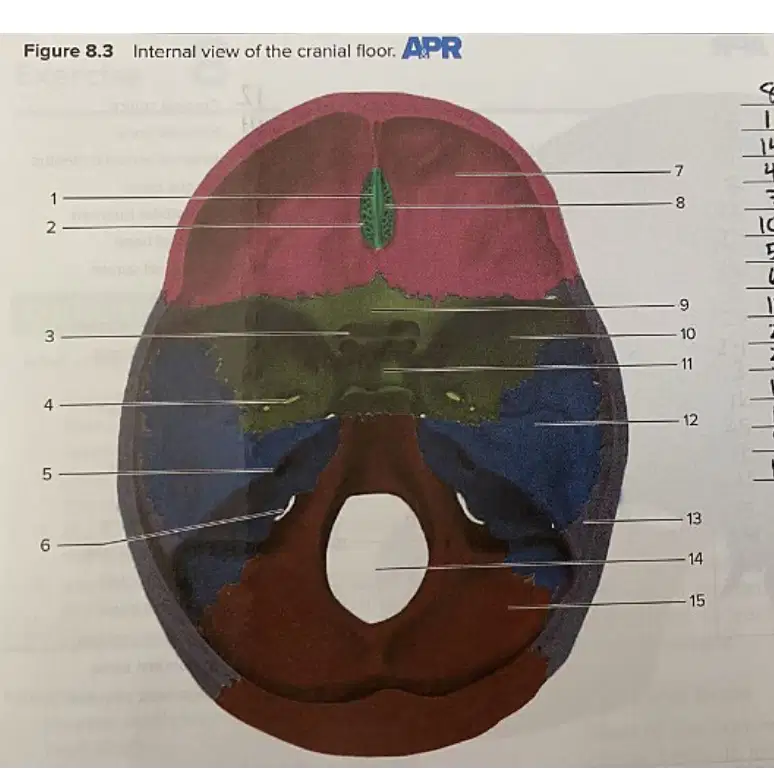
In the internal view of the cranial floor (Figure 8.3), label 12 corresponds to which anatomical structure?
Parietal bone
Temporal bone
Occipital bone
Sphenoid bone
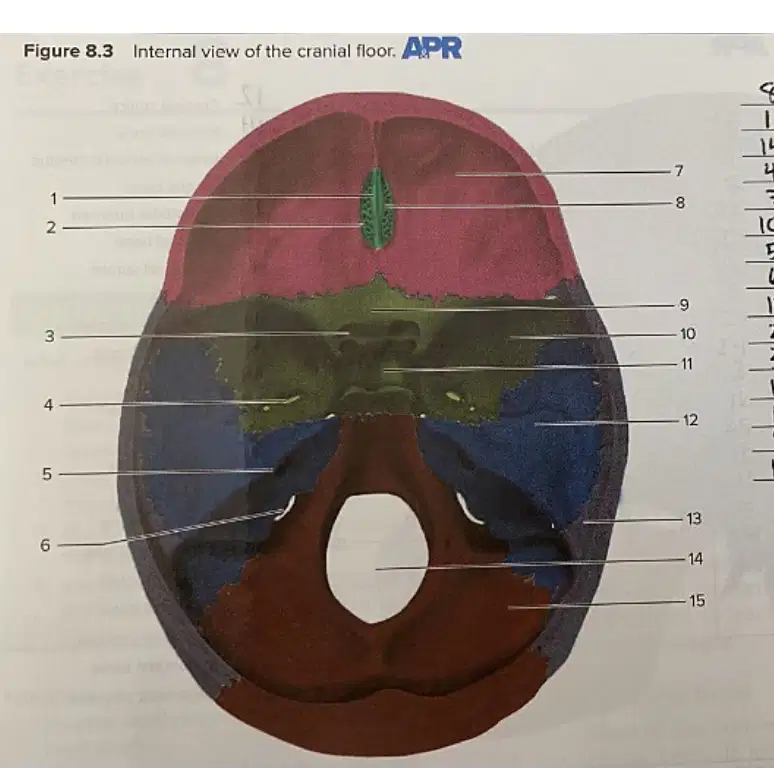
In the internal view of the cranial floor (Figure 8.3), label 13 corresponds to which anatomical structure?
Parietal bone
Cribriform plate.
Foramen magnum.
Petrous part of temporal bone.
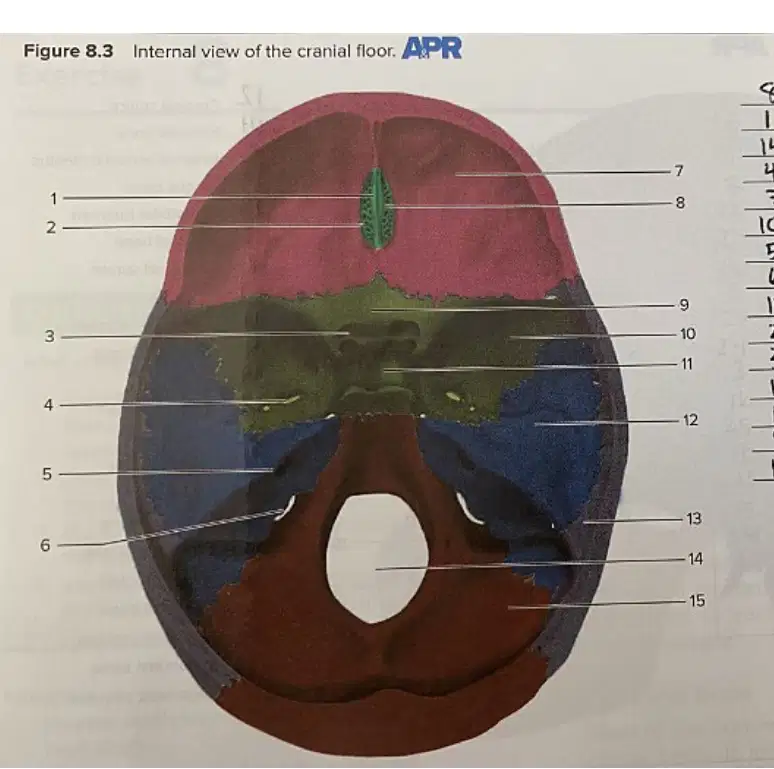
In the internal view of the cranial floor (Figure 8.3), label 14 corresponds to which anatomical structure?
Foramen magnum
Temporal bone.
Occipital condyle.
Cribriform plate.
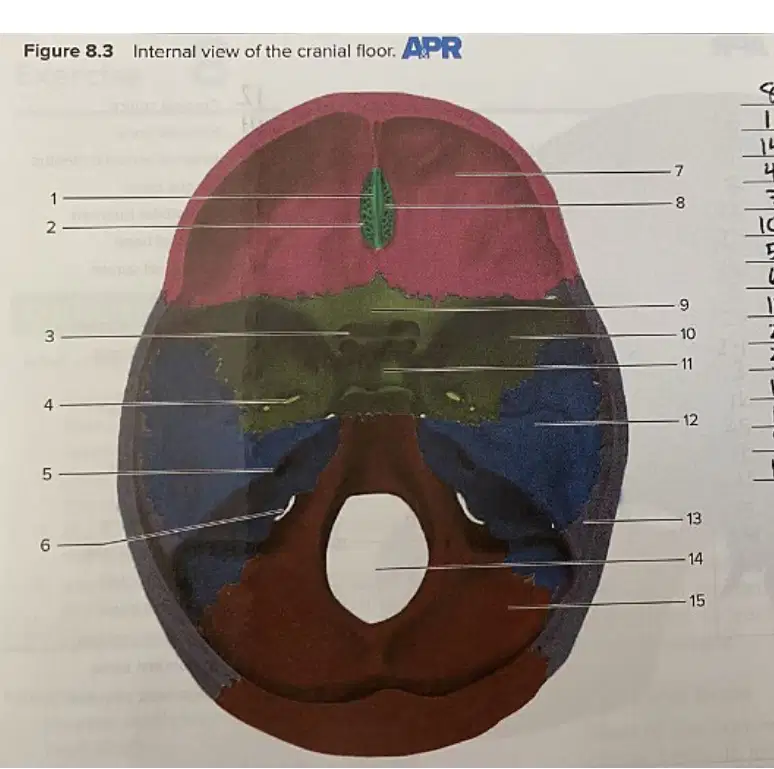
In the internal view of the cranial floor, label 15 corresponds to which anatomical structure?
Temporal bone
Occipital bone
Sphenoid bone
Ethmoid bone
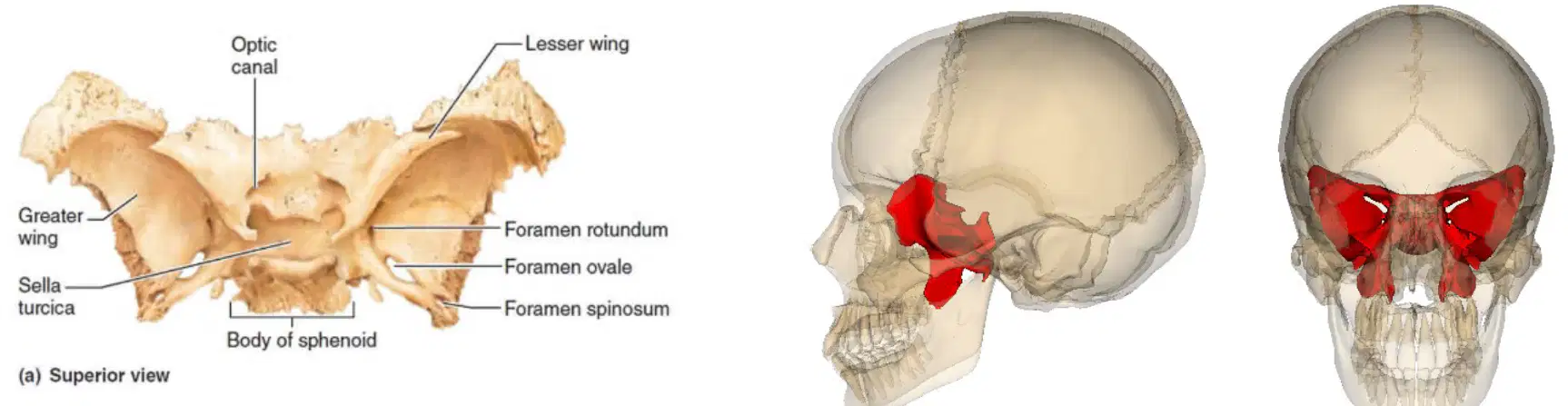
Where is the sphenoid bone located?
In the arm
In front of the temporal bone and part of the eye socket
In the leg
In the rib cage
The shape of the sphenoid bone can be compared to the shape of a ________.
butterfly
starfish
diamond
leaf
Which of the following is true about the sphenoid bone?
It is located in the leg
It forms part of the eye socket
It is shaped like a star
It is part of the rib cage
Where is the ethmoid bone located?
At the top of the nose and in between the two eye sockets
At the back of the skull
In the lower jaw
In the ear
What are the main functions of the ethmoid bone?
Protection of vital organs in the region and support of the nose and orbits
Chewing food
Hearing
Movement of the jaw
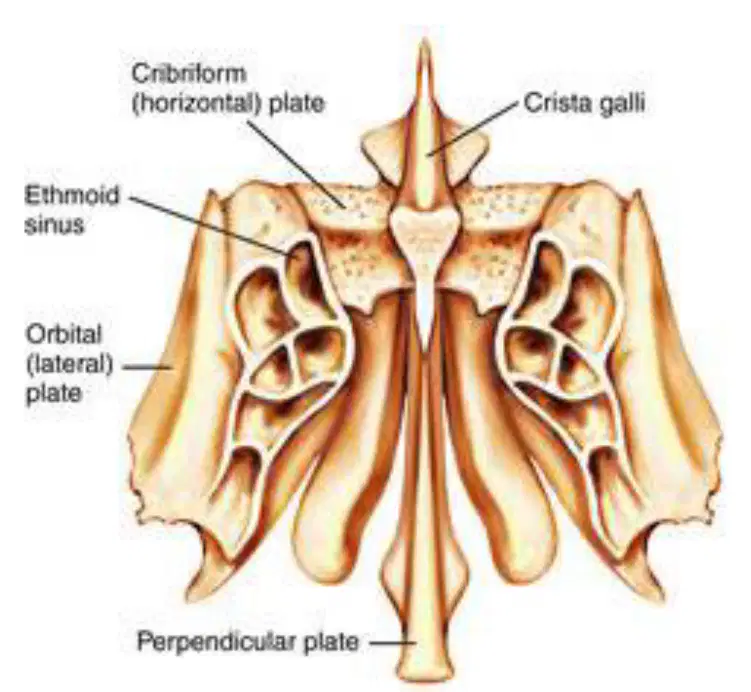
Label the following parts of the ethmoid bone diagram:
Cribriform (horizontal) plate, Crista galli, Ethmoid sinus, Orbital (lateral) plate, Perpendicular plate.
Sphenoid body, Pterygoid process, Greater wing, Lesser wing, Sella turcica.
Temporal squama, Zygomatic process, Mastoid process, Styloid process, Petrous part.
Frontal sinus, Supraorbital margin, Glabella, Nasal spine, Orbital plate.
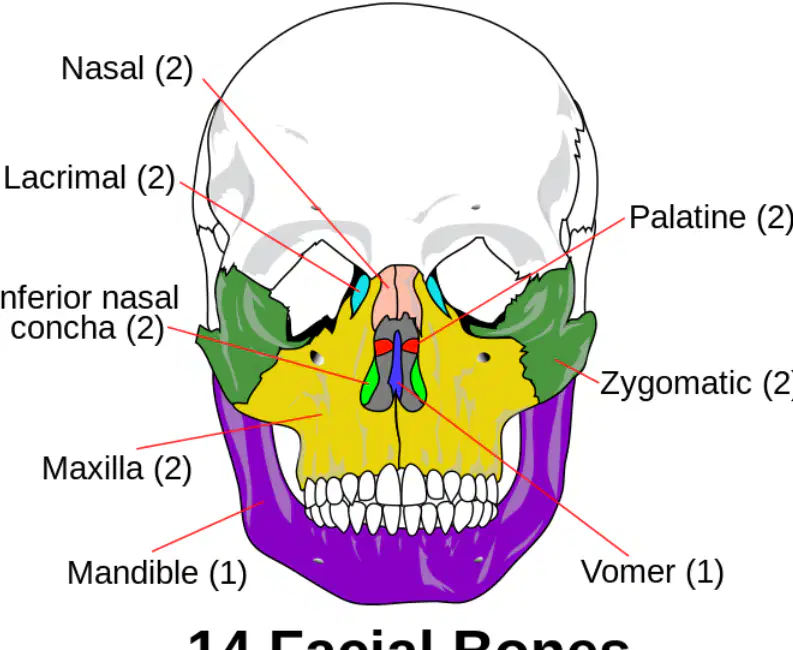
How many Nasal bones are there in the human face?
2
1
4
6
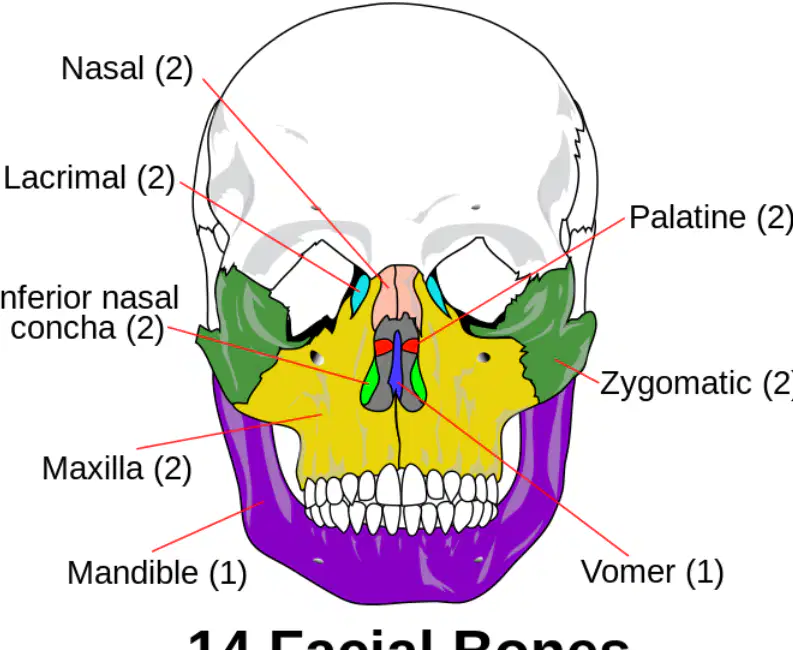
How many Lacrimal bones are there in the human face?
2
1
4
6
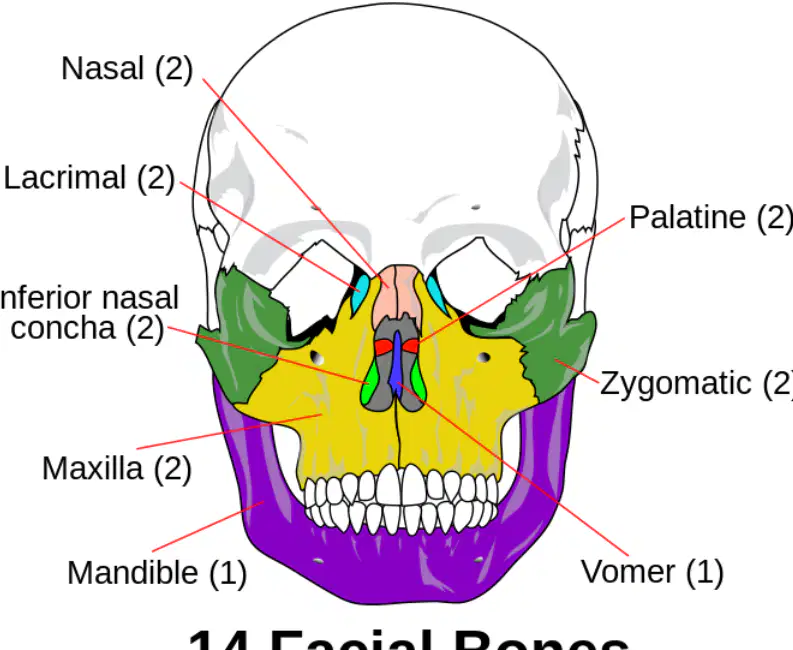
How many Inferior nasal concha bones are there in the human face?
2
1
4
6
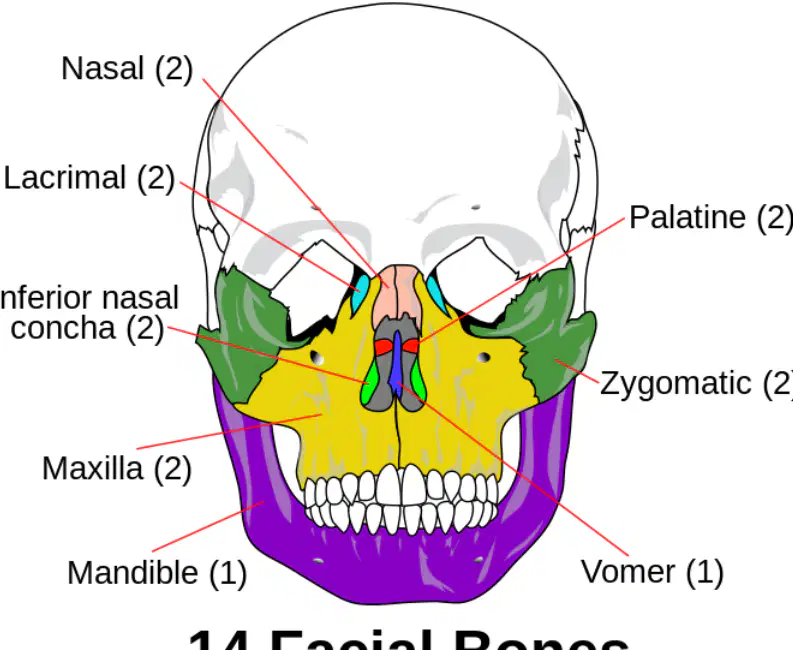
How many Maxilla bones are there in the human face?
2
1
4
6
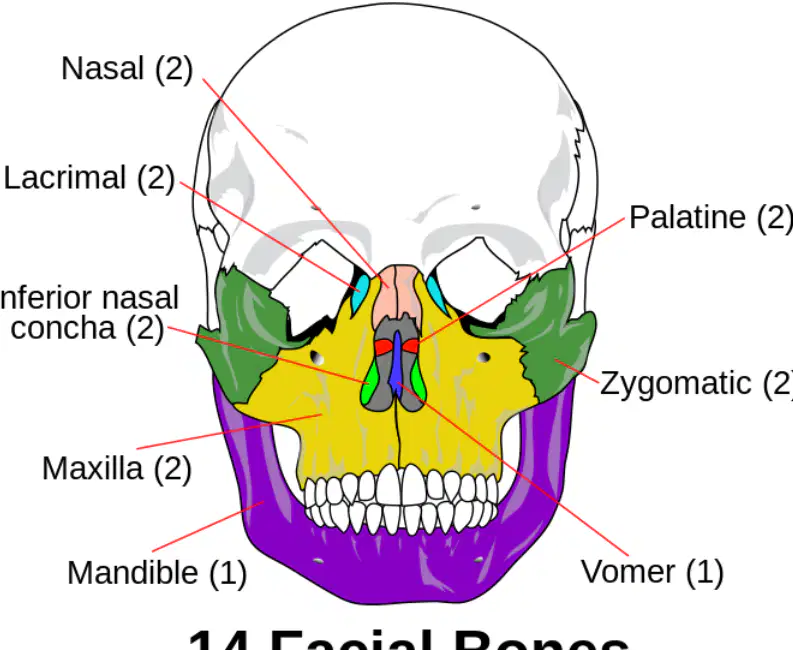
How many Mandible bones are there in the human face?
1
2
4
0
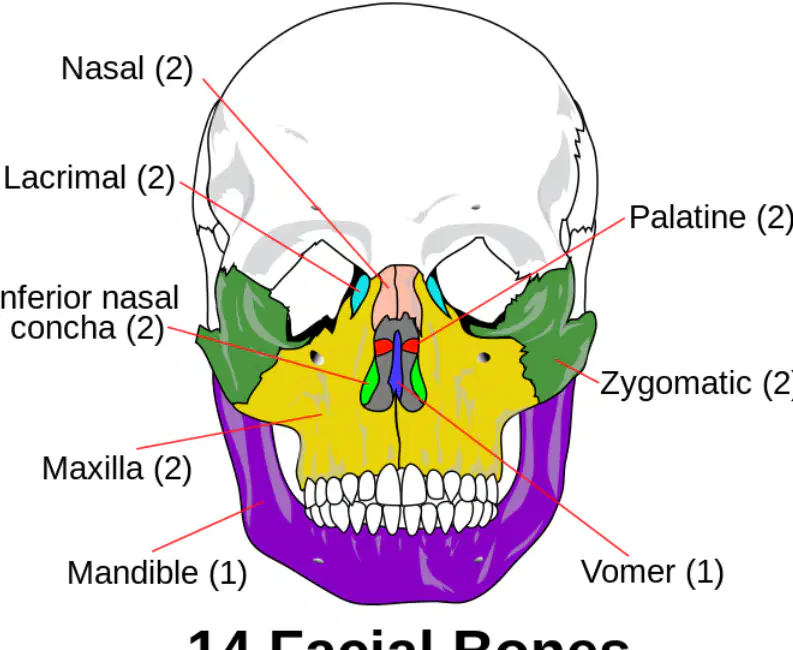
How many Palatine bones are there in the human face?
2
4
1
6
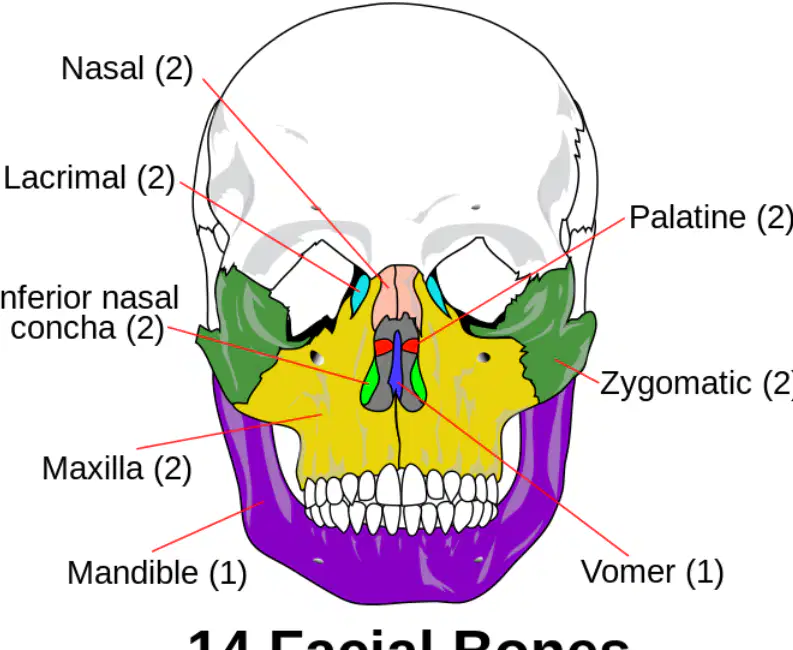
How many Zygomatic bones are there in the human face?
2
1
4
6
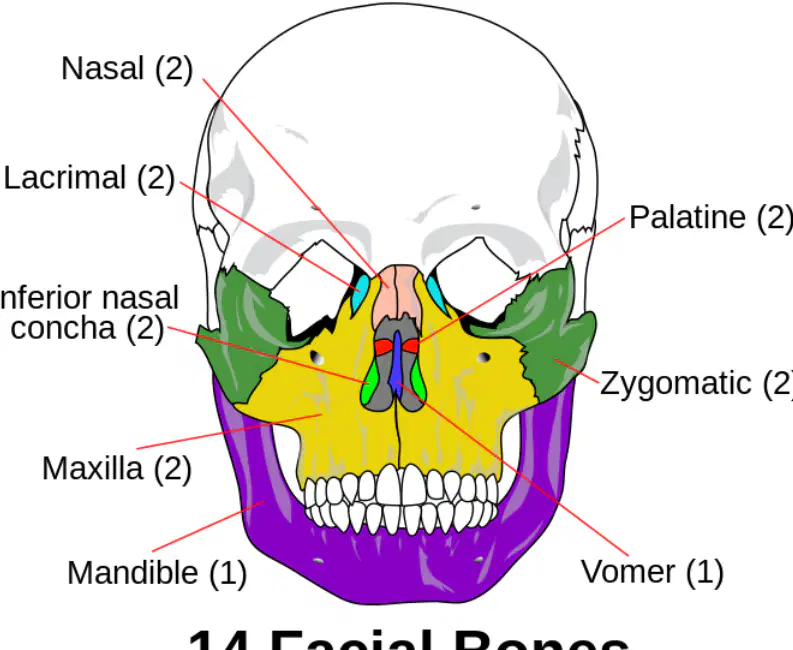
How many Vomer bones are there in the human face?
1
2
3
4
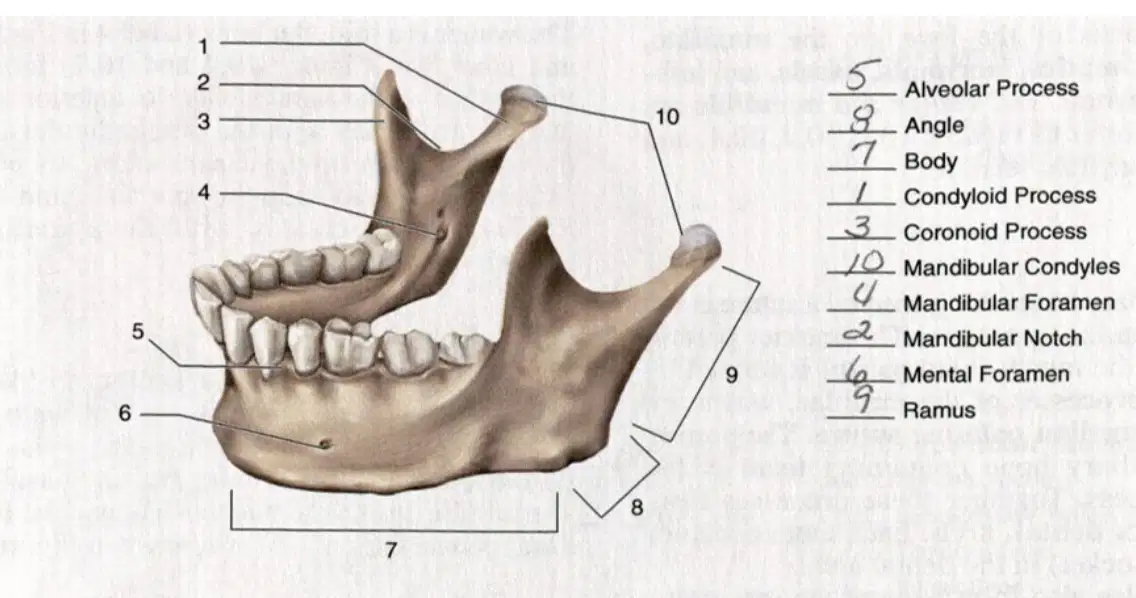
Fill in the blank: The part of the mandible labeled as 6 in the diagram is called the ________.
Mental Foramen
Coronoid Process
Mandibular Condyle
Ramus
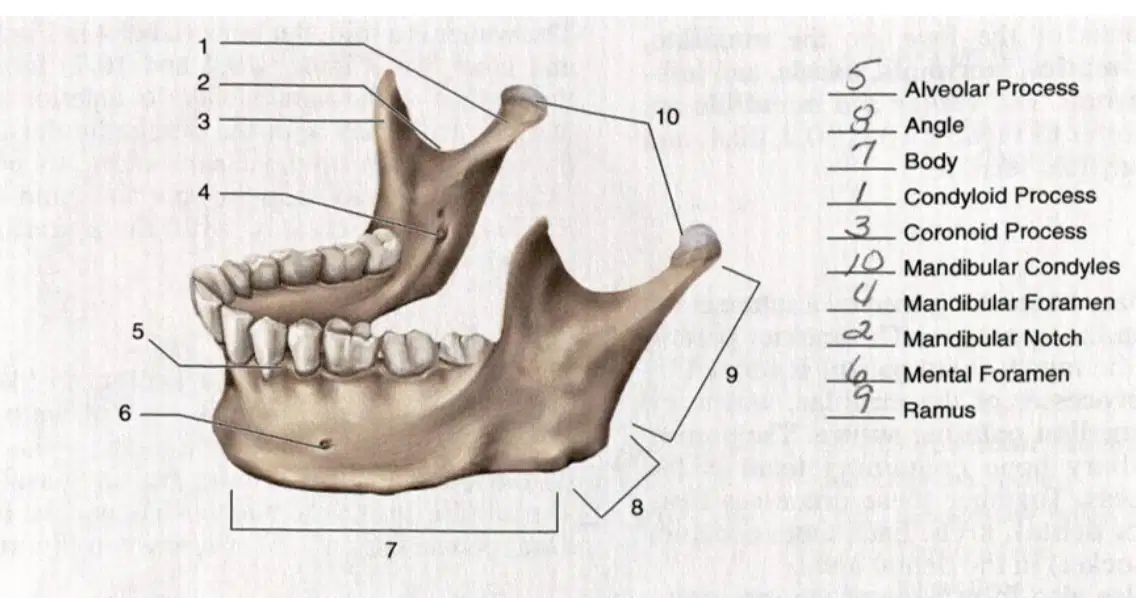
Fill in the blank: The part of the mandible labeled as 7 in the diagram is called the ________.
Body
Ramus
Coronoid process
Angle
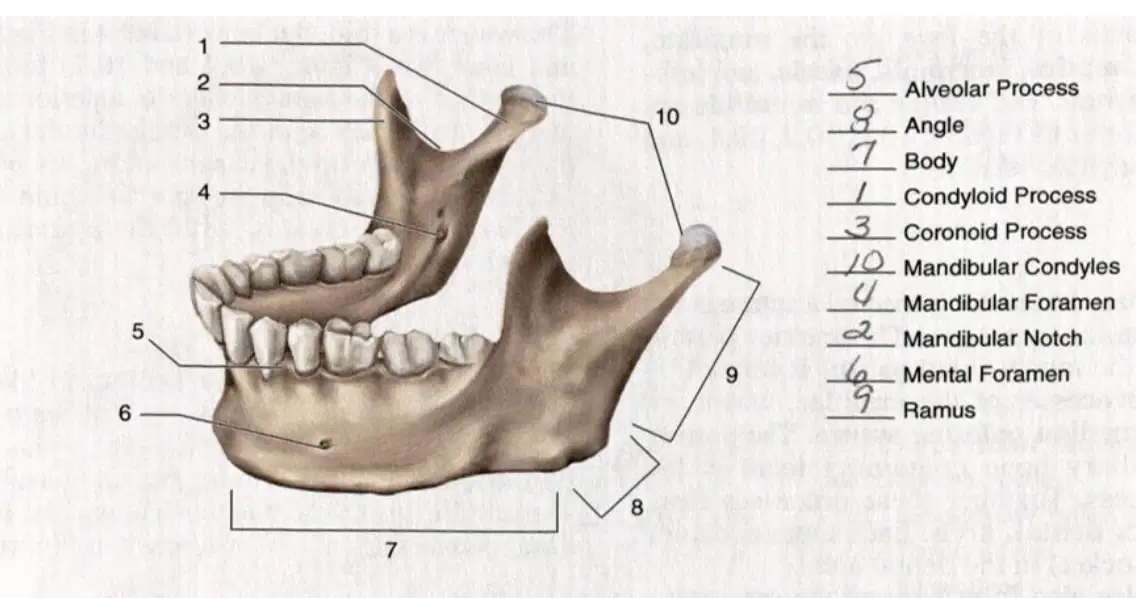
Fill in the blank: The part of the mandible labeled as 8 in the diagram is called the ________.
Angle
Body
Ramus
Coronoid process
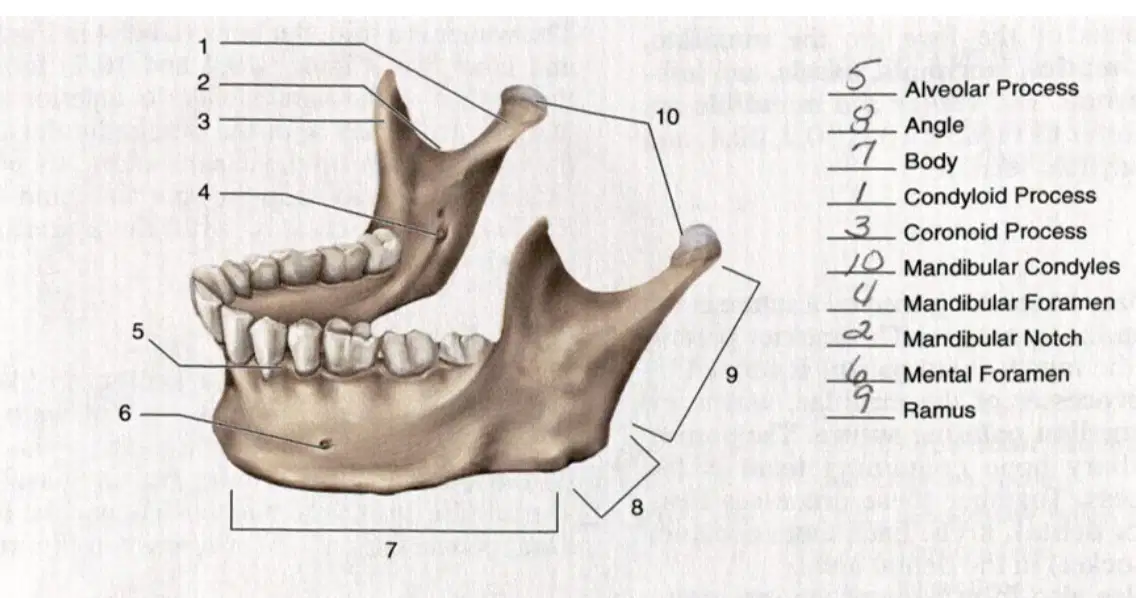
Fill in the blank: The part of the mandible labeled as 9 in the diagram is called the ________.
Ramus
Coronoid process
Mental foramen
Body
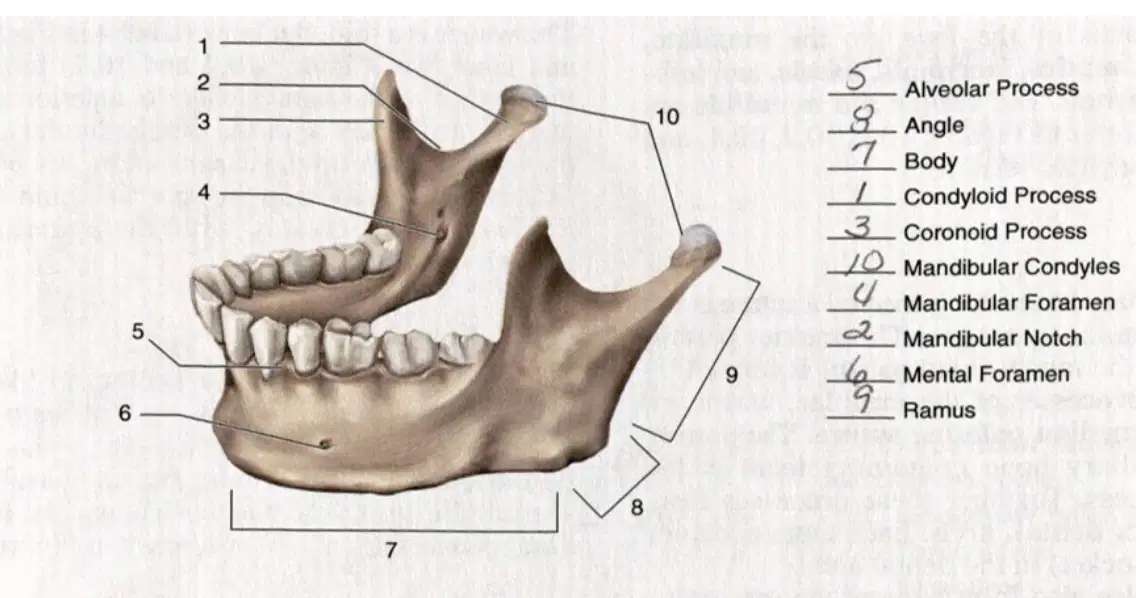
Fill in the blank: The part of the mandible labeled as 1 in the diagram is called the ________.
Condyloid Process
Condylar Process
Mental Foramen
Ramus
Cavities found in the interior of the maxilla, frontal, sphenoid, and ethmoid bones are called _________.
paranasal sinuses
alveoli
lacunae
fontanelles
The paranasal sinuses are filled with ________.
air
blood
mucus
water
Which of the following structures connects muscle to bone?
Ligament
Cartilage
Tendon
Fascia
What is the term for a 'Rounded articular surface' found at the end of some bones?
Condyle
Fossa
Crest
Spine
Which bone forms the lower jaw?
Maxilla
Mandible
Frontal bone
Temporal bone

