
 Worksheets
Fingerprint Analysis Exam
Total questions: 59
Worksheet time: 40mins
How has technology impacted fingerprint analysis?
It has made fingerprint analysis less reliable
It has advanced the world of fingerprint analysis
It has made fingerprint analysis obsolete
It has slowed down fingerprint analysis
What is one benefit for law-enforcement officers being able to submit prints at a traffic stop?
They can analyze fingerprints manually
They can quickly find people with outstanding arrest warrants
They can quickly determine guilt in a traffic violation
Explain how the use of the IAFIS national database might improve the efficiency of solving crimes.
It allows officers to avoid using technology
It enables quick comparison and identification of fingerprints nationwide
It eliminates the need for fingerprint evidence
What type of evidence are fingerprints mostly considered?
Class evidence
Individual evidence
Circumstantial evidence
Physical evidence
How have biometrics impacted the ability to establish one’s identity?
Made it more difficult
Had no effect
Improved it
Replaced fingerprints entirely
Explain why the use of biometrics, in addition to fingerprints, might be important in establishing a person's identity. Use reasoning based on the information provided.
Biometrics provide additional methods to confirm identity, making identification more reliable.
Biometrics are less accurate than fingerprints.
Biometrics are not accepted in legal cases.
What system replaced manual fingerprint analysis in 1999?
NGI
AFIS
Rap Back
AI Contract
In 2014, what new features did NGI add for teachers, day care workers, and others so that updated criminal information gets back to the agency who issues licenses and to employers.
Biometric data and AI contract
Iris and scars data
Facial recognition and Rap Back
Open crimes database
What are the raised portions of skin on fingers called?
Friction ridges
Ridge creases
Finger wrinkles
Ridge furrows
Why are the minutiae marks left by finger ridges considered important in forensic science?
They are considered group evidence
They are considered individual evidence
They are considered class evidence
They are considered circumstantial evidence
Where do ridge patterns of fingerprints grow?
Epidermal layer
Dermal layer
Basal layer
Surface layer
Which of the following can alter fingerprint ridge patterns?
Washing hands frequently
Exposure to sunlight
Scars with damage to the dermal layer
Wearing gloves
Which of those below explain why scars that damage the basal layer may alter fingerprint patterns, while superficial injuries do not.
Because the basal layer is where ridge patterns are formed, so damage here can change the pattern permanently.
Because superficial injuries heal quickly and do not affect the underlying ridge patterns.
Because the epidermal layer regenerates fingerprints, but the basal layer does not.
Which type of fingerprint is visible without any special treatment?
Patent fingerprints
Plastic fingerprints
Latent fingerprints
Magnetic fingerprints
What distinguishes plastic fingerprints from other types of fingerprints?
They are visible prints
They are actual indentations left in soft material
They are not visible to the unaided eye
They are made with ink
Which type of fingerprint is not visible to the unaided eye and often requires special techniques to be detected?
Patent fingerprints
Plastic fingerprints
Latent fingerprints
Inked fingerprints
A detective finds a fingerprint that is an actual indentation in a bar of soap at a crime scene. What type of fingerprint is this most likely to be?
Patent fingerprint
Plastic fingerprint
Latent fingerprint
Digital fingerprint
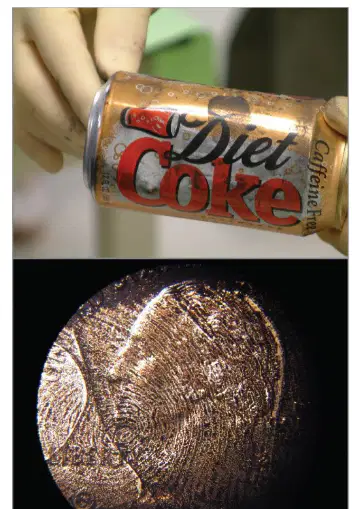
Based on the images, which type of fingerprint might require magnification or special lighting to be seen?
Patent fingerprint
Plastic fingerprint
Latent fingerprint
Visible fingerprint
Which of the following is NOT one of the basic ridge patterns found in fingerprints?
Loops
Arches
Whorls
Spirals
What percentage of fingerprints are classified as loops?
5%
30%
65%
50%
What is the ridge count in fingerprint analysis?
The number of loops in a fingerprint
The number of ridges between the core and center of the delta
The number of whorls in a fingerprint
The number of arches in a fingerprint
If a fingerprint is named for its general visual appearance and is found in only 5% of the population, which type is it most likely to be?
Loop
Arch
Whorl
Spiral
A forensic scientist finds a fingerprint with two deltas and a circular pattern. Based on the information provided, which type of fingerprint is this most likely to be?
Loop
Arch
Whorl
Spiral
What are the unique ridge characteristics details that are found in fingerprints called?
Minutiae
Ridges
Pores
Furrows
Which system currently evaluates over 20 minutiae patterns in fingerprints?
IAFIS (Integrated Automated Fingerprint Identification System)
DNA Analysis System
Retina Scan System
Voice Recognition System
Is there a standard number of minutiae patterns used for fingerprint identification?
No, there is no standard
Yes, 10 patterns
Yes, 54 patterns
Yes, 20 patterns
Why might the lack of a standard number of minutiae patterns be significant for fingerprint identification systems?
It can lead to inconsistencies in identification results.
It makes fingerprints invisible.
It increases the speed of identification.
It eliminates the need for computers.
What is the other name for "lakes" in fingerprint patterns?
Small enclosure
Small fragment
Double convergence
Bridge
What is the term for the point where a single ridge splits into two ridges in a fingerprint?
Dot
Bifurcation
Lake
Hook (spur)
Why are minutiae patterns important in forensic science?
They help identify the age of a person
The match provides individual evidence
They determine the color of fingerprints
They show how fingerprints are formed
According to the traditional minimum standard, how many pattern matches are required for a positive ID in England?
10 points matching
12 points matching
16 points matching
20 points matching
Which countries require 12 points matching for a positive ID according to the traditional minimum standard?
England only
US, Germany, Australia
France, Italy, Spain
Canada, Mexico, Brazil
What factor does the number of pattern matches required for a positive ID depend on?
The color of the print
The quality of prints and if it is a partial or full print
The age of the person
The type of ink used
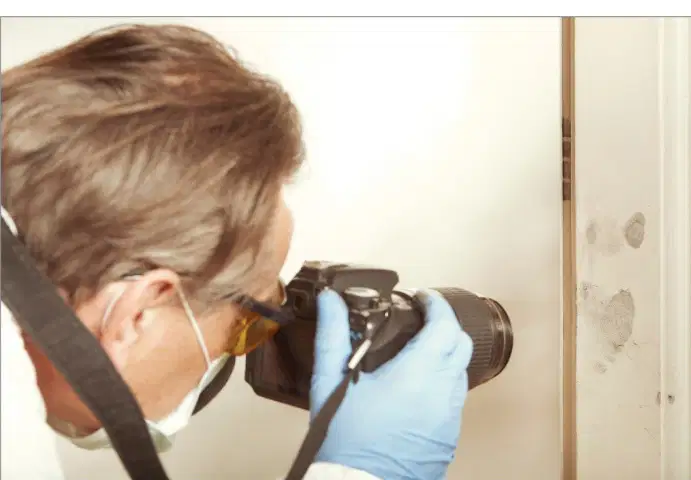
What is one of the main focuses of training for CSIs in the collection and documentation of fingerprints?
Where to look for fingerprints
How to make fingerprints
How to erase fingerprints
How to make casts for plastic fingerprints
Why is it important for CSIs to learn how to enhance fingerprints during their training?
To make the fingerprints more visible for analysis
To change the fingerprint pattern
To remove fingerprints from the scene
To create new fingerprints
A CSI is at a crime scene and needs to document a fingerprint found on a door. What is the first procedure to follow after finding the print?
Photograph and document the fingerprint
Move the print to the fingerprint card
mix plater for casting the fingerprint
Cover the fingerprint with tape
Which of the following is NOT commonly used when photographing fingerprints?
Alternative light sources
Lasers
LED devices
X-ray machines
Why is it important to photograph fingerprints where they are (in situ) before lifting them?
To ensure the fingerprint is not damaged during lifting
To make the fingerprint more visible
To avoid using alternative light sources
To clean the surface before lifting
Suppose you are at a crime scene and need to collect evidence. Which method would you use if you find a visible fingerprint left in a soft material like a bar of soap?
Collecting patent prints
Collecting plastic prints
Collecting suspect prints
Collecting latent fingerprints
Who is responsible for making the initial assessment of a fingerprint in forensic analysis?
Police officer
Fingerprint expert
Crime scene photographer
Laboratory technician
What is the main purpose of the initial assessment in fingerprint analysis completed by the fingerprint expert?
To match the fingerprint to a suspect
To determine if the fingerprint has adequate quality and quantity of features
To clean the fingerprint sample
To photograph the minutiae
Why is it important for a fingerprint to have adequate quality and quantity of features during forensic analysis?
It makes the fingerprint look better in photographs
It ensures the fingerprint can be properly analyzed and identified
It helps the fingerprint dry faster
It allows the fingerprint to be stored longer
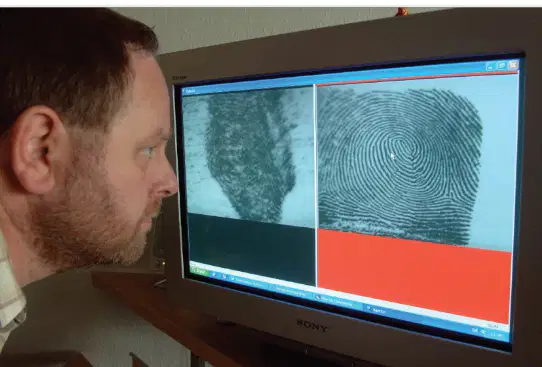
What is the likely role of the person shown in the image?
Crime scene investigator
Fingerprint expert conducting an initial assessment
Suspect under investigation
Laboratory cleaner
Label the finger prints correctly
Arch
Loop
Whorl

Which type of fingerprint is shown in the image below if it came from the right index finger?
radial loop
ulnar loop
plain whorl
central pocket whorl


Enclosure (or lake or eye)
Hook (or spur)

What is the name of this minutiae?
Bifurcation (or fork)
Splitting Ridge
Delta
Y
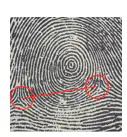
•is located between two deltas of the whorl pattern and has a minimum of one ridge that is continuous around the pattern
plain whorl
central pocket loop whorl
double loop whorl
accidental whorl
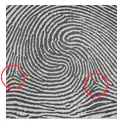
•is made up of two loops that swirl around each other
plain whorl
central pocket loop whorl
double loop whorl
accidental whorl

What type of minutiae is this?
trifurcation (triple fork)
opposed bifurcation
ridge crossing
opposed bifurcation/ridge ending
A (a) fingerprint is a three-dimensional fingerprint made in soft material such as clay, soap, or putty.

arch

whorl

loop

tented arch
Match the following minutiae.

ridge ending

bifurcation

enclosure or lake

island

bridge


Plain Whorl
Central Pocket Whorl
Enter which of the 8 types of fingerprints you found that you have.

