
 Worksheets
Benchmark 1 Review (Biology I) - Part I
Total questions: 25
Worksheet time: 13mins
Name
Class
Date
1.
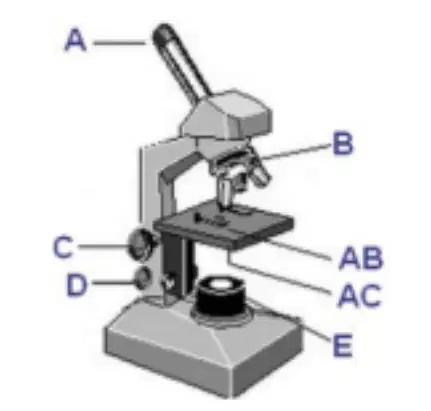
On the image, which letter represents the objective?
a)
A
b)
B
c)
C
d)
D
e)
E
2.
A microscope has a 4X ocular lens and a 10X objective. What is the total magnification?
a)
4X
b)
14X
c)
40X
d)
400X
3.
To focus a specimen, it is best to start with which objective?
a)
High powered
b)
Low powered
c)
Scanning
d)
Ocular
4.
A baby song bird hatches from its egg with both parent songbirds watching.
a)
All living things reproduce
b)
All living things maintain homeostasis
c)
All living things use energy
d)
All living things grow and develop
5.
A tulip opens in the morning at sunrise and closes in the evening at sunset.
a)
All living things have cells
b)
All living things use energy
c)
All living things respond to their environment
d)
All living things grow and develop
6.
A teacher said to the students, "Water is often considered a universal solvent". Which student's response could be used as evidence to reinforce this statement?
a)
"I remember that water works like magnets and has poles, causing the molecules to stick together. This helps many items to dissolve."
b)
"I believe that the universe has some planets that have water on them and others do not. However, Earth is the only planet that has water in all 3 phases."
c)
"I wonder how many gallons of water are on Earth. If we solved that problem that would take us a very long time."
d)
"I do think that water can be used to solve many problems in the universe. Everything needs water to live."
e)
"I know that there is more water on the Earth than land. Most of that water is salt water from the oceans: about 97 percent."
7.
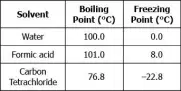
A teacher lists some solvents with their boiling point and freezing point temperatures, as shown.
She asks her students to predict the particle motion of the solvents at different temperatures. Which prediction(s) is/are correct?
a)
At 78°C, water molecules slide past each other.
b)
At – 2°C, water molecules have large spaces between them.
c)
At – 25°C, carbon tetrachloride molecules vibrate at non-fixed positions.
d)
At 106°C, formic acid molecules move with the lowest energy.
8.
Substance X changes from liquid to vapor at 100°C. What process happens to the substance at 100°C?
a)
Melting
b)
Freezing
c)
Boiling
d)
Condensing
9.

A student performed an experiment to show that dark colors absorb more heat than lighter colors. The student painted five test tubes with different colors and placed them in a test tube rack. He then added equal amounts of water to each test tube and left them in the sun for six hours. At the end of this he recorded the temperature of the water in each test tube using a thermometer. The table shows the data he collected.
Which statements show that the experiment was carried out using suitable controlled variables?
a)
Pouring an unequal amount of water in each of the test tubes
b)
Using sunlight for heat rather than other sources
c)
Using exactly five test tubes in the experiment
d)
Exposing all the test tubes under the sun for a fixed time
10.
Which of the following describe the properties and behavior of water as a solid?
a)
Floats on liquid water
b)
Molecules have free space to move
c)
Takes the shape of its container
d)
Molecules most tightly packed
11.
For scientific data to be considered accurate and reliable, how often should scientific experiments be repeated?
a)
Conducted as many times as possible
b)
Conducted 3 times
c)
Conducted only 1 time
d)
Repeated no more than 2 times
12.
Homeostasis means —
a)
the equivalent of evolution
b)
the maintenance of a stable internal environment
c)
a gradual change over long periods of time
d)
the rate of metabolism
13.
Capillary action is the process of water molecules moving upwards through a narrow tube, such as a plant steam. What characteristic of water causes this process?
a)
Solubility
b)
Adhesion
c)
Hydrogen bonds
d)
Surface tension
14.
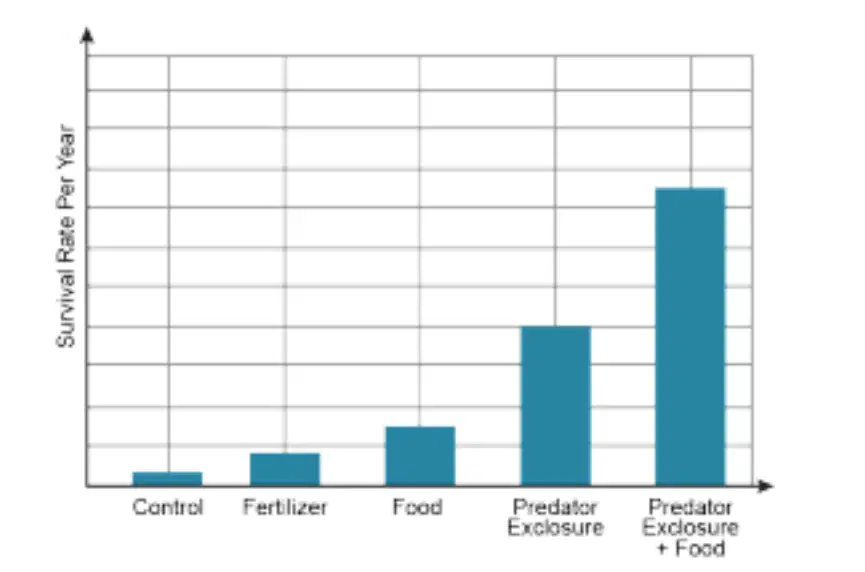
Scientists set up field experiments to study the influence of food abundance and predation on snowshoe hare over the course of eight years. They tested blocks of forest with either fertilizer treatments to increase plant production, supplemental food, electric fences to exclude predators, or supplemental food with electric fences.
The graph shows the average survival rate per year of the horseshoe hare under the influence of food abundance and predation.
Which one explains the experimental results?
a)
Horseshoe hare survival rate decreased with exclusion of predators compared to control.
b)
Abundance of food alone does lead to dramatic increases in horseshoe hare survival rate.
c)
An increase in resource availability did not lead to increased horseshoe hare survival rate in the control.
d)
An increase in resource availability combined with a decrease in predation drastically increased horseshoe hair survival rates.
15.
Which of the following statements concerning pH is correct?
a)
An acidic solution has an increased concentration of hydroxide ions in a solution.
b)
A basic solution will feel slippery and have a high pH.
c)
A basic solution could have a pH of 4.
d)
An acidic solution has a pH more than 7.
16.
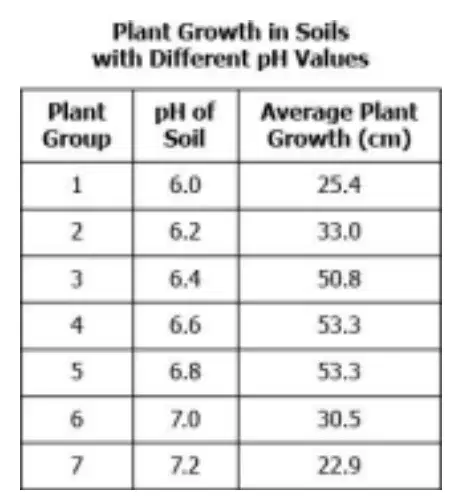
A researcher conducts an experiment in which he grows basil plants in soils of different pH values. He makes 7 groups of 10 basil plants each. Each group is grown in a soil of a different pH and the average growth of the plants is recorded after one month. The table above shows the data recorded.
What could be the possible reasons for the investigation?
a)
To demonstrate that a basil plant can grow in soils of all pH levels
b)
To determine if soil pH is a limiting factor for growth of basil plants
c)
To establish a pH range in which basil plants will not grow
d)
To identify if growing basil plants affect the pH level of the soil in which they grow
17.
What is the function of the microtubules inside a eukaryotic cell?
a)
The microtubules transport proteins from one side of the cell to the other.
b)
The microtubules are responsible for the synthesis of ATP.
c)
The microtubules provide locations where organelles can attach.
d)
The microtubules help facilitate the production of lipids that comprise cell membranes.
18.
A student used buffer solutions of pH 4 and pH 9 to calibrate the laboratory pH meter. He noticed that the pH reading was higher than 4 and 9 for the two solutions. Which factor would most affect the difference in the actual pH and the recorded pH of the solution?
a)
The potential rate of error of the pH meter
b)
The concentration of the solutions
c)
The volume of solutions being used to check the pH
d)
The size of the electrode in the pH meter
19.
During a lab, you accidentally break something, You should:
a)
Run screaming from the room
b)
Ignore the problem, hoping it will go away
c)
Throw your neighbor’s coat over it
d)
Notify your instructor immediately
20.
Which statement is true of carbohydrates?
a)
Carbohydrates form biological catalysts known as enzymes.
b)
Carbohydrates are a source of energy.
c)
Carbohydrates are major components of cell membranes.
d)
Carbohydrates carry the genetic information in plants.
21.
Bacilli, cocci and spirilla are used to describe —
a)
stains used to identify prokaryotes
b)
cellular shapes of prokaryotes
c)
methods of prokaryotes obtaining energy
d)
structures prokaryotes can use for movement
22.

Which cell or cells are eukaryotic?
a)
Cell B
b)
Both cell A and B
c)
Cell A
d)
Neither cell A or B
23.
Molecules of DNA are made of long chains of —
a)
amino acids
b)
fatty acids
c)
nucleotides
d)
simple sugars
24.

Milk has a pH that is less than pure water, but greater than coffee. What is the pH of milk?
a)
6
b)
8
c)
7
d)
5
25.
When using high power, what to not adjust
a)
coarse adjustment knob
b)
fine adjustment knob
c)
diaphragm
d)
stage clips
100 %

