
NEW
Font size
 Worksheets
Types of Collisions and Effects Worksheet
Total questions: 37
Worksheet time: 19mins
Which type of collision is this an example of? A baseball crashes into a window and breaks it.
A
B
C
Which type of collision is this an example of? Two shopping carts roll toward each other in a parking lot and smash together, bending their frames.
A
B
C
Which type of collision is this an example of? A glass vase falls off a table and shatters when it hits the floor.
A
B
C
Which type of collision is this an example of? A balloon drifts across the room and bumps into a wall, then bounces away.
A
B
C
Which type of collision is this an example of? Two rubber balls roll toward each other and bounce apart.
A
B
C
Whether the window breaks or not when you throw a ball towards it depends on what?
The force with which the ball hits the window
The color of the ball
The time of day
The number of people playing catch
Which term means up and down?
vertical
horizontal
A collision can cause the objects involved to change ______ and/or change motion.
shape
color
temperature
sound
When any two objects collide, they each exert ____ on each other.
forces
contact
energy transfer
When objects collide, one will transfer ___ to the other.
energy
color
shape
mass
Can a force change the shape of an object?
Yes, a force can change an object’s shape (like bending, stretching, or squashing it).
No, a force can only make an object start or stop moving (like a push or a pull).
Yes, but only if the object breaks into pieces (if the force is great enough).
How are energy transfer and force related during contact forces, like in a collision?
A force only changes motion, not energy.
Force and energy transfer are the same thing.
Energy transfer happens first, and then a force appears.
The force between objects is how energy is transferred from one to the other.
In science, what do we call "a push or a pull"?
force
energy
collision
A force that an object experiences due to contact with another object is called a
collisional force
contact force
What happened to the concrete beam when a lot of force was applied to it?
it cracked
nothing happened
it bent
How do the atoms of a solid differ from a liquid?
Solid and liquid atoms move the same way.
Solid atoms move in all directions; liquid atoms stay stuck in place.
Solid atoms are packed close and only vibrate in place; liquid atoms can slide past each other.
Why don't liquids and gases change shape in collisions?
Their particles can move around each other, so they don’t keep a fixed shape.
The atoms in a liquid or gas are too light to be affected by collisions.
They are stronger than solids, so collisions don't affect them.
Liquids and gases can stretch but always come back to their original form.
What unit of measurement did we use for FORCE?
newton
spring scale
damage
What measurement tool did we use to measure force?
Newton scale
ruler
spring scale

Look at the data for two different materials. Which material deformed the most easily?
Material A
Material B
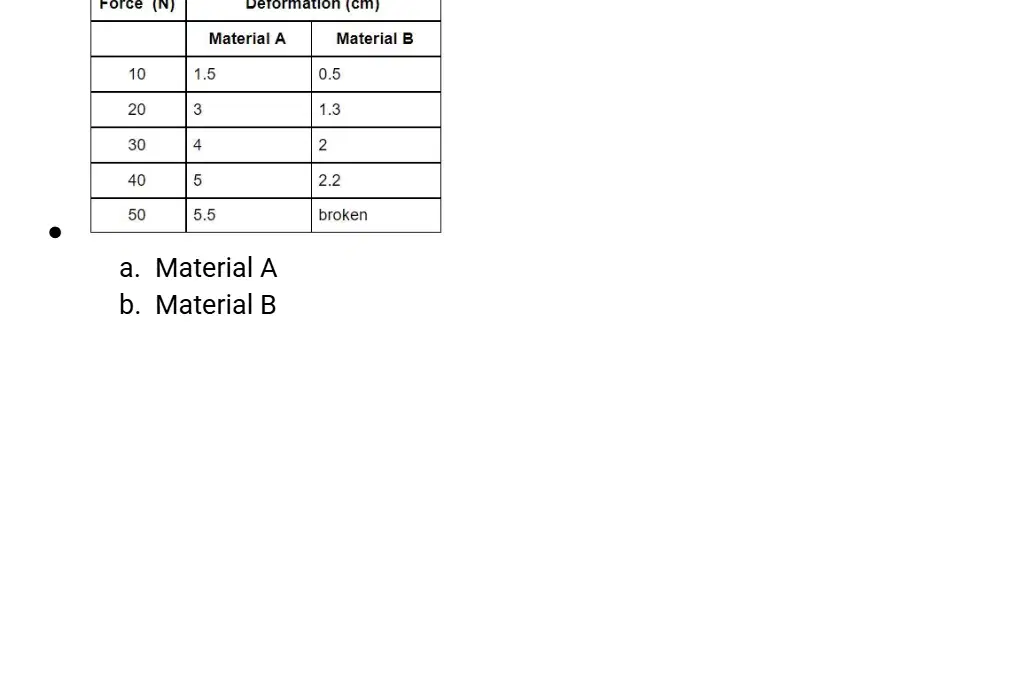
Which material had the lowest breaking point?
Material A
Material B
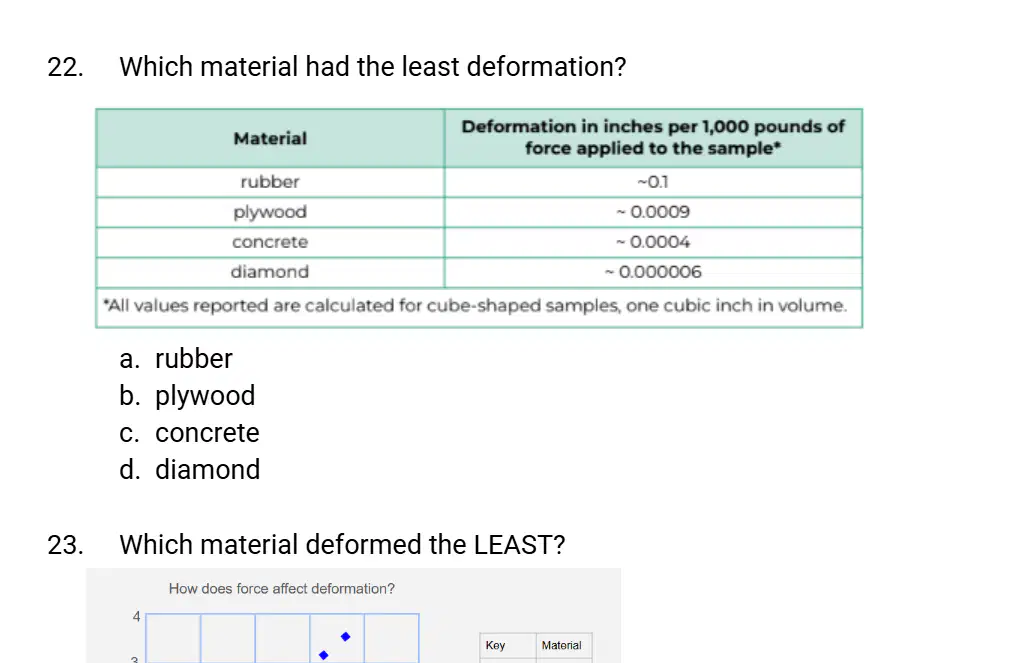
Which material had the least deformation?
rubber
plywood
concrete
diamond
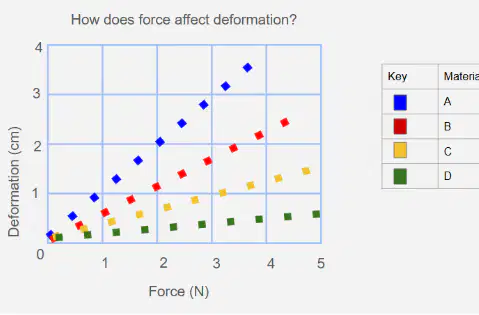
Which material deformed the LEAST?
A
B
C
D
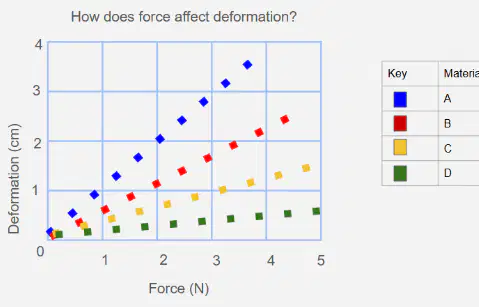
Which material deformed the MOST with 3 N of force?
A
B
C
D
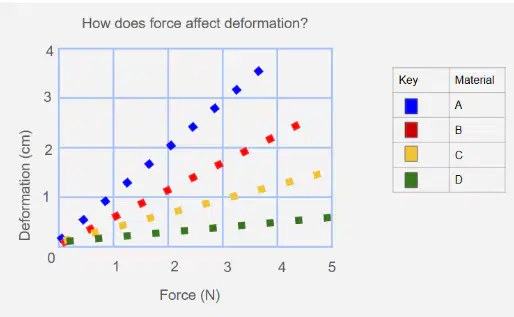
Which material was the least flexible but had the highest breaking point?
A
B
C
D
An independent variable is what you __________________________ in an experiment.
change
measure
A dependent variable is what you __________________________ in an experiment.
measure
change
ignore
predict
How does the weight of the cart affect the force of impact? What is the dependent variable in this investigation?
weight of the cart
force of impact
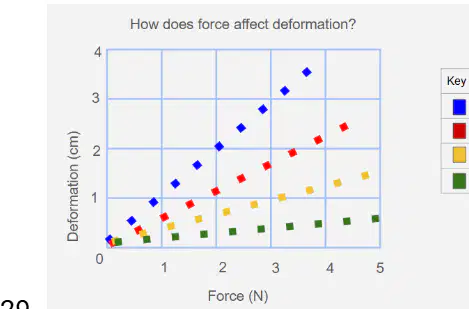
How does force affect deformation? (Refer to the graph provided) What is the Independent Variable in this investigation?
deformation
force
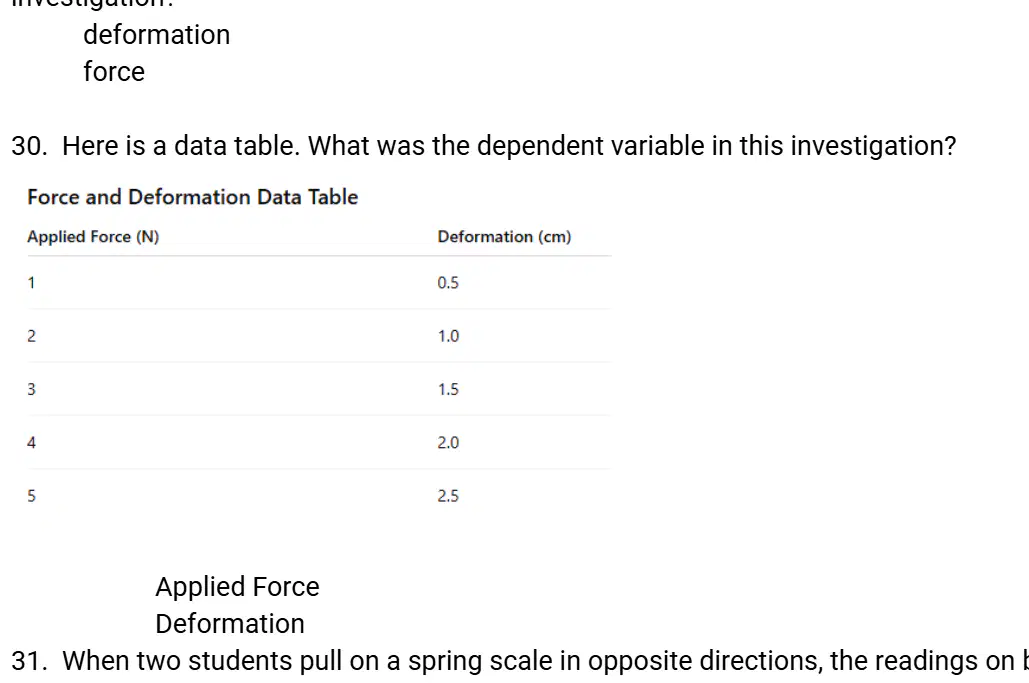
What was the dependent variable in this investigation?
Applied Force
Deformation
When two students pull on a spring scale in opposite directions, the readings on both scales are the same. What does this show?
One student is stronger than the other
The scales do not measure correctly
Contact forces are equal in strength but opposite in direction
Forces only act on one of the objects
When you push one fingertip against another fingertip, what happens?
Only your finger pushes; the other finger does not
Both fingers push back with equal force
The harder you push, the weaker the other finger pushes
Only the smaller finger feels the force
Spring scales help us observe which aspect of forces?
The magnitude of forces
The direction of forces
The speed of forces
The color of forces
When two objects interact, the forces that they exert on each other are _____ and opposite.
equal
unequal
random
parallel
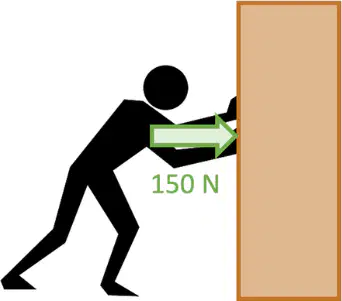
The diagram below shows an individual pushing a wall with a force of 150 N. What will be the size of the force that the wall exerts on the individual?
0 N
75 N
150 N
300 N
The individual now pushes against the wall harder and exerts a force of 300 N. What will be the size of the force that the wall now exerts on the individual?
0 N
75 N
150 N
300 N
If a cell phone lands on the ground with a force of 100 N, how much force is the ground pushing back with?
0 N
100 N
200 N

