
 Worksheets
U2 - Settlements Test Review
Total questions: 80
Worksheet time: 28mins
Which of the following inventions contributed to European domination of the world?
Castle
Catapult
Compass
Gunpowder
By the 1700's, European nations used their American colonies as a source of:
gold and silver for jewelry to trade with Spain.
raw materials for making manufactured goods.
livestock for working land and transportation.
slaves for working the cotton and tobacco farms.
Which device introduced around 1730 could help the navigator find the latitude of the ship by determining the altitude of the sun or stars?
Astrolabe
Magnetic Compass
Mercator projection
Sextant
Mercantilism can best be described as:
the idea that a colony should be self sufficient and able to provide for itself.
the idea that a nation needs to strongly equip its colonies to defend itself in case of foreign attack.
the idea that the religion of a colony should differ from the religion of the mother country.
the idea that a nation’s power is related to its wealth and needs a favorable balance of trade with its colonies.
Which of the following was a key goal of mercantilist economic policy?
Encourage free trade between nations.
Increase a nation's wealth through accumulation of precious metals.
Promote equal trade balances with all countries.
Discourage the establishment of overseas colonies.
Which economic activity did settlers in the New England colonies NOT participate?
fishing
shipbuilding
agriculture
trading
The English founded the colony _________, but many of the colonists would not work.
Massachusetts Bay Colony
New Netherland
Jamestown
Rhode Island
The people who wanted to change the Church of England by removing the false teachings and practices were called_____________.
Puritans
Europeans
Separatists
colonists
The process by which a foreign country comes to control the resources and humans of a distant and distinct area of land
Genocide
Colonization
Geographical
Settlement
The Colonies of Massachusetts, Maryland and Pennsylvania were all established for________
Religious Purposes
Economic Purposes
Political Reasons
empire expansion
Which of the following is the primary reason that European rulers became interest in trans-Atlantic exploration beginning in the 15th century?
They were curious about whether or not the world was round.
They were seeking an oversea trade route to Asia.
They wanted to become allies with Western Hemisphere natives.
They were looking to relocate their European empires to a new continent.

What is the Columbian Exchange?
A group of people settling in a new land under their native country's rule
The exchange of goods, ideas, and diseases between the Old and New World
Spanish conquerors claiming land in the Americas
French fur traders in North America

Who were the conquistadors?
A group of people who settle in a new land under their native country's rule
The exchange of goods, ideas, and diseases between the Old and New World
Spanish conquerors in the Americas
French fur traders in North America
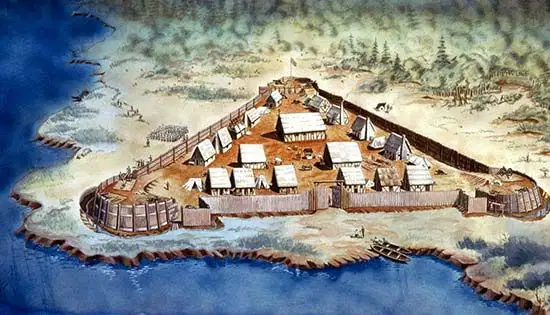
Where was the first English colony in North America?
Jamestown, Virginia
Plymouth, Massachusetts
New York, New York
Philadelphia, Pennsylvania
What impact did European diseases have on Native American populations?
European diseases led to an increase in Native American populations
European diseases had no impact on Native American populations
European diseases caused widespread illness and death among Native American populations
Native American populations were immune to European diseases
What were the main goals of Spanish colonization in South America?
Establish peace and harmony
Promote democracy and freedom
Protect the environment and wildlife
Acquire wealth, spread Christianity, and expand their empire
What were the main reasons for British colonization in North America?
Economic opportunities, religious freedom, and political autonomy
Scientific exploration, technological advancement, and educational development
Social reform, humanitarian aid, and environmental conservation
Military conquest, cultural assimilation, and territorial expansion
What were the effects of the British colonization on the Native American tribes?
Displacement, loss of culture, introduction of diseases, forced assimilation
Voluntary relocation, enhanced healthcare, educational opportunities, economic empowerment
Peaceful coexistence, economic prosperity, cultural exchange, technological advancement
Integration, preservation of culture, improved living conditions, mutual respect
What were the main challenges faced by indigenous populations as a result of European colonization?
Peaceful coexistence with Europeans
Acceptance and integration into European society
Loss of land, forced assimilation, diseases, and violence
Economic prosperity and growth

The ___ wanted to reform the Anglican Church, while the ___ wanted to leave the church altogether.
separatists / puritans
British / Americans
puritans / separatists
Catholics / Protestants

Which reason best completes this list?
To spread democratic ideals
To improve efficiency
To locate potential military allies
To claim new territory
What was the first legislature made up of elected representatives in Jamestown called?
Virginia Company
House of Burgesses
Mayflower Compact
Senate

Which 4 colonies makes up the Mid-Atlantic/Middle colonies?
New York, Maryland, New Jersey, Pennsylvania
New Jersey, Pennsylvania, Maryland, Rhode Island
New York, New Jersey, New Hampshire, Pennsylvania
New York, Pennsylvania, New Jersey, Delaware

Which 4 colonies makes up the New England colonies?
Massachusetts, New York, New Hampshire, Connecticut
Massachusetts, Connecticut, New Hampshire, Rhode Island
Massachusetts, New York, Connecticut, Rhode Island
Massachusetts, Connecticut, Delaware, New Hampshire

Which 5 colonies makes up the Southern colonies?
Virginia, Maryland, North Carolina, South Carolina, Georgia
Virginia, Delaware, North Carolina, South Carolina, Georgia
Virginia, Pennsylvania, North Carolina, South Carolina, Georgia
Virginia, North Carolina, South Carolina, Georgia, Florida

Which region is also known as the "Breadbasket Colonies?" (Pick 2)
New England
Mid-Atlantic
Middle
Southern

Which region depended on cash crops through slave labor for their economy?
New England
Southern
Middle
Mid-Atlantic

Which region depended on fur trading, whaling, shipbuilding, and fishing for their economy?
Southern
Mid-Atlantic
Middle
New England

Jamestown was founded by...
Captain John Smith
John Rolfe
The Virginia Company
King George II

People who could not afford to come to America agreed to work without pay for a certain number of years is called...
Indentured Servants
Slaves
Settlers
Debtors

Why did the Pilgrims AND Puritans leave England?
To find gold in the Americas
To escape religious persecution; to gain religious freedom
To escape the Inquisition
To escape the tyranny of King George II

The Middle Colonies was known for its ____________ population and religious ________________.
diverse; intolerance
diverse; tolerance
growing; freedom
declining; rules and regulations
What are cash crops?
Trees that grow money
Crops that are grown to be sold for profit
Plants that are really, really tall
Crops that are grown for the farmer to consume
What was the land good for in the Southern Colonies?
fishing
harbors
industry
agriculture
____________________ are things found in nature that are useful to people.
Trees
Sunlight
Renewable Resources
Natural Resources
The most common type of shelters the Catawba utilized
Cofitachequi was the largest native settlement in SC at the time of European exploration.
True
False
Evidence of palisades built by Native Americans prove that they were concerned about attacks from neighboring tribes.
True
False
A style of housing using sticks and mud
Waddle and Daub
Teepee
Which tribe lived along the rivers of the Piedmont region?
Yamasee
Catawba
Cherokee
Which tribe lived near the Savannah River in the southern tip of South Carolina?
Yemassee
Tuscarora
Which tribe used the clay along the waterways to make pottery?
Yemassee

Which region is labeled #1?
Blue Ridge
Coastal Plain
Coastal Zone
The Piedmont
The Sandhills
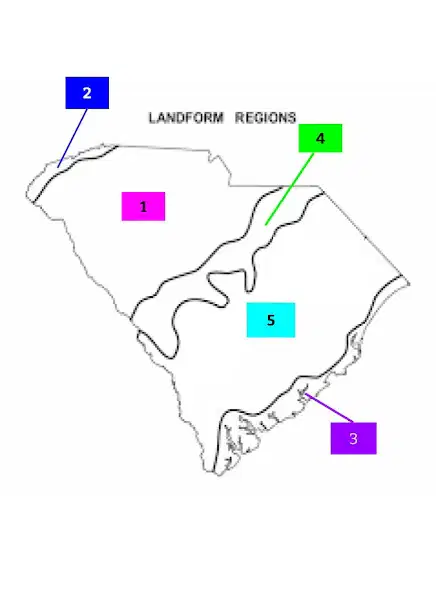
Which region is labeled #3?
Blue Ridge
Coastal Plain
Coastal Zone
The Piedmont
The Sandhills
Which of the following was a major reason for the establishment of the Southern Colonies?
To escape religious persecution
To develop fur trading posts
To seek economic opportunities through agriculture
To promote shipbuilding industries
Which Native American tribe was primarily located in the Piedmont region of South Carolina?
Catawba
Yemassee
Sioux
Cherokee
What was one effect of mercantilist policies on the American colonies?
Colonies developed their own independent governments
Colonies abolished the use of cash crops
Colonies were restricted to trading mainly with the mother country
Colonies could freely trade with any country
Correctly label the South Colonies.
Georgia
Virginia
Maryland
North Carolina
South Carolina
Match the description with the colony
immigrants from many different countries and with many varied cultures
Pennsylvania Colony
people building a settlement near Cape Cod Bay
Plymouth Colony
settlers growing and harvesting tobacco
Virginia Colony
a tree with the word "Croatoan" carved into it
Roanoke Colony
Was settled by people who had been in debtor's prison in England.
Pennsylvania
Jamestown
Georgia
Plymouth Colony
Which colonial region's economy was mostly based on cash crops such as rice, tobacco, indigo, and cotton?
What region of colonies supported their economy with fishing, lumber, and whale blubber?
Match each region to its correct economy
New England Colonies
shipbuilding, whaling and fishing
Middle Colonies
crops and mining
Southern Colonies
plantations, cashcrops, & enslaved labor

This image is depicting what?
salutary neglect
mercantilism
Great Awakening
freedom of speech

How does the information shown in the table reflect a key goal of mercantilism?
Great Britain profited from a favorable balance of trade with the colonies.
Steady economic growth made the colonies less dependent upon Great Britain.
Goods from the colonies made up for declining economic output in Great Britain.
Colonial trade promoted relations between Great Britain and other European powers.

Which region is shaded Dark Green?
Outer Coastal Plain
Which region is shaded Tan?
Outer Coastal Plain
Which region is shaded Light Green?
Outer Coastal Plain
One statement that is true about all Native American culture is
Their geography influenced their lifestyle and culture of each group
They all refused to be peaceful with colonists
All Native American tribes had identical cultures
All Native Americans lived in wigwams
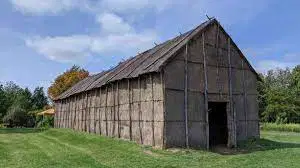
A long home made from birch trees is called
longjohn
wigwam
plankhouse
longhouse
What is the definition of "thatch"?
A type of edible plant commonly used in salads.
A thick, protective coating applied to wooden structures.
A roofing material made from straw, reeds, or palm leaves.
A traditional dance originating from Africa.
This refers to a group of people (or plants) who are native to a particular area.
Indignant
Foreign
Indigenous
Migratory
When Europeans came in contact with the Americas, it marked the start of an extensive exchange of plants, animals, and diseases between the two areas of the world.
Pre-Columbian era
Columbian Effect
Columbian Exchange
Worlds Collision
From the following, select the answer that explains the difference between push and pull factors.
a. Push factors are reasons why you want to fight people while pull factors are factors that influence you to pull someone's hair out
b. Push factors are components that encourage people to want to migrate somewhere while pull factors are conditions that motivate you to leave your current location.
c. Push factors are unfavorable factors that encourage someone to leave a place, while pull factors are elements of a location that motivate you to want to go there.
d. None of these.
What push factors swayed Europeans to travel to the colonies? Select MULTIPLE answers.
a. Increasing poverty because of increasing taxes that went to government reform programs
b. A desire to start a new lifestyle
c. Exploration, since people wanted to discover new trade routes
d. Dissatisfaction with the corruption of the Church of England and its incomplete Reformation

The geographic factors in this table led primarily to the -
founding of trade schools in some colonies
development of different economies in the two regions
establishment of import taxes in some colonies
pattern of religious differences in the two colonies
Which of the following regions is identified by a fertile, flat region characterized by well-drained, sandy soils and a long growing season that has historically made it an agricultural powerhouse for crops like cotton, soybeans, and peanuts?
Piedmont
Sandhills
Inner Coastal Plain
Outer Coastal Plain
Which of the following regions is identified by a location in the central part of the state, often referred to as the Midlands, is characterized by deep, sandy soil, rolling hills, and long-leaf pine forests?
Piedmont
Sandhills
Inner Coastal Plain
Outer Coastal Plain
Match the following
Being resistant to a disease or pathogen
immunity
Originating naturally in a particular place; native
indigenous
A light sailing ship that was faster & easier to maneuver
caravel
A instrument that uses the Earth's magnetic field to show the direction of magnetic north
compass
Hostility & ill-treatment especially on the basis of religion, culture, or political beliefs
persecution

