
 Worksheets
Unit 2 Review Biology
Total questions: 67
Worksheet time: 45mins
What is the process (equation) for photosynthesis?
6CO2 + C6H12O6 --> 6H2O + 6O2
6H2O + 6CO2 --> C6H12O6 + 6O2
6CO2 + C6H12O6 --> 6H2O + Energy
6O2 + C6H12O6 --> 6CO2 + 6H2O

What is the relationship between the plant and the duck?
"A" represents oxygen produced by the duck and "B" represents carbon dioxide produced by the plant
"A" represents carbon dioxide produced by the plant and "B" represents oxygen produced by the duck
"A" represents oxygen produced by the plant and "B" represents carbon dioxide produced by the Duck
"A" represents the sunlight received by the plant and "B" represents the oxygen produced by the duck

Which correctly explains the diagram?
Light Energy to Chemical Energy to Thermal Energy
Light Energy to Thermal Energy to Mechanical Energy
Thermal Energy to Light Energy to Chemical Energy
Thermal Energy to Light Energy to Mechanical Energy
What is produced in the leaves of the plant?
oxygen and water
carbon dioxide only
glucose and oxygen
oxygen only

Which describes the transfer in this image?
Carbon Dioxide from the air becomes glucose in the plant. The deer ingest the glucose and it becomes carbon.
Carbon Dioxide from the air becomes water in the plant. The deer ingest the water and it becomes oxygen.
Oxygen from the air becomes carbon dioxide in the plant. The deer ingest the carbon dioxide and it becomes carbon.
Water from the air becomes Oxygen in the plant. The deer ingest the Water and it becomes Oxygen.
Cellular respiration is the process that our cells use to ….
convert sugar (glucose) into energy (ATP)
break food down into smaller molecules (sugars)
makes acid
breathe
Where do animals get the glucose that is needed for cellular respiration?
from the exercise they get
from the water they drink
from the food they eat
from the sunlight they get
When there is not enough light.....
...the rate of photosynthesis is at the optimum.
...the rate of photosynthesis is limited.
...the rate of photosynthesis will not be affected.
Why does the amount of water affect rate of photosynthesis?
It is produced by the reaction
It is used in the reaction
It affects the enzymes responsible for the reaction
The plant cells have to stay turgid

The following graph represents a plant in a sealed ecosystem where the levels of carbon dioxide (pink) and oxygen (green) can be observed.
Which of the following explains the changes to the gas levels over the 24 hour period?
Carbon increases at night because there is less photosynthesis and more cellular respiration occuring in the plant
Carbon increases during the day because there is less photosynthesis and more cellular respiration occuring in the plant
Oxygen increases at night because there is more photosynthesis occuring in the dark
cellular respiration does not occur in plants, so carbon dioxide decreases during the day in the light and never increases again.

Photosynthesis and cellular respiration both involve taking in and giving off gases. During photosynthesis, what gas is released? (product)
Carbon Dioxide
Glucose
Oxygen
Water
Photosynthesis and cellular respiration both involve taking in and giving off gases. During cellular respiration, what gas is released? (product)
Carbon Dioxide
Glucose
Oxygen
Water
Photosynthesis and cellular respiration both involve taking in and giving off gases. During cellular respiration, what gas is taken in? (reactant)
Carbon Dioxide
Glucose
Oxygen
Water

The products of photosynthesis are the reactants in cellular respiration. What is the purpose of cellular respiration?
To create energy.
To create sunlight.
To create glucose.
To remove energy.

In photosynthesis, which molecule is synthesized as a source of energy for cellular respiration?
Protein
Sunlight
Oxygen
Glucose

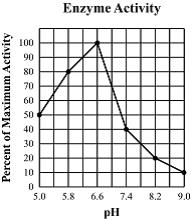
When do enzymes function best?
Under specific temperature and pH levels.
Under perfect atmospheric conditions.
When co-enzymes are present.
In any condition.
Enzymes are an example of
Lipids
Carbohydrate
Protein
Nucleic Acid
Chloroplast
Organelle that does photosynthesis
Organelle that does Cellular Respiration
Organelle that builds protein
Organelle that stores water in plants
Cellular respiration
Process that makes you breathe in CO2
Turning ATP into protein
One cell turning into two identical cells
Using glucose and oxygen to make ATP
Something that has to eat another living thing to get glucose:
Producer
Autotroph
Heterotroph
Plant
The products of photosynthesis are:
CO2 and H2O
the reactants of cellular respiration
sunlight and ATP
plants and other producers
C6H12O6
The reactant of photosynthesis
Glucose: the product of photosynthesis
The product of cellular respiration
Glucose: the energy made by cellular respiration
The difference between aerobic and anaerobic respiration:
Aerobic respiration only occurs in plants and anaerobic respiration occurs in heterotrophs.
Aerobic respiration uses oxygen and anaerobic respiration does not use oxygen.
Aerobic respiration does not create as much ATP as anaerobic respiration.
Aerobic respiration only complete glycolysis, while anaerobic respiration complete the electron transport chain.
The equation for photosynthesis is:
C6H12O6 + 6O2 > ATP + 6CO2 + 6H2O
6CO2 + 6O2 > sunlight + C6H12O6 + 6H2O
6H2O + 6CO2 + sunlight > C6H12O6 + 6O2
C6H12O6 + 6CO2 + sunlight > 6H2O + 6O2
A word synonymous with a producer:
Consumer
Carnivore
Heterotroph
Autotroph
Ribosome
→ Carbon dioxide + Water
→ Oxygen + Water
→ Glucose + Water
Which process stores energy?
Photosynthesis
Cellular Respiration
Which process releases energy?
Photosynthesis
Cellular Respiration
Which process occurs in the Mitochondria?
Photosynthesis
Cellular Respiration
Which process occurs in the Chloroplast?
Photosynthesis
Cellular Respiration
What are the products of Aerobic Cellular Respiration?
Carbon dioxide, water and ATP
Oxygen, glucose, and ATP
ATP, oxygen and water
Carbon dioxide, oxygen and glucose
What are the products of Photosynthesis?
water and ATP
carbon dioxide and water
glucose and oxygen
oxygen and water
Which category of macromolecules do enzymes belong to?
Carbohydrates
Proteins
Fats/Lipids
Enzymes are specific. This means that an enzyme only works with molecules that are....
the right size and shape
broken down already
present in water
too big for the body to handle

In the diagram, what is letter A?
product
enzyme-substrate complex
substrate
active site

Letter D...
enzyme
active site
substrate
products

Letter B...
substrate
active site
enzyme
products

Letter C...
products
substrate
enzymes
active site

Letter E...
active site
products
substrate
enzyme
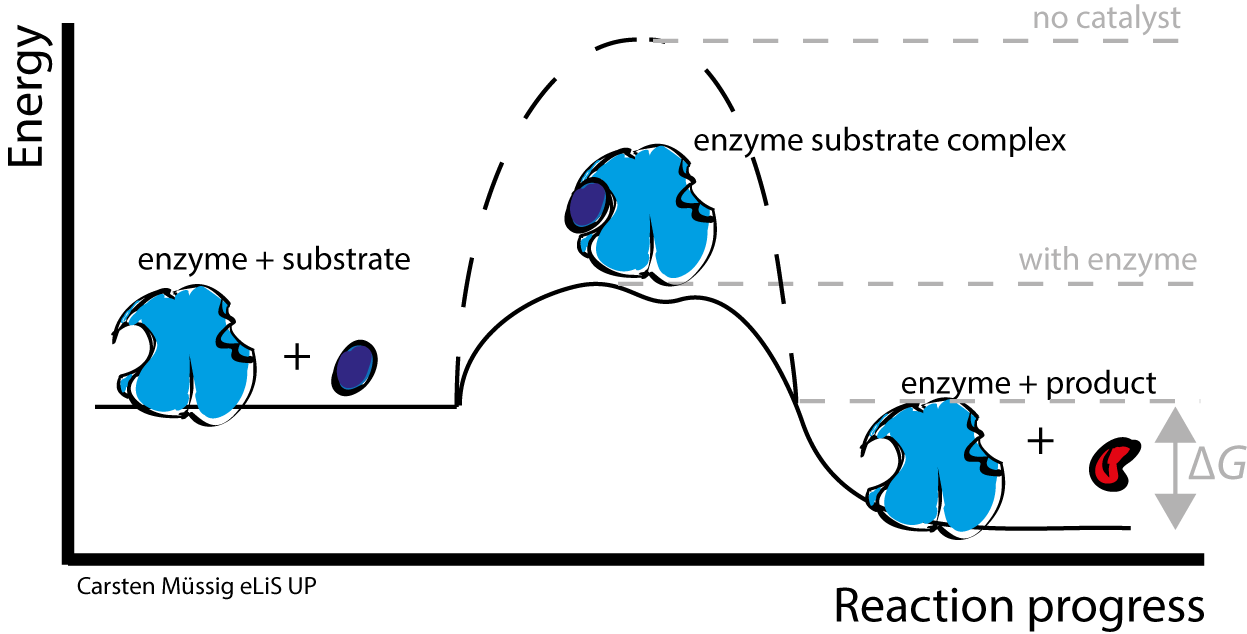
An enzyme speeds up a reaction by
raising the activation energy
lowering the activation energy
releasing energy
absorbing energy.
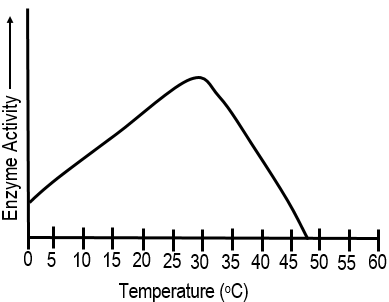
What happens when enzymes are heated to a high temperature?
The enzymes die.
The shape of the enzyme are changed and it denatures
The enzymes' amino acid sequence changes.
The enzymes remain the same
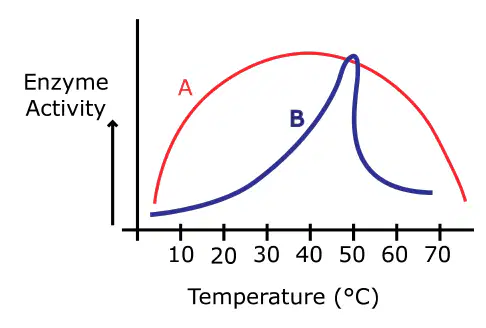
Which of the following is true according to the diagram?
Enzyme A has low activity over a broad range of temperatures.
Enzyme B works best at 49 degrees.
Enzyme A has high activity at a very specific temperature.
Enzyme B has no activity.
Photosynthesis is the process of converting solar energy into _____ energy in the form of glucose.
Kinetic
Gravitational
Chemical
Electrical
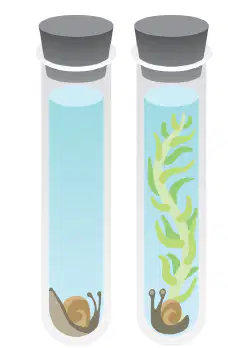
A student sets up the following materials, places them in a window, and observes them for 2 weeks. Which hypothesis would best fit this experimental setup?
If a snail is put into a closed test tube, the level of carbon dioxide in the water will decrease.
A snail and elodea, placed in a closed test tube, need air to survive.
If elodea is put into a closed test tube, the level of carbon dioxide in the water will increase.
A snail placed in a closed test tube will survive longer with elodea than without elodea.
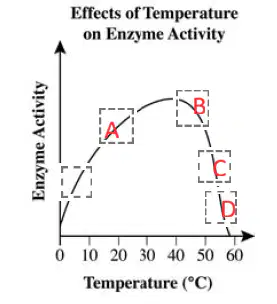
Where is the enzyme first becoming denatured?
Position A
Position B
Position C
Position D

