
 Worksheets
Chap 1 Section 1-5 Geography Review
Total questions: 92
Worksheet time: 1hrs 3mins
What's human
environment Interaction?
How people change create and destroy their environment
How people depend on, modify, and adapt to their environment
This theme of geography tells where something is, and can be relative or absolute
location
place
human-environment interaction
region
The reasons people and ideas move from one place to another is called
region
place
movement
human-environment interaction

This map shows which theme of geography?
place
movement
location
region

This image shows which theme of geography?
human-environment interaction
place
region
movement

Which theme of geography does this illustrate?
location
place
region
human-environment interaction

What theme of geography is shown here?
movement
location
place
region

What types of lines are represented here?
latitude lines
longitude lines

What is the name of the line shown here that divides the Earth into a Northern & Southern Hemisphere?
Prime meridian
International date line
arctic circle
equator

Also known as Meridians, these lines meet at the North and South Poles and circle the entire globe.
equator
prime meridian
longitude lines
tropic of cancer
As latitude lines move further north of the equator, what happens to the temperature?
It gets hotter
It gets colder
No change at all

The Prime Meridian divides the Earth into what two hemispheres? (PICK TWO)
northern hemisphere
eastern hemisphere
southern hemisphere
western hemisphere
True or False: The closer you get to the Equator, the colder it gets.
true
false

What type of map is this?
physical map
political map
thematic map

What type of map is this?
physical map
political map
thematic map
Which of the follow is NOT an example of a Thematic Map?
Missouri climate map
Missouri natural resource map
Missouri population map
Missouri county and city map
North, south, east, and west are examples of...
cardinal directions
intermediate directions
scale
compass rose

The following information is often found on a map in what area?
scale
key or legend
compass rose
cardinal directions

What is this a picture of?
scale
compass rose
key/legend
What tool on a map helps measure distances between two locations?
scale
compass rose
key/legend
Imaginary line running through Earth between the North and South Poles.
Solstice
Axis
Equinox
Point at which everywhere on Earth, days and nights are nearly equal in length.
Revolution
Orbit
Equinox
Path one object makes as it circles around another.
Orbit
Revolution
Time Zone
Circular journey around the sun.
Solstice
Equinox
Revolution
Point at which days are longest in one hemisphere and shortest in another.
Winter
Summer
Solstice
If it is summer in the Northern hemisphere, what season is it in the Southern hemisphere?
Winter
Fall
Spring
How can days be short and cold in one hemisphere when they are long and hot in another?
That's just the way it is
Tilt of Earth's axis and the position of the sun
At one point in the year, the Earth always faces away from the sun.
Each complete turn that Earth makes is a called a ______.
Rotation
Orbit
Solstice
Who decided we should have time zones?
Government
Isaac Newton
Zeus
The center of Earth that is very hot metal.
Water
Core
Mantle
Thick, rocky layer around the core.
Mantle
Crust
Atmosphere
A thick layer of gases or air.
Crust
Landforms
Atmosphere
The thin layer of rocks and minerals that surrounds the mantle.
Water
Crust
Mantle
Earth is covered in 75% of this.
Landforms
Core
Water
What is the difference between weather and climate?
Weather is the condition of the air and sky at a certain time and place. Climate is the average weather of a place.
Weather is the average condition of the air and sky at a certain time and place. Climate is the average weather of a place.
Weather is the condition of the air and sky at a certain time and place. Climate is the average condition of the air and sky at a certain time and place.
Weather is the average condition of the air and sky at a certain time and place. Climate is the condition of the air and sky at a certain time and place.
What are the key features of both weather and climate?
Cloud cover and air pressure
Precipitation and temperature
Humidity and wind speed
Sunlight and ozone levels
Why are temperatures cooler in areas near the North and South Poles?
The air circulation pattern in those areas
Because the sun is always low in the sky, making it relatively weak
The high altitude causes the temperature to drop
Due to the presence of large bodies of water
What is the movement of water from Earth's surface into the atmosphere and back again called?
Water cycle
Hydrological cycle
Evaporation process
Condensation cycle
Where are temperatures warmest and coolest on Earth?
Warmest near the Equator and coolest near the poles
Warmest near the poles and coolest near the Equator
Warmest in the polar zones and coolest in the temperate zones
Warmest in the temperate zones and coolest in the tropics
A region's distance from the Equator is a primary factor that determines its climate.
True
False
What is the term for the long-term weather patterns of an area?
Weather
Climate
Atmosphere
Environment
What is the main difference between a biome and an ecosystem?
A biome is a large region of Earth, while an ecosystem can be any size.
A biome is a type of animal, while an ecosystem is a type of plant.
A biome is a type of ecosystem, while an ecosystem is a type of biome.
A biome is a small region of Earth, while an ecosystem can be any size.
Which is not an example of a forest ecosystem?
Subarctic forests
Tropical Rain Forests
Temperate Forests
Desert forests
Grassland ecosystems do not have:
Brush
Grasses
Trees
Cacti
No plants can survive in the ice cap ecosystems.
True
False
No plants can survive in the tundra ecosystems.
True
False
What is not a "Tropic" line parallel to the Equator?
Tropic of Cancer
Tropic of Capricorn
Tropic of Climate
Which country is not part of the polar zone?
Antarctica
Russia
Canada
Australia
What is the definition of culture?
A way of life shared by a group of people
A type of food shared by a group of people
A set of laws and regulations
A group of people with shared beliefs and customs
Which of the following is an example of a cultural trait?
Social class
Technology
Standard of Living
How do traditions and customs contribute to a culture?
They provide a sense of identity and belonging
They determine the standard of living
They create social classes
They promote cultural diffusion
Which term refers to the pattern of organized relationships among groups of people in a society?
Social class
Social structure
Standard of living
Cultural diffusion
What is social class?
A pattern of organized relationships among groups of people in society
A group of people living in similar economic conditions
A group of people with shared beliefs and customs
A way of life shared by a group of people
What is the impact of cultural diffusion on societies?
It promotes cultural diversity
It can lead to conflict between cultures
It has no impact on societies
It leads to the disappearance of cultural traits
What factors contribute to the spread of cultural traits through cultural diffusion?
Trade, Migration, War
Education and Social media
Government policies
Natural disasters
What is the standard of living?
A level of comfort enjoyed by a person or society
A way of life shared by a group of people
A group of people with shared beliefs and customs
A pattern of organized relationships among groups of people in a society
What is an example of cultural diffusion?
The spread of a new language through trade
The creation of a new social class
The development of new technology through trade
The establishment of a new government
How has modern technology impacted the standard of living?
It has improved the standard of living for most people
It has made it more difficult to maintain a high standard of living
It has had no impact on the standard of living
It has only improved the standard of living for the upper class
What are Customs/Traditions?
A behavior or belief that has been passed down from many generations
Something that encourages people to leave a place behind
When cultures stay separate to protect their culture from change
Something that happens a singular time
Which of the following is NOT a factor that contributes to the spread of cultural traits through cultural diffusion?
Migration
Trade
War
What are traditions and customs?
Typical or usual ways of doing things
A group of people living in similar economic conditions
Features that make up a culture
A level of comfort enjoyed by a person or society
This is how culture spreads to other parts of the world:
Culture region
Culture diffusion
culture spreading
culture grouping
Cultural traits include language, laws, religion, values, food, clothing, and many other customs.
True
False
A culture region is an area in which a single culture or cultural trait is dominant.
True
False
The most basic unit of any society is the family.
True
False
Cultures could not exist without language.
True
False
Art forms meant to be seen, such as painting, sculpture, and photography, are known as the visual arts.
True
False
True/False: Death rates have gone down because of modern medicine and technology.
True
False
Population density is usually higher in places
along the coast or near water
in the high latitudes
in the desert
in the mountain ranges


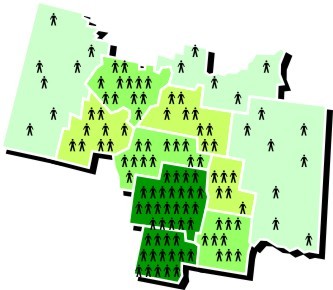

What is it called when the number of humans grows beyond what the available resources can support?
Population
Pollution
Overpopulation
Population Growth

What was the reason for the increase in population since the 1800s?
More births allowed people to work more on their land and have more food to eat.
Agriculture began to improve, and farmers could use antibiotics, fertilizers, and pesticides on their crops
The Industrial Revolution improved the availability of food and clean water to more people through technology.
The birth rate increased because people could travel from place to place to find food.
As the human population grows, the demand for natural resources stays the same.
true
false

Which of the following is a negative effect of URBANIZATION?
Greater variety of goods
Jobs
Pollution
A greater variety of cultural activities

Which of the following is a positive effect of URBANIZATION?
Slums
Access to education
Pollution
Poverty

What do we call an area of a city with inadequate housing and lack of services such as water and sanitation?
rural areas
suburbs
neighborhoods
slums

Which of the following are Pull Factors?
More opportunities
Warfare
Jobs
Oppressive Governments

Which of the following are PUSH FACTORS?
Warfare
Education
Poverty
Better Jobs
An area outside of a city with mainly resisential areas, is an example of what type of area?
Rural
Suburban
Urban
An area that is in a countryside is an example of what type of area?
Rural
Suburban
Urban
A city is an example of what type of area?
Rural
Suburban
Urban
on reason for rapid population growth
ubanization
declining death rate
population denisty
pull factor
What is the development of machine-powered production and manufacturing?
natural resource
industrialization
deforestation
biodiversity
Push factors are...
causes of migration that push people to leave their home country.
factors that attract people to new countries.
a person's way of life.
the number of types of living things in a region.
Pull factors are...
factors that force people to leave their home countries.
the movement of people from rural areas to urban areas.
factors that attract people to new countries.
moving from country to country.
What is it called when people leave a country to become a permanent or semi-permanent resident in another country?
Immigration
Wandering
Migrant
Emigration
How does urbanization impact ecosystems?
Urbanization impacts ecosystems through habitat loss, fragmentation, and pollution.
Urbanization reduces the risk of pollution in ecosystems.
Urbanization leads to increased biodiversity in ecosystems.
Urbanization has no impact on ecosystems.

