
 Worksheets
Credit
Total questions: 98
Worksheet time: 49mins
What are the ABCs of Credit?
The basics or fundamentals of credit, such as what credit is, how it works, and why it is important.
A type of credit card issued by banks.
A government program for student loans.
A rating system for movies based on financial themes.
What is a Credit Score?
A credit score is a numerical representation of a person's creditworthiness, based on their credit history.
A credit score is the amount of money in a person's bank account.
A credit score is a type of loan offered by banks.
A credit score is a government-issued identification number.
What does it mean to Establish Credit?
Establishing credit means starting to build a credit history, often by opening a credit account or taking out a loan and making payments on time.
Establishing credit means closing all your bank accounts to avoid debt.
Establishing credit means only using cash for all purchases.
Establishing credit means never borrowing money from any financial institution.
How can you Maintain Good Credit?
You can maintain good credit by paying bills on time, keeping credit balances low, and managing debt responsibly.
By ignoring your bills and only paying when reminded.
By maxing out your credit cards regularly.
By taking on as much debt as possible without a repayment plan.
What is a Credit Card?
A credit card is a card issued by a financial institution that allows the holder to borrow funds to make purchases, with the agreement to pay back the borrowed amount plus any interest.
A credit card is a card that can only be used to withdraw cash from ATMs and cannot be used for purchases.
A credit card is a prepaid card that requires you to load money before using it for transactions.
A credit card is a card that only allows you to make purchases within your own country and not internationally.
What does Managing Credit Challenges mean?
Managing credit challenges means handling difficulties related to credit, such as debt, missed payments, or poor credit scores, and finding ways to improve or resolve them.
Managing credit challenges means increasing your spending limit without any consequences.
Managing credit challenges means ignoring your credit report and not checking your credit score.
Managing credit challenges means only using cash and never borrowing money.
Fill in the blank: ______ is trust given to another person for future payment of a loan, credit card balance, etc.
Credit
Deposit
Interest
Withdrawal
Fill in the blank: ______ is a person or company to whom a debt is owed.
Creditor
Debtor
Investor
Supplier
Fill in the blank: The first C of credit is _________.
Capacity
Collateral
Character
Capital
Fill in the blank: The second C of credit is _________.
Capital
Currency
Collateral
Creditworthiness
Fill in the blank: The third C of credit is _________.
Collateral
Credit Score
Capital
Currency
Fill in the blank: The fourth C of credit is _________.
Conditions
Cash
Collateral
Credit Score
Fill in the blank: The fifth C of credit is _________
Character
Currency
Calculation
Collateral
A good time to use credit is when you need to make a large purchase you can pay off over time, while a bad time is when you cannot afford the payments or are buying unnecessary items. Which of the following best describes this situation?
Use credit for large, necessary purchases you can repay, but avoid it for unaffordable or unnecessary expenses.
Use credit for any purchase, regardless of your ability to repay.
Use credit only for small, everyday items.
Never use credit under any circumstances.
A credit score is a number that helps a lender predict how likely an individual is to ________ a loan, or make credit payments on time.
repay
ignore
delay
refuse
A credit score is a number that changes as the elements in a ________ change.
credit report
bank account
loan agreement
tax return
A credit score has broad use and impact. Your credit past is your credit future. True or False:
True
False
FICO® scores, one of the most common credit scoring systems, vary between which of the following ranges?
200-800
350-850
400-900
501-990
VantageScoreSM, a new credit scoring system developed by the three credit bureaus, ranges from ________ to ________.
501-990
300-850
200-900
600-1000
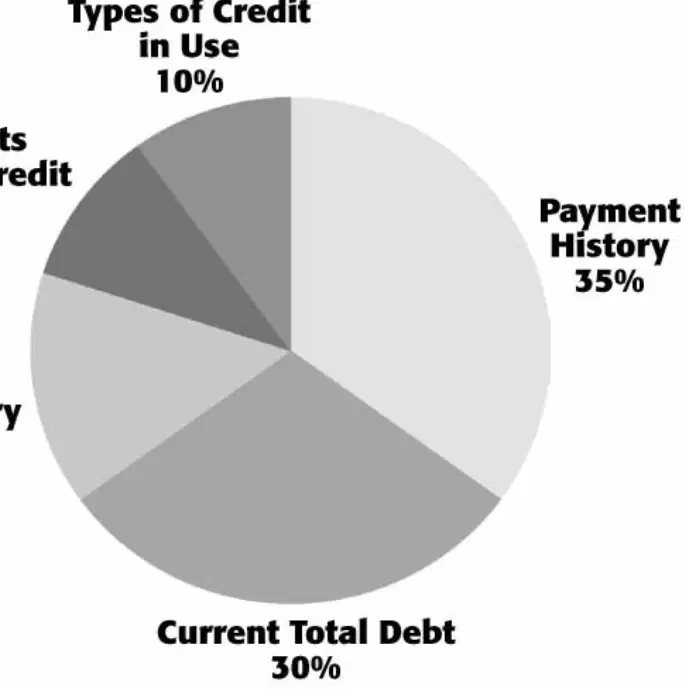
According to the pie chart, which component makes up the largest percentage of a typical credit score?
A) Payment History
B) Current Total Debt
C) Length of Credit History
D) Requests for New Credit
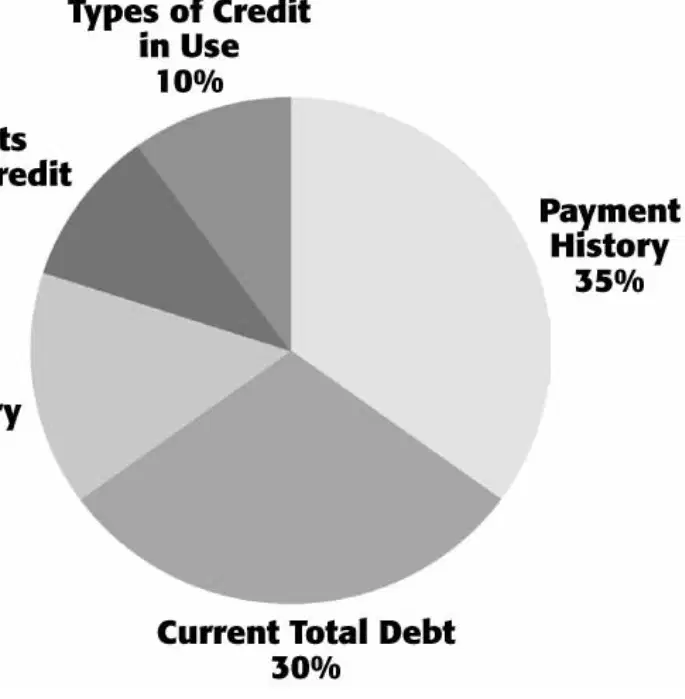
What percentage of a typical credit score is determined by Current Total Debt?
30%
10%
50%
70%
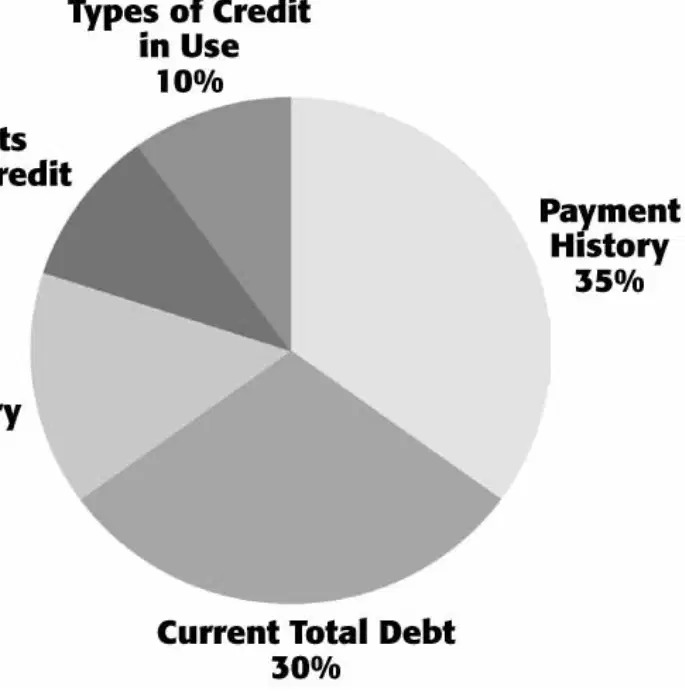
Which of the following is NOT a component listed in the pie chart for a typical credit score?
Payment History
Types of Credit in Use
Annual Income
Requests for New Credit
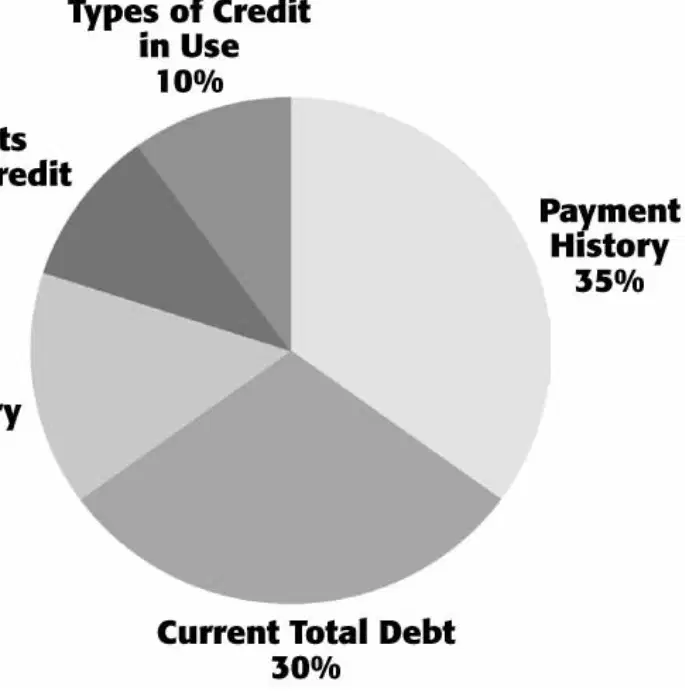
Fill in the blank: Length of Credit History makes up ____% of a typical credit score.
15%
10%
25%
35%
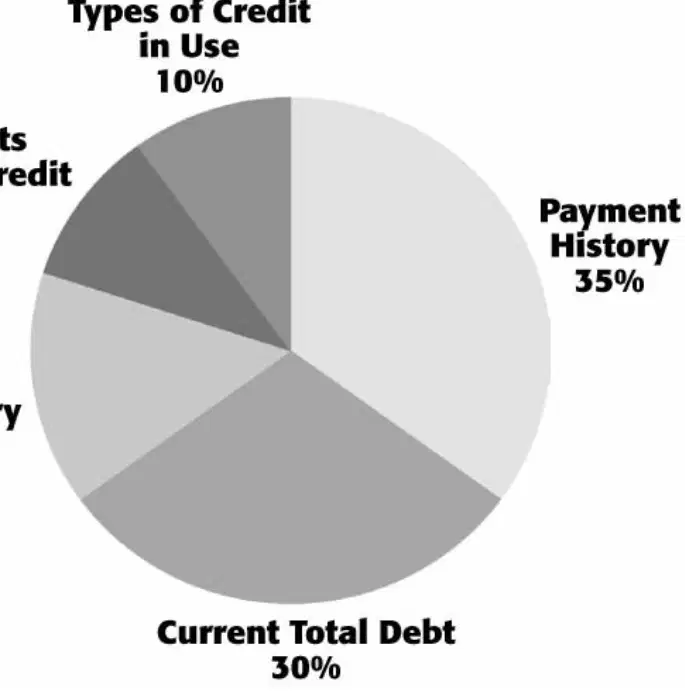
Requests for New Credit and Types of Credit in Use each make up 10% of a typical credit score according to the pie chart.
True
False
Fill in the blank: One way to improve your credit score is to ________ on time.
pay bills
ignore calls
miss payments
close accounts
Fill in the blank: To improve your credit score, get ________ and stay ________.
current, current
late, late
current, late
late, current
Fill in the blank: Don’t open a lot of new ________ too rapidly to improve your credit score.
accounts
loans
cards
investments
Fill in the blank: To improve your credit score, correct ________.
mistakes
payments
loans
accounts
Fill in the blank: Shop for loan rates within a ________ period of time to improve your credit score.
focused
random
extended
unlimited
Fill in the blank: Keep balances ________ on revolving credit to improve your credit score.
low
high
random
delayed
Fill in the blank: To improve your credit score, pay off ________.
debt
groceries
subscriptions
vacations
Fill in the blank: Check your ________ report to help improve your credit score.
credit
weather
medical
travel
Fill in the blank: ______ is a type of credit.
Cash Credit
Fixed Deposit
Savings Account
Current Account
Fill in the blank: ______ is a type of credit.
Sales Credit
Cash Payment
Debit Note
Purchase Return
Fill in the blank: ______ is a type of credit.
Secured Credit
Liquid Asset
Fixed Deposit
Current Account
Fill in the blank: ______ is a type of credit.
Revolving Credit
Fixed Deposit
Savings Account
Debit Card
Fill in the blank: ______ is a type of credit.
I.O.U.
Cash
Checkbook
Debit card
Fill in the blank: ______ is a type of credit.
Single Payment Credit
Annual Income Tax
Fixed Deposit Account
Monthly Rent Payment
Fill in the blank: ______ is a type of credit.
Installment Credit
Debit Card
Gift Card
Prepaid Card
Fill in the blank: ______ is a type of credit.
Other Types of Credit
Savings Account
Fixed Deposit
Recurring Deposit
Fill in the blank: One source of credit is _________.
Banks
Supermarkets
Cinemas
Parks
Fill in the blank: One source of credit is _________.
Retail Stores
Supermarkets
Bookstores
Cafeterias
Fill in the blank: One source of credit is _________.
Savings & Loan Associations
Grocery Stores
Movie Theaters
Public Parks
Fill in the blank: One source of credit is _________.
Credit Unions
Grocery Stores
Movie Theaters
Book Clubs
Fill in the blank: One source of credit is _________
Finance Companies
Grocery Stores
Movie Theaters
Book Publishers
Fill in the blank: One source of credit is _________.
Internet Stores
Public Parks
Movie Theaters
Art Galleries
Other sources of credit include which of the following?
Moneylenders
Farmers
Students
Children
Sources of credit that should be avoided include which of the following?
Payday loans and loan sharks because they have extremely high interest rates and fees.
Credit cards because they always have low interest rates.
Bank loans because they are always unsafe.
Student loans because they never need to be repaid.
STEPS TO TAKE TO AVOID ABUSIVE LENDING: Shopping around for the best deal is an important step. Which of the following is a recommended action?
Shop around for the best deal
Accept the first offer you get
Ignore loan terms and conditions
Borrow without comparing lenders
The lender pressured you to take the loan.
Yes, I felt pressured.
No, I did not feel pressured.
I am not sure.
I did not take a loan.
Understanding the terms of the loan is important.
Yes, I understand the terms.
No, I do not understand the terms.
I am unsure about the terms.
The terms do not apply to me.
Fill in the blank: One common part of a credit application is the ________ for Loan.
Reason
Signature
Date of Birth
Collateral
Fill in the blank: A credit application typically requires Personal ________ Information.
Identification
Financial
Educational
Medical
Fill in the blank: Employment ________ is a common part of a credit application.
Information
History
Reference
Agreement
Fill in the blank: Mortgage/Rental ________ is often included in a credit application.
Information
Agreement
Deposit
Duration
Fill in the blank: Some credit applications require additional ________.
Documentation
Furniture
Entertainment
Sunlight
Fill in the blank: A credit application may ask for information about Current ________.
Debts
Assets
Income
References
Fill in the blank: Credit ________ are often needed in a credit application.
References
Cards
Scores
Limits
Fill in the blank: Some credit applications require ________ as security.
Collateral
Interest
Signature
Guarantor
Fill in the blank: Bank ________ are a common part of a credit application.
References
Loans
Branches
Deposits
Fill in the blank: A credit application usually requires a ________ and Date.
Signature
Photograph
Reference Number
Bank Statement
What is the annual fee?
The annual fee is the amount charged yearly for having the credit account.
The annual fee is the interest charged on late payments.
The annual fee is the penalty for exceeding the credit limit.
The annual fee is the cashback earned on purchases.
What is the annual percentage rate (APR)?
The annual percentage rate (APR) is the yearly interest rate charged on borrowed money.
The annual percentage rate (APR) is the monthly fee for maintaining a bank account.
The annual percentage rate (APR) is the total amount of money borrowed in a year.
The annual percentage rate (APR) is the penalty for late payments on a loan.
When are payments due?
Payments are due on the date specified by the credit agreement, usually monthly.
Payments are due only at the end of the year.
Payments are due whenever the borrower chooses.
Payments are due only after five years.
What is the minimum payment required each month?
The minimum payment is the smallest amount you must pay each month to keep the account in good standing.
The minimum payment is the total balance due on your account each month.
The minimum payment is the amount you choose to pay each month, regardless of the statement.
The minimum payment is the interest charged on your account each month.
Is there a grace period?
A grace period is the time during which you can pay your balance without incurring interest charges.
A grace period is the time when you must pay extra fees.
A grace period is the time when your account is frozen.
A grace period is the time when you cannot use your card.
Are there other fees associated with the credit, such as minimum finance charges?
Other fees may include late fees, over-limit fees, or minimum finance charges.
No, there are never any additional fees with credit.
Only annual fees are charged, no other fees apply.
Credit accounts do not have any fees at all.
What is the credit limit?
The credit limit is the maximum amount you can borrow on the credit account.
The credit limit is the minimum payment required each month.
The credit limit is the interest rate charged on the account.
The credit limit is the total amount spent on the account last year.
What are the penalties for late or missed payments?
Penalties for late or missed payments may include late fees, increased interest rates, or negative impacts on your credit score.
You will receive a reward for late or missed payments.
There are no consequences for late or missed payments.
Late or missed payments will automatically reduce your loan amount.
What are the terms and conditions of the credit? What else is included in the fine print?
The terms and conditions outline the rules, fees, and responsibilities associated with the credit account, including any additional details in the fine print.
They only describe the interest rate and ignore all other details.
They are just marketing slogans with no legal value.
They only mention the rewards program and exclude any fees or penalties.
According to the Debt-to-Income Thermometer, what is the risk level if your debt-to-income ratio is 51% or more?
GREAT!
GOOD!
FAIR!
DANGER!
According to the Debt-to-Income Thermometer, what is the risk level if your debt-to-income ratio is between 39% to 50%?
HIGH!
FAIR!
GOOD!
DANGER!
According to the Debt-to-Income Thermometer, what is the risk level if your debt-to-income ratio is between 24% to 38%?
FAIR!
HIGH!
GOOD!
GREAT!
According to the Debt-to-Income Thermometer, what is the risk level if your debt-to-income ratio is between 16% to 23%?
GOOD!
FAIR!
HIGH!
DANGER!
According to the Debt-to-Income Thermometer, what is the risk level if your debt-to-income ratio is 15% or less?
GREAT!
GOOD!
FAIR!
HIGH!
Credit History is:
A record of a person's borrowing and repayment activities.
A list of all the banks in a city.
A summary of a person's educational background.
A report of a person's medical history.
A Credit Bureau is:
an organization that collects and maintains credit information about individuals.
a government agency that issues loans to the public.
a bank that provides only credit cards to customers.
a company that sells insurance policies.
A Credit Report is:
a detailed record of an individual's credit history and financial behavior
a document showing only your current bank balance
a report listing your monthly utility bills
a summary of your annual income only
A Credit Score is:
A numerical representation of a person's creditworthiness.
A type of bank account.
A government-issued identification number.
A method of calculating taxes.
A Credit Rating is:
an evaluation of the creditworthiness of an individual or organization
a type of bank account
a method of calculating interest rates
a government-issued identification number
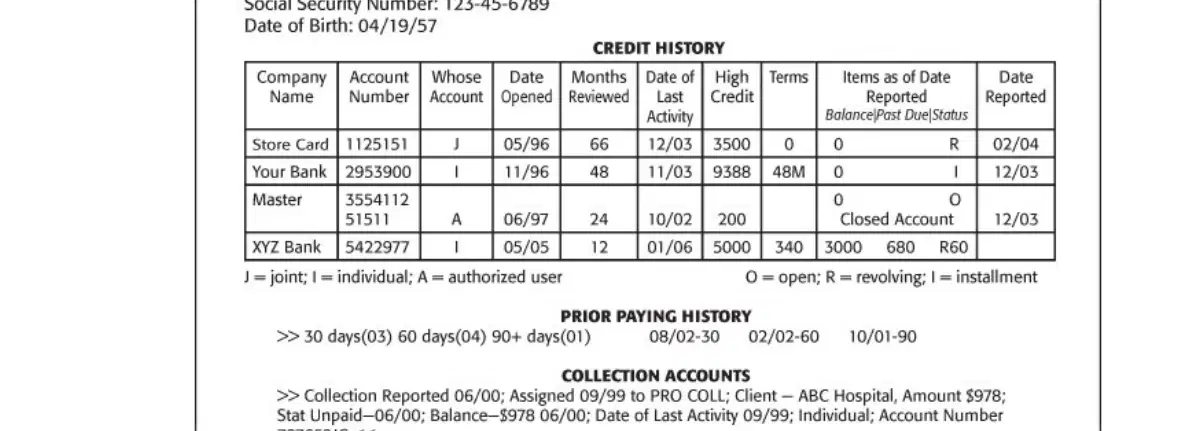
According to the sample credit report, what is the high credit amount for the Store Card account?
3500
1500
5000
2500
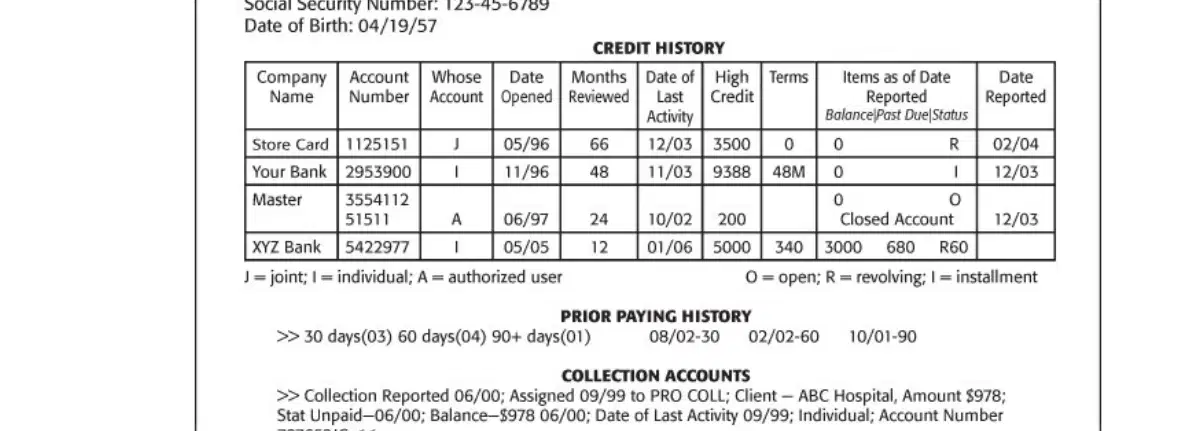
Which company has an account with the status 'Closed Account' as of the date reported?
Master
Visa
American Express
Discover
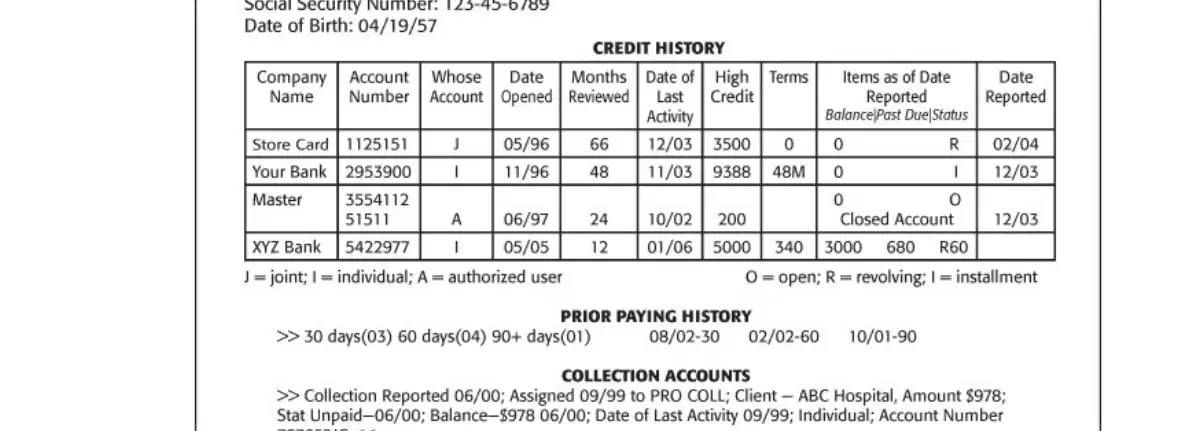
What is the date of birth listed for John Doe in the sample credit report?
04/19/57
01/23/60
12/15/55
07/30/59
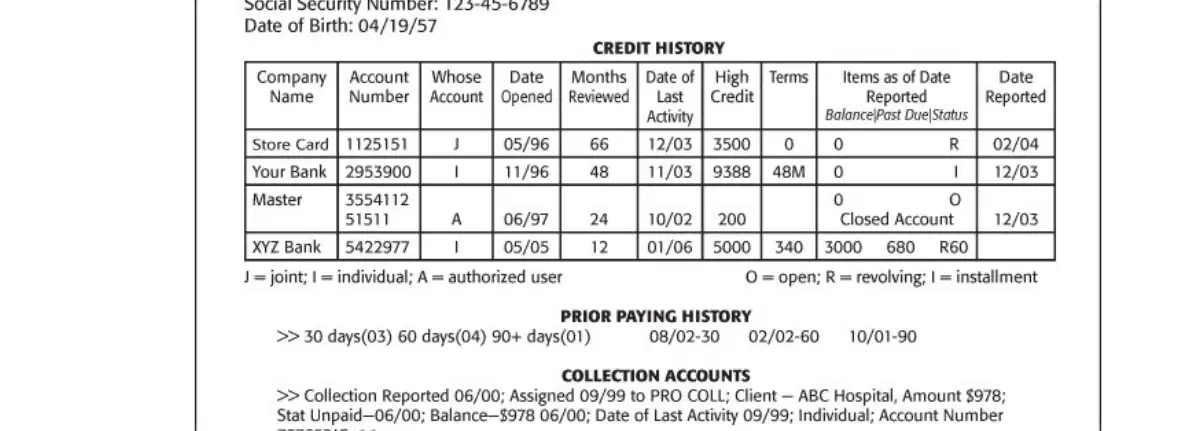
How many months has the 'Your Bank' account been reviewed according to the sample credit report?
48
12
24
36
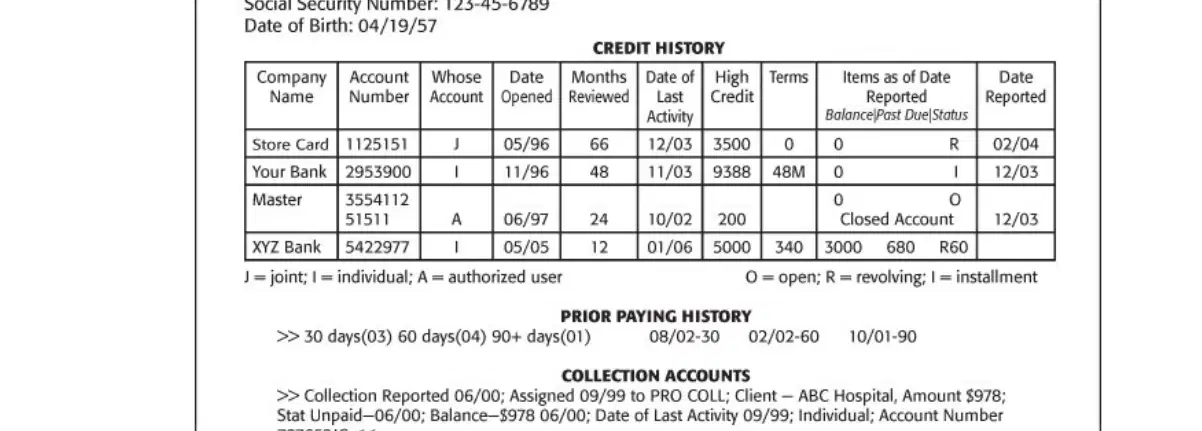
Which account has the highest high credit amount in the sample credit report?
XYZ Bank (5000)
ABC Finance (3000)
PQR Loans (2500)
LMN Credit Union (4000)
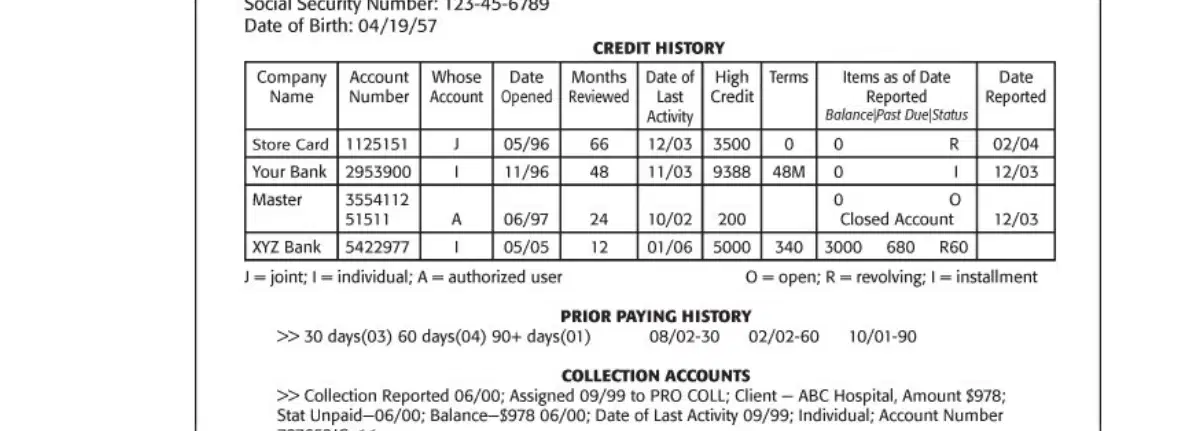
What does the letter 'J' stand for in the 'Whose Account' column of the sample credit report?
Joint
Judgment
Junior
Jumbo
Fill in the blank: One of the credit safeguards for consumers is the _________.
Truth In Lending Act
Fair Labor Standards Act
Sherman Antitrust Act
Civil Rights Act
Fill in the blank: One of the credit safeguards for consumers is the _________
Fair Credit Reporting Act
Equal Pay Act
Freedom of Information Act
Truth in Advertising Act
Fill in the blank: One of the credit safeguards for consumers is the _________
Equal Credit Opportunity Act
Fair Labor Standards Act
Freedom of Information Act
Occupational Safety and Health Act
Fill in the blank: One of the credit safeguards for consumers is the _________
Fair Credit Billing Act
Consumer Credit Protection Act
Truth in Lending Act
Equal Credit Opportunity Act
Fill in the blank: One of the credit safeguards for consumers is the _________
Fair Debt Collection Practices Act
Consumer Credit Reporting Act
Equal Credit Opportunity Act
Truth in Lending Act
What is one of the primary objectives behind the Fair and Accurate Credit Transaction Act (the FACT Act)?
To help consumers fight the growing crime of identity theft.
To increase the interest rates on credit cards.
To eliminate all credit reporting agencies.
To allow unlimited access to consumer credit reports.
Which of the following is a highlight of the Fair and Accurate Credit Transaction Act?
Free credit reports
Lower interest rates
Increased loan limits
None of the above
The Fair and Accurate Credit Transaction Act provides consumers with ________ alerts and Active Duty alerts.
Fraud
Credit
Security
Identity
Truncation under the FACT Act applies to which of the following?
Credit cards
Debit cards
Social Security Number
All of the above
The FACT Act includes provisions for identifying ________ as a way to prevent identity theft.
Red flags
Credit scores
Loan defaults
Bank statements
Disposal of ________ is a highlight of the Fair and Accurate Credit Transaction Act.
consumer reports
bank statements
tax returns
medical records
The FACT Act addresses the importance of ________ scores.
Credit
Test
Health
Attendance

