
Font size
 Worksheets
Child Development Fundamentals Quiz
Total questions: 100
Worksheet time: 50mins
What does the study of child development focus on?
Predictable patterns of change in children over time
Temporary changes such as illness
Sudden accidents like a broken bone
Random events in a child's life
Which of the following is NOT considered part of child development?
Predictable patterns of change
Temporary changes due to illness
Long-term growth and development
Changes that occur over time
Explain why a broken bone is not considered a part of child development, using evidence from the definition of child development.
Because it is a temporary change, not a predictable pattern of change over time
Because it is a common event in childhood
Because it affects only physical growth
Because it is related to nutrition
Which of the following is NOT a step involved in the scientific study of children based on scientific research?
Questioning based on current theories
Exploring biological and environmental factors
Ignoring information that does not fit theories
Developing theories, explanations, and predictions
What does the process of gathering and organizing information help achieve in the scientific study of children?
It helps in making random guesses
It helps in developing theories, explanations, and predictions
It helps in ignoring environmental factors
It helps in memorizing facts only
Why is exploring biological and environmental factors important in the scientific study of children?
It helps to understand the influence of nature and surroundings on development
It is only necessary for adult studies
It is not relevant to scientific research
It replaces the need for questioning
Which of the following periods of development in children is generally from birth to about 1 year?
Prenatal
Infant
Toddler
Early Childhood
What is the main basis for dividing the periods of development in children according to the provided material?
Physical appearance
Functional changes
Academic achievement
Social status
Arrange the following periods of development in children in the correct order from earliest to latest: Early Childhood, Infancy, Adolescence, Middle Childhood.
Infancy, Early Childhood, Middle Childhood, Adolescence
Early Childhood, Infancy, Middle Childhood, Adolescence
Infancy, Middle Childhood, Early Childhood, Adolescence
Early Childhood, Middle Childhood, Infancy, Adolescence
A researcher is studying children aged 8 years old. According to the periods of development described, which category would these children most likely fall into?
Infancy
Early Childhood
Middle Childhood
Adolescence
Which age range is associated with adolescence according to the material?
0-2 years
2-6/7 years
6/7-11/12 years
11/12-25 years
Which of the following domains is primarily concerned with gross and fine motor skills, health status, and sensory development?
Physical
Cognitive
Social
Moral
What does the cognitive domain focus on in child development?
Communication behaviors
Emotions and self-regulation
Intellectual development, problem-solving, and creativity
Physical skills and limitations
Which domain includes a child's communication behaviors?
Social
Linguistic
Emotional
Moral
How does the social domain contribute to a child's development?
By helping children learn to interact with others and maintain relationships
By improving their physical health
By teaching them to control impulses
By developing their creativity
A student is struggling to cope with stress and express their feelings. Which domain of development should be supported to help this student?
Moral
Emotional
Cognitive
Physical
Which domain is most directly related to a child's ability to tell right from wrong and act ethically?
Social
Moral
Linguistic
Physical
A teacher wants to help students improve their memory and creativity. Which domain should the teacher focus on?
Cognitive
Emotional
Physical
Social
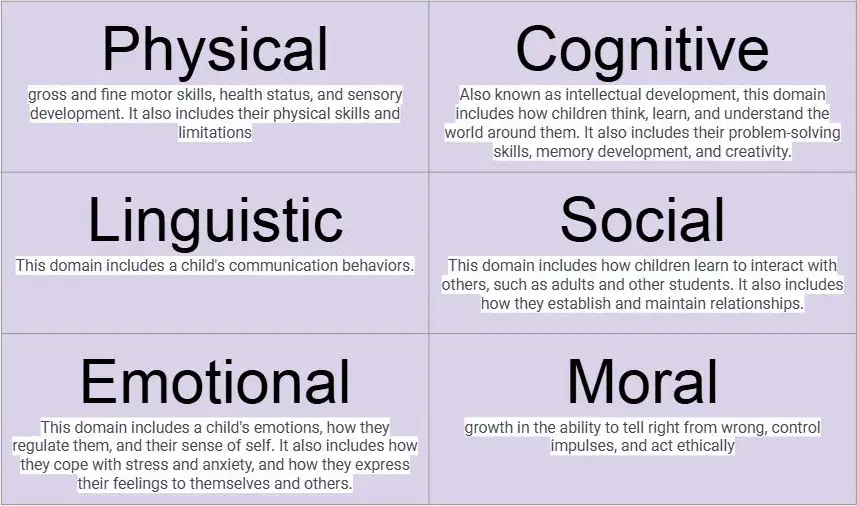
Which of the following pairs correctly matches a domain with its description?
Physical - growth in the ability to tell right from wrong
Linguistic - includes a child's communication behaviors
Emotional - includes problem-solving skills and creativity
Social - includes gross and fine motor skills
Which of the following best describes a continuous change?
Quantitative, gradual change like walking up a ramp
Qualitative change that occurs in stages
Sudden and unpredictable change
Change that happens only once
What is an example of a discontinuous change?
Gradual improvement in running endurance
Change from tadpole to frog
Increasing height slowly over time
Learning to ride a bike smoothly
How does a discontinuous change typically occur?
Gradually, like walking up a ramp
In stages, like walking up stairs
Without any noticeable difference
Only in physical development
A student is tracking their improvement in running endurance over several months. Which type of change does this represent, and why?
Discontinuous, because it happens in stages
Continuous, because it is a gradual improvement
Discontinuous, because it is a sudden change
Continuous, because it is unpredictable
Explain why the process of a tadpole turning into a frog is considered a discontinuous change rather than a continuous one.
Because it involves a gradual increase in size
Because it happens in clear, separate stages
Because it is a slow and steady process
Because it does not involve any change
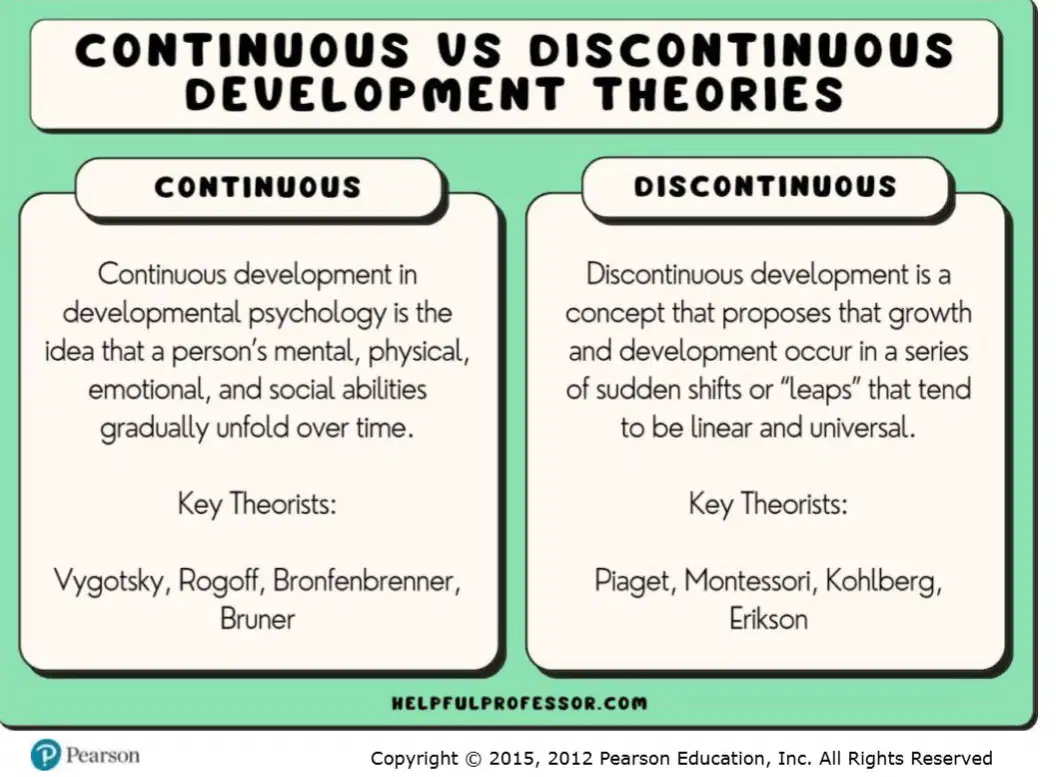
Which of the following best describes continuous development in developmental psychology?
Growth occurs in a series of sudden shifts or "leaps"
Abilities gradually unfold over time
Development is random and unpredictable
Growth only happens during childhood
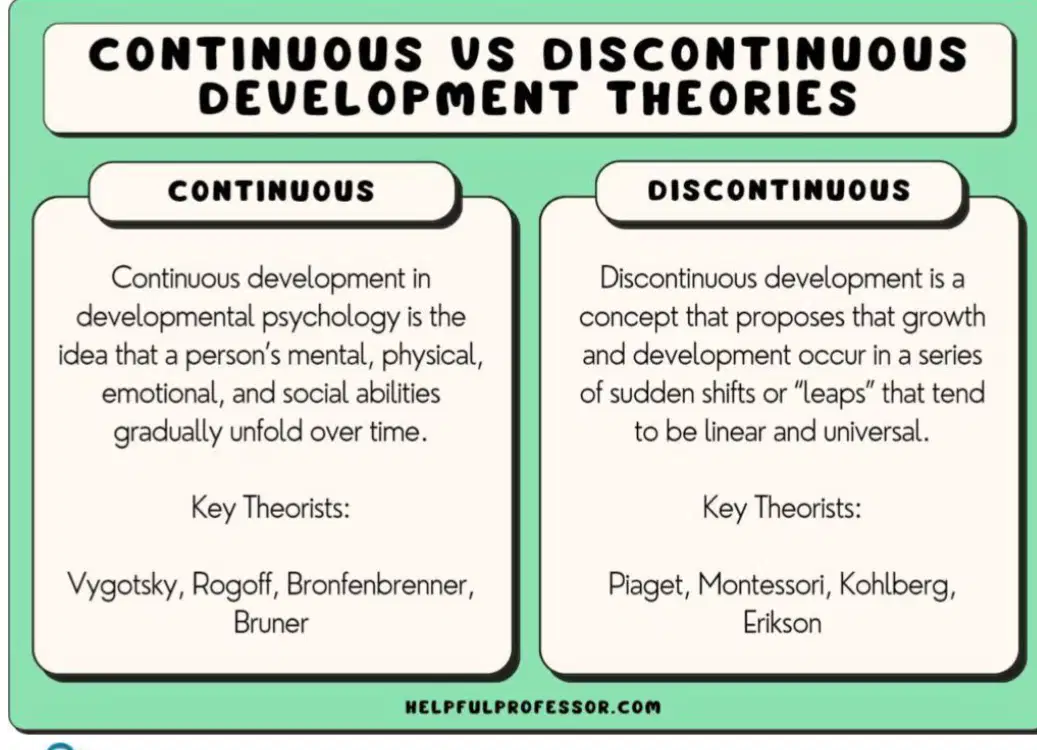
Who is NOT considered a key theorist of continuous development?
Vygotsky
Rogoff
Piaget
Bruner
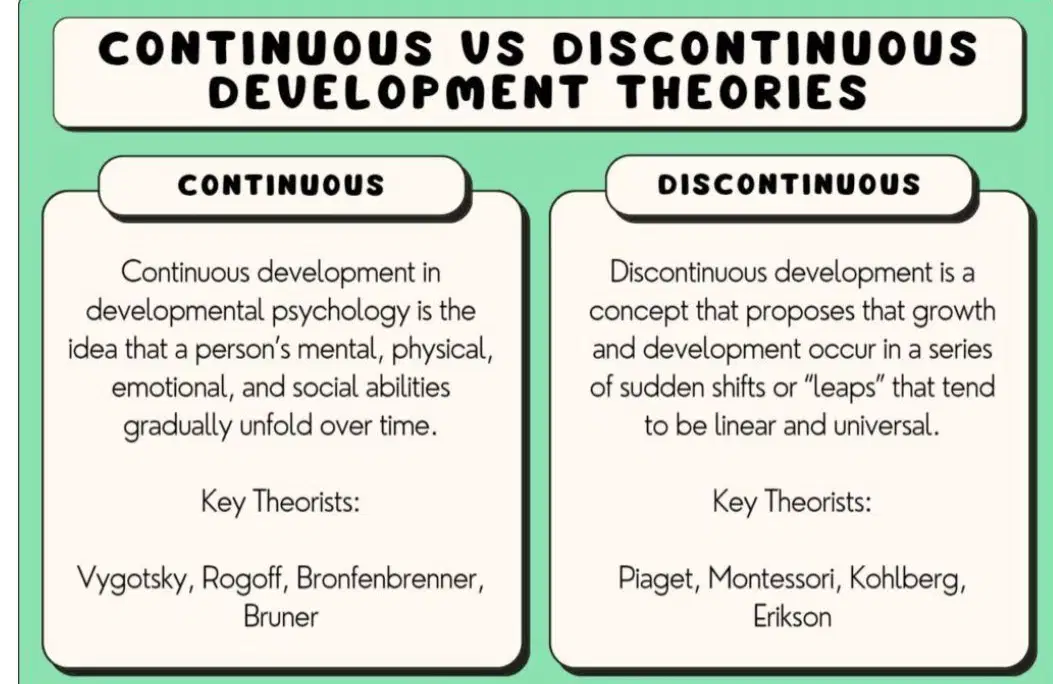
Which statement best explains discontinuous development?
Growth and development occur gradually and continuously
Growth and development occur in a series of sudden shifts or "leaps"
Development is only influenced by genetics
Abilities remain constant throughout life
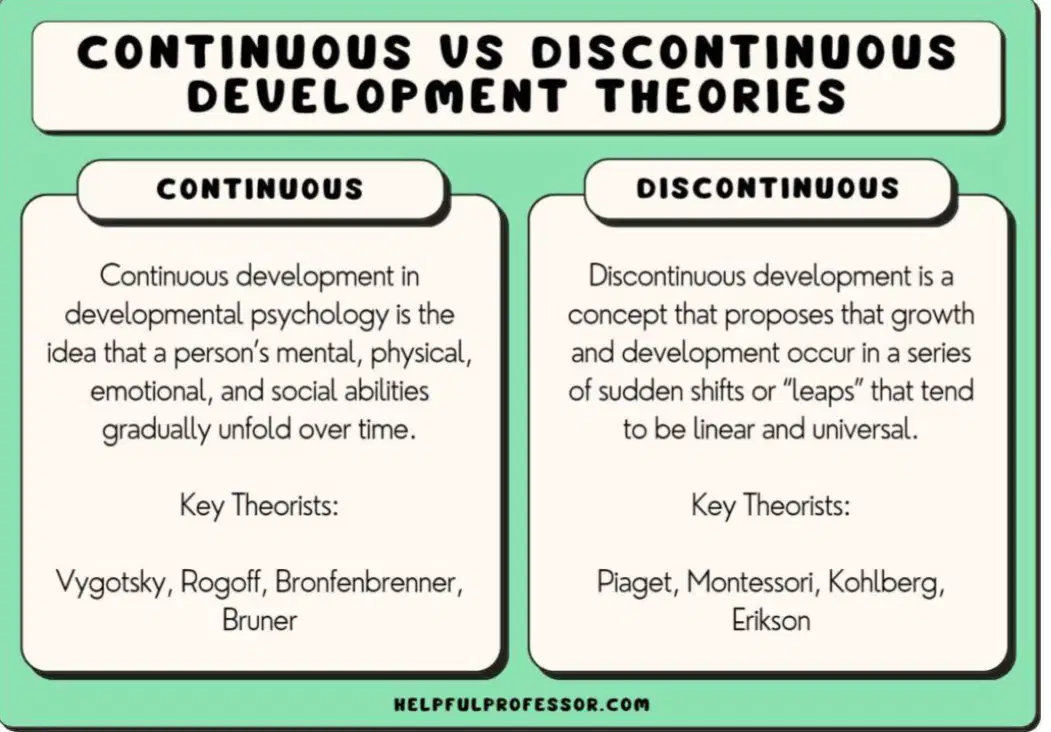
Explain how the views of Vygotsky and Piaget differ regarding the process of human development.
Vygotsky believed in sudden shifts, while Piaget believed in gradual change.
Vygotsky believed in gradual unfolding of abilities, while Piaget believed in development through distinct stages.
Both believed development is random.
Both believed development is only physical.
Which of the following is most closely associated with the "nature" side of the nature vs. nurture debate?
Heredity, genes, biological processes, maturation
Education, parenting, environment, social policies
Social media, technology, peer influence, culture
Nutrition, exercise, sleep, stress management
Which factors are emphasized in the "nurture" perspective of human development?
Heredity and genes
Education, parenting, environment, social policies
Biological processes and maturation
Physical growth and reflexes
Explain how both nature and nurture can influence a person's development. Provide an example for each.
Nature influences development through heredity, while nurture influences through education; for example, eye color is inherited (nature), while language skills are learned (nurture).
Nature and nurture both refer to genetic inheritance.
Only nurture affects development, not nature.
Nature and nurture are unrelated to development.
Which of the following best describes a "critical period"?
A time frame when something can occur if it’s going to ("Now or never")
A time frame when it is easier for something to occur ("Best time")
A period when learning is impossible
A time when all skills are learned equally well
What is an example of a critical period according to the provided material?
Developing vision
Learning to ride a bike
Learning to play chess
Memorizing multiplication tables
Which statement best explains the difference between a critical period and a sensitive period?
A critical period is the only time something can occur, while a sensitive period is when it is easier for something to occur.
Both periods mean the same thing.
A sensitive period is more important than a critical period.
A critical period is when learning is impossible.
Why might learning a second language be considered an example of a sensitive period?
It is easier to learn a second language during this time, but not impossible later.
It can only be learned during this period.
It is never possible to learn a second language.
It is unrelated to sensitive periods.
Given the definitions, how would you plan an educational program for children to maximize their development of vision and language skills?
Focus on vision development during the critical period and language exposure during the sensitive period.
Teach both skills at any age with the same methods.
Delay all learning until adulthood.
Ignore periods and teach randomly.
Which of the following best describes "Universality" as presented in the learning material?
Most share this in common, such as biological milestones
Uniqueness and differences are typical
Only a few people experience it
It refers to cultural traditions
According to the material, what is an example of "Diversity"?
Biological milestones
Social milestones
Physical growth
Language development
How does the concept of "Diversity" differ from "Universality" based on the provided information?
Diversity focuses on what most people share, while universality focuses on differences.
Diversity emphasizes uniqueness and differences, while universality highlights commonalities.
Diversity is only about biological milestones, while universality is about social milestones.
Diversity and universality mean the same thing.
If a researcher is studying milestones that most people experience regardless of culture, which theme are they focusing on?
Diversity
Universality
Individuality
Socialization
Which of the following best explains how "Total Surroundings" can impact an individual's "Self"?
By determining only their socioeconomic status
By influencing their behaviors, beliefs, and values
By controlling their knowledge directly
By limiting their access to friends

Which of the following is an example of "Self" as described in the diagram?
Community involvement
Family structure
Personal beliefs
Place in history
If a person's "Total Surroundings" change significantly, such as moving to a new country, which aspect of "Self" is most likely to be affected first?
Traditions and values
Place in history
Socioeconomic status
Ethnicity
Which of the following is considered the first context for a child's development?
School environment
Mother's womb
Peer group
Neighborhood
Which of the following is NOT listed as a type of family structure influencing a child's development?
Nuclear family
Blended family
Extended family
Single-parent family
How might a mother's nutrition and stress level impact a child's development according to the material?
They have no impact on development
They are the first context for development and can affect the child's health
They only affect the child's education
They only influence the child's social skills
If a psychologist wants to study the influence of people living with a child, which aspect of family context should they focus on?
Parenting styles
Family structure
Attachment styles
School environment
Suppose a child is raised by both biological parents and step-siblings. Which family structure does this scenario best represent?
Nuclear family
Blended family
Extended family
Single-parent family
Which attachment style is associated with a positive model of self and low anxiety?
Secure
Anxious
Avoidant
Fearful
What combination of models and anxiety is linked to the 'Fearful' attachment style?
Positive model of self, low anxiety
Negative model of self, high anxiety
Positive model of others, low avoidance
Positive model of self, high anxiety
If a person has a positive model of others and low avoidance, which attachment style do they most likely have?
Avoidant
Fearful
Secure
Anxious
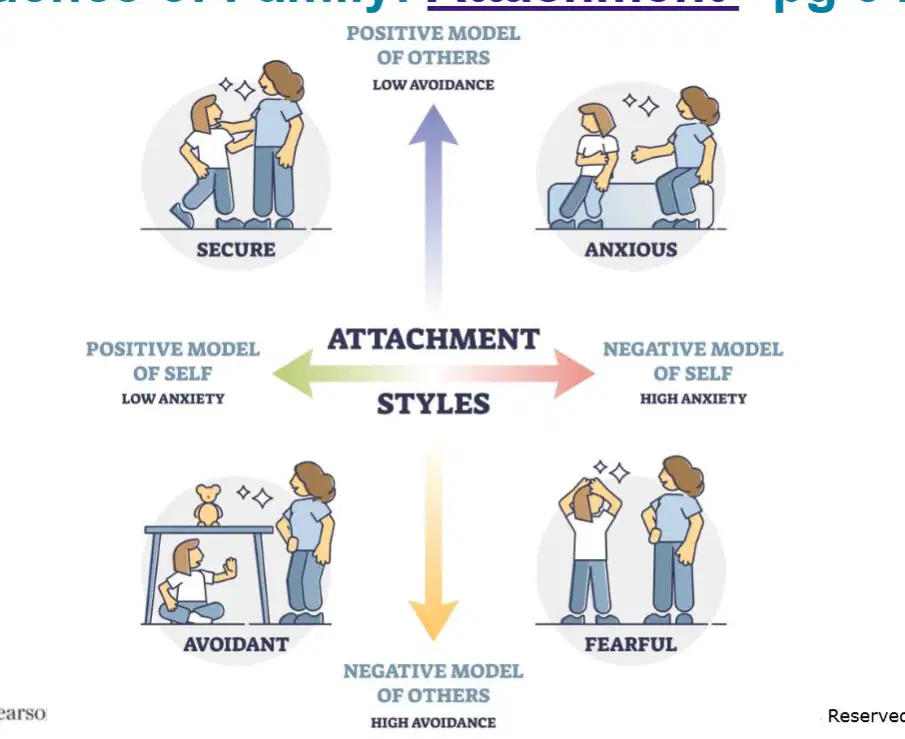
Compare and contrast the 'Avoidant' and 'Anxious' attachment styles in terms of their models of self and others.
Avoidant: Positive model of self, low anxiety; Anxious: Negative model of self, high anxiety
Avoidant: Negative model of others, high avoidance; Anxious: Positive model of others, low avoidance
Avoidant: Negative model of others, high avoidance; Anxious: Positive model of self, low anxiety
Avoidant: Positive model of others, low avoidance; Anxious: Negative model of others, high avoidance
Which parenting style is characterized by high responsiveness and high demandingness, often described as "Let's talk about it"?
Permissive
Authoritative
Uninvolved
Authoritarian
What is a key characteristic of the Permissive parenting style?
High expectations and clear standards
Indulgent and few rules
Punishment and emotionally distant
Neglectful and uninterested
Which parenting style is most likely to be described as "You're on your own" and is associated with neglectful and passive behavior?
Authoritative
Permissive
Uninvolved
Authoritarian
A parent who is autocratic, emotionally distant, and uses punishment as a primary method of discipline is demonstrating which parenting style?
Permissive
Authoritative
Uninvolved
Authoritarian
Compare the Authoritative and Authoritarian parenting styles in terms of warmth and control. What makes them different?
Both are low in warmth and high in control.
Authoritative is high in warmth and control, while Authoritarian is low in warmth but high in control.
Both are high in warmth and low in control.
Authoritative is low in warmth and control, while Authoritarian is high in warmth but low in control.
If a parent avoids confrontation, is lenient, and has low expectations, which parenting style are they most likely using?
Authoritative
Permissive
Uninvolved
Authoritarian
Why might the Uninvolved parenting style be considered the most detrimental to a child's development?
It combines high warmth with high expectations.
It provides little time, attention, and guidance to the child.
It uses clear rules and structured environments.
It encourages democratic decision-making.
Which of the following best defines "ethnicity"?
Common physical characteristics such as skin color and hair texture
Common cultural characteristics such as homeland, language, history, customs, and religion
People who have less power than the dominant group
The process of identifying with a dominant group
What is the main difference between "race" and "ethnicity"?
Race is about cultural traits, while ethnicity is about physical traits
Race is about physical traits, while ethnicity is about cultural traits
Both are only about language
Both are only about religion
Which group is described as having less power than the dominant group and may receive unequal or discriminatory treatment?
Ethnic group
Majority group
Minority group
Racial group
Why might a group be considered a "minority" even if they are not fewer in number?
Because they have more cultural influence
Because they have less power than the dominant group
Because they speak a different language
Because they have different physical characteristics
Consider a society where a group is culturally distinct but holds significant political power. According to the definitions provided, would this group be considered a minority? Why or why not?
Yes, because they are culturally distinct
No, because minority status is based on power, not just cultural difference
Yes, because they are fewer in number
No, because they have different physical characteristics
Which of the following is NOT typically influenced by levels of wealth, power, and prestige according to the material?
A child’s social class designation by society
People with whom a child associates
The weather in a child’s neighborhood
How others perceive a child
What does S E S stand for in the context of this material?
Social Economic Status
Socioeconomic Status
Societal Education System
Social Education Status
Explain how socioeconomic status (S E S) can impact a child's educational opportunities. Use evidence from the material to support your answer.
Socioeconomic status can impact a child's educational opportunities by influencing the level of education a child may achieve, as well as the income and resources available for their development.
Socioeconomic status only affects the friends a child makes.
Socioeconomic status determines the child's favorite subject.
Socioeconomic status has no impact on education.
Which of the following is a direct effect of social class on a child, as described in the material?
The type of food a child prefers
How others perceive a child
The child’s favorite color
The child’s height
According to the material, what are some factors that S E S and social class typically influence in a child's life?
Income and resources, level of education, and neighborhood
Favorite sports, hobbies, and music taste
Physical appearance, height, and weight
Language spoken at home, eye color, and hair color
Which of the following is a type of policy that influences child development?
Prenatal care and education for expectant mothers
Taxation on luxury goods
Road safety regulations
Environmental protection laws
What are some effects of policies on child development?
Effects are seen in physical, cognitive, and social emotional development
Effects are only seen in academic achievement
Effects are limited to financial growth
Effects are only seen in physical health
Explain how policies supporting maternity leave can impact child development. Use reasoning and evidence to support your answer.
They allow mothers to spend more time with their children, supporting emotional and cognitive development.
They increase the cost of living for families.
They reduce the need for childcare services.
They have no impact on child development.
Which of the following is NOT mentioned as a policy influencing child development?
Childcare and preschool opportunities
School age requirements
Policies supporting maternity leave
Environmental protection policies
What is a "cohort" as defined in the context of historical influence?
A group of people who share the same historical context based on their birth year
A group of people who work together in the same company
A group of people who live in the same neighborhood
A group of people who have the same hobbies
Which of the following is an example of a historical influence experienced by the Baby Boomers?
Acceptance of diversity and emerging technology
The internet age and multitasking
Civil Rights era, Vietnam War, first walk on the moon
Global citizenship and environmental activism
Generation X is characterized by which of the following experiences?
Experiencing the Civil Rights era and the first walk on the moon
Acceptance of diversity, emerging technology, and latchkey kids
Multitasking and global citizenship
Living through the Great Depression
Which generation is most associated with the internet age and multitasking?
Baby Boomers
Generation X
Millennial Generation
Silent Generation
Explain how general influences such as world events and economic conditions can impact the development of a cohort. Provide an example using one of the generations mentioned.
World events and economic conditions can shape the values, behaviors, and opportunities available to a cohort. For example, Baby Boomers were influenced by the Civil Rights era and the Vietnam War, which affected their perspectives on social justice and global affairs.
World events and economic conditions have no impact on a cohort's development.
Cohorts are only influenced by their family environment, not by world events or economic conditions.
Economic conditions only affect individual people, not entire cohorts.
Which of the following is NOT mentioned as a reason to learn about development?
Career
Family
General care for humanity
Financial investment
How might learning about development contribute to self-awareness?
By understanding personal growth and changes over time
By memorizing historical dates
By focusing only on scientific experiments
By ignoring social relationships
Why could general care for humanity be a motivation to study development?
It helps individuals understand and empathize with others' experiences.
It only benefits one's own career.
It is unrelated to family or society.
It focuses solely on financial gain.
What is the study of how humans and other species inherit characteristics called?
Biology
Genetics
Anatomy
Ecology
Which term describes an individual's collection of genes?
Phenotype
Chromosome
Genotype
Allele
What does the term "phenotype" refer to?
The genetic code of an organism
The observable behavioral and physical characteristics of an organism
The process of cell division
The inheritance of acquired traits
Which of the following can influence an organism's phenotype?
Only the environment
Only the genes
Genes interacting with each other and with the environment
Only the diet
A plant has the genotype "Bb" for flower color. According to the diagram, what is its phenotype?
purple = B white = b
White flowers
Red flowers
Purple flowers
Yellow flowers
Explain how genotype and phenotype are related, using the example of flower color in the diagram.
The genotype determines the phenotype, so different genotypes (BB, Bb, bb) result in different observable traits (purple or white flowers).
The phenotype determines the genotype, so the color of the flower changes the genes.
Genotype and phenotype are unrelated.
Only the environment determines the phenotype, not the genotype.
What is the basic unit of structure and function in living things?
Cell
Chromosome
Gene
DNA
How many pairs of chromosomes are found in each human cell?
23 pairs
46 pairs
12 pairs
3 pairs
Which of the following best describes the structure of DNA?
Two strands of molecules forming a double helix shape
Single strand of molecules in a circular shape
Three strands of molecules in a triple helix shape
A flat sheet of molecules
What is the function of genes in a cell?
Tell cells which proteins to make
Store energy for the cell
Transport oxygen in the blood
Break down waste products
Explain why DNA is considered dynamic and how this property can affect an individual. (DoK Level 3)
Because DNA can be altered, changes in DNA can lead to genetic variation or mutations, which may affect an individual's traits or health.
Because DNA is always the same, it never changes and has no effect on individuals.
Because DNA is only found in plants, it does not affect humans.
Because DNA is made of proteins, it only affects muscle cells.
Which statement best explains the relationship between chromosomes, DNA, and genes? (DoK Level 2)
Chromosomes are structures in the cell nucleus that contain DNA, and DNA contains genes.
Genes are made of chromosomes, which are made of DNA.
DNA is a type of gene found inside chromosomes.
Chromosomes are proteins that make up genes and DNA.
What is the structure that contains genetic information and is found inside the nucleus of a cell?
Chromosome
Mitochondria
Ribosome
Cell membrane
Which of the following correctly lists the order of biological structures from largest to smallest as shown in the diagram?
Cell → Nucleus → Chromosome → DNA → Gene
Gene → DNA → Chromosome → Nucleus → Cell
Chromosome → Cell → Nucleus → DNA → Gene
Nucleus → Cell → Chromosome → Gene → DNA
Based on the diagram, explain how genes are related to DNA and chromosomes.
Genes are segments of DNA found on chromosomes.
Genes are made up of chromosomes, which are found in DNA.
Genes are the outer covering of the cell.
Genes are the liquid inside the nucleus.
What is the primary purpose of pretend play in early childhood development?
To improve physical coordination
To enhance social skills
To develop cognitive abilities
All of the above
Sarah can name all of her colors.
Emotional
Cognitive
Physical
Social
involves acquiring information
physical development
emotional development
social development
cognitive development

