
NEW
Font size
 Worksheets
Chapter 4 Test: Geology—The Earth Speaks
Total questions: 44
Worksheet time: 33mins
The earth’s crust is made up of large divisions known as .
continents
geoshields
cores
Our seasons are most directly caused by the earth’s .
rotation
gravity
atmosphere
If the earth’s axis were perpendicular to its orbital plane,
the equatorial zone would be cooler than it is.
the polar zones would be warmer than they are.
the zone between the equatorial region and the poles would be much broader.
there would be a wide, hot equatorial belt and very cold polar zones.
What would happen if the earth orbited the sun beyond the habitability zone?
A. Too little sunlight would reach the earth, stunting plant growth.
B. Carbon dioxide clouds would form.
C. Most water on the earth’s surface would freeze over.
D. All of the above would occur.
Which planet’s gravity is most responsible for keeping asteroids away from Earth?
Venus
Jupiter
Mars
Saturn
Which of the following is the least dangerous location in a large galaxy like ours?
the dense galactic center
a dense, dusty spiral arm with lots of stars
the space between arms of the galaxy
a star cluster located between arms of the galaxy
Besides providing safety for life, why is the earth’s location in the Milky Way galaxy ideal for God’s image bearers?
It allows us a very clear view of the heavens.
It is about the same distance to travel to the nearest stars.
It is a good location to listen for intelligent life.
We are closer to heaven than we would be at the center of the galaxy.
The word geology literally means the study of the .
core
crust
ocean
Who introduced uniformitarianism to geology?
Alfred Wegener
Charles Darwin
Charles Lyell
James Hutton
Secular geologists currently believe that the earth’s age is .
1 million years
100 million years
3 billion years
Young-earth creationists believe that the earth’s age is about .
2018 years
4004 years
4–5 million years
Which of the following questions would fall within the limits of historical geology?
What causes earthquakes?
Where can we look for new iron ore deposits?
How thick is the earth’s crust?
How did the Grand Canyon form?
How do geologists collect data to model the earth’s interior?
from earthquake waves
by radar
by sonar
from x-rays
The earth’s crust is
thicker under oceans than under the continents.
thinner under oceans than under the continents.
about the same thickness no matter where you measure it.
constantly changing in thickness over time.
Which of the following layers of the earth is the thinnest?
asthenosphere
crust
mantle
core
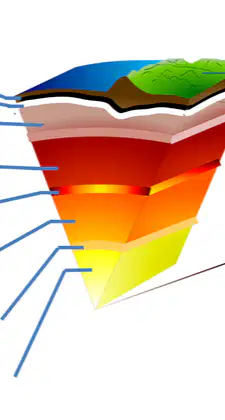
The Moho is found at the
bottom of the crust.
bottom of the mantle.
center of the earth.
bottom of the lithosphere.
Scientists believe that the earth’s core is composed mostly of ___________.
iron
copper
aluminum
nickel
Which of the following is a biological natural resource?
soil
seawater
sunlight
shrimp
What property or properties can make a resource precious or valuable?
the need or demand for it
how accessible it is
both A and B
neither A nor B
A resource manager who is concerned with sustainable yields works with ___________.
a renewable resource
a nonrenewable resource
an artificial resource
a finite resource
According to a secular view of the earth, its solar system, and the universe, our planet and its stars are quite ordinary.
True
False
The earth’s orbit is best described as an ellipse.
True
False
The earth is the only body in our solar system that has an atmosphere.
True
False
The plate tectonics theory can be explained within a young-earth worldview.
True
False
All scientists believe that the earth is regular and predictable.
True
False
Gravity and magnetic sensors can help define the shape of structures deep in the earth’s interior to its core.
True
False
The mantle material is denser than the core material.
True
False
If a natural resource has been located and identified but is not currently being used, it is called an actual resource.
True
False
Managing a renewable resource requires knowing how fast it can be replaced.
True
False
A Christian should not be concerned about a species becoming extinct since only man is made in God’s image.
True
False
Of all the planets and moons in the solar system that have dense atmospheres, only the earth’s atmosphere is _____________.
transparent
opaque
toxic
flammable
The earth’s ________________ protects us from harmful radiation particles that are streaming through space.
magnetic field
ozone layer
gravitational pull
atmosphere
The old-earth view of the earth’s history—which includes assigning ages to rocks that extend far back into time—is called the ________________ viewpoint.
deep-time
catastrophic
short-age
recent-creation
Scientists theorize about what is inside the earth by studying the movement of __________ as they pass through the earth.
seismic (or earthquake) waves
ocean currents
wind patterns
magnetic fields
One way to conserve a nonrenewable resource while still using it is to __________ it for reuse.
recycle
burn
discard
ignore
Resources must be protected from __________.
pollution or abuse
growth and development
natural resources
renewable energy
It is significant that the earth is the only planet in our solar system with liquid water on its surface because:
liquid water is essential for life as we know it
it makes Earth the hottest planet
it causes Earth to have no atmosphere
it means Earth is the largest planet
The earth orbiting within the sun’s habitability zone results in which of the following aids to life?
Presence of liquid water
Extreme temperatures
Lack of atmosphere
Constant volcanic eruptions
Building a model of earthquake faults around Los Angeles, California, would be placed in operational geology because:
it deals with current processes and can help predict future events.
it only studies events that happened in the past.
it focuses on the chemical composition of rocks.
it is unrelated to real-world applications.
Geologists learn about the presence of layers in the earth’s interior by:
studying seismic waves
digging deep holes to the core
observing volcano eruptions only
using satellites to scan the core
The value of a particular natural resource is determined by:
its availability and demand
its color and shape
the country it is found in
the age of the resource
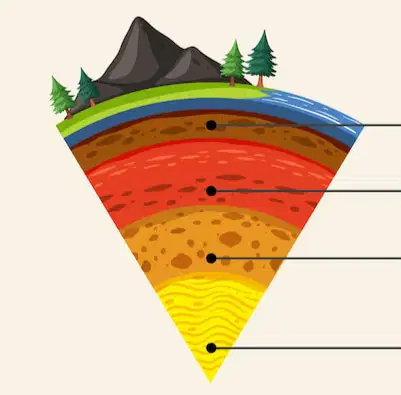
Which color represents the outer core?
red
dark brown
light brown
yellow
Which color represents the mantle?
red
dark brown
light brown
yellow
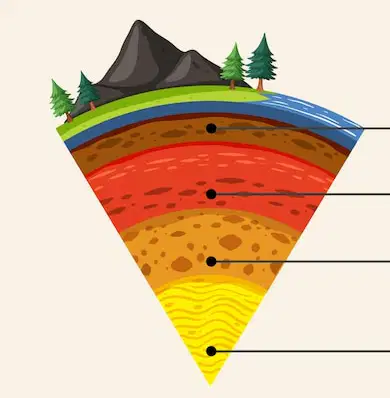
In which layer would you find the asthenosphere?
inner core
mantle
outer core
crust

