
 Worksheets
PREP - Exam #1 (149)
Total questions: 149
Worksheet time: 1hrs 15mins
Name
Class
Date
1.
What is considered a normal body temperature range in adults?
a)
95.0°F - 96.8°F
b)
97.8°F - 99.1°F
c)
100.4°F - 102.2°F
d)
102.4°F - 104.0°F
2.
The prefix "uni-" means:
a)
Two
b)
One
c)
Three
d)
Many
3.
What is the primary purpose of infection control in healthcare settings?
a)
To prevent spread of infection between patients only
b)
To monitor staff performance
c)
To reduce hospital costs
d)
To address all factors related to infection spread between patients, staff, and prevent outbreaks
4.
According to WHO statistics from May 2022, what percentage of infections are preventable with a good infection control program?
a)
50%
b)
60%
c)
70%
d)
80%
5.
What was the primary catalyst for the emergence of physical therapy as a profession in the early 20th century?
a)
Ancient healing practices
b)
World War I injuries and rehabilitation needs
c)
Development of massage techniques
d)
Formation of professional associations
6.
Who is recognized as the founding member of the physical therapy profession?
a)
A group of physicians
b)
The American Physical Therapy Association
c)
Mary McMillan
d)
Ancient healers
7.
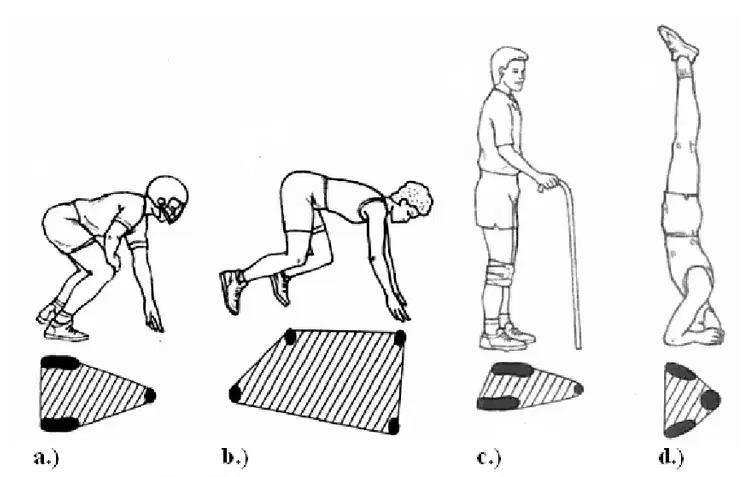
Which body position is MORE STABLE?
a)
A
b)
B
c)
C
d)
D
8.
Which of the following is a principle of GOOD Body Mechanics when lifting boxes?
a)
Wide base of support
b)
Narrow base of support
c)
High center of gravity
d)
Twist your body
9.
The PTT student assesses respiratory rate in a 17 year old patient directly after exercising. The PTT student observed the chest rise and fall, 18 times in 30 seconds. What respiratory rate (RR) would the PTT student report to the Physical Therapist Assistant?
a)
17
b)
26
c)
34
d)
36
10.
The patient just finished 10 minutes of moderately intense exercise. The PTA asks the PTT to check their blood pressure. The PTT reports the BP as 160/80. What does this mean?
a)
Hypotension
b)
Hypertension
c)
Normal
11.
Which of the following is ONE of the 5 C's of medical documentation?
a)
Concise
b)
Copious
c)
Crayons
d)
Collect
12.
While inflating the BP cuff, you notice the brachial artery pulse stops at the 100 mmHG reading. Which of the following numbers is documented as the ESTIMATED SYSTOLIC PRESSURE?
a)
70 mmHG
b)
100 mmHG
c)
130 mmHG
d)
140 mmHG
13.
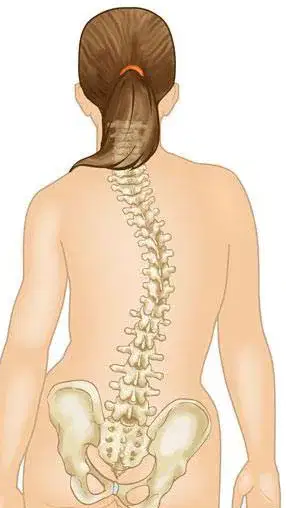
Which term means, "Lateral curvature of spine in either direction in the frontal or coronal plane, accompanied by some degree of vertebral rotation"?
a)
kyphosis
b)
lordosis
c)
scoliosis
d)
retrolisthesis
14.

Which of the following TERMS indicates, "when legs are curved outward at the knees?
a)
Genu Recurvatum
b)
Genu Varum
c)
Genu Valgum
15.
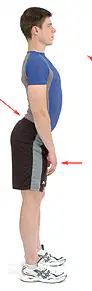
Which of the following can contribute to excessive lumbar lordosis?
a)
weak hip flexors
b)
posterior pelvic tilt
c)
weak abdominals
d)
tight gastrocnemius
16.
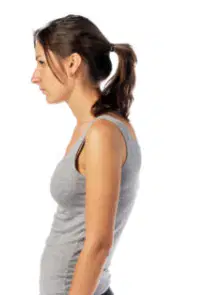
Which of the following may contribute to increased shoulder protraction?
a)
tight pectoralis muscle
b)
strong scapular muscles
c)
weak pectoralis muscles
d)
tight scapular muscles
17.
A cane or a walker will increase which of the following to help improve the patient's balance?
a)
center of gravity
b)
line of gravity
c)
base of support
d)
line of support
18.
Center of Gravity is defined as:
a)
the area on which an object or body rests
b)
the point at which a body's weight is concentrated
c)
excessive forward rotation of the pelvis
d)
the way the parts of the body move together to help prevent injury
19.
What was the original name of the first professional association for physical therapy?
a)
American Physical Therapy Association
b)
Physical Therapists United
c)
American Women's Physical Therapeutics Association
d)
Physiotherapy Organization
20.
What was the first publication for the AWPTA called?
a)
Physical Therapy Journal
b)
P.T. Review
c)
AWPTA Monthly
d)
Therapy Times
21.
In what time period did physiotherapists change their title to physical therapists?
a)
1920s
b)
1930s
c)
1940s
d)
1950s
22.
What is a primary focus of physical therapy as a healthcare profession?
a)
Prescribing medications
b)
Performing surgery
c)
Improving movement and managing pain
d)
Conducting laboratory tests
23.
What was Mary McMillan's significant contribution to the field besides forming the first association?
a)
Invented new therapy techniques
b)
Wrote the first textbook by a physical therapist
c)
Established the first PT school
d)
Created rehabilitation hospitals
24.
When did the earliest forms of manual therapy and exercise appear in civilization?
a)
1500 BC
b)
2000 BC
c)
2500 BC
d)
3000 BC
25.
Which of these activities falls within a physical therapist's scope of practice?
a)
Performing surgery
b)
Prescribing medication
c)
Examining persons with impairments to determine PT diagnosis
d)
Conducting laboratory tests
26.
What type of treatment modalities do physical therapists commonly use?
a)
Therapeutic exercise and manual therapy
b)
Surgery and medication
c)
X-rays and blood tests
d)
Psychological counseling
27.
In anatomical position, how should the body be positioned?
a)
Body lying down with palms facing up
b)
Body standing upright, facing forward with palms forward
c)
Body standing sideways with arms crossed
d)
Body standing upright with palms facing backward
28.
Which anatomical plane divides the body into right and left halves?
a)
Frontal plane
b)
Transverse plane
c)
Sagittal plane
d)
Coronal plane
29.
The frontal (coronal) plane divides the body into:
a)
Right and left portions
b)
Top and bottom portions
c)
Front and back portions
d)
Medial and lateral portions
30.
What term describes a position that is closer to the trunk or point of origin?
a)
Distal
b)
Lateral
c)
Medial
d)
Proximal
31.
Which position describes lying face up?
a)
Prone
b)
Fowler's position
c)
Left lateral recumbent
d)
Supine
32.
The movement of turning the palm downward is called:
a)
Supination
b)
Pronation
c)
Inversion
d)
Eversion
33.
This movement happens at the hip or shoulder and is the arm moving away from the body's midline.
a)
Adduction
b)
Abduction
c)
Flexion
d)
Extension
34.
Which movement occurs at both the shoulder and hip joints?
a)
Plantarflexion
b)
Dorsiflexion
c)
Circumduction
d)
Pronation
35.
What position describes lying face down?
a)
Supine
b)
Prone
c)
Hooklying
d)
Fowler's position
36.
When the sole of the foot is turned outward, this movement is called:
a)
Inversion
b)
Dorsiflexion
c)
Plantarflexion
d)
Eversion
37.
Hooklying position is characterized by:
a)
Lying face down with arms extended
b)
Semi-sitting with head elevated
c)
Lying on back with knees bent and feet flat
d)
Lying on side with knees straight
38.
The anterior aspect of the body refers to the:
a)
Back side
b)
Front side
c)
Right side
d)
Left side
39.
When performing plantarflexion, the:
a)
Heels are lifted upward
b)
Toes point inward
c)
Foot turns outward
d)
Heels remain down
40.
The term 'caudal' is synonymous or the same as:
a)
Superior
b)
Anterior
c)
Inferior
d)
Lateral
41.
Which movement occurs at the forearm only?
a)
Circumduction
b)
Abduction
c)
Supination
d)
External rotation
42.
The relationship between shoulder and hip joints demonstrates that both can perform:
a)
Plantarflexion and dorsiflexion
b)
Pronation and supination
c)
Inversion and eversion
d)
Abduction and adduction
43.
Full plank position requires:
a)
Support on forearms and knees
b)
Support on hands and knees
c)
Support on hands and toes
d)
Support on forearms and toes
44.
The posterior aspect of the body refers to the:
a)
Front side
b)
Top side
c)
Back side
d)
Bottom side
45.
Internal rotation is a movement that occurs at the:
a)
Ankle and wrist
b)
Elbow and knee
c)
Shoulder and hip
d)
Wrist and elbow
46.
In left lateral recumbent position, the patient is:
a)
Lying face up
b)
Lying on the left side
c)
Lying face down
d)
Semi-sitting
47.
Adduction of a limb or arm/leg involves:
a)
Moving away from midline
b)
Moving toward midline
c)
Rotating outward
d)
Rotating inward
48.
Circumduction describes:
a)
Linear movement
b)
Circular movement
c)
Angular movement
d)
Spiral movement
49.
When the palm faces upward, this position is called:
a)
Pronation
b)
Eversion
c)
Supination
d)
Inversion
50.
The term 'lateral' in anatomical direction means:
a)
Toward the midline
b)
Away from the midline
c)
Toward the front
d)
Toward the back
51.
In anatomical position, the palms are:
a)
Facing backward
b)
Facing the sides
c)
Facing forward
d)
Facing each other
52.
During inversion of the foot:
a)
The sole turns outward
b)
The sole turns inward
c)
The toes point upward
d)
The heel lifts up
53.
Which term describes the relationship of the nose to the chin?
a)
The nose is lateral to the chin
b)
The nose is superior to the chin
c)
The nose is posterior to the chin
d)
The nose is medial to the chin
54.
The anatomical position is important because:
a)
It's the most comfortable position
b)
It's used during surgery only
c)
It's the standard reference position
d)
It's used for exercise only
55.
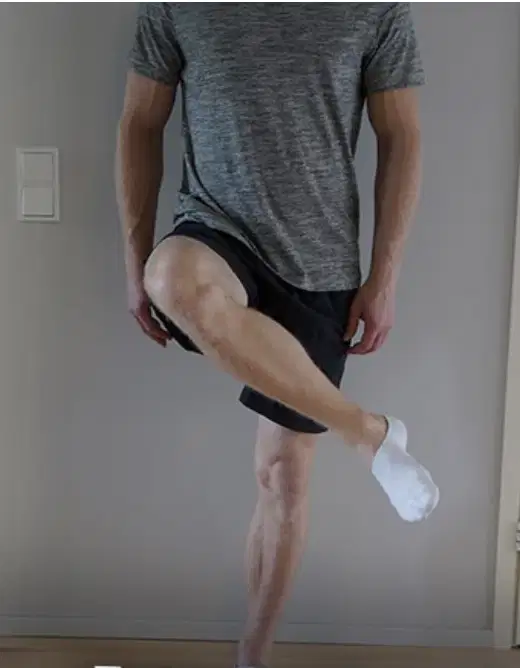
External rotation at the hip joint:
a)
Moves the leg away from midline
b)
Rotates the femur/leg inward; foot goes outward
c)
Rotates the femur/leg outward; foot goes inward
d)
Bends the hip joint
56.
The transverse plane is also known as the:
a)
Coronal plane
b)
Sagittal plane
c)
Vertical plane
d)
Horizontal plane
57.
What is a nosocomial infection?
a)
An infection present at admission
b)
An infection acquired during hospital stay
c)
A chronic infection
d)
A community-acquired infection
58.
What is the single most important factor in preventing pathogen spread in healthcare settings?
a)
Wearing gloves
b)
Hand hygiene
c)
Wearing masks
d)
Using gowns
59.
What type of precautions require negative pressure rooms?
a)
Standard precautions
b)
Contact precautions
c)
Droplet precautions
d)
Airborne precautions
60.
What is the proper procedure when exiting an isolation room?
a)
Remove PPE in any order and leave
b)
Keep PPE on until reaching another patient's room
c)
Follow specific sequence of PPE removal and perform hand hygiene
d)
Only remove gloves before leaving
61.
According to the Chain of Infection model, what is the first link?
a)
Susceptible Host
b)
Portal of Entry
c)
Infectious Agent
d)
Mode of Transmission
62.
During which stage of infection do specific signs and symptoms of the disease appear?
a)
Incubation period
b)
Prodromal stage
c)
Full stage of illness
d)
Recovery stage
63.
Which workplace hazard category includes needle sticks and scalpel injuries?
a)
Biological hazards
b)
Chemical hazards
c)
Sharps hazards
d)
Physical hazards
64.
What percentage of needle stick injuries occur to non-users of the needles?
a)
15%
b)
20%
c)
25%
d)
30%
65.
In the Chain of Infection model, where do germs live and grow?
a)
Portal of entry
b)
Reservoir
c)
Mode of transmission
d)
Portal of exit
66.
Which term refers to the legal responsibility for actions or omissions in healthcare?
a)
Autonomy
b)
Liability
c)
Beneficence
d)
Justice
67.
What is the key principle that refers to acting in the patient's best interest?
a)
Non-maleficence
b)
Justice
c)
Autonomy
d)
Beneficence
68.
A surgeon operates on the wrong body part. This is an example of:
a)
Slander
b)
Libel
c)
Malpractice
d)
Justice
69.
What term describes a patient's right to self-determination in their healthcare decisions?
a)
Autonomy
b)
Beneficence
c)
Justice
d)
Non-maleficence
70.
A magazine publishes false statements about a nurse's professional behavior. This is an example of:
a)
Slander
b)
Libel
c)
Negligence
d)
Malpractice
71.
A healthcare worker fails to clean equipment properly, leading to infection. This is an example of:
a)
Libel
b)
Negligence
c)
Slander
d)
Justice
72.
What guides professional conduct within a specific healthcare context?
a)
Laws only
b)
Personal beliefs
c)
Ethics
d)
Morals
73.
A nurse stays late to comfort a frightened patient, even though it's not required. This best demonstrates:
a)
Legal compliance
b)
Ethical behavior
c)
Mandatory duty
d)
Required protocol
74.
Which of the following is a current challenge in healthcare ethics?
a)
Basic hygiene practices
b)
Traditional medicine
c)
Artificial intelligence implications
d)
Standard record-keeping
75.
In the case of a 17-year-old seeking tattoo removal, what ethical principle is primarily being challenged?
a)
Non-maleficence
b)
Autonomy
c)
Justice
d)
Beneficence
76.
HIPAA violations primarily concern which aspect of healthcare?
a)
Treatment protocols
b)
Patient privacy
c)
Medical research
d)
Staff training
77.
Which of the following best describes professional negligence by a healthcare provider?
a)
Defamation
b)
Malpractice
c)
Libel
d)
Liability
78.
Which position describes lying face up?
a)
Prone
b)
Fowler's position
c)
Left lateral recumbent
d)
Supine
79.
This movement happens at the hip or shoulder and is the arm moving away from the body's midline.
a)
Adduction
b)
Abduction
c)
Flexion
d)
Extension
80.
Hooklying position is characterized by:
a)
Lying face down with arms extended
b)
Semi-sitting with head elevated
c)
Lying on back with knees bent and feet flat
d)
Lying on side with knees straight
81.
The relationship between shoulder and hip joints demonstrates that both can perform:
a)
Plantarflexion and dorsiflexion
b)
Pronation and supination
c)
Inversion and eversion
d)
Abduction and adduction
82.
The posterior aspect of the body refers to the:
a)
Front side
b)
Top side
c)
Back side
d)
Bottom side
83.
The term 'lateral' in anatomical direction means:
a)
Toward the midline
b)
Away from the midline
c)
Toward the front
d)
Toward the back
84.
During inversion of the foot:
a)
The sole turns outward
b)
The sole turns inward
c)
The toes point upward
d)
The heel lifts up
85.
The prefix "mono-" indicates:
a)
One
b)
Two
c)
Three
d)
Four
86.
The prefix "quad-" indicates:
a)
One
b)
Two
c)
Three
d)
Four
87.
"Poly-" refers to:
a)
Few
b)
One
c)
Many
d)
Two
88.
"Oligo-" indicates:
a)
Many
b)
Few
c)
All
d)
One
89.
The prefix "pan-" means:
a)
Some
b)
Few
c)
Many
d)
All
90.
"Peri-" refers to:
a)
Through
b)
Around
c)
Between
d)
Within
91.
"Inter-" indicates:
a)
Within
b)
Around
c)
Through
d)
Between
92.
The prefix "intra-" means:
a)
Outside
b)
Between
c)
Within
d)
Around
93.
"Ad-" refers to:
a)
Away from middle
b)
Toward middle
c)
Around middle
d)
Through middle
94.
The prefix "ab-" indicates:
a)
Toward middle
b)
Away from middle
c)
Around middle
d)
Through middle
95.
"Ante-" means:
a)
After
b)
During
c)
Between
d)
Before/forward
96.
The prefix "co-/con-" refers to:
a)
Against
b)
Without
c)
With/together
d)
Apart
97.
"Extra-" indicates:
a)
Inside
b)
Between
c)
Outside
d)
Through
98.
The prefix "endo-" means:
a)
Outside
b)
Inside
c)
Between
d)
Through
99.
The prefix "trans-" means:
a)
Around
b)
Through
c)
Across
d)
Between
100.
The prefix "para-" means:
a)
Through
b)
Around
c)
Beside
d)
Between
101.
"Neo-" means:
a)
Old
b)
Current
c)
New
d)
Ancient
102.
The prefix "hypo-" means:
a)
Above
b)
Below
c)
Through
d)
Between
103.
"Infra-" refers to:
a)
Above
b)
Through
c)
Below
d)
Between
104.
The prefix "supra-" refers to:
a)
Below
b)
Through
c)
Above
d)
Between
105.
The prefix "leuko-" means:
a)
Black
b)
White
c)
Red
d)
Blue
106.
The prefix "auto-" refers to:
a)
Other
b)
Self
c)
Multiple
d)
None
107.
"Allo-" indicates:
a)
Self
b)
Same
c)
Similar
d)
Not self/donor tissue
108.
The prefix "anti-" means:
a)
With
b)
For
c)
Against
d)
Through
109.
"Contra-" refers to:
a)
With
b)
For
c)
Against
d)
Through
110.
The prefix "hemi-" indicates:
a)
Whole
b)
Quarter
c)
Half
d)
Third
111.
"Semi-" means:
a)
Whole
b)
Quarter
c)
Half
d)
Third
112.
The prefix "iso-" refers to:
a)
Different
b)
Unequal
c)
Equal
d)
Varied
113.
"Dys-" indicates:
a)
Easy
b)
Difficult
c)
Normal
d)
Simple
114.
The prefix "an-" means:
a)
With
b)
Without
c)
Through
d)
Around
115.
"A-" refers to:
a)
With
b)
Without
c)
Through
d)
Around
116.
The prefix "per-" indicates:
a)
Around
b)
Between
c)
Through
d)
Outside
117.
The prefix "eu-" refers to:
a)
Bad
b)
Poor
c)
Good/normal
d)
Difficult
118.
"Hetero-" indicates:
a)
Same
b)
Equal
c)
Similar
d)
Different
119.
What happens if the blood pressure cuff is too small?
a)
The reading will be artificially lowered
b)
The reading will be artificially elevated
c)
The reading won't be affected
d)
The cuff won't inflate properly
120.
2. The center of gravity in females is approximately what percentage of their standing height?
a)
52%
b)
53%
c)
55%
d)
57%
121.
3. During pregnancy, how does the center of gravity change?
a)
Moves backward
b)
Remains unchanged
c)
Moves upward
d)
Moves forward
122.
4. Which condition is characterized by an exaggerated forward curve in the upper back?
a)
Lordosis
b)
Scoliosis
c)
Kyphosis
d)
Genu varum
123.
7. For every inch the head moves forward from neutral position, how much does the perceived weight increase?
a)
5 pounds
b)
10 pounds
c)
15 pounds
d)
20 pounds
124.
8. Which postural condition involves lateral curvature of the spine?
a)
Kyphosis
b)
Lordosis
c)
Scoliosis
d)
Genu recurvatum
125.
9. What is the term for flat feet?
a)
Pes cavus
b)
Pes planus
c)
Genu valgum
d)
Genu varum
126.
10. When is genu valgum (knock-knees) considered normal?
a)
In adults over 50
b)
In children ages 2-6
c)
In teenagers
d)
In pregnant women
127.
11. What is the primary characteristic of protracted scapulae?
a)
Shoulders pulled back
b)
Shoulders rounded forward
c)
Shoulders elevated
d)
Shoulders depressed
128.
12. Which condition describes hyperextended knees?
a)
Genu valgum
b)
Genu varum
c)
Genu recurvatum
d)
Pes planus
129.
14. In optimal posture, how much muscle activity is required to maintain stability?
a)
Moderate amount
b)
Maximum effort
c)
Little to none
d)
Constant engagement
130.
15. What is the term for high-arched feet?
a)
Pes planus
b)
Pes cavus
c)
Genu valgum
d)
Genu varum
131.
18. The Line of Gravity (LOG) in optimal posture should be:
a)
Far from joint axis
b)
Close to joint axis
c)
Behind joint axis
d)
Irrelevant to joint axis
132.
19. Which is a characteristic of sway back posture?
a)
Forward head position
b)
Exaggerated thoracic curve
c)
Posterior pelvic tilt with forward hip position
d)
Anterior pelvic tilt only
133.
20. What type of muscles become tight in Upper Crossed Syndrome?
a)
Deep neck flexors and serratus anterior
b)
Lower trapezius and rhomboids
c)
Upper trapezius and pectorals
d)
Core muscles and deltoids
134.
21. During what ages is some degree of genu varum (bowlegs) considered normal?
a)
Ages 5-8
b)
Ages 2-6
c)
Birth to 3-4 years
d)
Ages 8-12
135.
22. What is the term for the compensatory postures that develop to either improve function or normalize appearance?
a)
Adaptive positioning
b)
Functional alignment
c)
Postural compensation
d)
Structural adaptation
136.
When measuring blood pressure, the systolic pressure is:
a)
The average pressure reading
b)
The pressure between heartbeats
c)
The first clear sound you hear
d)
The last clear sound you hear
137.
Which of the following is a correct procedure for estimating systolic pressure?
a)
Listen for Korotkoff sounds immediately
b)
Inflate cuff until radial pulse disappears
c)
Deflate cuff completely before starting
d)
Take multiple readings without rest
138.
For accurate blood pressure measurement, the patient's arm should be:
a)
Below heart level
b)
At the same height as the heart
c)
Above heart level
d)
At any comfortable position
139.
When performing orthostatic blood pressure measurements, what is the correct sequence?
a)
Standing, sitting, supine
b)
Supine, standing, sitting
c)
Supine, sitting, standing
d)
Sitting, standing, supine
140.
How long should a patient rest before taking blood pressure?
a)
30 seconds
b)
1-2 minutes
c)
3-5 minutes
d)
10 minutes
141.
What represents the diastolic pressure?
a)
The first clear sound
b)
The highest pressure reading
c)
The last clear sound
d)
The middle pressure reading
142.
Each small black tick mark on the blood pressure cuff dial represents:
a)
5 mmHg
b)
2 mmHg
c)
1 mmHg
d)
3 mmHg
143.
What type of sounds are you listening for when taking blood pressure?
a)
Whooshing sounds
b)
Korotkoff sounds
c)
Breathing sounds
d)
Heart murmurs
144.
At what temperature is a patient considered febrile (having a fever)?
a)
Above 98.6°F
b)
Above 99.5°F
c)
Above 100.4°F
d)
Above 101.3°F
145.
What is the normal resting respiratory rate range for adults?
a)
8-12 breaths per minute
b)
12-20 breaths per minute
c)
20-30 breaths per minute
d)
30-40 breaths per minute
146.
What is considered a normal oxygen saturation level for most adults?
a)
Above 85%
b)
Above 90%
c)
Above 95%
d)
Above 98%
147.
What is the normal capillary refill time?
a)
Less than 1 second
b)
Less than 2 seconds
c)
Less than 3 seconds
d)
Less than 4 seconds
148.
What condition can cause an elevated respiratory rate?
a)
Sleep
b)
Fever
c)
Rest
d)
Meditation
149.
What can cause false low readings on a pulse oximeter?
a)
Bright room lighting
b)
Clean fingernails
c)
Dark skin pigmentation
d)
Warm hands
100 %

