
 Worksheets
Stock Exchange Order Matching and Transaction Value Questions
Total questions: 75
Worksheet time: 40mins

A Stock Exchange holds a periodic auction to fix an opening price. During the opening session on 2/1/N, it received limit orders of stock A as the following table: Assuming that the prior closing price is 18.7. Determine the transaction value of this session
127,160 (1,000 dong)
137,240 (1,000 dong)
126,480 (1,000 dong)
125,800 (1,000 dong)
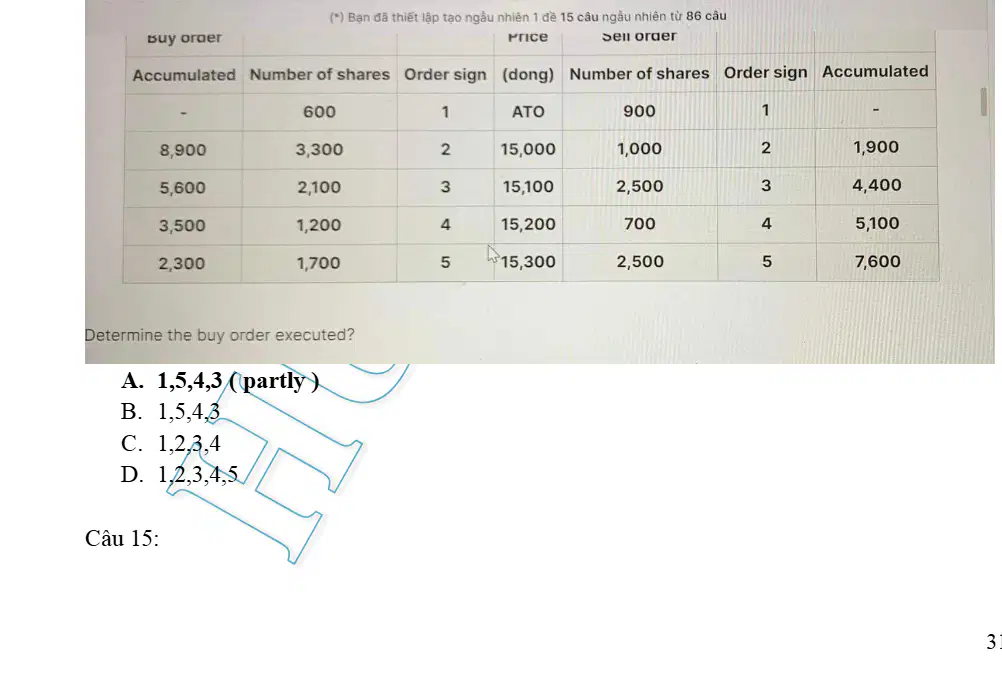
Determine the buy order executed?
1,5,4,3 (partly)
1,5,4,3
1,2,3,4
1,2,3,4,5
Trading unit in Ho Chi Minh city Stock Exchange (HOSE) is
100 shares of stock
10 shares of stock
1000 VND
100 VND
Which of the following statements is false for OTC market?
There is no physical trading floor
It is carried out by market makers
OTC stocks are non-listed stocks
The trading securities are often stocks big and reputable companies
Price spread of Hanoi Stock Exchange (HNX) is
+/- 7%
+/- 10%
+/- 15%
+/- 20%
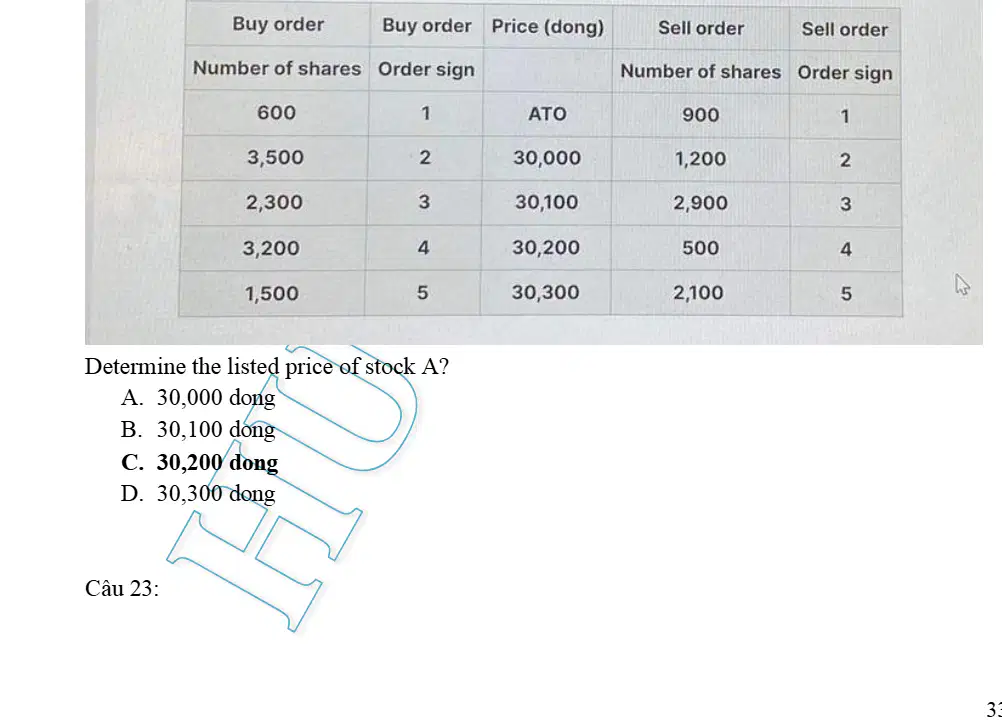
A Stock Exchange holds a periodic auction to fix an opening price. After 15 minutes opening on 2/1/N, it received limit orders of stock A as the following table: [Table: Buy order, Buy order sign, Price (dong), Sell order, Sell order sign] Determine the listed price of stock A?
30,000 dong
30,100 dong
30,200 dong
30,300 dong
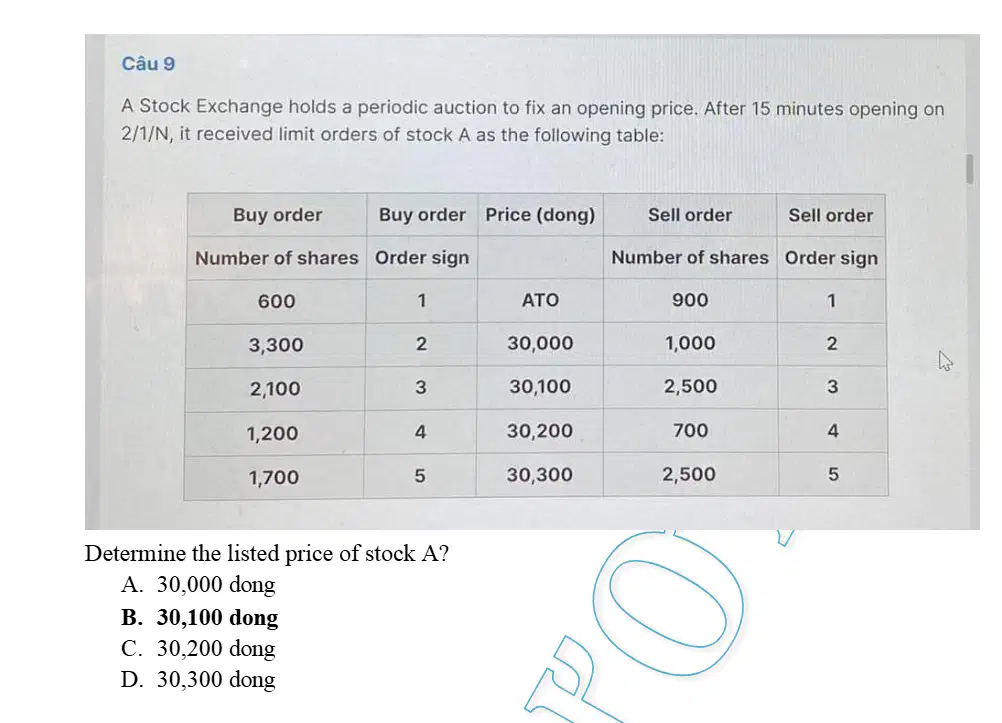
A Stock Exchange holds a periodic auction to fix an opening price. After 15 minutes opening on 2/1/N, it received limit orders of stock A as the following table: | Buy order | Buy order | Price (dong) | Sell order | Sell order | |-----------|-----------|--------------|------------|------------| | Number of shares | Order sign | | Number of shares | Order sign | | 600 | 1 | ATO | 900 | 1 | | 3,300 | 2 | 30,000 | 1,000 | 2 | | 2,100 | 3 | 30,100 | 2,500 | 3 | | 1,200 | 4 | 30,200 | 700 | 4 | | 1,700 | 5 | 30,300 | 2,500 | 5 | Determine the listed price of stock A?
30,000 dong
30,100 dong
30,200 dong
30,300 dong
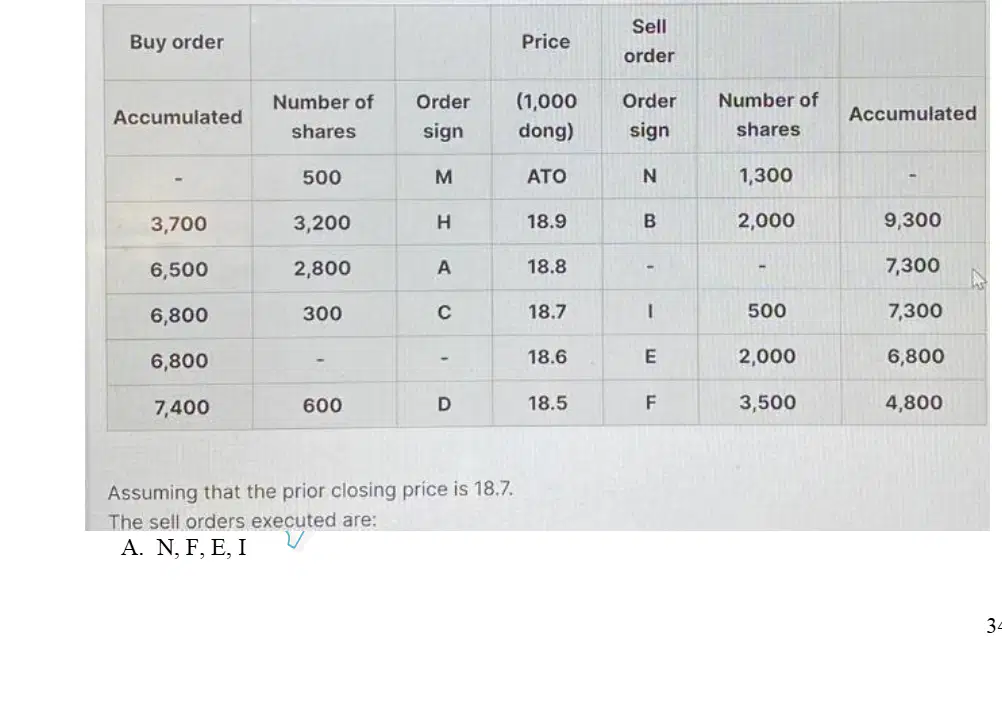
A Stock Exchange holds a periodic auction to fix an opening price. During the opening session on 2/1/N, it received limit orders of stock A as the following table: | Buy order | | Price | Sell order | | |-----------|----------------|-------|----------------|-------| | Accumulated | Number of shares | Order sign | (1,000 dong) | Order sign | Number of shares | Accumulated | | - | 500 | M | ATO | N | 1,300 | - | | 3,700 | 3,200 | H | 18.9 | B | 2,000 | 9,300 | | 6,500 | 2,800 | A | 18.8 | - | - | 7,300 | | 6,800 | 300 | C | 18.7 | I | 500 | 7,300 | | 6,800 | - | - | 18.6 | E | 2,000 | 6,800 | | 7,400 | 600 | D | 18.5 | F | 3,500 | 4,800 | Assuming that the prior closing price is 18.7. Which of the following is the correct matching of order signs for the opening price fixing?
N, F, E, I
A, B, C, D
M, H, A, F
B, E, D, M

A Stock Exchange holds a periodic auction to fix an opening price. During the opening session on 2/1/N, it received limit orders of stock A as the following table: Buy order | Buy order | Price | Sell order | Sell order Number of shares | Order sign | (dong) | Number of shares | Order sign 600 | 1 | ATO | 900 | 1 3,300 | 2 | 15,000 | 1,000 | 2 2,100 | 3 | 15,100 | 2,500 | 3 1,200 | 4 | 15,200 | 700 | 4 1,700 | 5 | 15,300 | 2,500 | 5 Which table below is true?
A. (Table shown below)
B. N, B, I, E
C. N, F, E
D. N, B, I, E, F
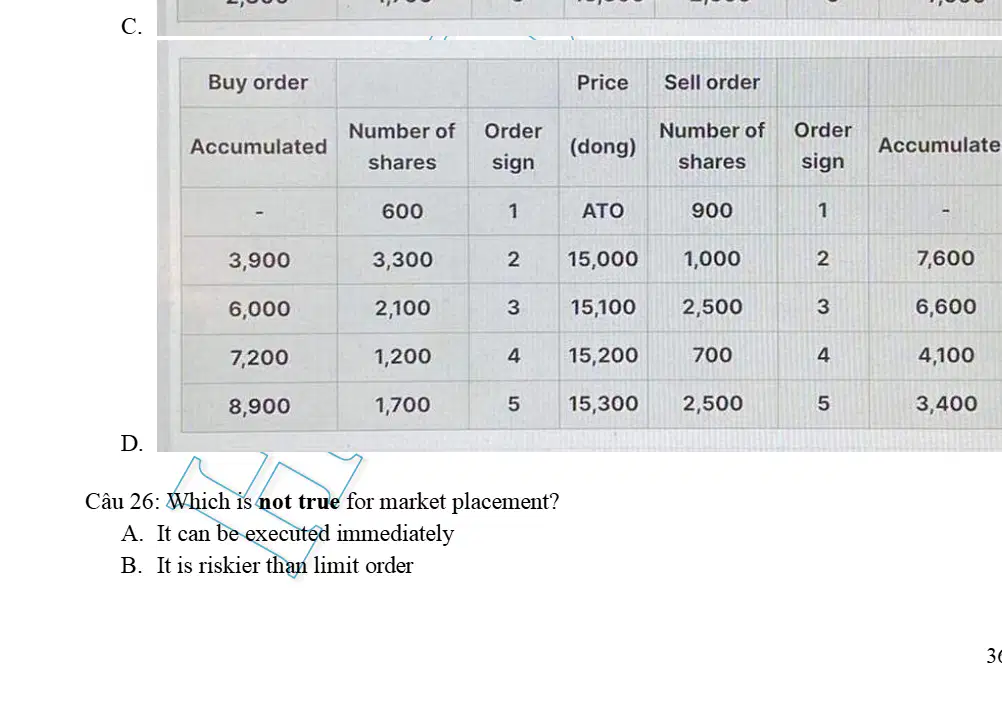
Which is not true for market placement?
It can be executed immediately
It is riskier than limit order
Which of the following statements is true?
a. a bondholder repays principal when the bond matures
b. generally speaking, bonds are riskier than common stocks
c. low inflation is expected to have a negative effect on bond prices
d. bonds are usually less liquid than stocks
Which type of risk below is classified as systematic risk?
reinvestment risk
management and corporate governance risk
business risk
liquidity risk
Which type of risk below is classified as non-systematic risk?
inflation risk
legal risks
reinvestment risk
default risk
Your bank is considering investing in a stock that has an expected yield of 10%. The T-bill interest rate is 8%, the average interest rate of the stock market is 12%, the stock under consideration has risk equal to 70% of the average market risk. What should investors do?
invest because required rate is lower than real interest rate
do not invest because real interest rate is lower than required rate
do not invest because real interest rate is higher than required rate
unspecified and no advice
Your bank is considering investing in a stock that has an expected yield of 9%. The T-bill interest rate is 6%, the average interest rate of the stock market is 10%, the stock under consideration has a beta of 0.6. What should investors do?
invest because required rate is lower than real interest rate
do not invest because real interest rate is lower than required rate
do not invest because real interest rate is higher than required rate
unspecified and no advice
Similarities between internal rate of return (IRR) and yield to maturity (YTM)
they are discount rates that make the net present value (NPV) of all cash flows from a bond equal to zero
they are often determined by interpolation method
they can be determined by 3 methods: trial and errors, interpolation and graph method
all of the above
In periodic auction, the orders are executed base on price priority with the first priority belonging to…
ATO/ATC
Buying orders with higher price, selling orders with lower price are executed
Buying and selling orders having price equal to the listed price can be partly or fully executed depend on each case
All of the above
Trading unit is
The standardized number of units in which a financial instrument trades
Smallest price unit
Both a and b
None a nor b
Principle of price auction in descending order of priority
Price priority, Customer priority, Time priority, Quantity priority
Time priority, Price priority, Customer priority, Quantity priority
Price priority, Time priority, Customer priority, Quantity priority
Price priority, Time priority, Quantity priority, Customer priority
… is an order to buy or sell a security at the opening/closing price
limit order
market order
stop order
ATO; ATC
Principle of price auction in decreasing order of priority:
price priority, customer priority, time priority, quantity priority
time priority, price priority, customer priority, quantity priority
price priority, time priority, customer priority, quantity priority
price priority, time priority, quantity priority, customer priority
Which of the following assumptions does the constant-growth discount model require?
dividends grow at a constant rate
the dividend growth rate continues indefinitely
What type of market is referred to as the secondary market?
Floating market
Risky market
Secondary market
Primary market
Which is the common point among ATO, ATC and MP?
They have priority over limit order in matching priority
They have priority after limit order in matching priority
They are all used in continuous auction
They are all used in periodic auction
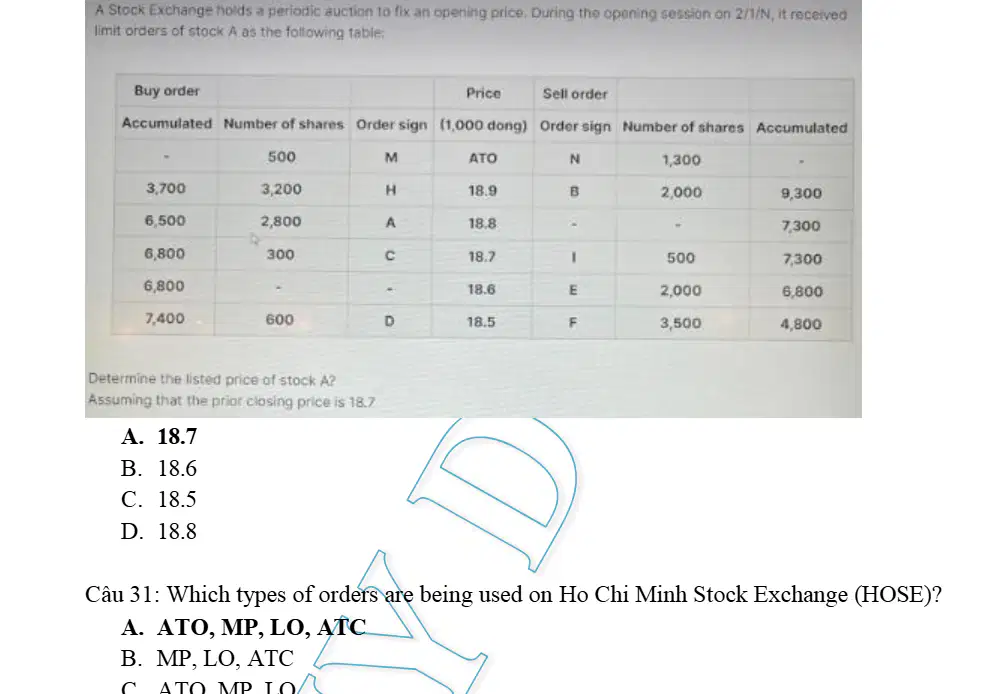
A Stock Exchange holds a periodic auction to fix an opening price. During the opening session on 2/1/N, it received limit orders of stock A as the following table: Determine the listed price of stock A? Assuming that the prior closing price is 18.7
18.7
18.6
18.5
18.8
Which types of orders are being used on Ho Chi Minh Stock Exchange (HOSE)?
ATO, MP, LO, ATC
MP, LO, ATC
ATO, MP, LO
ATO, MTL, MOK, MAK, LO
… is often the prior closing price
Today listed price
Today opening price
Today reference price
Today executed price
Exchange market and over-the-counter market are considered as two types of ________.
financial markets
retail stores
manufacturing units
transportation systems
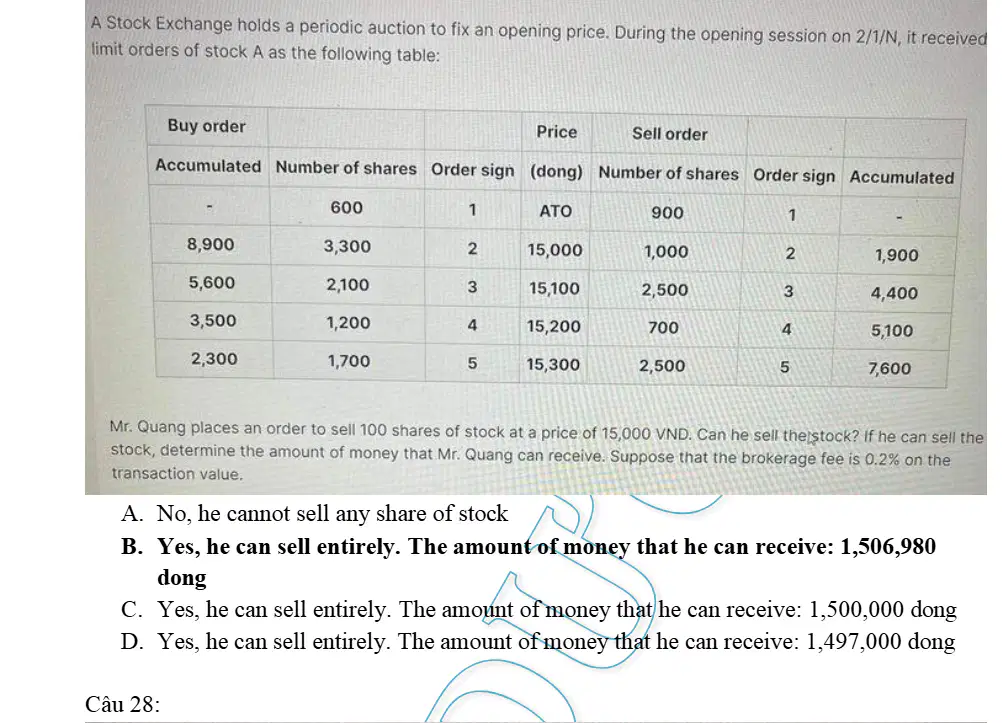
A Stock Exchange holds a periodic auction to fix an opening price. During the opening session on 2/1/N, it received limit orders of stock A as the following table: Mr. Quang places an order to sell 100 shares of stock at a price of 15,000 VND. Can he sell the stock? If he can sell the stock, determine the amount of money that Mr. Quang can receive. Suppose that the brokerage fee is 0.2% on the transaction value.
No, he cannot sell any share of stock
Yes, he can sell entirely. The amount of money that he can receive: 1,506,980 dong
Yes, he can sell entirely. The amount of money that he can receive: 1,500,000 dong
Yes, he can sell entirely. The amount of money that he can receive: 1,497,000 dong
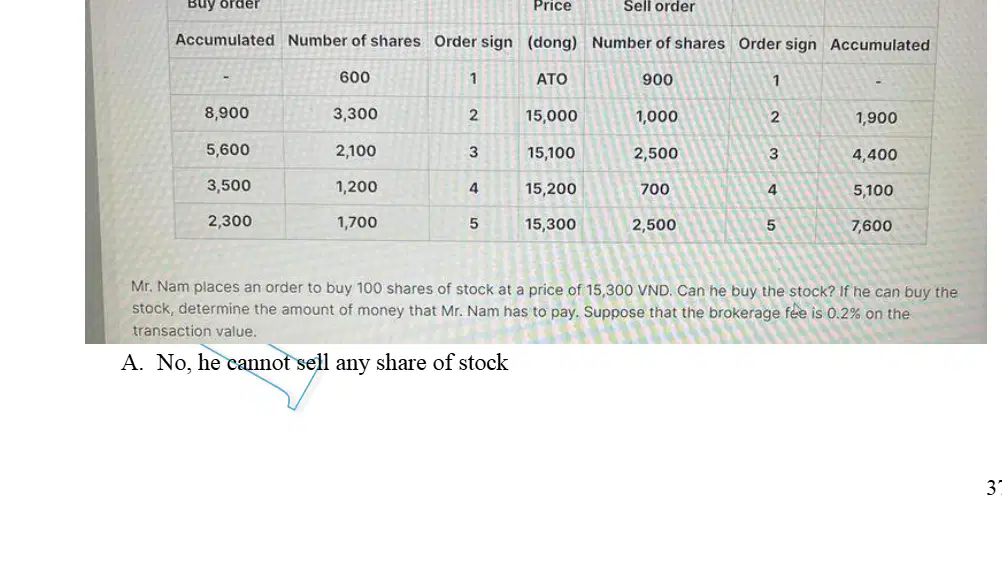
A Stock Exchange holds a periodic auction to fix an opening price. During the opening session on 2/1/N, it received limit orders of stock A as the following table: Mr. Nam places an order to buy 100 shares of stock at a price of 15,300 VND. Can he buy the stock? If he can buy the stock, determine the amount of money that Mr. Nam has to pay. Suppose that the brokerage fee is 0.2% on the transaction value.
In Capital Asset Pricing Model (CAPM): Ri = Rf + βi (RM - Rf), what can we call Rm - Rf?
expected return of investment i
risk-free rate
risk premium of the investment i
market risk premium
In Capital Asset Pricing Model (CAPM): Ri = Rf + βi (RM - Rf), what can we call βi(Rm - Rf)?
expected return of investment i
risk-free rate
risk premium of the investment i
market risk premium
A zero-coupon bond has the following features: Face value of 100,000 dong; maturity of 5 years; issuing price of 80,000 dong. This bond has been circulating for 3 years. An investor bought the bond at the issuing time. Currently, the investor sells this bond at a price of 88,000 dong. Determine the internal rate of return in this case?
3.43%
3.23%
3.33%
unspecified and no answer
A zero-coupon bond has the following features: Face value of 100,000 dong; maturity of 5 years; issuing price of 80,000 dong. This bond has been circulating for 3 years. An investor bought the bond at the issuing time. Currently, the investor sells this bond at a price of 88,000 dong. Determine the price of bonds that investors can sell? Assumption that: Market interest rates are stable at 7% per year, the expected rate of return of investor is 8% per annum
87,343.87 dong
85,733.88 dong
81,629.79 dong
Unspecified and no answer
A corporate bond has a face value of VND 100,000, paying interest once a year at the end of each year. This bond has a coupon yield of 9% per annum and a maturity of 6 years. Issued price was 102,000 dong. Investor A bought this bond at the time of the issuance last year and received interest once. Currently, investor A sells this bond at a price of 104,000 dong. Determine the term interest of the investment?
10.78%
8.82%
1.96%
9%
A Coupon bond has a face value of VND 100,000; a maturity of 5 years; Coupon yield of 11% per annum, paying interest once a year at the end of each year. Issued price was 96,000 dong. Investor A bought this bond at the time of the issuance 3 years ago and received interest three times. He has just sold this bond at the price of 108,000 dong. Did his investment decision 3 years ago met his requirements? Assumption: Market interest rates are stable at 14% per year, the expected rate of return of investors is 15% per annum.
Yes, he did because PV=96,127.23 dong > Issued price
No, he did not because PV=96,127.23 dong< Issued price
Yes, he did because PV = 98,434.88 dong> Issued price
No, he did not because PV = 98,434.88 dong> Issued price
A stock has dividend in year N-1 is 2,000 VND per share. The dividend distribution strategy in the following years is as follows: In the next 2 years the growth rate is 8% per annum and the following years the growth rate is 5% per annum indefinitely. Investor A intends to invest in this stock on 1/1/N and he will sell it after 3 years. Estimate the sale price of this stock after 3 years from the date of 1/1/N? Assumption that: The required rate of return is 10% per year.
48,988.8 dong
54,010.15 dong
51,438.24 dong
42,000 dong
Joint Stock Company X has the following information: The Company issued: 120,000 shares of common stocks; 20,000 shares of preferred stocks (cumulative and non-participating) with par value of VND 10,000 per share and dividend of 10% per annum; Earnings before tax of the company in year N is 412 million dong, the company must pay corporate income tax at the rate of 20%. The Board of Directors announces dividend payout ratio of year N is 0.6 Determine the dividend per share of a common stock in year N? Assumption that: The company's business expenses are reasonable and valid. In the year N and years before the year N, the company has paid all dividends to shareholders.
2,580 dong
1,548 dong
1,032 dong
1,857.6 dong
The probability of the economy happening at 5 levels is the same next year. Here are the expected rates of returns for stock P in each situation: Economic situation | Stock P 1 | 4% 2 | 6% 3 | 9% 4 | 4% 5 | -5% Determine the risk level of stock P
4.67%
3.6%
7.13%
3.67%
A corporate bond has a face value of VND 100,000, paying interest once a year at the end of each year. This bond has a coupon yield of 9% per annum and a maturity of 6 years. Issued price was 102,000 dong. Investor A bought this bond at the time of the issuance 3 years ago and received interest three times. Currently, investor A intends to sell this bond. Determine the sale price that A can sell? Assumption that: Market interest rate is stable at 10% per year, required rate of return of A is 11% per annum
97,513.15 dong
95,112.57 dong
98,264.46 dong
95,112.57 dong
The probability and rate of return in 4 situation for stock A are in the table below
Economic situation | Probability | Expected rate of return
1 | 25% | 9%
2 | 30% | 10%
3 | 15% | 14%
4 | 30% | -6%
Determine the expected rate of return of stock A?
(a)
A coupon bond with a face value of 100,000 dong is being sold at price of 98,750 dong. Which of the following statements is true?
coupon yield < current yield
coupon yield > internal rate of return
coupon yield > yield to maturity
b and c are correct
Which of the following assumptions does the one-stage growth model require?
Dividends grow at an inconstant rate
The dividend growth rate continues indefinitely
The required rate of return is lower than the dividend growth rate
ALL of above
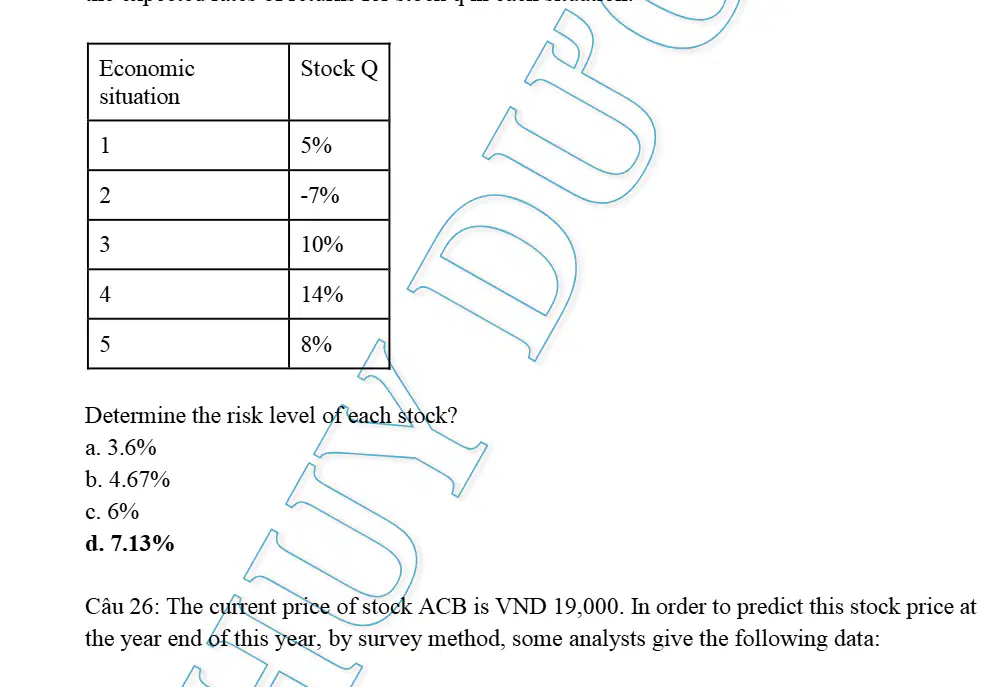
Determine the risk level of each stock?
3.6%
4.67%
6%
7.13%
Requirements: determine the expected rate of return when investing in ACB
2.11%
3.11%
4.11%
5.11%
… is an order to buy or sell stock immediately at the best available price
limit order
market order
Stop order
Open order
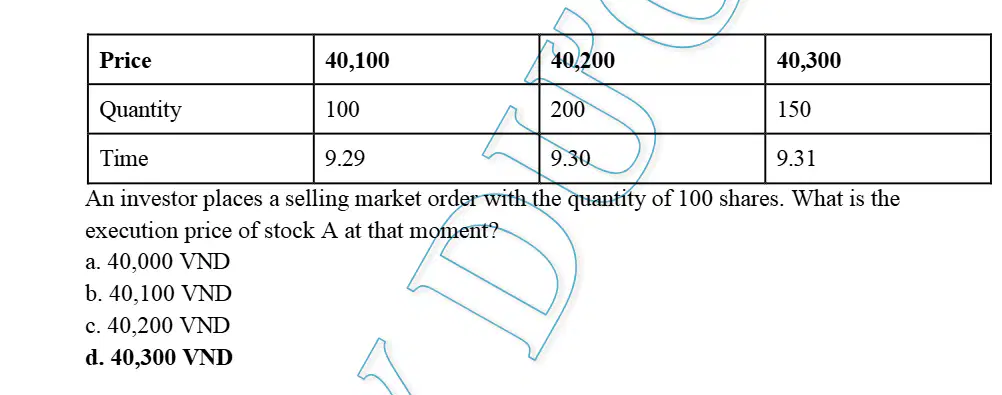
Assumption that in a continuous auction a stock exchange receives buying orders of stock A as the following table: Price | 40,100 | 40,200 | 40,300 Quantity | 100 | 200 | 150 Time | 9.29 | 9.30 | 9.31 An investor places a selling market order with the quantity of 100 shares. What is the execution price of stock A at that moment?
40,000 VND
40,100 VND
40,200 VND
40,300 VND
Difference between internal rate of return (IRR) and yield to maturity (YTM) is
IRR is determined for a period from buying date to selling date whereas YTM is calculated for a period from buying date to maturity date
IRR is calculated by interpolation method whereas YTM is determined by trial and error method
IRR is a discount rate that makes the net present value (NPV) of all cash flows from a bond equal to zero whereas YTM is not
IRR is calculated by interpolation method whereas YTM is determined by graph method
which sentence below is FALSE for yield to maturity (YTM)
YTM is determined for a period from buying date to selling date
YTM is calculated for a period from buying date to maturity date
Which type of risk below is classified as non-systematic risk?
Interest rate risk
Inflation risk
Exchange rate risk
Liquidity risk
A stock exchange holds a periodic auction to fix an opening price. The listed price is 18,700 dong. Mr Nam places an order to buy 100 shares of stock at a price of 18,99 VND. Can he buy the stock? If he can buy the stock, when will the stock be on his account? Suppose that today is Monday, 2nd, Jan, N
Yes he can. The stock will be on his account on Tuesday, 3rd, Jan, N
Yes he can. The stock will be on his account on Wednesday, 4th, Jan, N
Yes he can. The stock will be on his account on Thursday, 5th, Jan, N
No he cannot
Your company is considering to invest in a stock has an expected interest rate of 18%. Treasury bill interest rate is 8%; market risk premium is 15%; the stock has a beta of 0.8. What should your company do?
Invest because required rate low is lower than real interest rate
Do not invest because real interest rate is lower than required rate
Invest because real interest rate is higher than required rate
Unspecified and no advice
Which of the following statements is false?
A bond is a financial contract
Bond prices remain fixed over time
A bond issuer must pay periodic interest
Bonds carry no corporate ownership privileges
Which type of bond yield reflects the percentage of bond interest compared to the face value of the bond?
Nominal interest rate
Current interest rate
Internal rate of return
Yield to maturity
A corporate bond has a face value of VND 100,000, paying interest once a year at the end of each year. This bond has a coupon yield of 9% per annum and a maturity of 6 years. Issued price was 102,000 dong. Investor A bought this bond at the time of the issuance 3 years ago. What is the annual coupon payment that Investor A receives?
VND 9,000
VND 10,200
VND 6,000
VND 12,000
Currently, investor A sells this bond at a price of 104,000 dong. Determine the internal rate of return on this investment.
9.42%
9%
9.12%
9.31%
A joint stock company has the following information: - The Company issues two types of stocks: + Cumulative and non-participating preference shares: Number of issued shares is 10,000 shares (issued 5 years ago) with par value of 10,000 dong per share and a dividend of 12% per year. + Ordinary shares: Number of shares issued is 80,000 shares with par value of 10,000 dong per share - Because of the difficult business situation, in 2 years before year N, the Company did not pay dividends to preference shareholders. - According to the balance sheet data as of December 31st, year N: + Total assets: 2,000,000,000 dong. + Total liabilities: 800,000,000 dong.
a. 13,500 dong
b. 13,450 dong
c. 13,300 dong
d. 13,800 dong
The probability of the economy happening at 4 levels is the same next year. Here are the expected rates of returns for stock P in each situation: Economic situation | Stock P 1 | 4% 2 | 6% 3 | 9% 4 | -4% Determine the risk level of stock P
3.75%
3.82%
4.75%
4.82%
Assumption that in a continuous auction a stock exchange receives buying orders of stock A as the following table: | Price | 50,000 | 50,100 | 50,200 | |---------|--------|--------|--------| | Quantity| 100 | 200 | 100 | | Time | 9,29 | 9,30 | 9,31 | An investor places a selling limit order at 9,32 at the price of 50,100 VND with the quantity of 100 shares. What is the execution price of stock A at the moment?
50,000
50,100
50,200
50,300
In case market interest rate increases:
A. Bond investments are beneficial because investors receive higher interest rates
B. The price of bonds has dropped, so the term interest rate has increased
C. Current yield increased
D. Bond price increases as investors expected to receive higher interest rates
Which of the following statements is true
Bond prices fluctuate in opposite directions with market interest rates
Market interest rates fluctuate in opposite directions with bond prices
Estimated inflation does not affect bond price
a and b are correct
Which type of bond yield reflects the relationship between bond interest and bond price?
Coupon yield
Current interest rate
Internal rate of return
Yield to maturity
Investor A has an expected rate return of 12% per annum and the estimated price of bond X is 98,675 dong. The market price of bond X is 99,000 dong. What should investor A do?
Do not buy this bond because A can get a loss
Buy this bond because A can get a profit
Do not buy this bond because he cannot reach the expected rate of return
Wait until the bond price drops to buy
Câu 44: Loại rủi ro nào dưới đây được phân loại là rủi ro hệ thống?
Rủi ro thị trường
Rủi ro tín dụng
Rủi ro thanh khoản
Rủi ro hoạt động
A bond has a face value of 100,000 dong, nominal interest rate is 9% per annum, and the remaining term to maturity is 5 years. This bond is being sold on the market at price of 100,000 dong. Determine the YTM of that bond?
9%
9.1%
9.2%
None of the above
The probability of the economy happening at 4 levels is the same next year. Here are the expected rates of returns for stock P in each situation: Economic situation | Stock P 1 | 4% 2 | 6% 3 | 9% 4 | -4% Determine the expected rate of return of stock P
3.75%
3.82%
4.75%
4.28%
Your company is considering to invest in a stock has an expected interest rate of 16%. Treasury bill interest rate is 8%; market risk premium is 10%; the stock has a beta of 0.9. What should your company do?
Invest because required rate is lower than real interest rate.
Do not invest because real interest rate is lower than required rate
Invest because real interest rate is higher than required rate
Unspecified and no advice.
Which of the following statements is not true for the one-stage growth model?
Dividends grow at a constant rate
The dividend growth rate continues indefinitely
The required rate of return is higher than the dividend growth rate
The required rate of return is lower than the dividend growth rate
Your company is considering to invest in a stock has an expected interest rate of 18%. Treasury bill interest rate is 8%; market risk premium is 15%; the stock has a beta of 0.8. What should your company do?
Invest because required rate low is lower than real interest rate
Do not invest because real interest rate is lower than required rate
Invest because real interest rate is higher than required rate
Unspecified and no advice
A stock's dividend in year N-1 is 2,000 VND per share. The dividend distribution strategy in the following years is as follows: in the next 2 years the growth rate is 5% per annum and the following years increase steadily every year to 6% per annum. Investor A intends to invest in this stock on 1/1/N and he will sell it after 3 years. Estimate the sale price of this stock after 3 years from the date of 1/1/N. Assumption that: the required rate of return is 10% per year
58,435.41 dong
58,432.51 dong
61,938.45 dong
62,938.45 dong
A joint stock company has the following information: - The Company issues two types of stocks: + non-Cumulative and non-participating preference shares: Number of issued shares is 10,000 shares (issued 5 years ago) with par value of 10,000 dong per share and a dividend of 12% per year. + Ordinary shares: Number of shares issued is 80,000 shares with par value of 10,000 dong per share - Because of the difficult business situation, in 2 years before year N, the Company did not pay dividends to preference shareholders. - According to the balance sheet data as of December 31st, year N: + Total assets: 2,000,000,000 dong. + Total liabilities: 800,000,000 dong.
(a)
Which of the following is an interest rate risk?
Interest rate risk
Business risk
Payment risk
Liquidity risk
A Joint Stock Company has the following information: - The Company only issues common stock: Number of issued shares is 700,000 shares - According to the data on the balance sheet as of June 30, year N + Total assets: 13,000 million dong + Total liabilities: 4,000 million dong - In August of year N, the company bought back 75,000 shares with the amount of VND 1,875 million and completed the payment. Determining the book value per share after buying back shares?
14,000 dong
11,400 dong
14,400 dong
14,100 dong
The probability of the economy happening at 5 levels is the same next year. Here are the expected rates of return for stock P and Q in each situation: Economic situation | Stock P | Stock Q 1 | 4% | 5% 2 | 6% | -7% 3 | 9% | 10% 4 | 4% | 14% 5 | -5% | 8% Determine the expected rate of return of each stock?
A. 5.6% and 6%
B. 3.6% and 6%
C. 3.6% and 6.1%
D. 5.6% and 6.1%
Một cổ phiếu có cổ tức năm N-1 là 2.000 VND/cổ phiếu. Chiến lược chia cổ tức trong các năm tiếp theo như sau: trong 2 năm tới tốc độ tăng trưởng là 5%/năm và các năm sau đó tăng đều mỗi năm 6%/năm. Nhà đầu tư A dự định đầu tư vào cổ phiếu này vào ngày 1/1/N và sẽ bán sau 2 năm. Ước tính giá bán của cổ phiếu này sau 2 năm kể từ ngày 1/1/N. Giả sử rằng: tỷ suất sinh lợi yêu cầu là 10%/năm. Giá bán của cổ phiếu sau 2 năm là bao nhiêu?
22.550 VND
21.200 VND
23.000 VND
20.800 VND

