
 Worksheets
Sumer, Babylonia, and Hammurabi's Code Test
Total questions: 36
Worksheet time: 18mins
Name
Class
Date
1.
1. On what continent was the earliest fossil evidence of humans found?
a)
Australia
b)
North America
c)
Asia
d)
Africa
2.
2. One of the most important technologies used by Paleolithic people (hunter-gatherers) was _____________.
a)
tools
b)
language
c)
art
d)
religion
3.
3. How did the Neolithic Revolution change civilizations?
a)
People relied completely on trade with distant civilizations rather than producing their own food.
b)
People focused only on hunting and fishing instead of raising crops or animals.
c)
People began farming and settling in one place, which led to the growth of villages and cities.
d)
People abandoned farming and returned to a fully nomadic lifestyle.
4.
Why was Mesopotamia known as "the cradle of civilization?"
a)
It was the only place in the world where babies were born in ancient times.
b)
It was one of the first places where people built cities and developed writing.
c)
It had the largest mountains and deepest caves in the ancient world.
d)
People believed the rivers there were magical and could grant wishes.
5.
The first civilizations arose _____________ because the conditions for farming were good.
a)
in the mountains
b)
near the sea
c)
in river valleys
d)
in the desert
6.
Mesopotamia is located between which two rivers?
a)
Amazon and Rio
b)
Rhine and Danube
c)
Tigris and Euphrates
d)
Tiber and Nile
7.
Sumer was a collection of city-states that occupied the southernmost portion of which area?
a)
Greece
b)
Rome
c)
Egypt
d)
Mesopotamia
8.
Which of the following traits does NOT describe the physical environment of Sumer?
a)
heavy rain
b)
palm trees
c)
dry climate
d)
fertile soil
9.
In Sumer, what was used to pay workers and was also collected as a tax from farmers?
a)
barley
b)
money
c)
land
d)
rice
10.
As the government and economy grew in size and complexity, officials and merchants required a sophisticated writing system. Why did they need a writing system?
a)
to write letters
b)
to record transactions
c)
to learn math
d)
to write death certificates
11.
The Sumerians were the first people to develop a
a)
a government
b)
mummification process
c)
numerical system
d)
library
12.
The Mesopotamian city-states competed with each other for power and influence. Who united the city-states and brought glory to Babylon?
a)
Sargon
b)
Nineveh
c)
Hammurabi
d)
Nabopolassar
13.
Which of the following were accomplishments of Babylonian rulers?
a)
the construction of temples
b)
the construction of a canal system
c)
the construction of roads
d)
all of the above
14.
How many laws were in Hammurabi's Code?
a)
10
b)
282
c)
302
d)
250
15.
In Hammurabi's Code, all punishments were given equally regardless of social class.
a)
True
b)
False
16.
The Babylonians believed that their fates were controlled by their gods, so a number of laws refer to jumping in the _________________ River to demonstrate one's guilt or innocence.
a)
Nile
b)
Rhine
c)
Tigris
d)
Euphrates
17.

Identify the location marked #1 on the map.
a)
Red Sea
b)
Black Sea
c)
Nile River
d)
Caspian Sea
e)
Tigris River
18.

Identify the location marked #2 on the map.
a)
Mediterranean Sea
b)
Black Sea
c)
Nile River
d)
Caspian Sea
e)
Tigris River
19.

Identify the location marked #4 on the map.
a)
Caspian Sea
b)
Black Sea
c)
Nile River
d)
Tigris River
e)
Mediterranean Sea
20.

Identify the location marked #5 on the map.
a)
Persian Gulf
b)
Black Sea
c)
Nile River
d)
Caspian Sea
e)
Tigris River
21.

Identify the location marked #6 on the map.
a)
Nile River
b)
Black Sea
c)
Caspian Sea
d)
Tigris River
e)
Mediterranean Sea
22.

Identify the location marked #7 on the map.
a)
Tigris River
b)
Black Sea
c)
Euphrates River
d)
Caspian Sea
e)
Mediterranean Sea
23.

Identify the location marked #8 on the map.
a)
Euphrates River
b)
Black Sea
c)
Nile River
d)
Caspian Sea
e)
Tigris River
24.

Identify the location marked #9 on the map.
a)
Mesopotamia
b)
Black Sea
c)
Nile River
d)
Caspian Sea
e)
Tigris River
25.

The green portion of the map is known as __________________________.
a)
Mesopotamia
b)
The Fertile Crescent
c)
Egypt
d)
Sumeria
26.
Ziggurat – What was a ziggurat used for in Mesopotamia?
a)
a) a marketplace for trade
b)
b) a step-shaped temple for religious purposes
c)
c) a farm for growing crops
d)
d) a dwelling or housing area for commoners
27.
Civilization – Which of the following best describes a civilization?
a)
a) a group of hunters and gatherers
b)
b) a small group of farmers with no writing system
c)
c) a complex society with cities, governments, art, religion, classes, and writing
d)
d) a single family living in one house
28.
Scribe – Why were scribes important in Mesopotamia?
a)
a) They built irrigation systems.
b)
b) They were record keepers and could become judges or leaders.
c)
c) They led armies in battle.
d)
d) They farmed the land.
29.
Empire – What makes an empire different from a city-state?
a)
a) An empire is ruled by farmers.
b)
b) An empire is a single city.
c)
c) An empire is a group of many lands under one ruler.
d)
d) An empire has no government.
30.
City-State – What is a city-state?
a)
a) a large empire with many rulers
b)
b) a city that governs itself and its surrounding land
c)
c) a farming village with no leader
d)
d) a type of writing system
31.
Irrigation – What was the purpose of irrigation in Mesopotamia?
a)
a) to build temples
b)
b) to bring water to crops using canals and ditches
c)
c) to store extra food
d)
d) to defend the city from enemies
32.
Scarcity – What does scarcity mean?
a)
a) when there are not enough resources to meet needs or wants
b)
b) when there is extra food available
c)
c) when people trade with one another
d)
d) when a city builds a ziggurat
33.
Surplus – Which of the following is an example of a surplus?
a)
a) a shortage of wheat after a bad harvest
b)
b) farmers having more grain than their families need
c)
c) running out of water in the canals
d)
d) a city with too few scribes
34.
Cuneiform – What was cuneiform?
a)
a) a style of farming with canals
b)
b) a wedge-shaped writing system developed by the Sumerians
c)
c) a type of religious temple
d)
d) a form of government
35.
On a timeline, which year comes first?
a)
A. 350 BCE
b)
B. 120 BCE
c)
C. 25 CE
d)
D. 1000 CE
36.
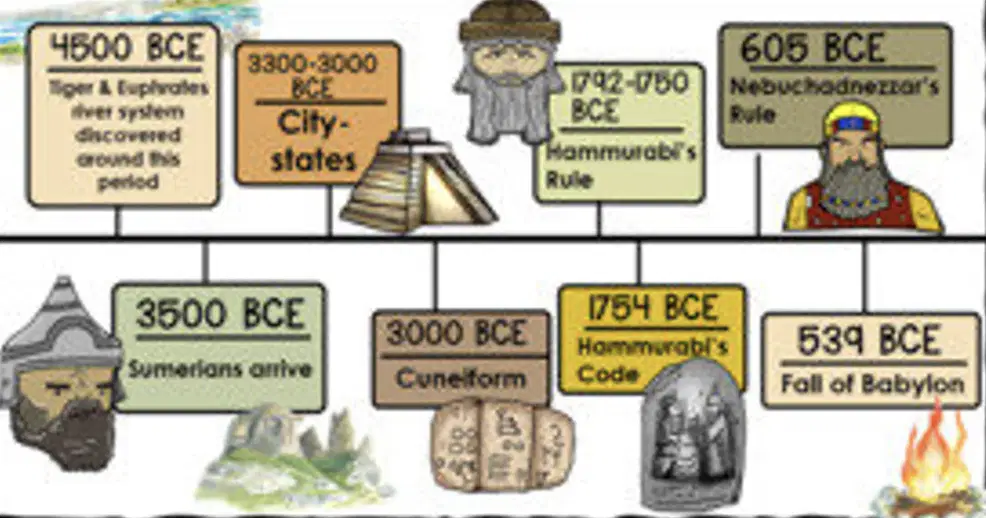
Which event on the timeline below occurred first?
a)
Cuneiform developed
b)
Sumerians arrive
c)
Tigris and Euphrates river systems discovered
d)
Hammurabi's Code
100 %

