wayground logo

Free Printable Worksheets

Font size

S
M
L
XL
Worksheets

Ch 3 Ecosystems TEST

Total questions: 32

Worksheet time: 17mins
Name
Class
Date
1.
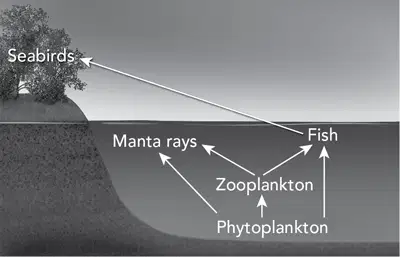
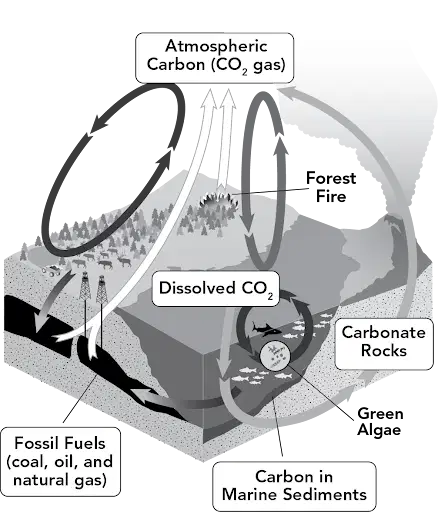
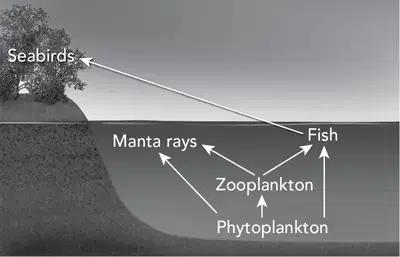
Free Response Question: To earn full points you must completely explain your answer using academic vocabulary, complete thoughts and complete sentences. Scientists working on small islands in the Pacific Ocean observed that manta rays were more abundant along coastlines covered with native forests than coastlines covered with coconut palms. These coconut palm forests formed when humans disturbed native forests to produce coconut oil. The diagram shows a highly simplified marine food web that connects to the native terrestrial ecosystem through seabirds that nest in native forests and feed on aquatic organisms, such as fish. What could you add to this model to show the role of photosynthesis and cellular respiration in the cycling of carbon among the biosphere, atmosphere, hydrosphere, and geosphere?
4 lines
2.
According to the food web, which organism is a primary producer?
a)
sea bird
b)
manta ray
c)
zooplankton
d)
phytoplankton
3.
Scientists working on small islands in the Pacific Ocean observed that manta rays were more abundant along coastlines covered with native forests than coastlines covered with coconut palms. These coconut palm forests formed when humans disturbed native forests to produce coconut oil. The diagram shows a highly simplified marine food web that connects to the native terrestrial ecosystem through seabirds that nest in native forests and feed on aquatic organisms, such as fish. Which organisms are carrying out both photosynthesis and cellular respiration?
a)
terrestrial plants and phytoplankton
b)
terrestrial plants and zooplankton
c)
phytoplankton and zooplankton
d)
zooplankton and manta rays
4.
Year after year, Xavier raises a vegetable garden in the same plot of soil. He observes that the plants grow less abundantly from one year to the next, and they produce fewer vegetables. Which of these processes could help explain Xavier's observations?
a)
the rate at which soil bacteria perform photosynthesis
b)
the rate at which soil bacteria perform denitrification
c)
the rate at which soil bacteria perform nitrogen fixation
d)
the rate at which soil bacteria perform chemosythesis
5.
Rabbits are members of a community in a meadow. The rabbits eat grasses, clover, as well as roots, seeds, and tree bark. What defines the organisms that share the same trophic level as the rabbits?
a)
snakes, hawks, and other animals that eat rabbits
b)
community members that interact with rabbits
c)
meadow animals that are about the same size as a rabbit
d)
meadow animals that eat plants and plant products
6.
Juanita is studying the food web of the open ocean. Which step would be most useful for her to follow to identify the primary producers of the food web?
a)
Look for floating plants, such as water lilies.
b)
Look for tiny phytoplankton that float on the ocean surface.
c)
Look for small animal plankton near the ocean surface.
d)
Look for plants or animals that live along the ocean floor.
7.
Laney is asked to research an organism that performs denitrification. Which strategy is the MOST LIKELY to be successful?
a)
Look for phytoplankton that perform photosynthesis.
b)
Look for ocean-dwelling organisms that perform chemosynthesis.
c)
Look for soil bacteria that convert atmospheric nitrogen to nitrates.
d)
Look for soil bacteria that convert nitrates to nitrogen gas.
8.
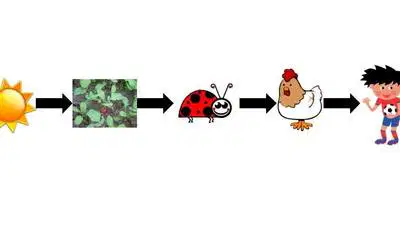
In the food chain, which of the pictures is a PRODUCER?
a)
Chicken
b)
Ladybug
c)
Sun
d)
Plant
9.

Which of the following animals in the food web is a predator of the mouse? 

Select all that apply.

a)
Lizard
b)
Grasshopper
c)
Hawk
d)
Snake
10.

Which of the following animals in the food web is a APEX predator of the mouse? 
a)
Lizard
b)
Grasshopper
c)
Hawk
d)
Snake
11.
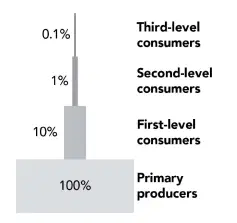
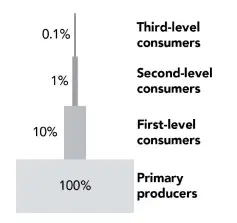
How much energy is transferred from one trophic level to the next in an energy pyramid?
a)
10%
b)
1%
c)
100%
d)
90%
12.
Only 10 percent of the energy stored in an organism can be passed on to the next trophic level. Of the remaining energy, some is used for the organism’s _________, and the rest is eliminated as heat.
a)
reproduction
b)
body tissue
c)
body fat
d)
life processes
13.
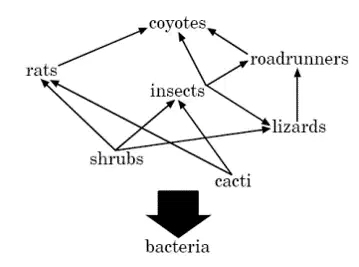
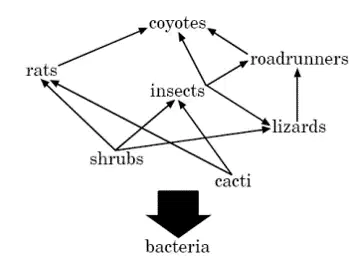
If these organisms were arranged in an energy pyramid, which organism would have the least amount of total energy available?
a)
Cacti
b)
Coyotes
c)
Lizards
d)
Rats
14.
What role would BACTERIA play in this food web?
a)
Producers
b)
Decomposers
c)
Primary Consumers
d)
Secondary Consumers
15.
The weight of all living things within an environment or habitat is referred to as...
a)
energy
b)
biomass
c)
rules of 10s
d)
organisms
16.

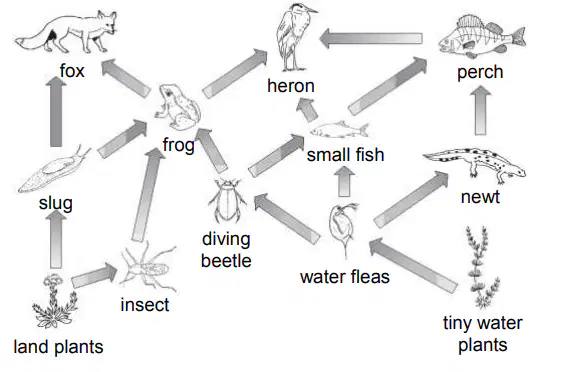
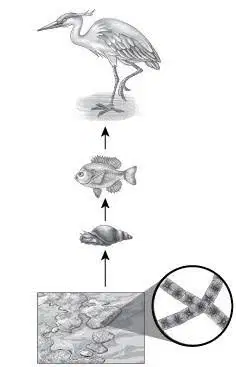
Examine the food web below. Which of the following organisms are PRODUCERS? Check all that apply.

a)

land plants

b)

insects

c)

newt

d)

heron

e)

tiny water plants

17.

Examine the food web below. Which of the following organisms are PRIMARY CONSUMERS? Check all that apply. (Hint: Follow the arrows...)

a)

fox

b)

insects

c)

slug

d)

water fleas

e)

fish

18.
Examine the food web below. Which of the following food chains is INCORRECT?
a)
Land Plants --> Insect --> Frog --> Heron
b)
Tiny Water Plants --> Water Fleas --> Small Fish --> Perch
c)
Water Fleas --> Diving Beetle --> Frog --> Fox
d)
Diving Beetle --> Frog --> Heron --> Fox
19.
Daniel is studying feeding relationships in a neighborhood pond. He observes several organisms that feed on one another, and he organizes them into a food chain model shown below. Daniel's observations and the food chain model provide the strongest evidence for which statement about pond organisms?
a)
Matter cycles and energy flows through pond organisms from primary producers to a series of consumers.
b)
Matter, but not energy, flows through pond organisms from primary consumers to a series of consumers.
c)
Energy cycles through pond organisms, and returns to primary consumers through the actions of decomposers and detritivores.
d)
Energy and matter flow in opposite directions through pond organisms between primary producers and consumers.
20.
Autotrophs can be classified into two groups according to which of these properties?
a)
energy source, either sunlight or chemicals
b)
food type, either plant matter or animal matter
c)
food quality, either living matter or dead matter
d)
water quality, either fresh water or salt water
21.
Celia is classifying a group of organisms that are either primary producers or consumers. What is the direct source of energy for all of the consumers?
a)
either producers or other consumers
b)
producers only
c)
nonliving sources, such as sunlight
d)
other consumers only
22.
Which of the following BEST describes the flow of energy through a food chain?
a)
Energy flows between primary producers and consumers, in either direction.
b)
Energy flows from consumers to primary producers, in one direction only.
c)
Energy flows from primary producers to consumers, in one direction only.
d)
Energy flows between primary producers and consumers, in an endless cycle.
23.
A pyramid of biomass is one way to model an ecosystem. How does the amount of biomass generally change from the bottom of the pyramid to the top?
a)
The amount of biomass decreases.
b)
The amount of biomass increases.
c)
The amount of biomass varies only slightly, and may increase or decrease.
d)
The amount of biomass varies widely, and both increases and decreases.
24.
The diagram shows a model of an ecosystem. What does the model represent?
a)
the total biomass in each trophic level
b)
the total amount of energy in the ecosystem
c)
the relative amount of energy available at each trophic level
d)
"6 - 7" ¯\_(ツ)_/¯
25.
How does water transfer when it evaporates from the ocean?
a)
from the hydrosphere to the geosphere
b)
completely within the hydrosphere
c)
from the hydrosphere to the atmosphere
d)
from the biosphere to the hydrosphere
26.
Which statement BEST describes how matter moves within and between ecosystems?
a)
"6 - 7" ¯\_(ツ)_/¯
b)
Matter cycles between trophic levels in food chains and food webs.
c)
Matter is made and destroyed as it is used by living things.
d)
Matter cycles through food webs and biogeochemical cycles.
27.
Which vital element for life participates in the carbon, nitrogen, and phosphorus cycles?
a)
oxygen
b)
sodium
c)
calcium
d)
chlorine
28.
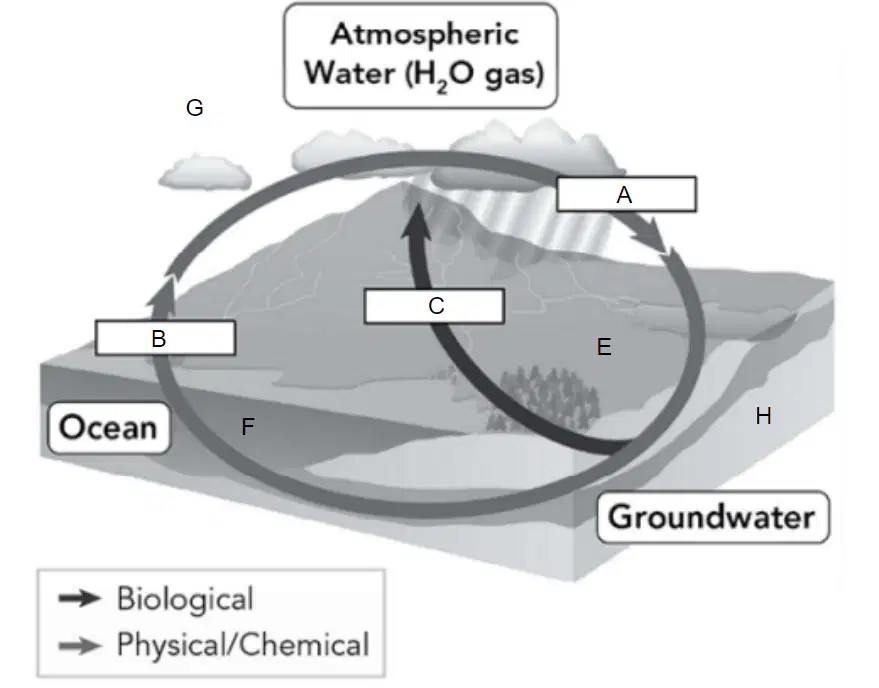
Raphael is studying the water cycle and its critical role in ecosystem functions. He is developing a model of the water cycle, and his initial work is shown below. Which three letters correctly identify the processes of precipitation, evaporation, and condensation in the water cycle diagram?
a)

G, B, and C

b)

A,C,G

c)
C, D, and E
d)
A, C, and E
29.
Francine is developing a model of the carbon cycle, which involves the movement of carbon among various Earth systems. She begins by drawing the diagram shown below. How does Francine's model show the effect of photosynthesis and cellular respiration on Earth systems?
a)
The model shows that their combined effects determine the amount of solid carbon compounds in the geosphere.
b)
The model shows that their combined effects determine the level of carbon dioxide that dissolves in the hydrosphere.
c)
The model shows that they have identical effects on carbon dioxide levels in the atmosphere.
d)
The model shows that they have opposite effects on carbon dioxide levels in the atmosphere.
30.

Francine is developing a model of the carbon cycle, which involves the movement of carbon among various Earth systems. She begins by drawing the diagram shown below.


In addition to the movement of carbon through Earth’s systems, Francine also wants her model to show how much carbon is stored in reservoirs or sinks. Which of these aspects of the carbon cycle could she add to her model to start building a more quantitative   model? 

Select all that apply.

a)

The process of photosynthesis moves carbon from the atmosphere to the biosphere.

b)

About 550 gigatons of carbon is stored in plant biomass.

c)

Geologic processes such as eruptions move carbon from the geosphere to the atmosphere.

d)

The ocean is the greatest carbon sink, storing about 38,000 gigatons of carbon per year.

31.
Which of the following best summarizes the effects that plants have on the global carbon cycle?
a)
Plants perform photosynthesis, adding carbon to the atmosphere.
b)
Plants perform cell respiration, removing carbon from the atmosphere.
c)
Plants perform both photosynthesis and cell respiration and cause a net decrease of carbon in the atmosphere.
d)
Plants perform both photosynthesis and cell respiration and cause a net increase of carbon in the atmosphere.
32.


Choose correct answers:

Which statement describes all primary producers?

a)

All harness the energy of sunlight through the process of photosynthesis.

Toggle as correct answer for All harness the energy of sunlight through the process of photosynthesis.


b)

All take in energy to assemble energy-rich compounds.

Toggle as correct answer for All take in energy to assemble energy-rich compounds.


c)

All are small, single-celled organisms, such as bacteria and algae.

Toggle as correct answer for All are small, single-celled organisms, such as bacteria and algae.


d)

All take in food and break it apart to release energy.

Toggle as correct answer for All take in food and break it apart to release energy.

Set point value for All take in food and break it apart to release energy.