
 Worksheets
Ch 6: Biomes & Aquatic Ecosystems TEST
Total questions: 40
Worksheet time: 20mins
Name
Class
Date
1.
Ecologist use similarities between ecosystems to classify them into broad categories called
a)
biomes.
b)
littoral zones.
c)
estuaries.
d)
benthic zones.
2.
Over a given unit of time, the rate at which plants and algae convert solar or chemical energy into energy stored in the bonds of organic sugars is called
a)
natural selection.
b)
gross primary production.
c)
salinity.
d)
estivation.
3.
WEATHER describes the average conditions, including temperature and precipitation, over long periods in a give area.
a)
True
b)
False
4.
WARM AND WET biomes have the lowest net primary production.
a)
True
b)
False
5.
Which biome would have the lowest net primary production?
a)
tropical rain forest
b)
temperate grassland
c)
coral reef
d)
desert
6.
Why do short trees and plants that make up the understory in tropical rain forests have large, flat leaves?
a)
to shade themselves from excessive sunlight
b)
to create habitat for forest insects
c)
to offer protection from rain
d)
to allow maximum surface for light absorption
7.
In the temperate rain forests, trees such as cedars and spruces, which do not lose their leaves at anytime of year, are called
a)
coniferous.
b)
succulent.
c)
chaparral.
d)
deciduous.
8.
To help them survive in the tundra, caribou have various adaptations, such as
a)
thin coats of fur to prevent overheating.
b)
wide hooves for travel on mud and snow.
c)
a diet that consists mostly of deciduous tree leaves.
d)
the ability to hibernate.
9.
Most trees in tropical dry forest are
a)
deciduous
b)
intertidal
c)
photic
d)
coniferous
e)
limnetic
10.
Criteria such as salinity, depth, and whether the water is flowing or standing are used by scientists to
a)
classify aquatic ecosystems.
b)
measure net primary productivity in lakes.
c)
distinguish aquatic ecosystems from terrestrial ecosystems.
d)
determine the number of species in a body of water.
11.
Water with a salinity that is greater than fresh water but less than saltwater is classified as
a)
photic.
b)
aphotic.
c)
brackish.
d)
littoral.
12.
Which zone of an aquatic ecosystem tends to have the highest temperatures?
a)
photic zone
b)
aphotic zone
c)
benthic zone
d)
All have roughly the same temperatures.
13.
Which statement about the littoral zone in a lake or pond is true?
a)
There are no rooted aquatic plants.
b)
It has deep water.
c)
It is far from the shore.
d)
It is rich in invertebrates.
14.
Marshes, swamps, and bogs are examples of
a)
terrestrial biomes.
b)
freshwater wetlands.
c)
estuaries.
d)
ocean zones.
15.
What is the difference between swamps and freshwater marshes?
a)
Swamps have deep water, but marshes have shallow water.
b)
Swamps have mostly woody shrubs and trees, but marshes have mostly grasses.
c)
Swamps usually have saltwater, but marshes have fresh water.
d)
Swamps have lots of wildlife, but marshes do not.
16.
Where rivers flow into the ocean, mixing fresh water with saltwater, brackish ecosystems occur which are called
a)
bogs.
b)
flood plains.
c)
estuaries.
d)
limnetic zones.
17.
In which ocean zones do crabs, mussels, anemone, barnacles, and sea stars live?
a)
big
b)
intertidal
c)
open ocean
d)
aphotic
18.
What is the name of the type of large brown algae that grows from the ocean floor of continental shelves, reaching upward toward the sunlit surface?
a)
coral
b)
chiton
c)
kelp
d)
phytoplankton
19.
Under water, photosynthesis by aquatic plants and phytoplankton is mostly limited by the amount of OXYGEN available.
a)
True
b)
False
20.
Rivers and streams are types of STANDING freshwater ecosystems.
a)
True
b)
False
21.
The NERITIC ZONE contains over 90% of the ocean's water.
a)
True
b)
False
22.
The uppermost layer of an aquatic ecosystem, where there is enough sunlight for photosynthesis to occur, is called the ______ zone.
a)
photic
b)
deciduous
c)
limnetic
d)
upwelling
e)
aphotic
23.
In lakes and ponds, the _______ zone is the area farther from the shore.
a)
limnetic
b)
photic
c)
upwelling
d)
intertidal
e)
coniferous
24.
_______ is the vertical flow of cold, nutrient-rich water toward the surface.
a)
upwelling
b)
deciduous
c)
photic
d)
limnetic
e)
intertidal
25.
Where the ocean meets the land, ________ ecosystems spread between the uppermost reach of the high tide and the lower limit of the low tide.
a)
intertidal
b)
deciduous
c)
photic
d)
limnetic
e)
upwelling
26.
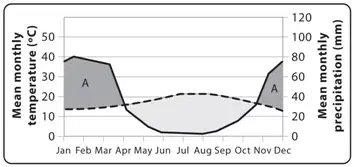
In the graph, the solid line represents precipitation and the dashed line represents temperature. What type of conditions are indicated by the areas of the graph labeled A?
a)
hot
b)
moist
c)
dry
d)
freezing
27.
extremely poor soil
a)
temperate grasslands
b)
temperate forest
c)
tropical rain forest
28.
driest biome, but not hot
a)
tropical rain forest
b)
desert
c)
tundra
29.
has a Mediterranean type climate
a)
chapparal
b)
temperate rain forest
c)
taiga
30.
has very acidic, so blueberry bushes grow well in this biome.
a)
tropical rain forest
b)
savanna
c)
taiga
31.
grasses thrive despite droughts and plants adapted to promote burning of wildfires.
a)
tropical rain forest
b)
temperate grasslands
c)
tundra
32.
treeless biome, with grasses and tough shrubs that grow in frozen soil.
a)
savanna
b)
temperate grasslands
c)
tundra
33.
experiences extreme seasonal variations and trees shed their leaves.
a)
taiga
b)
temperate forest
c)
tropical rain forest
34.
not enough precipitation to support large trees and has very rich soil
a)
temperate grassland
b)
tropical rain forest
c)
tundra
35.
lowest diversity
a)
intertidal
b)
estuaries
c)
open ocean
36.
standing water
a)
rivers
b)
streams
c)
pond
37.
characterized by woody plants
a)
swamps
b)
marshes
c)
oceans
38.
characterized by grasses
a)
swamps
b)
marshes
c)
oceans
39.
are colonial structures found in the shallow areas of the neritic zone and are highly diverse.
a)
kelp forest
b)
coral reefs
c)
open-ocean ecosystems
40.
Also known as the boreal forest
a)
tundra
b)
taiga
c)
temperate rain forest
100 %

