
 Worksheets
Properties and Changes of Matter
Total questions: 30
Worksheet time: 20mins

When mixed, the liquids in the image separate into layers as shown. Which of the following statements is true about the density of the liquids? Select TWO correct answers.
A. Ethyl alcohol is less dense than water.
B. Ethyl alcohol is more dense than water.
C. Liquid soap is more dense than water.
D. Liquid soap and molasses have the same density.
E. Molasses is less dense than vegetable oil.
Four students are working together on a group project. They must include an example of a chemical change, but they can't agree about whose idea would be the most accurate. Which student's idea should the group include in the project?
Sugar dissolves in water.
A machine dices vegetables into very small pieces.
Two clear liquids are mixed together, and the solution turns pink.
When two liquids are mixed, one sinks to the bottom and the other floats on top.

Students were studying elements on the periodic table. The physical properties of a set of elements are listed in the chart below. Physical Properties of a Set of Elements: - Malleable - Good conductor of thermal energy - Shiny in appearance - Used in building materials Which set of elements are most likely being described in the chart?
Neon, Sodium, Boron
Plutonium, Arsenic, Iodine
Tin, Zinc, Nickel
Copper, Zinc, Cobalt
Lithium, Potassium, Hydrogen
This question has two parts. First, answer Part A. Then, answer Part B. Part A Francesca mixed three liquids together in a jar at the beginning of class. She noticed that, at the end of class, the liquids had separated. Which claim can Francesca make about the liquids? Select the correct answer.
All three liquids have the same density.
Two of the liquids have the same density, but the third liquid is heavier.
The black liquid is the most dense.
The liquids were not mixed well at the beginning of class.
What evidence from the picture BEST supports the answer in Part A?
The liquid at the top is light blue.
The black liquid is at the bottom.
The jar is made of glass.
The liquids are different colors.

The liquid water in a kettle changes to a gas, as shown in the following image. Which of the following are true as the water changes from a liquid to a gas? Select TWO correct answers.
A. The particles start to vibrate in place.
B. The particles’ kinetic energy increases.
C. The particles’ kinetic energy decreases.
D. The substance changes from having a definite volume to having no definite volume.
E. The substance changes from having no definite volume to having a definite volume.
A student is trying to classify an unidentified, solid gray material as a metal or a nonmetal. Which question will best help the student classify the material?
Will the material float in water?
Is the material malleable or ductile?
Does the material feel hard to the touch?
Does the material feel rough or smooth?

Which of the following best completes the graphic organizer above? (The graphic organizer shows: gas produced, color change, precipitate produced, temperature change, all connected to a central box with a question mark.)
A. Physical properties of elements
B. Chemical properties of elements
C. Evidence of a physical change
D. Evidence of a chemical change
Which statement BEST describes the motion of the molecules of a solid object?
They vibrate in place within a fixed volume.
They move around freely within a fixed volume.
They vibrate in place and take the shape of a container.
They move around freely and take the shape of a container.
Samples of the air we breathe that were taken from different parts of the world have all been found to contain about 78% nitrogen, 21% oxygen, 0.9% argon, 0.03% carbon dioxide, and 0.07% other gases. Based on this analysis, which is the correct classification for air?
element
compound
homogenous mixture
heterogeneous mixture
Santi was making iced tea during the hot summer. He added a spoonful of sugar to his tea. After he added it, he noticed that the sugar sank to the bottom. Which answer choice best describes why this happened?
The temperature outside forced the sugar to the bottom of the iced tea.
The ice in the drink forced the sugar to the bottom of the glass.
The sugar was less dense than the iced tea.
The sugar was more dense than the iced tea.
A student examines four mixtures in the kitchen: Mixture 1: Sugar stirred into hot water Mixture 2: Italian dressing Mixture 3: Orange juice with pulp Mixture 4: Chocolate milk Which two mixtures are heterogeneous?
A. Mixtures 1 and 4
B. Mixtures 2 and 3
C. Mixtures 1 and 2
D. Mixtures 3 and 4
Which of the following is a rare Earth element?
Zirconium (Zr)
Argon (Ar)
Gallium (Ga)
Yttrium (Y)
Four students perform different activities: - Student 1: Burns a piece of paper - Student 2: Crushes a can - Student 3: Mixes baking soda with lemon juice - Student 4: Freezes water Which students observed a chemical change?
Students 1 and 2
Students 1 and 3
Students 2 and 4
Students 3 and 4
What evidence would Student 1 observe that indicates a chemical change?
The paper becomes smaller
Smoke, ash formation, and heat release
The paper changes shape
The paper becomes wet


When iron is exposed to water vapor and air, it rusts. This ia an example of a _______________ change
Chemical
Physical
Both
Which of the following is an example of a chemical change?
boiling
burning
evaporation
melting



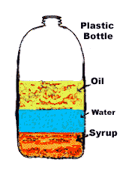


How much matter an object contains for it´s size
Mass
Density
Matter
Volumen

When copper changes color a new substance is formed. How and Why? Explain this in once sentence.

