
NEW
Font size
 Worksheets
How the Other Half Lived and Worked
Total questions: 24
Worksheet time: 12mins
According to the introduction, who made millions during America's industrial era?
Factory workers
Businessmen such as John D. Rockefeller
Coal miners
Government officials
What was one of the hardest and most dangerous jobs in the United States during the industrial era?
Farming
Teaching
Mining coal
Building railroads
At what age did the boy in the passage start working in the coal mines?
Twelve years old
Ten years old
Fourteen years old
Sixteen years old
According to the passage, what is the average age of those killed in the mines?
32
45
27
39
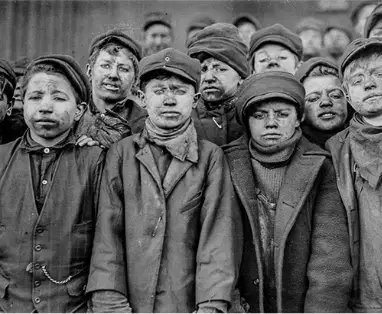
Based on the photograph of coal miners, what does the image reveal about the working conditions and appearance of the workers, especially regarding child labor during this era?
The image shows harsh working conditions and the presence of child labor among coal miners.
The image shows clean and safe working conditions with no child labor present.
The image depicts coal miners working in modern, well-lit facilities.
The image shows coal miners enjoying leisure activities at work.
The miner's daily pay for the past 20 years averaged over $3.00 a day.
True
False
Who was Jacob Riis, and what was he known for?
Jacob Riis was an immigrant from Denmark, a social reformer, police reporter, and photographer known for exposing the living conditions of the poor in New York City's alleys and tenement houses.
Jacob Riis was a famous architect who designed many of New York City's skyscrapers.
Jacob Riis was a wealthy industrialist who owned several factories in New York City.
Jacob Riis was a politician who served as the mayor of New York City in the early 1900s.
According to the passage, what was the only source of fresh air for the tenants in the tenement houses?
The only source of fresh air was the air that entered the stairs from the hall door that was forever slamming and from the window of dark bedrooms.
The only source of fresh air was the rooftop garden maintained by the tenants.
The only source of fresh air was the open courtyards in the center of the building.
The only source of fresh air was the mechanical ventilation system installed in every apartment.
The sinks in the tenement hallways were shared by all tenants and contributed to the spread of stench and disease.
True
False
What does the author mean by 'the soiled bow of white you saw on the door downstairs will have another story to tell'?
The author means that the dirty cloth (bow of white) on the door is a sign of another tragedy or sad story that has occurred in the tenement.
The author is referring to a celebration that will happen soon in the building.
The author means that the bow is a decoration for a festival.
The author is talking about a tradition of hanging bows for good luck.
How many people lived in rear tenements in New York last year, according to the passage?
100,000 people lived in rear tenements in New York last year.
50,000 people lived in rear tenements in New York last year.
10,000 people lived in rear tenements in New York last year.
200,000 people lived in rear tenements in New York last year.
Who exposed the horrors of working in meatpacking plants in Chicago, and in what book?
Upton Sinclair exposed the horrors in his book The Jungle.
Ida Tarbell exposed the horrors in her book The History of the Standard Oil Company.
Jacob Riis exposed the horrors in his book How the Other Half Lives.
Lincoln Steffens exposed the horrors in his book The Shame of the Cities.
According to the passage, what dangers did workers in the pickle rooms face?
Workers in the pickle rooms risked having sores from scraping their fingers, and their joints could be eaten by acid, one by one.
Workers in the pickle rooms risked being exposed to extreme cold temperatures.
Workers in the pickle rooms risked being injured by falling machinery.
Workers in the pickle rooms risked inhaling toxic fumes from burning coal.
What disease might workers in the cooking rooms contract, according to the passage?
Tuberculosis
Rheumatism
Influenza
Malaria
Read the passage about working conditions in the meatpacking industry. What was the job of the beef-luggers?
Carrying 200-pound quarters into refrigerator cars
Plucking wool from sheep
Working in tank rooms full of steam
Overseeing the cooking rooms
Read the passage about working conditions in the meatpacking industry. Fill in the blank: The wool-pluckers' hands went to pieces even sooner than the hands of the _________?
pickle men
butchers
inspectors
foremen
What was the favorite steed at the dinner fed?
Oats and water
Flowers and champagne
Sugar cubes and apples
Bread and milk
Read the passage about Charles A. Beard: A Dinner Eaten on Horseback. Fill in the blank: At one function, the cigarettes were wrapped in ________ bills.
$100
$1
$5
$50
Working conditions in coal mines and meatpacking plants were both hazardous, but one was generally considered more dangerous due to the risk of explosions, cave-ins, and lung diseases. Which was more dangerous?
Coal mines were more dangerous due to explosions, cave-ins, and lung diseases.
Meatpacking plants were more dangerous due to slippery floors and sharp tools.
Both were equally dangerous for different reasons.
Neither was particularly dangerous compared to other jobs of the time.
Choose the place you would have rather worked at that time.
Factory
School
Hospital
Farm
Wealthy people at the time might have felt which of the following emotions when hearing Jacob Riis’s lectures about how the “other half” lived?
Surprised and possibly guilty about the harsh conditions of the poor
Indifferent and uninterested in the lives of the poor
Proud of the social divide and their own wealth
Angry at the poor for their situation
Coal mine owners and meatpacking plant owners should have been legally responsible to provide better working conditions.
Agree
Disagree
Not sure
No opinion
Workers might argue that coal mine and meatpacking plant owners are responsible for providing better working conditions because:
Owners control the workplace and have a duty to ensure safety.
Workers have complete control over their own safety.
Government regulations make owners powerless.
Unsafe conditions are unavoidable in these industries.
Choose THREE of the problems that you highlighted as we read the documents. How could the government potentially fix these problems?
The government could address highlighted problems by creating new laws, increasing funding, and improving oversight.
The government could ignore the problems and hope they resolve themselves.
The government could reduce regulations and cut funding for related programs.
The government could delegate all responsibility to private companies without oversight.

