
Font size
 Worksheets
bio retake
Total questions: 47
Worksheet time: 24mins
Choose from the following list all the human inputs to the phosphorous cycle.
Combustion from fossil fuels
Phosphate mining for fertilizer
Sewage treatment plants
Lightning
When living things have extra resources, like more food and energy, they generally direct those resources to
reproduction
communication
homeostasis
overall body health
Which of these is an example of deductive reasoning?
Every fungus that has ever been studied absorbs its food; therefore, food absorption is characteristic of fungi
All fungi absorb their food; if mushrooms are fungi; then the mushroom absorbs its food
This cell from a mushroom has a nucleus
A mushroom is classified in the kingdom Fungi of the domain Eukarya
Population growth rate would be negative when
all couples are married but average less than two children apiece.
birthrate is greater than death rate.
better health care reduces the death rate and increases survivorship of newborns.
death rate is greater than birth rate.
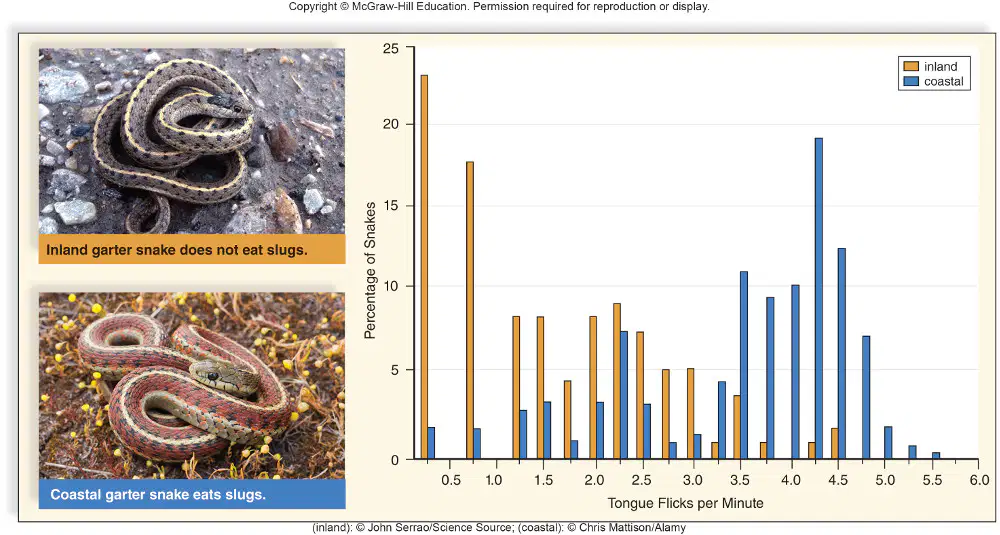
Garter snake eggs from two different populations, inland and coastal, were collected in the field. They were hatched in the lab and the baby snakes were presented with a cotton swab covered in slug slime. Which of the following statements is true?
The behavior was imprinted by whatever they ate when they were first born.
Garter snakes learn that slugs are food organisms by exposure to them in the environment.
The behavior was genetic. Organisms were born either recognizing slugs as food or not.
The behavior was learned. One group learned to like to eat slugs, the other, fish.
The first female aphids to hatch in the spring settle on large leaves and defend them against other females. This is an example of
learned behavior
dominance hierarchy
reproductive behavior
territoriality
A cardinal is a colorful bird that lives in Arkansas. All of the cardinals and all other living things in a specific area would represent a/an __________ in the hierarchy of life.
population
community
organ
ecosystem
A cardinal is a colorful bird that lives in Arkansas. The heart, veins, arteries, and blood of a cardinal would represent a/an __________ in the hierarchy of life.
organ system
community
organ
population
Nucleic acids, like DNA, are polymers of
nucleotides
glycerol
fatty acids
monosaccharides
A number of populations of different species interacting with one another is called
an ecosystem
a community
competition
preditation
-COOH
the functional group above is a
amino group
hydroxyl group
methyl group
carboxyl group
-OH
the functional group above is a
hydroxyl group
amino group
methyl group
carboxyl group
The outbreak of a disease, such as the bubonic plague, that kills large numbers of people in a city is an example of
predation
density dependent factor
commensalistic factor
density independent factor
Statement 1: Many structures inside living organisms have a large surface area packed into a small volume.
Statement 2: Living things have evolved structures with a large surface area because a physiological process can go faster if it has a large surface area on which to work.
Statement 2 is a
law
theory
Which of the following is NOT a form of environmental resistance?
accumulation of waste products
limited food supply
limited living space
number of offspring produced per litter
Compared to the numbers of grasshoppers or deer, there are few mountain lions. The reason that large and fierce animals, such as the mountain lion, are rare in an ecosystem is that
through evolution, most fierce animals have been killed off by others.
food chains are only 10-20% efficient at each step and top carnivores are physically limited in how far they can roam for food.
such animals do not tolerate other members like them.only a few such animals are permitted by succession in a biome and there are only a few biomes.
only a few such animals are permitted by succession in a biome and there are only a few biomes.
A phospholipid is composed of
one glycerol molecule linked to three phosphate groups.
one glycerol molecule linked to one phosphate group and two fatty acids.
one fatty acid molecule linked to one glycerol molecule and two phosphate groups.
one fatty acid molecule linked to three glycerol molecules.
A description of a pattern in nature is a _________.
prediction
theory
law
Which of the following would be an example of sexual selection?
bright color of flowers
grooming behavior in baboons
bright colors on a male peacock
claws on a female fish
which of the following does NOT add carbon into the atmosphere?
burning fossil fuels
photosynthesis
carbon dioxide produced by cellular respiration
carbon dioxide produced by cellular respiration of animals
Male rhinoceros beetles battle on limbs of trees. One of the beetles gets knocked off the tree and falls to the ground. The winner then mates with the female waiting nearby. This is an example of
sexual selection
marital selection
predation selection
genetic drift
The water strider is an insect that skates across the water without sinking. The tips of its feet must be coated with molecules that are
hydrophilic
acidic
basic
hydrophobic
what is starch found in
plants
animals
what is chitin found in
plants
animals
what is cellulose found in
plants
animals
what is glycogen found in
plants
animals
Which of the following global biogeochemical cycles is driven by geology of tectonic activity?
oxygen
phosphorus
water
nitrogen
what is considered the exchange pool for the nitrogen cycle?
geological formations
the atmosphere
ammonia in the soil
proteins in animals
which organisms change nitrogen from the inorganic form, N2, to an organic form that living things can use?
plants
bacteria
animals
fungi
which of the following is a biotic factor found in an ecosystem?
temperature
the food chain
water availability
sunlight
In the carbon biogeochemical cycle the organisms that change carbon dioxide to an organic form are
humans
green plants
soil bacteria
vertebrates
Interaction between two species as both attempt to use the same environmental resources, they have overlapping niches, is
a community
predication
an ecosystem
competition
A form of symbiosis in which one participant benefits and the other apparently is not benefited nor harmed is
mutualism
parasitism
commensalism
coevolution
unselfish acts that others in a group so that they increase their chances of surviving and reproducing is called
altruistic behavior
natural selection
inclusive fitness
sexual selection
A tilapia fish farmer in Arkansas wants to know if the food given to the fish will have a effect on the oils in the fish flesh. Fish are placed in two different ponds. Each pond is fed a different fish food as follows: “A” – 90% grain and 10% soybeans; “B” – 10% grain and 90% soybeans. After three months the fish are harvested and 20 fish from each pond are tested for the amount of omega-three fatty acids in their muscle tissues. Well-designed experiments have replicates. If this experiment has replicates what are they?
the different fish foods A and B
the amount of omega 3 fatty acids in the muscle tissues
the number of fish in the pond
the 20 fish tested from each pond
Polar covalent bonds result from
unequal sharing of electrons in an ionic bond
unequal sharing of electrons in a covalent bond
hydrogen bonding between molecules
equal sharing of electrons in a covalent bond
In an experiment carried out to study the energy flow through an ecosystem scientists measure the total solar energy captured by plants to be 100,000 kilocalories. The portion of this available to the next trophic level will be
1,000 kilocalories
100 kilocalories
10 kilocalories
10,000 kilocalories
When growth proceeds at a rate similar to 2 → 4 → 8 → 16 → 32 → 64...etc., it is called
exponential growth
additive growth
carrying capacity
arithmetic growth
Most plant roots are associated with fungi in a relationship in which the plant gives the products of photosynthesis to the fungus and the fungus gives water and minerals to the plant. What kind of interspecific relationship does this represent?
herbivory
predator/prey
parasitism
mutualism
Fatty acids with double bonds between some of their carbons are said to be
unsaturated
saturated
monoglycerides
completely hydrogenated
Which large organic molecules use lots of phosphate?
Carbohydrates
Glucose
DNA
Protein
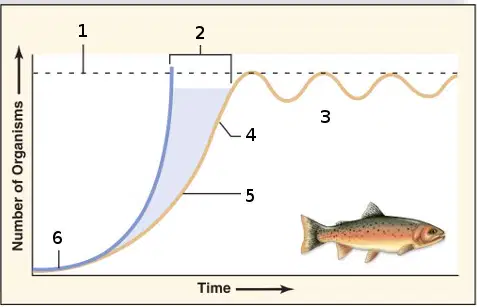
Limiting factors of food and space will first be observed in Figure 34.03 at number
2
3
1
6
In dehydration synthesis __________.
one monomer loses a hydrogen atom, and the other loses a hydroxyl group, forming water.
water is broken as the monomers are joined.
Animal digestive systems utilize this process to break down food.
Monomers are broken off of a polymer.
The final shape of a protein is very important to its function. When proteins undergo an irreversible change in shape called ________________ they ________________ perform their usual functions.
naturation/cannot
naturation/can
denaturation/cannot
dehydration reaction/cannot
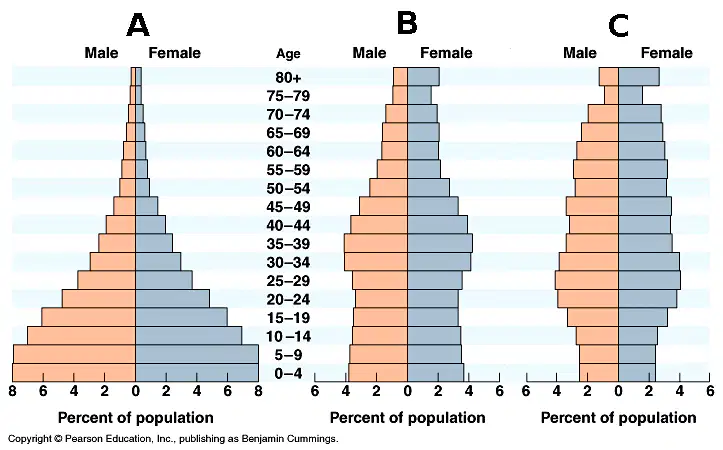
Consider the above diagram. Which population has the highest birth rate?
A
B
C
Ions of a given element have
the same atomic mass but different number of protons.
the same number of protons but differ in atomic mass.
the same number of neutrons.
lost or gained electrons.
Population size is believed to level off at the _______ of an environment.
carrying capacity
doubling time
biotic potential
environmental resistance

