
 Worksheets
Cell Functions: Communication, Protein Synthesis
Total questions: 67
Worksheet time: 39mins
Anabolism and catabolism are best described as which of the following?
Anabolism builds molecules and catabolism breaks them down
Both anabolism and catabolism build molecules
Both anabolism and catabolism break down molecules
Anabolism and catabolism are unrelated processes
Enzymes control metabolic reactions by:
lowering the activation energy required for reactions
increasing the temperature of the cell
breaking down cell membranes
removing all substrates from the reaction
A metabolic pathway is best described as:
A series of chemical reactions occurring within a cell.
A single chemical reaction in a cell.
A type of physical exercise.
A method of cell division.
Energy in the form of ATP becomes available for cellular activities when:
the terminal phosphate bond is broken, releasing energy
ATP is converted directly into glucose
ATP is stored in the nucleus
ATP is absorbed from the environment without change
Cellular respiration releases chemical energy by:
breaking down glucose to produce ATP
absorbing sunlight to create glucose
storing energy in large molecules
releasing oxygen as a waste product
DNA molecules store genetic information by:
arranging nucleotides in a specific sequence
forming double helix structures for stability
binding to proteins for cellular transport
replicating only during cell division
The steps of protein synthesis are:
Transcription and translation
Replication and mutation
Photosynthesis and respiration
Diffusion and osmosis
What is the meaning of the prefix 'An-'?
without
with
before
after
What is the meaning of the prefix 'Ana-'?
up
down
across
against
What is the meaning of the prefix 'Cata-'?
down
across
before
against
What is the meaning of the prefix 'Mut-'?
change
move
stop
grow
What is the meaning of the prefix 'Zym-'?
causing to ferment
relating to animals
pertaining to heat
referring to plants
Cell Function: Cells differentiate to fill needs within the body.
True
False
One of the major cellular functions necessary for cell survival is gene ________.
expression
mutation
deletion
replication
One of the major cellular functions necessary for cell survival is protein ________.
synthesis
digestion
degradation
oxidation
The Signal in cell communication is a chemical molecule called a _______
ligand
enzyme
receptor
substrate
In cell communication, receptors are proteins usually embedded in a _______ that connects to the ligand.
membrane
nucleus
cytoplasm
ribosome
What is Transduction in cell communication? Transduction – _______ Reaction in the cell
Chemical
Physical
Electrical
Thermal
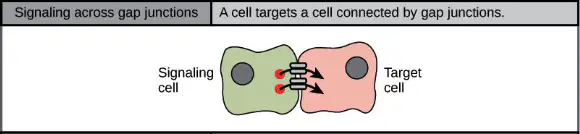
Which form of chemical signaling involves a cell targeting a cell connected by gap junctions?
Direct
Paracrine
Endocrine
Autocrine
Which form of chemical signaling involves a cell targeting itself and is used for self regulation?
Paracrine
Endocrine
Autocrine
Direct
Paracrine signaling is when a cell targets a ________ cell in close proximity.
nearby
distant
identical
foreign
Endocrine signaling involves a cell targeting a distant cell through the ________.
bloodstream
synapse
gap junction
extracellular matrix
Which form of communication is used to talk to other organisms?
Paracrine
Pheromone
Endocrine
Direct
External reception is typically fast acting.
True
False
Internal reception is slow to respond but has a long-term effect.
True
False
Gene expression involves the process of turning information encoded in a gene into a _______.
function
chromosome
nucleus
membrane
Gene expression can be thought of as an "on/off" switch to control when and where which of the following are made?
DNA molecules and lipids
RNA molecules and proteins
Carbohydrates and vitamins
Hormones and minerals
Gene expression can also be described as a "volume control" to determine how much of those products are made. What does "those products" refer to?
RNA molecules and proteins
Carbohydrates and lipids
Vitamins and minerals
DNA and chromosomes
Which of the following statements is true about gene expression regulation?
It is always constant in all cell types
It is carefully regulated and can change under different conditions
It only occurs in bacteria
It does not affect protein production
All cells have the same genes throughout the body.
True
False
What does cell specialization involve?
All cells doing the same job
How cells control what genes are on and off
Cells having different DNA
None of the above
The control of what genes are on and off can be variable in terms of hours, days, or minutes.
True
False
Transcription factors are signals that can impact gene expression.
True
False
Genes can be turned on by:
DNA wrapping and bundling
Blocking transcription enzymes
Increasing cell size
None of the above
What are the two main processes involved in protein synthesis?
Replication and Translation
Transcription and Translation
Transcription and Replication
Translation and Mutation
Protein synthesis is responsible for producing both ______ and enzymes.
tissues
hormones
vitamins
carbohydrates
In the process of protein synthesis, the role of mRNA is to:
carry the genetic code from DNA to the ribosome
synthesize amino acids directly
break down proteins into amino acids
transport amino acids to the ribosome
DNA is a ______ - a large molecule made up of many smaller molecules joined together in a specific sequence.
polymer
monomer
atom
ion
What are the building blocks of DNA called?
nucleotides
amino acids
fatty acids
monosaccharides
A nucleotide consists of which of the following components?
1 phosphate group, 1 sugar group, and 1 nitrogenous base
2 phosphate groups and 1 sugar group
1 sugar group and 2 nitrogenous bases
1 phosphate group and 2 sugar groups
Which of the following is NOT a nitrogenous base found in DNA?
Adenine
Thymine
Guanine
Uracil
What is the genetic code?
The genetic code is the sequence of nucleotide bases in DNA that specifies a particular sequence of amino acid building blocks in proteins.
The genetic code is the process by which cells divide and multiply.
The genetic code is the structure of the cell membrane in all living organisms.
The genetic code is the energy currency used by cells for metabolic processes.
How many amino acids are represented in a DNA molecule by a specific sequence of 3 nucleotides?
20
4
64
1
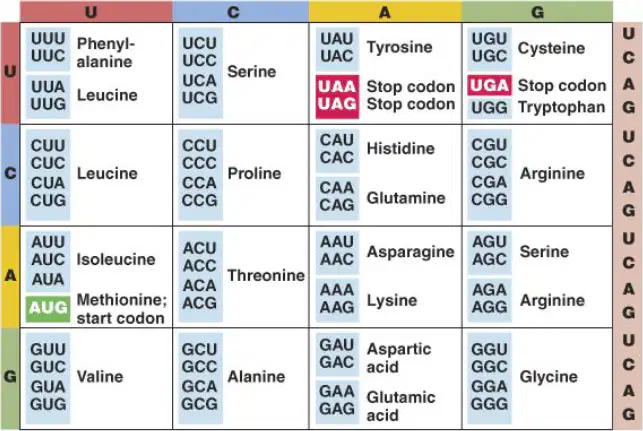
Which of the following codons is a start codon?
A. AUG
B. UAA
C. UGA
D. UAG
The sequence of nucleotides in a DNA molecule denotes the order of _______ in a protein molecule, as well as where to start and stop the protein synthesis.
amino acids
fatty acids
nucleotides
sugars
DNA is too large to leave the nucleus, so transcription using mRNA is essential to getting the genetic information out of the nucleus.
True
False
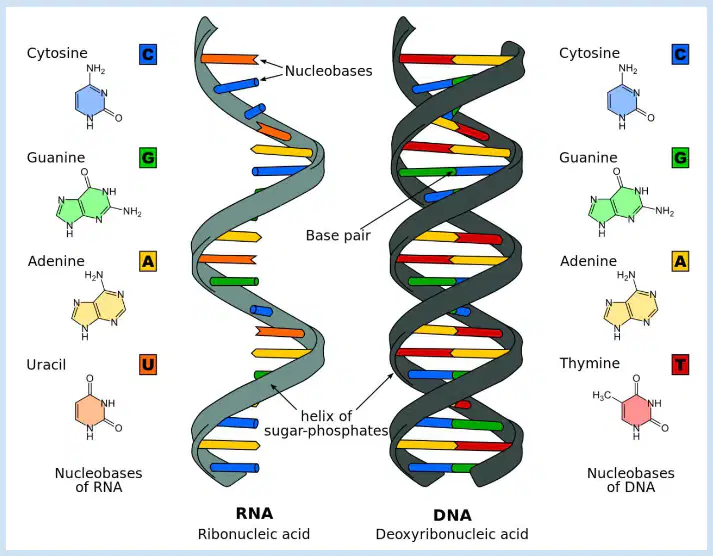
Which of the following is NOT a nucleobase found in DNA?
Adenine
Thymine
Uracil
Cytosine
RNA molecules are ______ stranded.
single
double
triple
quadruple
Nucleotides in RNA contain the sugar ______ rather than deoxyribose.
ribose
glucose
fructose
galactose
Which nitrogenous base is only found in DNA?
A) Adenine
B) Cytosine
C) Thymine
D) Uracil
Which nitrogenous base is only found in RNA?
A) Adenine
B) Cytosine
C) Thymine
D) Uracil
What is synthesized following the rules of complementary base pairing?
mRNA
Glucose
Cholesterol
ATP
The DNA sequence A, T, G, C, G specifies the complementary mRNA bases ________.
U, A, C, G, C
A, U, G, C, G
T, A, C, G, C
U, T, G, C, A
Which enzyme is responsible for reading the DNA and synthesizing mRNA?
RNA polymerase
DNA ligase
Helicase
DNA polymerase
RNA polymerase knows where the gene begins, where it stops, and the correct direction to read the DNA.
True
False
What happens when the RNA polymerase reaches the end of the gene?
It releases the newly formed mRNA and transcription is complete.
It starts translating the mRNA into protein.
It binds to the ribosome to begin translation.
It replicates the DNA strand again.
Each amino acid in a protein corresponds to how many contiguous bases in the DNA sequence?
3
1
2
4
What are the series of 3-base sequences that represent amino acids called?
Codons
Ribosomes
Genes
Nucleotides
To complete protein synthesis, mRNA must leave the nucleus and associate with a ________.
ribosome
mitochondrion
lysosome
Golgi apparatus
The process of translating the series of codons on mRNA to the language of amino acids is called ________.
translation
transcription
replication
mutation
To build the protein, the correct amino acids must be in the cytoplasm and positioned in a specific order along the strand of _______.
mRNA
DNA
tRNA
rRNA
Which molecule correctly aligns amino acids, which are linked by an enzyme to form proteins?
mRNA
tRNA
DNA
Ribosome
During translation, the code from (a) is read by the (b) and translated into a sequence of (c) .
(a) is the process by which mRNA is decoded and a protein is produced, and it occurs in a (b) in the (c) .
Puts together amino acids
Ribosome
Transports amino acids
tRNA
Carries the code to the ribosome
mRNA
Provides the protein code
DNA
Put together to make the protein
Amino Acids
Is where amino acids are formed
Ribosome
Contains anticodons and Amino acids
tRNA
Carries the code to the ribosome
mRNA
Genetic information never leaves nucleus
DNA
Put together to make the protein
Amino Acids
In a DNA molecule, adenine (A) always pairs with (a) , and guanine (G) always pairs with (b) .

