
 Worksheets
Review
Total questions: 40
Worksheet time: 3600secs
Which of the following is NOT a glial cell type?
Ependymal cells
Oligodendrocytes
Parietal cells
Microglia
Astrocytes
What plane of sectioning would divide the rostral part from the caudal part of the cerebral cortex?
Coronal
Midsagittal
Parasagittal
Horizontal
Axial
In the peripheral nervous system, groups of neuronal somata are called ________, and bundles of axons are called ________.
ganglia, nerves
nuclei, tracts
plexuses, fascicles
centers, columns
The two hemispheres of the brain are separated by which of the following?
Interhemispheric fissure
Lateral fissure
Central gyrus
Parasagittal fissure
Parieto-occipital fissure (or sulcus)
What does ectoderm give rise to?
Muscle, nervous system
Skin, muscle, and some internal organs
Mesoderm, gut, and glandular tissue
Skin, nervous system
Gut, bone
What occurs during the G0 phase of the cell cycle?
DNA is replicated
Proteins needed for mitosis are synthesized
Mitosis no longer occurs
Factors that initiate cell division may be expressed
7. The ____ induces the ____ to become the neural plate.
mesoderm, endoderm
endoderm, mesoderm
ectoderm, mesoderm
mesoderm, ectoderm
What structure produces most of the cerebrospinal fluid?
Arachnoid granulations
Dura mater
Choroid plexus
Ventricular plexus
What is a major result of the CSF not draining properly?
Spina bifida
Hydrocephalus
Microcephaly
Hydrocele
Anencephaly
The cerebral aqueduct allows cerebrospinal fluid to move directly from the ____ ventricle to the ____ ventricle.
lateral, third
third, lateral
lateral, fourth
third, fourth
In principle, there are multiple sites from which CSF could be sampled. From which of the following sites is sampling LEAST likely to result in damage to the CNS?
lateral ventricle
third ventricle
fourth ventricle
the space between the L3 vertebra and the L4 vertebra
The anterior cerebral artery primarily supplies blood flow to which of the following?
midline of the cerebral cortex
lateral side of cerebral cortex
posterior-inferior cerebral cortex
brainstem and cerebellum
midbrain and pons
What do the dural venous sinuses drain into?
Internal jugular vein
Middle cerebral artery
Pulmonary vein
Internal carotid artery
Great vein of Galen
The right ventricle pumps ____ blood to the ____
deoxygenated, lungs
deoxygenated, body
oxygenated, lungs
oxygenated, body
deoxygenated, brain
What alleviates decreased oxygen to the brain?
Vasodilation
Hypoxia
Vasoconstriction
Ischemia
Existence of the blood-brain barrier
Synthesis of mRNA from DNA in the nucleus is a process called…
Translation
Transcription
Replication
Elongation
Termination
What mechanism moves microtubules and neurofilaments away from the cell body?
Fast retrograde transport
Slow anterograde transport
Fast anterograde transport
Slow retrograde transport
Contraction of actin and myosin after release of calcium from the sarcoplasmic reticulum
Nissl substance is composed of which of the following?
Mitochondria
Golgi apparatus
Rough endoplasmic reticulum
Nuclei
Lysosomes
Which of the following is NOT a function of astrocytes?
A. “Insulation” of synapses from each other
B. Regulation of the extracellular ionic environment
C. Contributes to the blood-brain barrier
D. Increases axonal conduction velocity
What is the resting membrane potential?
About 140 mv
About 70 mv
About 0 mv
About -70 mv
About -140 mv
Which of these comes first during an action potential? Pick best answer.
Hyperpolarization of the cell
Opening of voltage-gated Na+ channels
Opening of voltage-gated K+ channels
Depolarization of the cell to its threshold
Closing of voltage-gated Na+ channels
Which of the following is a result of the refractory period?
Removes most limits on the frequency at which action potentials can be generated
It allows synaptic release to happen during periods of very rapid cell firing
Any action potentials that occur during the refractory period will larger than usual.
Ensures that the action potential is only propagated in one direction
Which of the following has the greatest effect on axonal conduction velocity?
Length of the axon
Diameter of the axon
Diameter of the cell body
Number of voltage-gated Na+ channels
Number of voltage-gated K+ channels
What are SNARE proteins?
Ca++ channel proteins in the synaptic terminal that allow neurotransmitter release
Proteins that pull the vesicle away from the cell membrane after neurotransmitter is released
Ca++-binding proteins in the axon terminals that allow action potentials to enter the synaptic terminal
Proteins that cause the vesicle to fuse with the cell membrane
K+-binding proteins in the axon terminals that allow release of neurotransmitter
Some toxic nerve gasses act by inhibiting the action of the enzyme acetylcholinesterase. What is the function of acetylcholinesterase?
It is the pump that moves acetylcholine back into the cholinergic terminal after its release into the synapse.
It is the pump that moves acetylcholine into the vesicle prior to its release from the synapse
It is the enzyme that synthesizes acetylcholine
It is the enzyme that breaks down acetylcholine after its release into the synapse
It is the pump that moves acetylcholine into a glial cell after its release into the synapse
Which of the following statements are TRUE?
G-protein coupled receptors have a rapid action of short duration
In metabotropic receptors, binding of a neurotransmitter changes the activation of a G-protein
The actions of ionotropic receptors typically are slow and of long duration
A neurotransmitter can only bind to the one receptor for which it is the ligand
The three general types of neurotransmitter receptors are ionotropic receptors, metabotropic receptors and chronotropic receptors.
Which of the following statements is correct?
The spinal cord is longer than the vertebral column.
Each vertebra has two spinal nerves exiting from beneath it
Motoneurons develop from the alar plate
The spinal cord is found just dorsal to the spinous process of the vertebral arch
Sensory axons extend from dorsal root ganglia to the cervical spinal cord via the cauda equina
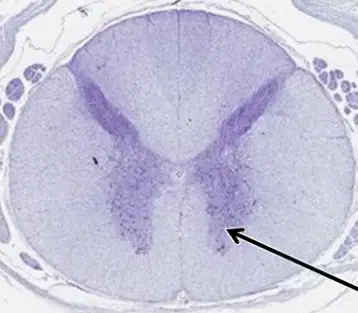
To which of the following does the arrow point?
Dorsal funiculus
Dorsal horn
Intermediate gray
Ventral funiculus
Ventral horn
Which of the following relationships is correct?
The largest amount of white matter is found in the lumbar and cervical enlargements
Gray matter increases as you move rostrally in the spinal cord
White matter increases as you move caudally in the spinal cord
Gray matter increases as you move caudally in the spinal cord
White matter increases as you move rostrally in the spinal cord
The spinal cord can process information in several ways. Which of the following is NOT one of those ways?
A. Sensory input from muscles can cause reflexive responses
B. Sensory input from muscles can be relayed to the cerebellum and used to coordinate movements
C. Sensory input can be relayed to the cerebral cortex, where it is consciously perceived
D. Sensory input arriving through the ventral roots can evoke a special type of extremely fast reflex
E. Sensory axons can synapse on relay neurons that transmit the information to other sites
Which of the following structures can NOT be seen on the ventral surface of the sheep brain?
Optic chiasm
Oculomotor nerve
Abducens nerve
Cerebral peduncles
Corpus callosum
Which of the following structures surrounds the cerebral aqueduct?
Hypothalamus
Midbrain
Medulla
Corpus callosum
Frontal lobe of the cerebral cortex
There are vessels that feed into the Circle of Willis that don’t form part of the “circle” (i.e. don’t form part of its anastomotic loop). Which of the following vessels is NOT part of the anastomotic loop of the Circle of Willis?
Internal carotid artery
Anterior cerebral artery
Anterior communicating artery
Vertebral artery
Posterior communicating artery
Which of the following meningeal membranes follows the surface of the brain into the sulci of the human cerebral cortex?
Dura mater
Pia mater
Arachnoid
Arachnoid granulations
Which of the following structures does not need to be severed in order to remove the cerebellum from the brainstem?
Superior cerebellar peduncle
Cerebral peduncle
Middle cerebellar peduncle
Inferior cerebellar peduncle
The basal plate develops into ____ neurons ____ the spinal cord.
sensory, exiting
sensory, entering
motor, exiting
motor, entering
Excitatory neurotransmitter receptors often open ________ channels causing the cell to
___________.
K+, depolarize
K+, hyperpolarize
Na+, depolarize
Ca++, hyperpolarize
Which of the following structures is derived from the embryonic diencephalon?
Superior colliculus
Pons
Hypothalamus
Cerebellum
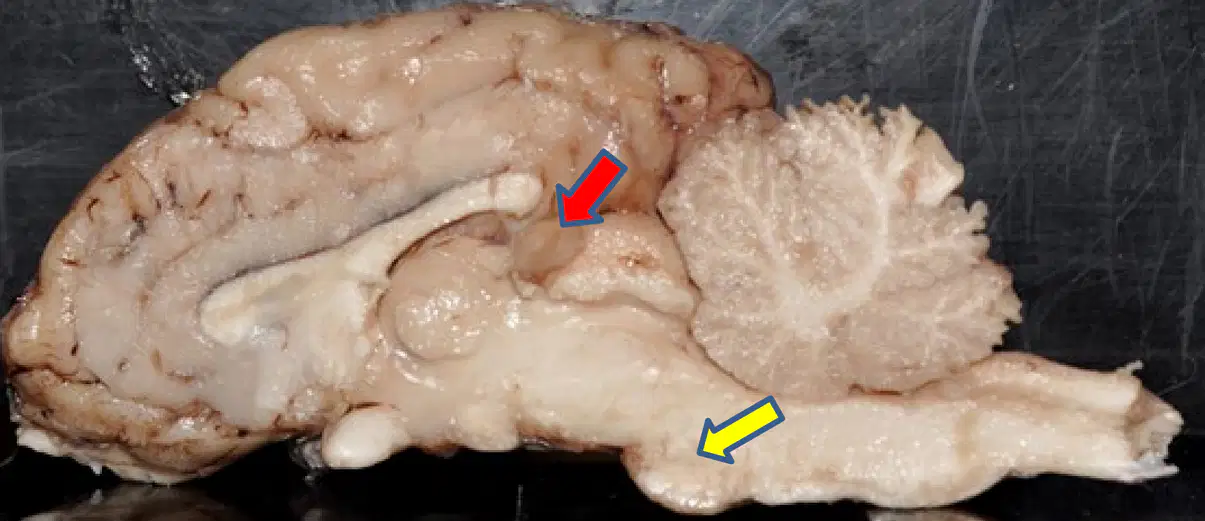
In the image of a mid-sagittal cut through a sheep brain above, what is the structure at the tip of the yellow arrow?
Pons
Cerebellum
Corpus callosum
Pineal gland
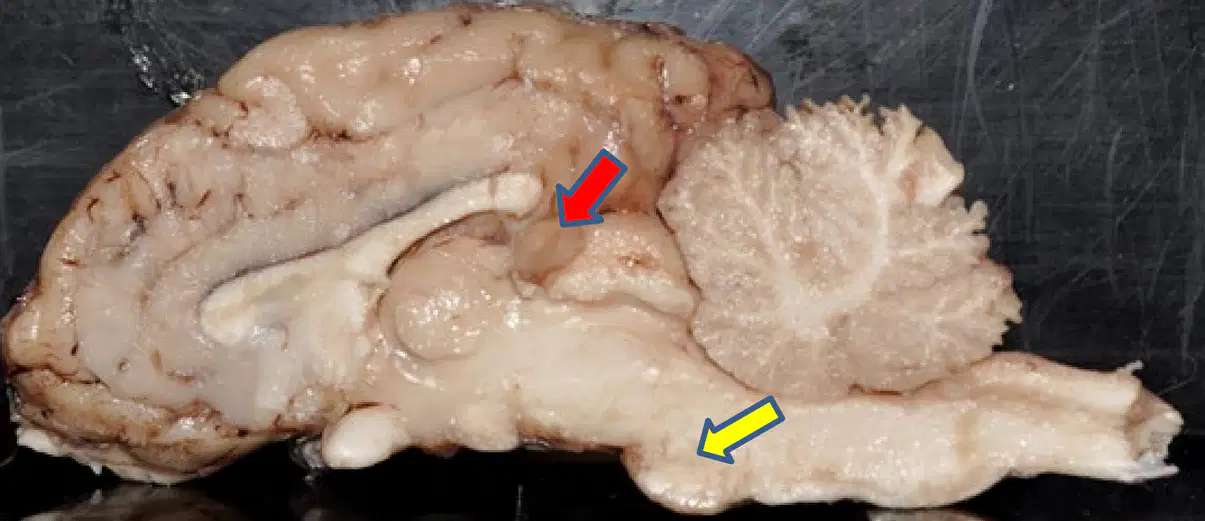
In the image of a mid-sagittal cut through a sheep brain above, what is the structure at the tip of the red arrow?
Pons
Cerebellum
Corpus callosum
Pineal gland

