wayground logo

Free Printable Worksheets

NEW

Font size

S
M
L
XL
Worksheets

Periodic Table Unit 1 Review

Total questions: 35

Worksheet time: 38mins

Name
Class
Date
1.

Semiconductors are elements that

a)

have large atomic masses but small atomic numbers.

b)

do not form compounds.

c)

can conduct heat and electricity under certain conditions.

d)

are extremely hard.

2.

In Mendeleev's periodic table, elements in each column had similar

a)

atomic masses.

b)

propeties

c)

atomic number.

d)

symbols.

3.

Elements in an element family have similar

a)

atomic symbols.

b)

atomic sizes.

c)

atomic weights.

d)

chemical properties.

4.

Which statement about noble gases is correct?

a)

They form compounds with very bright colors.

b)

They exist as single atoms rather than as molecules.

c)

They are highly reactive with both metals and nonmetals.

d)

They are extremely rare in nature.

5.

Which is not a family of the periodic table?

a)

alkaline-earth metals

b)

anions

c)

halogens

d)

noble gases

6.
Who was the first person to study atomic theory?
a)
Dalton
b)
Democritus
c)
Chadwick
d)
Miller
7.
The word 'atomos' termed by Democritus means:
a)
Indivisible
b)
Unconscious
c)
Blue
d)
Nuclear powered
8.
Developed the “chocolate chip cookie” model of the atom
a)
James Chadwick
b)
Niels Bohr
c)
Schrodinger & Heisenberg
d)
J.J. Thomson
9.
Developed the very first atomic theory
a)
Ernest Rutherford
b)
Schrodinger & Heisenberg
c)
Niels Bohr
d)
John Dalton
10.
Discovered the electron
a)
Bohr
b)
Dalton
c)
Rutherford
d)
Thomson
11.

First person to propose the concept of an atom

a)

Rutherford

b)

Democritus

c)

Dalton

d)

Bohr

12.

Which scientist was the first person responsible for proposing the discovery of the nucleus?

a)

Democritus

b)

John Dalton

c)

Ernest Rutherford

d)

J.J. Thomson

e)

Niels Bohr

13.
Which of the following is an Alkali Metal? 
a)
Magnesium
b)
Chromium
c)
Sodium
d)
Fluorine 
14.
Which of the following is an Alkaline Earth Metal? 
a)
Calcium
b)
Lithium
c)
Phosphorus
d)
Copper 
15.
Which of the following is a transition metal? 
a)
Iron
b)
Oxygen
c)
Neon
d)
Barium
16.
Which of the following is a Halogen? 
a)
Bromine
b)
Rubidium
c)
Argon
d)
Beryllium
17.
Which of the following is a Noble Gas? 
a)
Krypton
b)
Chlorine
c)
Radium
d)
Gallium
18.
Which of the following is the most reactive group of metals? 
a)
Alkali
b)
Alkaline Earth
c)
Halogen
d)
Transition Metals
19.
Which of the following is the most reactive group of non-metals? 
a)
Alkali
b)
Alkali Earth
c)
Halogen
d)
Noble Gas
20.
An element has two naturally occurring isotopes. One is 10.013 amu and is 19.9% abundant. The other is 11.01 amu and is 80.1% abundant. What is the average atomic mass? What element is it?
a)
9.012, Beryllium
b)
12.011, Carbon
c)
6.941, Lithium
d)
10.812, Boron
21.
24.1% of all the isotopes of a an element have a mass of 75.23 amu, 48.7% have a mass of 74.61 amu, and 27.2% have a mass of 75.20 amu.
What is the average mass of this element?
a)
74.92 amu
b)
24.97 amu
c)
75.01 amu
d)
74.51 amu
22.

What is the atomic number?

a)

the number of protons

b)

the number of protons and neutrons

c)

the number of neutrons

d)

the number of atoms

23.
What is the mass number defined as?
a)
the number of protons
b)
the number of protons and neutrons
c)
the number of neutrons
d)
the number of protons and electrons
24.
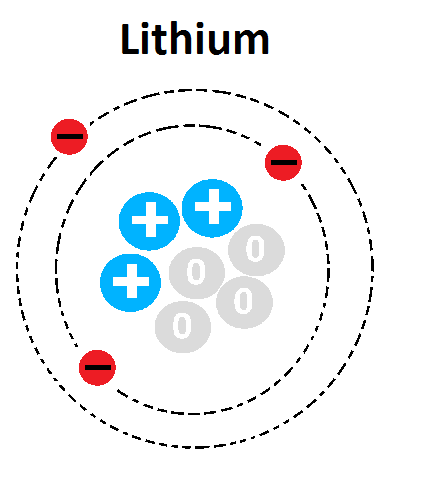
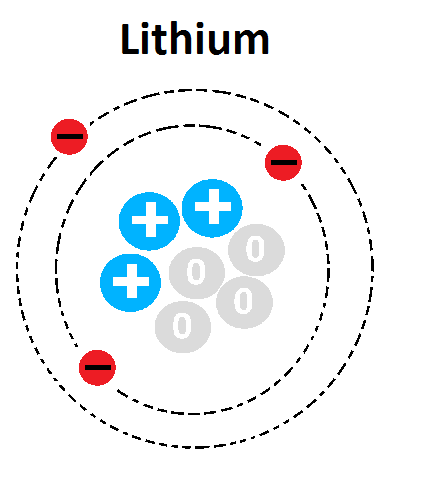
What is the atomic number of this atom?
a)
1
b)
3
c)
4
d)
7
25.

What is the mass number of this atom?

a)

1

b)

3

c)

4

d)

7

26.

The fluorine atom has an atomic number of

a)

19

b)

9

27.
Which particle has a positive charge?
a)
electron
b)
orbital
c)
proton
d)
neutron
28.
Choose the particle that has no charge.
a)
nucleus
b)
neutron
c)
proton
d)
electron
29.

Which subatomic particle has a negative charge in the atom?

a)

proton

b)

neutron

c)

electron

d)

quark

30.
What is the formula to solve for the neutron?
a)
Mass + Atomic Number= Neutrons
b)
Mass x Atomic Number = Neutrons
c)
Mass - Atomic Number = Neutrons
d)
Mass + Number of Protons = Neutron
31.
An atom with 19 protons, and 19 electrons and a mass of 39 has how many neutrons?
a)
19
b)
39
c)
20
d)
58
32.
4.35% of all X atoms have a mass of 39.946 amu. 83.79% have a mass of 41.941 amu, 9.50% have a mass of 42.941 amu, and 2.36% have a mass of 43.939 amu. What is the average atomic mass of atom X?
a)
41.97 amu
b)
42.19 amu
c)
10.43 amu
d)
40.04 amu
33.
If an atom contains exactly three protons, then it's an atom of _____
a)
lithium
b)
gold
c)
nitrogen
d)
carbon
34.

All of the following are found in the nucleus EXCEPT

a)

Proton

b)

Neutron

c)

Electron

d)

There are no exceptions. All are found in the nucleus

35.

How many electrons are in Sulfur?

a)

32

b)

16

c)

48

d)

8