
 Worksheets
BIOL-1407 Practice Exam 1 v2
Total questions: 25
Worksheet time: 13mins
Name
Class
Date
1.
Which statement best defines microevolution?
a)
Changes in allele frequencies in a population across generations
b)
The sudden origin of new phyla
c)
Extinctions recorded in the fossil record
d)
Changes in individuals’ traits during their lifetimes
2.
Natural selection is best described as:
a)
Random changes that alter allele frequencies from one generation to the next
b)
Creation of new alleles by mutation
c)
Immigration of individuals between populations
d)
Differential reproductive success tied to heritable variation
3.
Which scenario violates a Hardy–Weinberg condition?
a)
Random mating
b)
Immigration of fertile individuals between populations
c)
Very large population size
d)
No mutation
4.
In a large population, the frequency of a recessive disorder is 1 in 10,000 births and the locus is at Hardy–Weinberg equilibrium. What is the carrier (heterozygote) frequency?
a)
0.10
b)
0.20
c)
0.01
d)
0.02
5.
A severe winter reduces a population of foxes from thousands to a few dozen at random, and rare coat‑color alleles become common in descendants even after numbers rebound. Which process most directly explains the change?
a)
Directional selection
b)
Genetic drift (bottleneck)
c)
Gene flow
d)
Mutation
6.
A few wind‑blown insects colonize a remote island. Several generations later, allele frequencies differ markedly from the mainland although environments are similar. What mechanism most directly explains the difference?
a)
Balancing selection
b)
Disruptive selection
c)
Founder effect (genetic drift)
d)
Stabilizing selection
7.
Mainland snakes with strong banding repeatedly migrate to an island where unbanded snakes are better camouflaged. Over time, island populations retain banding alleles. This pattern is best explained by:
a)
Genetic drift fixing banding
b)
Heterozygote advantage
c)
Mutation introducing new banding alleles each generation
d)
Gene flow opposing local selection
8.
In alpine plants, intermediate leaf thickness yields highest seed set; extreme thin or thick leaves fare worse. What mode of selection is acting?
a)
Sexual
b)
Disruptive
c)
Stabilizing
d)
Directional
9.
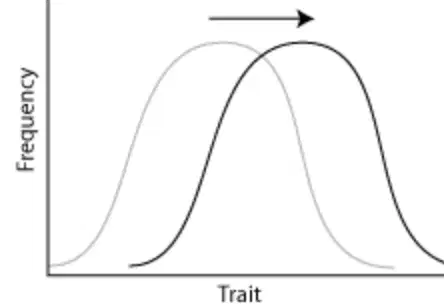
Trait distribution for beak depth shifts right after a drought; individuals with deeper beaks have higher relative fitness. Which selection mode fits the figure?
a)
Directional
b)
Frequency‑dependent balancing
c)
Disruptive
d)
Stabilizing
10.
Relative fitness refers to:
a)
Physical strength relative to predators
b)
Heterozygote superiority
c)
An individual’s absolute number of offspring
d)
The contribution of a genotype to the next generation relative to other genotypes
11.
In a randomly mating population, allele A has frequency p = 0.6. Assuming Hardy–Weinberg equilibrium, what proportion is heterozygous?
a)
0.36
b)
0.48
c)
0.60
d)
0.24
12.
You genotype a large population at locus M and observe genotype frequencies that deviate significantly from p² : 2pq : q² expectations. The best conclusion is:
a)
The population is definitely under directional selection only
b)
The population is evolving at this locus or a H–W assumption is violated
c)
No conclusion is possible from genotype data
d)
The population must be small and experiencing drift only
13.
According to the biological species concept, species are:
a)
Groups that interbreed in nature to produce viable, fertile offspring and are reproductively isolated from other such groups
b)
Groups with identical morphology
c)
Groups sharing the same habitat
d)
Groups with identical chromosome numbers
14.
Two frog species breed in the same pond, but one calls at dusk and the other at dawn. This is an example of:
a)
Mechanical isolation
b)
Behavioral isolation
c)
Temporal isolation
d)
Habitat isolation
15.
Two snail species attempt to mate, but shell coiling directions prevent alignment of reproductive openings. This barrier is:
a)
Behavioral isolation
b)
Gametic isolation
c)
Mechanical isolation
d)
Hybrid inviability
16.
Horses and donkeys can produce mules, which are typically sterile. This is:
a)
Gametic isolation
b)
Hybrid breakdown
c)
Reduced hybrid viability
d)
Reduced hybrid fertility
17.
Which statement is most accurate?
a)
Both allopatric and sympatric speciation require polyploidy
b)
Allopatric speciation involves geographic isolation; sympatric speciation occurs without geographic separation
c)
Sympatric speciation cannot be driven by sexual selection
d)
Allopatric speciation requires natural selection; sympatric speciation requires drift
18.
Which case most clearly illustrates autopolyploidy?
a)
Gradual accumulation of mutations in isolated populations
b)
Hybridization between two species followed by chromosome doubling
c)
Mitotic error within one species producing a fertile 4n lineage that mates with itself
d)
Allopatric divergence of diploid populations
19.
A fly population splits into host‑associated lineages that mate on different plant species in the same region. This illustrates:
a)
Hybrid breakdown
b)
Allopatric speciation via vicariance
c)
Sympatric speciation via polyploidy
d)
Sympatric speciation via habitat differentiation
20.
Two diverging bird populations form a hybrid zone. Over time, hybrids are less fit than parentals and prezygotic isolation strengthens. This outcome is called:
a)
Polyploidy
b)
Fusion
c)
Stability
d)
Reinforcement
21.
The punctuated equilibrium model predicts that most morphological change occurs:
a)
Only during polyploid events
b)
In rapid bursts associated with speciation, with long periods of stasis
c)
Gradually and evenly over long intervals within lineages
d)
Only in response to climate cycles
22.
Order the steps of one pathway to allopolyploid speciation from earliest → latest:
a)
1, 2, 3, 4
b)
1, 3, 2, 4
c)
3, 2, 1, 4
d)
2, 1, 3, 4
23.
In a small pond population, shell‑band frequency fluctuates unpredictably over five generations without consistent fitness differences. The best explanation is:
a)
Gene flow
b)
Genetic drift
c)
Directional selection
d)
Heterozygote advantage
24.
In a cichlid fish, females choose mates by male breeding coloration, and color‑based preferences diverge within the same lake. This process can facilitate:
a)
Sympatric speciation via sexual selection
b)
Mechanical isolation
c)
Allopatric speciation via vicariance
d)
Hybrid breakdown
25.
In a population under Hardy–Weinberg conditions, q = 0.3 for allele a at a diallelic locus. What is the expected frequency of the recessive phenotype (aa)?
a)
0.09
b)
0.21
c)
0.49
d)
0.42
100 %

