
 Worksheets
Transport Modes and Their Functions
Total questions: 30
Worksheet time: 15mins
What is the primary function of rail transport according to the text?
Links major towns and cities to docks and airports
Links local and national locations
Links regional and international destinations
Transports goods through canals
Airports are mainly used to:
Link regional and international destinations, carrying people and goods
Transport goods through canals
Connect only local towns
Serve as leisure locations
Compare the roles of modern ports and traditional canals in water transport.
Modern ports handle international goods transport, while traditional canals were used for local goods transport before railways.
Both are mainly used for leisure today.
Traditional canals are deeper than modern ports.
Modern ports are used for passenger transport, while canals are for goods.
Explain the main difference between motorways and A/Trunk roads in the UK.
Motorways are major roads, normally three lanes wide, connecting all parts of the UK and avoiding built-up areas, while A/Trunk roads are major roads between towns and cities that can be both single and dual carriageways.
Motorways are only for bicycles, while A/Trunk roads are for cars.
Motorways are underground, while A/Trunk roads are above ground.
Motorways are only found in rural areas, while A/Trunk roads are only in cities.
Cycle paths in the UK can run alongside which types of roads?
Only motorways
Only unclassified roads
A/B roads or be a separate path
Only in city centers
Explain how the construction method of an arch bridge differs from that of a beam bridge, using the examples provided in the material.
Arch bridges use cables, while beam bridges use arches.
Arch bridges use curved structures to distribute weight, while beam bridges use straight beams supported by piers.
Arch bridges are only made of wood, while beam bridges are only made of steel.
Arch bridges float on water, while beam bridges are built underground.
What is the main function of an aqueduct?
To carry water from a source to a distribution point.
To support a railway across a valley.
To provide shelter for animals.
To generate electricity.
Which of the following best describes how canals use aqueducts?
Canals use aqueducts to cross valleys or low-lying areas in much the same way as a viaduct.
Canals use aqueducts to store water for future use.
Canals use aqueducts to generate hydroelectric power.
Canals use aqueducts to provide drinking water to cities.
Why might engineers choose to build a viaduct instead of a regular road or railway at ground level? (DoK Level 3)
To cross a valley or gorge where building at ground level is not possible.
To make the road look more attractive.
To avoid building tunnels.
To reduce the cost of construction.
How is an immersed tube tunnel constructed?
By drilling through rock and lining the tunnel
By excavating and back-filling the ground
By prefabricating a concrete structure, floating it to its location, sinking it, joining sections, and pumping out water
By building a bridge over water
A city needs to build a tunnel under a river. Which tunnel construction method would be most suitable and why? (DoK Level 3)
Cut and covered, because it is the simplest method
Bored, because it allows drilling under a body of water
Immersed tube, because it involves floating and sinking prefabricated sections under water
None, because tunnels cannot be built under rivers
Why are water and gas services usually piped underground rather than overground?
To protect them from weather and reduce hazards
Because it is cheaper than overground installation
To make them easier to repair
To increase the voltage of electricity
Explain how a mobile phone tower acts as part of the communication process between two mobile phones. Use evidence from the material to support your answer.
It stores the call until the recipient is available
It acts as a large antenna, transmitting and receiving radio waves to a radio base station, and then forwards the call via fibre optic cable or satellite link
It only receives messages but does not transmit them
It connects directly to the internet to send messages
Why is flood management and protection of Wales’s coasts becoming more important?
Due to increased tourism
Because of climate change and weather unpredictability
To improve fishing opportunities
To reduce water usage
Explain how dams contribute to both domestic/commercial use and hydroelectricity generation. (DoK Level 2)
Dams only store water for drinking purposes.
Dams regulate water flow, form reservoirs for use, and generate electricity by releasing water through turbines.
Dams are used only for recreational activities.
Dams prevent all forms of flooding.
Why are houses built on flood plains at increased risk of flooding?
Because they are closer to the river source
Because the soil is too dry
Because if the levees break, the area naturally floods
Because there are no trees to absorb water
Which of the following best explains how levees help in flood management?
They increase the amount of rainfall in the area
They prevent rivers from ever flooding
They assist in regulating water flow and reduce the risk of flooding by containing river water
They make the river water cleaner
Which of the following best describes a bund?
A small dam designed to regulate water flow
A wall built of stone or soil formed into an embankment that holds back water
A naturally formed riverbank
A gate used to control water levels
How does a levee differ from a bund?
A levee is always made of concrete
A levee is normally formed naturally by the river, while a bund is built
A levee is used only in cities
A levee is smaller than a bund
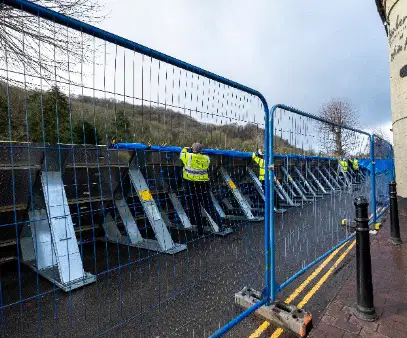
What is the main function of floodgates?
To create electricity from water flow
To control water levels in flood barriers, reservoirs, rivers, and levee systems
To provide drinking water to cities
To prevent fish from migrating
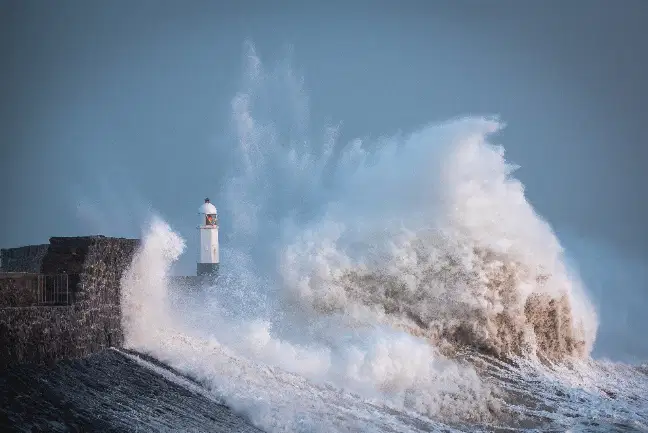
What does the image illustrate about the importance of coastal defences?
It shows how sea walls protect the land from powerful waves and storm surges.
It shows how lighthouses are used to guide ships.
It shows a typical day at the beach.
It shows the construction of new buildings.
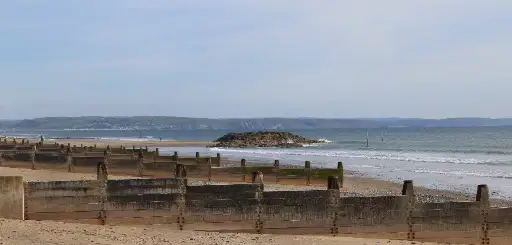
Which of the following best describes the function of groynes in coastal defence?
They are low walls or barriers built out into the sea to help stop erosion and prevent beaches from drifting or washing away.
They are cages filled with stones to allow water to flow through and decrease water velocity.
They are sloping structures made from timber or rocks to absorb wave energy.
They are underwater barriers to stop fish migration.
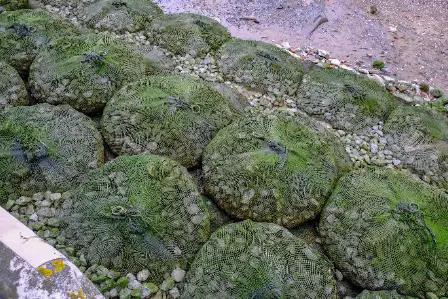
What is the main purpose of gabions in coastal defence?
To provide a habitat for marine life.
To allow water to flow through while decreasing the velocity of the water, thus preventing erosion.
To act as a decorative feature on beaches.
To block all water from reaching the shore.
Which material is NOT commonly used to construct revetments?
Timber
Concrete blocks
Plastic sheets
Rocks
What was one major benefit of constructing canals in England during the industrial period?
They provided fresh drinking water to cities.
They allowed goods and building materials to be cheaply transported.
They were used for recreational boating only.
They prevented flooding in industrial cities.
Explain how locks on canals help barges travel over obstacles.
By providing a direct route over hills.
By raising and lowering boats between water stretches at different levels.
By making the water flow faster.
By widening the canal for larger boats.
What is the primary function of a dry dock?
To provide a recreational area for visitors.
To allow ships to dock while loading and unloading cargo.
To drain water so that work can be done on a ship, then re-flood the dock so the ship can sail out.
To store cargo in warehouses.
Explain the difference between a dock and a dry dock.
A dock is for recreational use, while a dry dock is for loading cargo.
A dock is an enclosed area for loading and unloading cargo, while a dry dock is drained to allow work on ships.
A dock is a raised structure extending into the sea, while a dry dock is a platform for fishing.
A dock is used for boarding boats, while a dry dock is used for swimming.
Which of the following is a source of clean electricity produced by wind turbines?
Wind farms
Solar farms
Industrial biomass boilers
Hydroelectric dams
Which renewable energy source uses sunlight to generate electricity?
Wind farms
Tidal movement
Solar farms
Industrial biomass boilers

