
 Worksheets
Sample Collection and Blood Collection Sites
Total questions: 70
Worksheet time: 35mins
Match the animal to its commonly used blood collection site(s):
Cephalic vein, Jugular vein, Saphenous vein
Dog
Cephalic vein, Jugular vein
Cat
Jugular vein
Horse
Coccygeal vein, Jugular vein
Cattle
Jugular vein, Medial metatarsal vein
Bad
The commonly used blood collection sites for a Dog are ________, ________, and ________.
Cephalic vein, Jugular vein, Saphenous vein
Femoral artery, Carotid artery, Renal vein
Brachial vein, Subclavian vein, Hepatic vein
Radial artery, Popliteal vein, Pulmonary vein
The commonly used blood collection sites for a Cat are ________ and ________.
Cephalic vein, Jugular vein
Femoral artery, Carotid artery
Saphenous vein, Subclavian vein
Radial artery, Popliteal vein
The commonly used blood collection site for a Horse is ________.
Jugular vein
Cephalic vein
Saphenous vein
Femoral artery
The commonly used blood collection sites for Cattle are ________ and ________.
Coccygeal vein, Jugular vein
Cephalic vein, Saphenous vein
Femoral artery, Auricular vein
Subclavian vein, Median vein
The commonly used blood collection sites for a Bad are ________ and ________.
Jugular vein, Medial metatarsal vein
Cephalic vein, Saphenous vein
Femoral vein, Tail vein
Auricular vein, Cardiac puncture
The commonly used blood collection site for a Rabbit is ________.
Ear vein
Jugular vein
Cephalic vein
Femoral artery
The commonly used blood collection site for a Rodent is ________.
Tail vein
Jugular vein
Femoral artery
Ear vein
What is the largest comfortable needle size used for?
Human patients
Animal
Laboratory experiments
Plant samples
If 2.5 mL of sample is needed, what size syringe should be used?
1 mL
2 mL
3 mL
5 mL
The syringe must be closest to the sample size needed.
True
False
What is the preferred method for collecting multiple samples with one stick?
Needle and syringe
Vacutainer
Pipette
Capillary tube
Vacutainer is composed of needle, needle holder, and _________?
collection tubes
syringes
pipettes
slides
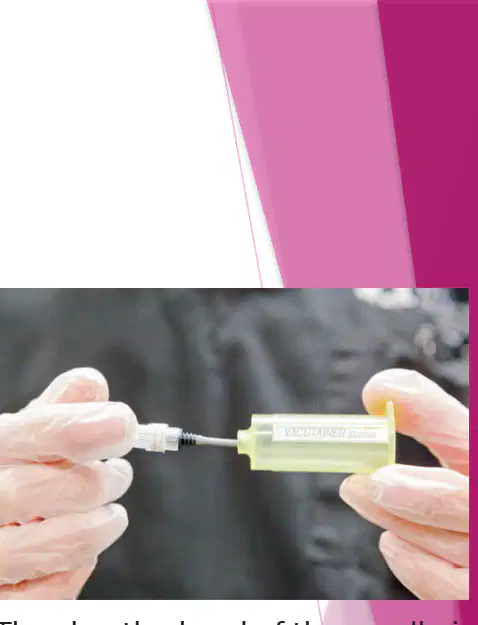
What is being shown in the diagram?
The sheathed end of the needle is inserted into the Vacutainer holder
Blood being drawn with a pipette
Syringe being filled with medication
Animal being injected
What is the size range for vacutainer tubes?
1 μL to 15 mL
10 mL to 100 mL
0.1 mL to 1 L
5 mL to 50 mL
Why is it important to choose the correct size of vacutainer tube?
To minimize vein collapse
To increase blood flow
To reduce pain
To speed up collection
When filling a vacutainer tube, ensure the anticoagulant is in proper ______ to blood.
ratio
temperature
color
pressure
What should be used when handling whole blood?
Water
Proper anticoagulant
Sugar
Salt
Once whole blood is collected, what should be done to mix it?
Shake vigorously
Leave it still
Gentle rocking
Heat it
What is the fluid portion of whole blood called?
Serum
Plasma
Fibrinogen
Buffy coat
Plasma is composed of 90% ______ and 10% dissolved constituents.
water
protein
glucose
salt
Which of the following is NOT a constituent found in plasma?
Proteins
Carbohydrates
Fibrinogen
Bone marrow
Serum is ______ without fibrinogen.
plasma
water
hemoglobin
platelets
Which of the following best describes the difference between plasma and serum?
Plasma contains fibrinogen, serum does not.
Serum contains fibrinogen, plasma does not.
Both contain fibrinogen.
Neither contains fibrinogen.
Anticoagulants are required when ______ or plasma is needed.
whole blood
serum
platelets
red blood cells
What should you do if you are unable to run a test with anticoagulant within 1 hour?
Freeze the sample
Refrigerate the sample
Leave the sample at room temperature
Discard the sample
You should choose the appropriate anticoagulant for the specific test.
True
False
What is the recommended ratio of Heparin to blood to be collected?
10 U/mL
20 U/mL
30 U/mL
50 U/mL
Heparin is used in ______ amounts when collecting blood.
small
large
moderate
excessive
What part of the syringe should be coated with Heparin when using small amounts?
The inside of the syringe
The outside of the syringe
The plunger of the syringe
The needle of the syringe
Vacuum tubes are premeasured to the proper amount for Heparin collection.
True
False
What is the full form of EDTA?
Ethylenediaminetetraacetic acid
Ethanol diamine tetraacetate
Ethylene diamine triacetic acid
Ethylenediamine tetraacetone
EDTA is preferred for which type of studies?
Hematologic studies
Biochemical studies
Microbiological studies
Serological studies
Does EDTA alter cell morphology?
No, it does not alter cell morphology.
Yes, it causes significant cell lysis.
Yes, it induces cell proliferation.
Yes, it changes cell color.
Should EDTA be used in plasma samples for chemical assays?
True
False
What is the recommended amount of EDTA per mL of blood?
1 to 2 mg/mL
5 to 10 mg/mL
0.1 to 0.5 mg/mL
10 to 20 mg/mL
What happens if excessive amounts of EDTA are used?
Cells shrink and cell counts are invalidated in automatic analyzers.
Cells swell and burst, leading to hemolysis.
EDTA enhances the accuracy of cell counts.
No effect occurs on the cells or analysis.
Which of the following salts can be found in oxalates used as anticoagulants?
Sodium
Potassium
Ammonium
Lithium
All of the above
Which salt is most commonly used in oxalates as an anticoagulant?
Sodium
Potassium
Ammonium
Lithium
Potassium oxalate may inhibit ________ and alkaline phosphatase activity.
lactate dehydrogenase
amylase
pepsin
trypsin
Potassium oxalate is not used in assays for ________.
potassium
calcium
magnesium
sodium
Which of the following salts can be found in citrates used as anticoagulants?
Sodium
Potassium
Ammonium
Lithium
Both A and D
Which salt is most commonly used in citrates as an anticoagulant?
Sodium
Potassium
Ammonium
Lithium
Sodium citrate interferes with ________ assays.
sodium
potassium
calcium
magnesium
Sodium fluoride is used as a ______ preservative.
glucose
protein
lipid
vitamin
What is the concentration range of sodium fluoride used in blood as a glucose preservative?
1 to 3 mg/mL
6 to 10 mg/mL
15 to 20 mg/mL
20 to 25 mg/mL
Sodium fluoride may be added to other samples as a glucose preservative at a concentration of ______ mg/mL of blood.
2.5
1.0
5.0
0.5
Sodium fluoride interferes with many enzymatic tests.
True
False
What does PCV stand for in the context of sample volume in animals?
Plasma Cell Volume
Packed Cell Volume
Protein Cell Volume
Partial Cell Volume
In a well-hydrated animal with PCV 50%, what percentage of the blood is fluid?
30%
50%
70%
100%
In a well-hydrated animal (PCV 50%), 10 mL of blood contains ______ mL of fluid.
5
2.5
7.5
10
In dehydrated animals (PCV 70%), what percentage of the blood is cells?
30%
50%
70%
100%
In dehydrated animals (PCV 70%), 10 mL of blood contains ______ mL of fluid.
3
5
7
1
What is the first step in the collection procedure?
Gather equipment and supplies
Label the specimen container
Wash your hands
Send the specimen to the lab
What should be done to the preparation site before collection?
Shave if possible and clean site
Apply lotion to the site
Bandage the site before collection
Leave the site untouched
Mark the site with a pen
What is used to occlude the vein during the collection procedure?
Restrainer or tourniquet
Syringe
Alcohol swab
Bandage
Why should venipuncture be performed with minimal tissue injury?
To prevent contamination and hemolysis
To increase blood flow
To cause more pain
To make the procedure longer
During venipuncture, what angle should the needle be inserted at?
30 degrees
10 degrees
60 degrees
90 degrees
After collection, what should be done immediately?
Remove needle and apply pressure
Label the sample tube
Ask the patient to stand up quickly
Dispose of gloves before removing needle
If using a Vacutainer, what should you do?
Fill to capacity
Shake vigorously
Leave partially filled
Use without a needle
Restraint is a valuable tool during the collection procedure.
True
False
According to the Collection Procedure, what should you do before transferring blood from a syringe to a tube?
Remove needle from syringe before transferring
Shake the syringe vigorously
Add anticoagulant to the syringe
Heat the syringe before transferring
According to the Collection Procedure, why should you gently invert any tubes containing anticoagulant?
To ensure proper mixing with blood
To prevent the tube from breaking
To increase the temperature of the blood
To speed up clotting
According to the Collection Procedure, what information should be included on the label?
Date and time, Patient name and ID number, Owner name
Test result, Doctor's signature, Expiry date
Hospital address, Room number, Insurance details
Sample color, Technician's favorite color, Lab temperature

According to the table 'Order of Draw for Commonly Used Blood Collection Tubes', which cap color is drawn first?
Red
Light blue
Green or tan
Gray

According to the table 'Order of Draw for Commonly Used Blood Collection Tubes', what is the primary use of the tube with a red cap?
Hematology
Coagulation studies
Serum for blood chemistry
Plasma for blood chemistry

According to the table 'Order of Draw for Commonly Used Blood Collection Tubes', the tube with a lavender, royal blue, or tan cap contains which additive?
EDTA
Heparin
Sodium Citrate
Potassium Oxalate

According to the table 'Order of Draw for Commonly Used Blood Collection Tubes', match the cap color to its primary use:
Coagulation studies
Light blue
Plasma for blood chemistry
Green or tan
Coagulation testing and glucose testing
Gray

According to the table 'Order of Draw for Commonly Used Blood Collection Tubes', which additive is found in the tube with a gray cap?
Potassium oxalate or sodium fluoride
EDTA
Sodium citrate
Heparin

According to the table 'Order of Draw for Commonly Used Blood Collection Tubes', the tube with a red/gray, gold, or red/black 'tiger top' cap contains which additive?
Gel separator and clot activator
EDTA
Sodium citrate
Heparin

