
 Worksheets
GACE II
Total questions: 74
Worksheet time: 6hrs 6mins
How many fraction–percent equivalents are listed in the worksheet represented above?
One
Two
Three
Four
Students in a fourth-grade class are learning how to copy line segments and angles from their textbook onto a piece of paper. Which of the following tools is appropriate for the activity?
Select all that apply.
A protractor
A straightedge
A geoboard
A compass
Which of the following activities will best help kindergarten students understand the concept of negative numbers?
Watching a needle on a dial that shows how fast a wheel is turning
Using a thermometer to illustrate extreme temperatures recorded at the South Pole
Moving the hands of a clock back an hour at the beginning of daylight saving time
Placing money from a change purse into a piggy bank
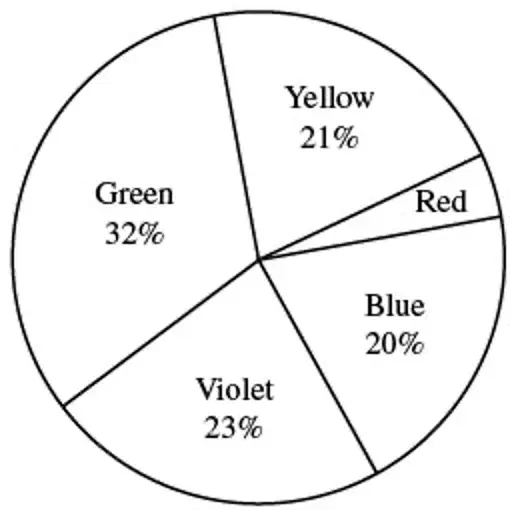
The circle graph above shows the distribution, in percents, of various colors of gems in a collection. What fraction of the collection is red?
2/50
4/50
2/25
4/25
The Evergreen Shoe Factory received an order for 100 pairs of shoes. The factory ships shoes in cartons that each holds up to 12 pairs. How many cartons will the factory need to ship this order?
Question:
Most of the fourth graders who worked on the problem above gave answers such as 8 R4, 8.333, and 813 . These responses suggest that the students need practice in
rounding down
expressing remainders
applying number sense
using fractions rather than decimals
Second-grade students are using a calculator to total the number of books in their classroom library. At one point, they mistakenly subtract 12 instead of adding 12. The calculator display shows a total of 57. What one operation can they do to correct the mistake?
Add 12
Add 24
Subtract 12
Subtract 24
"A retailer wants to determine the size most often purchased of a certain type of children's shoe to ensure that enough of that item is available to meet consumer demand. Sizes sold last month: 2, 2, 2, 3, 5, 5, 7, 8."
A fifth-grade teacher poses the question above to the class during a lesson. The lesson most likely addresses which of the following concepts?
Mode
Median
Mean
Range
Which of the following activities requires a student to perform a mathematical computation at the most concrete level?
Adding 2+4
Joining two blocks and four blocks
Adding two apples and four apples using pictures of the apples
Solving x+4=6
19+17+15+13+7+5+3+1
Question:
A teacher writes an addition problem on the board and asks students to think of other ways to write the sum, using a different operation. Which of the following represents the sum of the numbers shown using multiplication?
4×18
4×19
4×20
4×21
A fourth-grade class is discussing the problem shown.
Sid is traveling by train from Little City to Big City. The train departs Little City at 8:30 A.M. and arrives in Big City at 9:15 P.M. How long does it take the train to travel from Little City to Big City?
Question:
During the discussion, one student says, “All you have to do is subtract 830 from 915, and you have the answer! It’s 85 minutes.” For which of the following reasons is the student incorrect?
The student did not consider how fast the train was traveling.
The student used an inappropriate number-base system to calculate elapsed time.
The student did not consider the distance between the cities.
The student made a subtraction error in calculating elapsed time.
Which of the following is a nonmetric unit of measurement?
Square meter
Kilogram
Centimeter
Mile
Luis, Kristina, Mallory, and Hasan are four friends with pets. One has a horse, one a cat, one a white mouse, and one a rabbit. Mallory is allergic to cats and does not have one. Luis has the smallest pet, and Hasan’s pet sleeps standing up. Kristina does not have a rabbit. What is each friend’s pet?
Question:
A fourth-grade math teacher presents the problem above to the class. Which of the following problem-solving strategies is most likely to help the students solve the problem?
Using manipulatives and concrete materials
Presenting mathematics problems devised from newspaper articles and advertisements
Lecturing and allowing time for questions and answers
Having students write a story about regrouping
A fifth-grade teacher has students cut some two-dimensional shapes from paper and then fold them into three-dimensional figures. Which of the following concepts are the students most likely exploring?
Rotations
Reflections
Nets
Tessellations
Fred, a student in a math class, showed the following solutions for two problems.
Problem: Dan cooked 60 of the 200 burgers at a company picnic. What percent of the burgers did he cook?
Work: 200 × 0.60 = 120
Answer: 120%
Problem: Tara watered 50 of the 180 plants in her mother’s garden. What percent of the plants did she water?
Work: 180 × 0.50 = 90
Answer: 90%
Question:
Which of the following strategies could best help the student check answers to word problems and look for errors?
Estimate the answer first, use an algorithm, and compare results
Practice multiplication with decimals outside the context of a word problem
Multiply the first digits and add the appropriate number of zeros
Complete the multiplication, then use division to check the answer
How many different pairs of positive whole numbers have a product of 12?
One
Two
Three
Four

Ms. Whitehead asked her students to shade 1/7 of the units in an array. Based on the figures shown, which student or students responded correctly?
Jolene only
Brittany only
Fred only
Jolene and Marc only
29×57= _____
Question:
Before students in a fifth-grade class solve the problem above, the teacher has them use mental mathematics to compute 9×7,20×7,9×50, and 20×50. For which of the following reasons is it appropriate to have the students use mental mathematics that way?
To reinforce the connection between multiplication and addition
To practice rounding to the nearest 10
To introduce the associative property of multiplication
To recall the partial products used in the algorithm
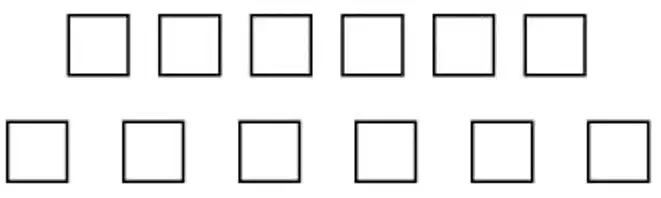
A teacher arranges 12 tiles on two rows, as shown above, and then asks a student if one of the rows has more tiles than the other. Pointing to the bottom row, the student says, “There’s more here.” The response suggests that the student does not yet understand the concept of
ordering
sequencing
equivalent sets
counting by doubles
25÷10=N
A third-grade teacher asks students to write a word problem for the number sentence above, where N is the exact answer to the problem. Which of the following student responses best satisfies the conditions set by the teacher?
A team of 10 students wins 25 movie tickets. How many tickets will each student get?
Ten students tied for the winning prize of $25 in a contest. How many dollars will each student receive?
Twenty-five children at a birthday party will eat 10 pizzas. How many slices will each child have?
A tub of paint holds 25 gallons. How many 10-pint cans can be completely filled with paint before the tub is empty?
The ability to skip count by tens is a benchmark mathematical skill for first- and second-grade students primarily because it
serves as a conceptual foundation for multiplication
shows an understanding of number and quantity
familiarizes students with the concept of order of magnitude
prepares students for reading and constructing scales and grids
30 ÷ 6
53 ÷ 7
84 ÷ 8
75 ÷ 9
Question:
Third graders studying division were asked to solve and check the four division problems above and then write a story for each problem. Which of the following is the most likely reason for asking the students to write the stories?
To have students demonstrate that division can mean partitioning a set of objects
To have students practice division skills through drill-and-check exercises
To help students write quotients that might contain a decimal
. To have students practice the strategy of solving a simpler problem than those presented
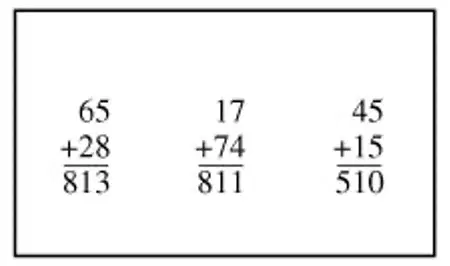
The work of a student is shown above. The most likely reason for the error in the work is that the student has difficulty
recalling addition facts
recognizing an appropriate answer
interpreting arithmetic symbols
rounding up whole numbers
To introduce students to geometry, a first-grade teacher selects a variety of classroom objects having different shapes and passes them to the students. Which of the following concepts is most appropriate for the students to explore?
Measurement of angles
Plane and solid figures
Area and perimeter
Reflection and rotation
Omar had 12 cookies. After he gave some of his cookies to Leah, he had 6 cookies left. How many cookies did he give to Leah?
Question:
Which of the following best describes the problem type above?
Result unknown
Order unknown
Start unknown
Change unknown

Question:
A third-grade teacher gives students the following list of fractions: 4/8,7/8,11/8,7/12, and 9/12. How many of the fractions on the list can students correctly graph on the number line?
Two
Three
Four
Five
5(6+4)=30+20=50
Question:
Which of the following properties of operations is illustrated in the example above?
Commutative property
Distributive property
Transitive property
Reciprocal property
A kindergarten teacher shows students how to count objects in a set and then represent the number of objects with a numeral. The activity best fosters students' understanding of which of the following mathematical concepts?
Identifying patterns and relationships
Recognizing and naming numbers
Comparing two- and three-dimensional shapes
Applying the cardinality principle
Craig wants to buy 3 compact discs from a friend who is selling them for $14.49 each. Craig has $45 to spend. His sister says that is not enough money to buy all the compact discs. Is she right or wrong?
Question:
A teacher poses the preceding word problem to fifth-grade students. Which of the following students has created an expression that will solve the problem?
Student A: 14.49+3−45
Student B: 45−(3×14.49)
Student C: (45−3)×14.49
Student D: 45−14.99+3
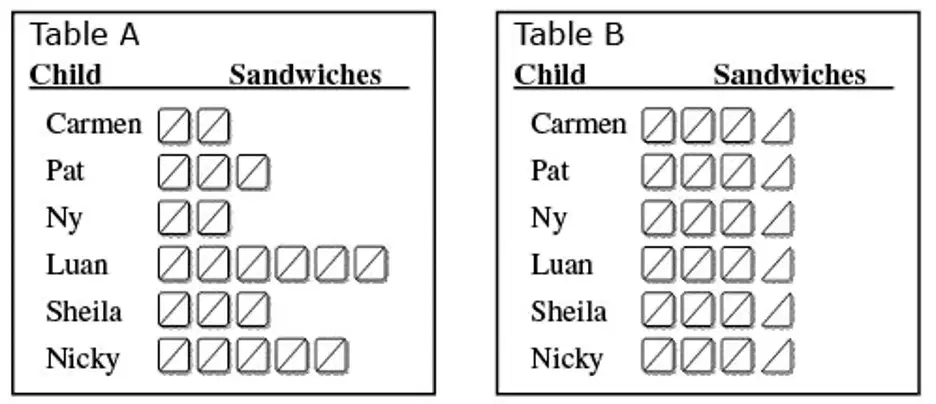
Fifth-grade students create Table A to represent the number of sandwiches they each ate during the last month. The teacher then shows the students that redistributing the pictures of sandwiches equally among the students creates Table B.
Question:
The activity will best help students understand which of the following mathematical concepts?
Probability
Mean
Range
Proportions
A third-grade student cuts out three pairs of rectangles, with the rectangles in each pair having equal size, and then glues the pieces together to make a box. The activity requires the student to demonstrate which of the following mathematical understandings?
Number sense
Data sense
Spatial sense
Symbol sense
A kindergarten teacher asks questions that encourage students to think numerically and make quantitative judgments. In the morning, the teacher might ask students to figure out how many students are absent. During snack time, the teacher might ask students if there are enough snack cups for everyone in the classroom. During recess, the teacher might ask students to determine how many balls they take outside so they know how many balls to bring back inside. Which of the following mathematical concepts is the teacher most likely reinforcing?
Classifying
Ordering
Patterning
Counting
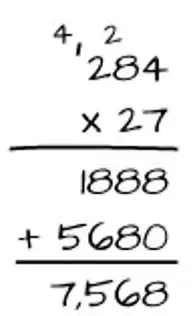
Question:
A teacher shows students the problem above and asks them to identify the first error that occurs in the solution. Which of the following student answers is correct?
The sum in the ones column is incorrect.
There is an addition mistake in the tens column.
The number of tens that were composed from ones is incorrect.
The number of hundreds that were composed from tens in incorrect.
A teacher taps each child in line, calling out, “First, second, third, fourth.” Which of the following types of numbers is the teacher using?
Nominal
Cardinal
Ordinal
Real
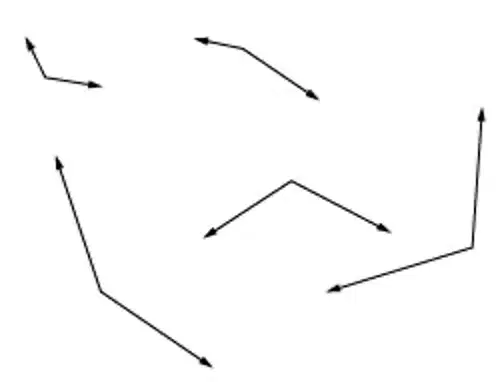
Students in a fifth-grade class draw the angles shown above on their papers. Which of the following best describes the types of angles that the students are drawing?
Obtuse
Acute
Straight
Right
At the beginning of a unit on division, a third-grade teacher asks students working in groups to devise a method for dividing 156 gum balls equally among four people. The activity will most likely require students to use which of the following?
Select all that apply.
Cooperative learning
Standard algorithms for division
Guess and check
Estimation
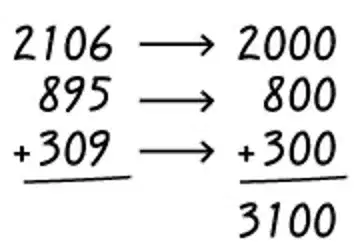
A third-grade student uses the following strategy to begin solving an addition problem.
Rounding up
Front-end estimation
Regrouping
Compatible numbers
Students place unit cubes in a rectangular solid until the base is covered. Students continue adding layers of cubes until the solid is filled to the top. Which of the following concepts does the activity address?
Area
Volume
Perimeter
Circumference
A second-grade teacher is preparing a lab activity in which students will compare the weight of an ice cube in a cup to the weight of the water that remains in the cup when the ice cube melts. The activity can best be used to introduce the unifying scientific concept of
adaptations
system
conservation
interdependency
Which of the following are the likely effects of an oil spill in a body of water?
Select all that apply.
Sea plants cannot make their own food, and they eventually die.
Toxins from the oil accumulate in shellfish.
Sunlight reaches greater depths.
Seabirds and mammals are harmed.
A kindergarten student notices that a bug on the classroom window emits a strong smell when touched. The teacher encourages the student to infer why the bug emits the smell. Of the following, which is the most likely inference?
The bug is protecting itself.
The bug is looking for a mate.
The bug is hungry.
The bug is cold.
When introducing a unit on seeds, an elementary teacher explains that seeds are often transported far away from the parent plant so that they have enough space and light to grow. The teacher takes the students outdoors to observe the puffy white balls of seeds on dandelion plants. Which of the following is the most likely way that dandelion seeds are transported?
Animals pick up the seeds on their fur and carry them to a new location.
The seeds fall into a stream and are carried by the water to a new location.
Birds eat the seeds and deposit them at a new location in their droppings.
The wind blows the seeds to a new location.
A first-grade teaching team is planning an activity in which students are given an orange, a golf ball, and a table tennis ball and asked to roll each of the objects down a slanted board and record their observations. The activity best addresses knowledge in which of the following areas of science?
Heat and chemical reactions
Forces and motion
Electricity and magnetism
Natural resources
A kindergarten class is learning about the different soil layers. The teacher shows the students a plastic milk jug half filled with several soil layers of different compositions and then asks them to predict what will happen if they shake the jug. The students’ descriptions are best characterized as which of the following?
Hypothesis
Observation
A scientific law
Data collection
Students observe that fresh white carnations placed in water to which green food coloring has been added turn green after a few days. Which of the following processes is most involved in the color change?
Condensation
Respiration
Transpiration
Water pressure
Which of the following best describes igneous rocks?
Rocks that have been altered by intense pressure
Rocks formed when molten magma cools
Rocks formed from accumulated sediments cemented together
Rocks formed from hardened soil
Which of the following best defines an ecosystem?
A transition in the species composition of an area following a disturbance of the area
All the nonliving factors that make up the physical environment of an area in which organisms live
All the organisms living in a given area as well as the nonliving components of their environment
The ways in which a particular species makes use of the living and nonliving resources in its geographic range
Which of the following tools is most appropriate to use in determining the volume of a large block of wood of unknown density?
A metric ruler
A triple-beam balance
A 200 mL volumetric flask
A micrometer
A teacher places some items on a table and then asks students to predict whether the items will sink or float in a container filled with water. Which of the following information will be most helpful to provide to the students?
The temperature of the water
The density of each item
The capacity of the container
The volume of the water
A first-grade teacher explains to students how Earth’s surface changes. Which of the following contributes the most to the changes on Earth’s surface?
Fire
Earthquakes
Water
Wind
Which of the following describes an event that involves the transformation of chemical energy?
Burning wood in a fireplace
Running and kicking a soccer ball
Winding the propeller on a toy plane
Strumming the strings on a guitar to make music
A second-grade class is learning about sound. To help students understand the concept of vibration and its relationship to sound, the teacher does a demonstration with a drum. The teacher puts a pile of confetti on top of the drum and asks, “What do you suppose will happen to the confetti when I hit the drum?” Of the following science-process objectives, which does the teacher’s question best address?
Students will be able to create a model.
Students will be able to record data.
Students will be able to define variables.
Students will be able to formulate a hypothesis.
Which of the following is a destructive force?
The formation of a river delta
The buildup of coral at a reef
Cave formation through weathering
Cooling and hardening of lava flows
Which of the following describes a physical change only?
A silver bracelet tarnishes when exposed to air.
An ice cube melts when heated.
Lemon juice turns brown when heated.
Iodine solution becomes purple when starch is added.
Which of the following statements best describes plate tectonics?
The continents are parts of plates that move relative to each other.
Ocean waves and currents push continents through ocean water.
Magnetic forces at the poles alternately push and pull the continents in different directions.
The gravitational pulls of both the Sun and the Moon cause movement of the plates.
Which of the following best illustrates complete metamorphosis in an insect?
A grasshopper hatches from an egg and sheds its exoskeleton many times as it grows to adult size.
Female mosquitoes bite animals to obtain blood meals, but male mosquitoes feed on plant juices.
Gypsy moth caterpillars eat leaves until they pupate, after which they emerge as winged adults.
A queen bee lays all the eggs in a hive, but worker bees produce wax and gather nectar and pollen.
In the National Science Education standards, which of the following characterizes the process in which students learn skills such as observation, inference, and experimentation?
Motions and forces
Form and function
Science as inquiry
Science and technology
A first-grade teacher brings different types of flowers into the classroom and asks the students to make observations about the flowers. Which of the following student responses is an example of a scientific observation that can best help in classifying the flowers?
Some of the flowers are wilted.
Some of the flowers are yellow.
The flowers are pretty.
The flowers are soft.
Students will develop an understanding of the characteristics of organisms and their interaction with their environments.
Question:
Which of the following activities best addresses the standard?
Creating a model of an insect and labeling important features
Constructing and maintaining a class terrarium and recording daily observations
Building and using weather instruments to observe changes in weather over time
Classifying rocks, shells, leaves, or seeds by shape, color, or size
A kindergarten class experiments at the sand and water tables with buckets, shovels, molds, ramps, waterwheels, tubes, screens, and funnels. Afterward, the teacher conducts a discussion on what the students discovered. Which of the following learning objectives does the activity best address?
Students will describe common physical changes in matter.
Students will identify the differences between living and nonliving things.
Students will use the scientific skills of observation, inquiry, and analysis.
Students will distinguish between solids, liquids, and gases.
A teacher gives each of several groups of students a container of water and a variety of objects of different sizes and materials to place in it. To the students’ surprise, several of the larger items float, while many of the smaller items sink. Which of the following best describes the purpose of the activity?
The teacher is stimulating student learning by producing a discrepant event.
The teacher is allowing the students an opportunity to play with the materials before the lesson begins.
The teacher is demonstrating the characteristics of the states of matter.
The teacher is demonstrating the ability to follow the written text and to deliver the stated objectives.
Which of the following are complementary colors on a color wheel?
Black and red
Blue and purple
Red and green
Yellow and orange
Which of the following will most likely reduce the number of accidents on school playgrounds?
Scheduling the same playground times for students in primary and intermediate grades
Posting informational signs that show how to use playground equipment properly
Asking students to monitor playground activities
Having asphalt or concrete surfaces installed to ensure better traction for playground users
Which of the following activities is most likely to be achieved independently by typically developing kindergarten students?
Dribbling a basketball with one hand
Juggling three sponge balls
Tossing and catching a beanbag
Striking a tossed ball with a bat
Which of the following is most important to monitor closely when managing diabetes?
Blood Pressure
Sodium
Cholesterol
Blood Sugar
Which of the following instruments would be found in the woodwind section of an orchestra?
Clarinet
Violin
Trombone
Triangle
Which of the following are most important for elementary students to develop as they progress in the area of art production?
Select all that apply.
Using art materials effectively
Representing figures and objects with a high degree of accuracy
Seeing relationships among their work, their world, and their imagination
Employing multiple processes in creating artwork
In a physical education class, small-group activities that focus on cooperative learning through student interaction will most likely require which of the following?
Organizational skills
Note-taking skills
Collaborative skills
Metacognitive skills
Which of the following terms is most closely associated with dramatic writing?
Rhyme
Alliteration
Meter
Dialogue
Which of the following is the most appropriate strategy to use when first teaching primary-grade students the mathematical concept of regrouping?
Using manipulatives and concrete materials
Presenting mathematics problems devised from newspaper articles and advertisements
Lecturing and allowing time for questions and answers
Having students write a story about regrouping
Which of the following is a correct feature of a mature forward roll?
The arms extend to the sides during the roll.
The action of the body is segmented.
The body uncurls to an L position after rolling forward.
The head lightly touches the mat surface.
Karl, a student in first grade is having difficulty adjusting to healthful food that his parents have been trying to add to his diet. Karl's parents ask the teacher for suggestions to help him adapt to the change. Which of the following is the most appropriate suggestion for the teacher to give?
Continue to provide the healthful food, and insist that Karl eat it
Discuss the food’s benefits with Karl, and let him help prepare the meals that include the new food
Allow Karl to eat the foods that are familiar to him and that he prefers
Provide both the healthful food and the more familiar food, and allow Karl to choose which to eat
Which of the following would be an appropriate activity for a simple second-grade lesson that teaches the concept of tempo?
The teacher plays fast- and slow-paced music selections; students stamp their feet to indicate how fast or slow they perceive the music to be.
The teacher makes loud and soft sounds on a piano; students jump up when they hear a loud sound and crouch down when they hear a soft sound.
The teacher claps and snaps a pattern; students sit in a circle as they listen to the pattern and try to repeat it, with each student adding a new part to the pattern.
The teacher puts on a recording of various musical instruments; students listen to the sounds the instruments make and discuss their similarities and differences.
Which of the following skills must a child master before learning to skip?
Running
Hopping
Walking backwards
Crab walking
Which of the following instruments has the highest pitch?
Trombone
Piccolo
Alto saxophone
Clarinet

