
 Worksheets
ENL Reconstruction
Total questions: 40
Worksheet time: 20mins
Name
Class
Date
1.
__________ led the Radical Republicans in the Senate
a)
Charles Sumner
b)
scalawags
c)
sharecroppers
2.
__________ were Southerners who supported the new (northern) reconstruction governments
a)
Charles Sumner
b)
scalawags
3.
One of the black senators from Mississippi during Reconstruction was
a)
carpetbaggers
b)
Hiram Revels
c)
sharecroppers
4.
Many freedmen and poor whites became ________ on the farms of large planters.
a)
Charles Sumner
b)
Hiram Revels
c)
sharecroppers
5.
The leader of the Radical Republicans in the House of Representatives was
a)
carpetbaggers
b)
Thaddeus Stevens
c)
sharecroppers
6.
Lincoln's Ten Percent Plan called for
a)
10% of the voters in each Southern State to swear an oath of loyalty to the United States
b)
Denying the right to vote to southerners who had served in the Confederate Army
c)
Forbidding any Southern State to take part in the national government again
7.
Food clothing and education were given to former slaves by the
a)
Freedmen's Bureau
b)
Wade Davis Bill
c)
Conservatives
8.
Slavery in the United States was officially banned by the
a)
13th Amendment
b)
24th Amendment
c)
Civil Rights Act
9.
Which of the following groups did not take an active role in reconstruction governments in the south?
a)
Carpetbaggers
b)
Former Confederate leaders
10.
Radical Republicans believed that
a)
The rights of freedmen in the South had to be protected
b)
Former Confederate states should be readmitted quickly and easily
c)
Congress could not interfere in the Affairs of the South
11.
Which of the following was not part of the Reconstruction Act of 1867?
a)
Poll taxes and literacy tests were made illegal
b)
The South was placed under military rule
12.
The House of Representatives impeached (got rid of) President Johnson because of his
a)
Disagreements with Congress
b)
Friendship with Thaddeus Stevens
13.
Jim Crow Laws _______________
a)
were segregation laws that separated all public facilities by race.
b)
was congresses.
c)
put Democrats back into office.
14.
An important result of the presidential election of 1876 was the
a)
Creation of the Republican Party
b)
end of Reconstruction
15.
After Reconstruction, African Americans in the South began to
a)
lose interest in politics and government
b)
lose political power
16.
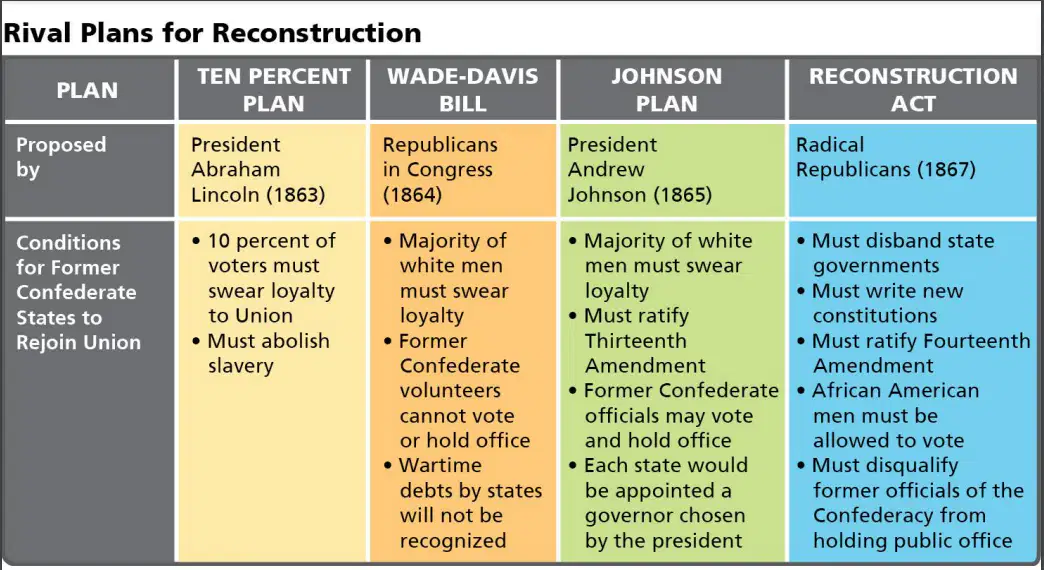
Base this question on the image: Who proposed the first plan for reconstruction?
a)
Abraham Lincoln
b)
Andrew Johnson
17.
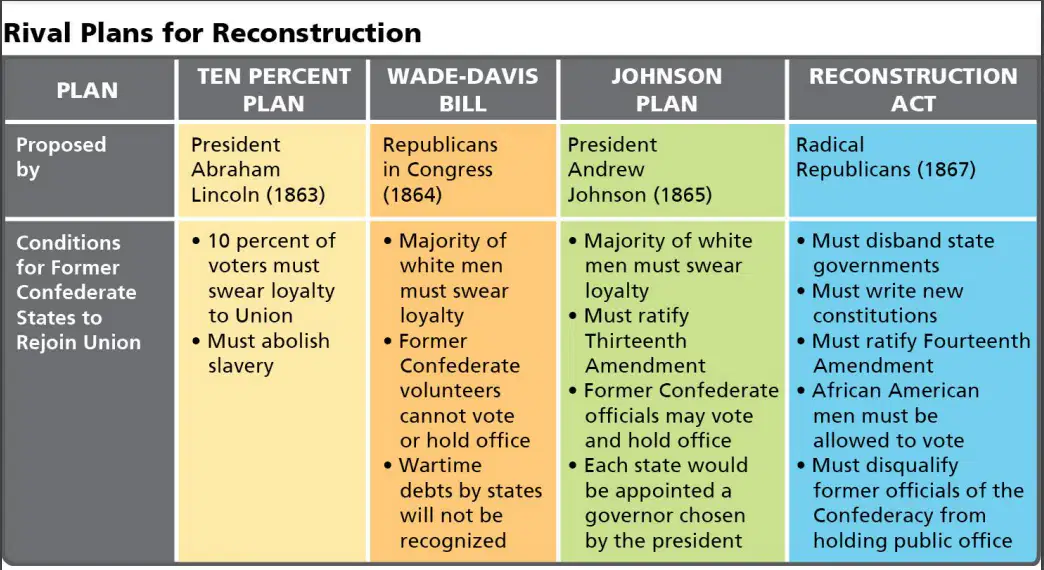
Base this question on the image: On which point did the Johnson Plan and the Wade-Wavis bill differ?
a)
The rights of former Confederates
b)
The abolition of slavery
18.

Base this question on the image: Which plan for reconstruction gave African American men the right to vote?
a)
The Johnson Plan
b)
The Reconstruction Act
19.
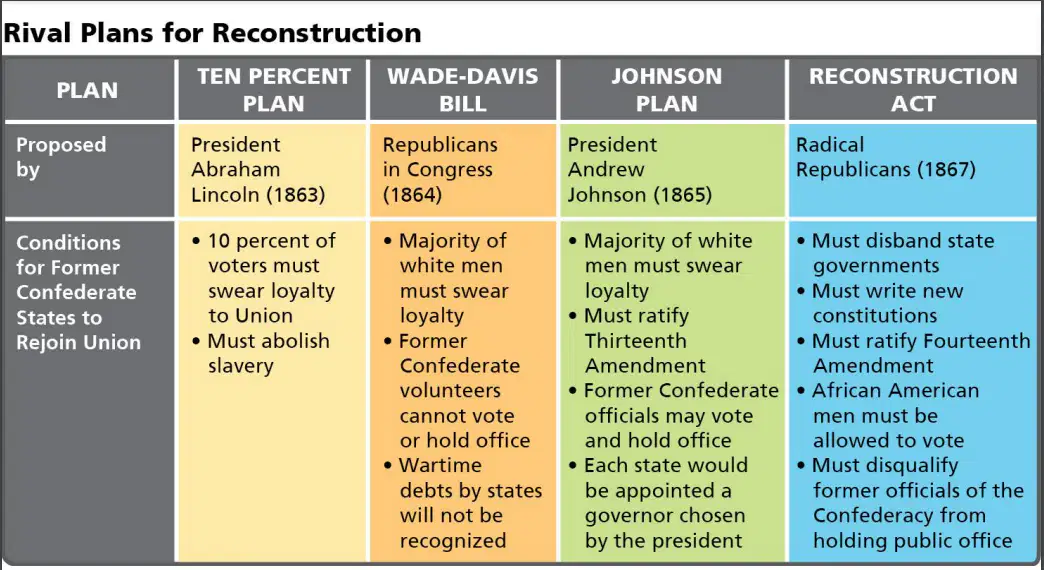
Base this question on the image: Which plan for Reconstruction was the easiest for Southern States to meet?
a)
The Lincoln plan
b)
The Wade-Davis bill
20.
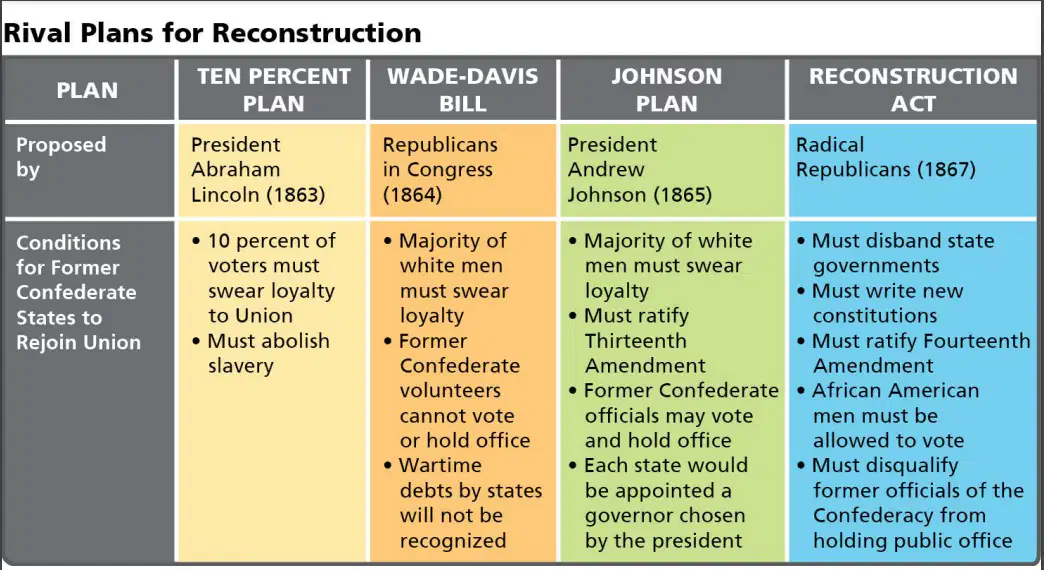
Base this question on the image: Which plan for Reconstruction required southern states to write new constitutions?
a)
The Johnson Plan
b)
The Reconstruction Act
21.
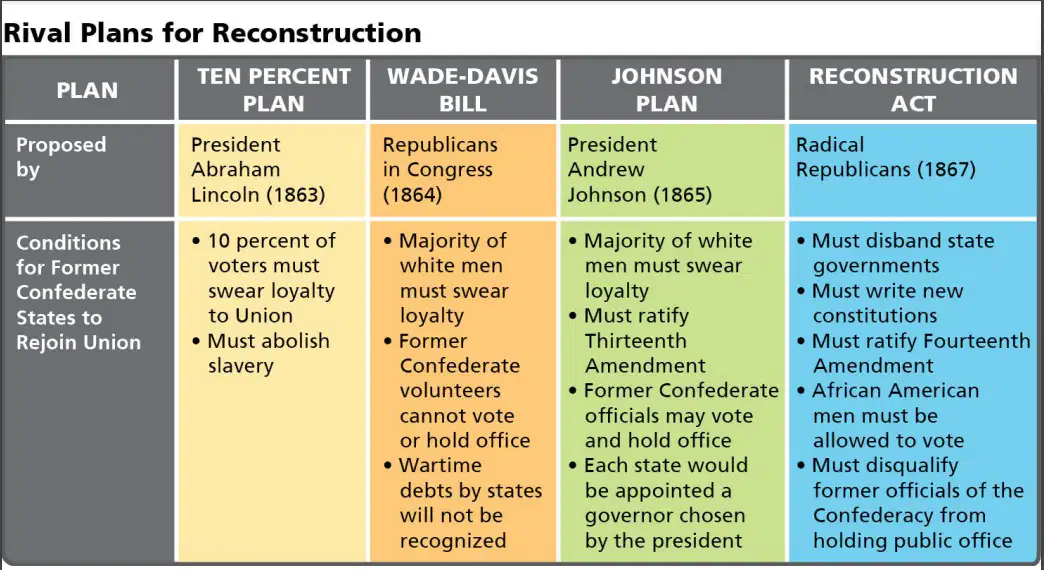
Base this question on the image: What issue did the Wade-Davis Bill not address?
a)
How many white Southerners must swear loyalty
b)
The abolition of slavery
22.
___________ were passed to increase the number of eligible southern white voters.
a)
Black Codes
b)
Grandfather clauses
23.
The rights of freedmen were severely limited by
a)
the election of 1868
b)
Black Codes
c)
Grandfather clauses
24.
_____________ were used to make it difficult for uneducated freedmen to vote
a)
Literacy tests
b)
Grandfather clauses
25.
A ___________ required a voter to pay a fee each time he voted
a)
Poll tax
b)
Literacy tests
c)
Grandfather clauses
26.
Northerners who moved South after the Civil War called
a)
carpetbaggers
b)
Literacy tests
c)
Grandfather clauses
27.
Who was a Radical Republican?
a)
Charles Sumner
b)
John Wilkes Booth
28.
The Freedmen's Bureau did all of the following except
a)
establish new factories
b)
provide medical care for blackas and whites
29.
Moderate Repubicans and Radical Republicans agreed that
a)
blacks should control Southern state legislators
b)
southern Democrats should be barred from Congress
30.
14th Amendment stated that
a)
Slavery was banned throughout the United States
b)
All persons born in the United States were citizens
31.
The Reconstruction Act of 1867 stated that
a)
southern states had to ratify the 14th Amendment in order to rejoin the Union
b)
The President could not interfere with Reconstruction
32.
Some Republican senators voted against President Johnson of "high crimes" because they
a)
wanted Johnson to serve another four years as president
b)
Did not think they should remove a president just because he disagreed with Congress
33.
The Ku Klux Klan wanted to
a)
Keep blacks out of office
b)
Defeat its enemies peacefully
c)
Organized schools for freedmen
34.
Plessy v. Ferguson ruled that....
a)
you can separate people based on race as long as everything is "separate but equal."
b)
Johnson deserves to be impeached.
35.
Why did the Election of 1876 bring an end to Reconstruction?
a)
Tilden, a southerner, won the election
b)
Hayes agreed to end Reconstruction if he received all the disputed electoral votes
36.
In the Plessy v. Ferguson decision, the Supreme Court ruled that
a)
Segregation was legal where there were separate but equal facilities
b)
Grandfather Clauses has violated the Constitution
37.
The following groups of people gained power in the South after the Civil War except
a)
settlers from the West
b)
African Americans
38.
Under the sharecropping system, many farmers
a)
Save enough money to buy land
b)
Stayed very poor
c)
Shared land with state governments
39.
Reconstruction ended because
a)
Radical Republicans gained power
b)
northerners lost interest in it
40.
In Plessy v. Ferguson, the Supreme Court
a)
outlawed lynching
b)
upheld segregation
100 %

