
Font size
 Worksheets
Btech Cert Drop Quiz
Total questions: 92
Worksheet time: 46mins
Fill in the blank: The business environment refers to the conditions or forces that affect the way the business ________.
operates
sleeps
paints
sings
Which of the following is included in the internal environment of a business?
A) Organisational structure and resources
B) Factors outside the control of the business
C) Government policies
D) Market trends
Fill in the blank: The external environment includes the factors that are ________ the control of the business.
outside
inside
under
within
What is the place called where buyers and sellers come together to trade?
market
library
hospital
school
In a competitive market, what is true?
There are few sellers
There are large numbers of sellers who compete to satisfy the needs and wants of many consumers
There are no buyers
Only one seller exists
'Market size' as described in the passage refers to:
the total number of potential buyers or sales in a particular market
the physical size of a marketplace
the number of competitors in a market
the price of goods in a market
According to the passage on 'Business environment characteristics', what must business owners do to survive in an ever-changing world?
Business owners must adjust their operations to match an ever-changing world and survive.
Business owners must ignore changes in the environment and continue as usual.
Business owners must only focus on internal company matters.
Business owners must avoid adapting to new technologies.
Changes in the business environment can threaten the survival of businesses that fail to adapt.
True
False
According to the passage on 'Business environment characteristics', what can changes in the business environment provide?
A) New opportunities
B) Higher taxes
C) Lower profits
D) More employees
What is one characteristic of a stable business environment?
Change is slow and resources are available for the business to operate and grow.
Frequent changes in regulations disrupt business operations.
High employee turnover is common.
Resources are scarce and competition is intense.
If the environment becomes unstable and resources become scarce, this can lead to ________ as it becomes very difficult to predict where and how change will occur.
uncertainty
prosperity
stability
abundance
According to the passage, in an unstable business environment, businesses must make decisions based on:
Clear facts
Assumptions
Past data
Unlimited resources
What is the difference between needs and wants according to the passage?
Needs are things that satisfy the basic requirements of life, such as shelter, clothes, food and water. Wants are desires for goods or services that are not necessary but that the consumer wishes for.
Needs are things that people desire for fun, while wants are only for survival.
Needs are always more expensive than wants.
Needs and wants are the same and can be used interchangeably.
According to the passage, what are some services older consumers spend their money on?
Holidays, gym memberships, and eating out.
Toys, video games, and comic books.
School supplies, tuition fees, and textbooks.
Pet food, gardening tools, and car accessories.
What are trends in the context of business environment characteristics?
Patterns of change that affect businesses
Only technological changes
Only environmental changes
Only ethical changes
Social trends involve the way we live and behave. Changes in population, the make-up of households and families, education, and how we work, think and spend our leisure time all impact on businesses.
The way we live and behave
Only technological changes
Only environmental changes
Only ethical changes
Read the passage below and fill in the blank: People with high ______ may be able to buy luxury or premium goods, while those on lower incomes look for more affordable or budget items.
incomes
expenses
debts
savings
How do supermarkets respond to different consumer needs?
By offering only food items
By having a range of products and prices
By selling only luxury goods
By not using technology
What do environmental trends in business include?
Caring for the environment.
Increasing product prices.
Reducing employee salaries.
Expanding office space.
Improving customer service.
What is sustainable development in the context of business environment characteristics?
Sustainable development is the process of preserving natural resources while changing business operations to offer more environmentally friendly and reusable products.
Sustainable development is the process of maximizing profits without considering environmental impacts.
Sustainable development is the expansion of business operations regardless of resource depletion.
Sustainable development is the reduction of business costs by eliminating all environmental regulations.
Name one way a business may focus on being environmentally friendly:
using renewable energy from natural sources such as the sun or wind.
increasing the use of single-use plastics in packaging.
expanding operations without considering waste management.
maximizing profits by ignoring environmental regulations.
Name one way a business may focus on being environmentally friendly:
reducing emissions to lower or reduce its carbon footprint.
increasing paper usage in the office.
disposing waste irresponsibly.
using more non-renewable resources.
Name one way a business may focus on being environmentally friendly:
reducing water and energy use, e.g., switching off lights and equipment when not in use
increasing paper waste by printing unnecessary documents
using more single-use plastics in packaging
ignoring recycling programs in the workplace
Name one way a business may focus on being environmentally friendly:
putting efficient recycling and waste management procedures in place
increasing paper usage for documentation
using more single-use plastics
ignoring energy-saving technologies
Name one way a business may focus on being environmentally friendly:
reducing packaging
increasing energy consumption
using more plastic bags
expanding landfill sites
Name one way a business may focus on being environmentally friendly:
sourcing materials responsibly, such as using recycled materials and sustainable timber.
increasing the use of single-use plastics in packaging.
expanding operations without considering environmental regulations.
disposing of waste in landfills without recycling.
Name one way a business may focus on being environmentally friendly:
having eco-friendly office and business travel policies
increasing paper usage in the office
encouraging employees to use more plastic products
expanding the use of fossil fuels
Name one way a business may focus on being environmentally friendly:
working with environmentally conscious suppliers and distributors
increasing paper usage in the office
using more single-use plastics
ignoring recycling programs
Name one way a business may focus on being environmentally friendly:
buying from local suppliers to save fuel costs
increasing paper usage in the office
using more plastic packaging
leaving lights on overnight
According to the passage on 'Business environment characteristics', what does it mean for a business to be ethical?
It means doing the right thing, giving something back to the community, and treating workers, suppliers, and customers in the right way, even if not required by law.
It means focusing only on maximizing profits, regardless of the impact on others.
It means following only the minimum legal requirements and ignoring social responsibilities.
It means prioritizing competition over cooperation and disregarding the needs of employees.
According to the passage on 'Business environment characteristics', why do customers avoid buying from businesses that use unethical practices?
Because such businesses may use child labour, do not pay fairly, or expect workers to work long hours with poor working conditions.
Because such businesses offer products at a higher price than competitors.
Because such businesses do not advertise their products enough.
Because such businesses only accept cash payments.
Fill in the blank: The place where buyers and sellers come together is called the _______.
Market
Library
Hospital
School
Fill in the blank: A market with a large number of sellers who compete to satisfy the needs and wants of many consumers is called a _______.
Competitive market
Monopoly
Oligopoly
Command market
Fill in the blank: The number of customers in the market and the amount they buy is referred to as _______.
Market size
Market share
Market trend
Market segment
Fill in the blank: Factors that are controlled by the business such as organisational structure, culture and resources are called the _______.
Internal environment
External environment
Market forces
Legal environment
Fill in the blank: The factors that occur outside of the business that cause change and are usually outside of the control of the business are called the _______.
External environment
Internal environment
Organizational structure
Corporate culture
Fill in the blank: The buying and selling of goods and services is known as _______.
Trade
Agriculture
Manufacturing
Mining
Fill in the blank: Situations in which businesses face risks that cannot be predicted or measured are called _______.
Uncertainty
Liability
Profitability
Certainty
Fill in the blank: Patterns of change that affect business are called _______.
Trends
Risks
Budgets
Assets
Fill in the blank: People who live and share a space together are called a _______.
Household
Vehicle
Classroom
Team
Fill in the blank: Money received, especially on a regular basis, for work or through investments is called _______.
Income
Expense
Debt
Liability
Fill in the blank: Development that meets the needs of the present without compromising the ability of future generations to meet their own needs is called _______.
Sustainable development
Industrial development
Rapid urbanization
Technological advancement
Fill in the blank: The amount of a product that a producer is willing and able to supply at a given price at a given time is called _______.
Supply
Demand
Revenue
Profit
Fill in the blank: The amount of a product that customers are willing and able to pay for at a given time is called _______.
Demand
Supply
Revenue
Inventory
What is the definition of 'Market'?
The place where buyers and sellers come together.
A place where only sellers meet.
A place where only buyers meet.
A place where goods are always free.
What is the definition of 'Competitive market'?
A market with a large numbers of sellers who compete to satisfy the needs and wants of many consumers.
A market where only one seller controls the entire supply of goods.
A market with no buyers and only sellers.
A market where prices are fixed by the government.
What is the definition of 'Market size'?
The number of customers in the market and the amount they buy.
The total profit made by a company in a year.
The number of competitors in a market.
The average price of products in a market.
What is the definition of 'Internal environment'?
Factors that are controlled by the business such as organisational structure, culture and resources.
External factors that influence a business but cannot be controlled by it.
The economic and legal conditions outside the business.
The global trends and international events affecting the business.
What is the definition of 'External environment'?
The factors that occur outside of the business that cause change and are usually outside of the control of the business.
The internal policies and procedures of a business.
The financial resources available within a business.
The products and services offered by a business.
What is the definition of 'Trade'?
The buying and selling of goods and services.
The process of making laws for a country.
The study of ancient civilizations.
The practice of growing crops and raising animals.
What is the definition of 'Trends'?
Patterns of change that affect business.
A list of company employees.
A type of financial statement.
A method of product packaging.
According to the passage on technological trends, how do restaurants and coffee shops attract customers using technology?
By offering free Wi-Fi
By providing free meals
By giving discounts on coffee
By offering delivery services
According to the passage on technological trends, which global home furnishing brand allows you to scan and design your own space and bring 3D products into your home using mixed reality or a virtual showroom?
Ikea
Amazon
HP
Vinted
According to the passage on technological trends, which suppliers give you the option to download and listen to a book using their apps?
A) Amazon, Audible, and Spotify
B) HP and Ikea
C) Vinted and Wallapop
D) Starbucks and Costa
According to the passage on technological trends, what has become a popular way for customers to buy and sell second-hand clothes?
The second-hand clothes marketplace
Restaurants
Book suppliers
Printer ink services
According to the passage on technological trends, what do printer ink subscription services like HP Instant Ink do when the printer is running low on ink?
Automatically send more ink
Stop working
Increase the price
Offer free Wi-Fi
What can you use 3D printers for?
You can use 3D printers to build complete products, make spare parts or create objects.
You can use 3D printers to cook food instantly.
You can use 3D printers to send emails.
You can use 3D printers to watch movies.
Technology can increase or reduce the demand for existing products.
True
False
The purchase of music downloads has been replaced by which of the following?
CD sales
Music streaming services such as Spotify, Apple Music and Tidal
Vinyl records
Radio broadcasts
What is the amount of a product or service that a producer is willing and able to supply at a given price at a given time called?
Supply
Demand
Revenue
Profit
What is the amount of a product or service that customers are willing and able to pay for at a given time called?
Demand
Supply
Revenue
Inventory
According to the passage, what happens if a business sets its prices too high or makes too much of a product?
It will be left with products that it cannot sell.
It will increase its profits immediately.
Customers will buy more products.
The government will reward the business.
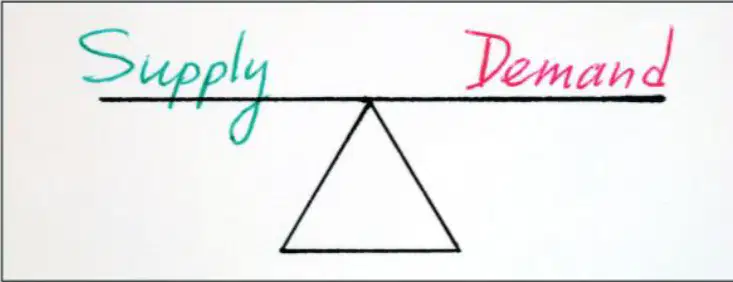
What does the diagram illustrate?
The diagram illustrates the balance between supply and demand.
The diagram illustrates the process of photosynthesis.
The diagram illustrates the structure of an atom.
The diagram illustrates the water cycle.
According to the passage, which of the following is NOT a factor that can affect the demand for a product?
A) Price
B) Consumer income
C) Tastes and preferences
D) Weather
Fill in the blank: If the price of a luxury product, such as a gym membership, increases, you may decide not to ______ your membership or visit the cinema less often.
renew
cancel
upgrade
transfer
If the price of a necessity, such as bread or fuel, goes up or down, demand changes significantly.
True
False
According to the passage, if your income increases, what might you decide to do regarding holidays?
Take more trips
Take fewer trips
Stop taking holidays
None of the above
Fill in the blank: A change in ______ and preferences can impact on-demand. Businesses will advertise products to persuade you to try them and hopefully make them your preferred purchase.
tastes
weather
location
income
If products are fashionable, more people want them, and demand can rise.
True
False
What is the definition of 'target audience'? Fill in the blank: Target audience is ________.
a particular group at which a product is aimed.
the total number of products sold in a market.
a list of all possible customers worldwide.
the process of advertising a product to everyone.
What is the definition of 'pop-up business'? Pop-up business is ________.
a business that moves into an empty space, often quickly, and trades for a short length of time.
a business that only operates online and never has a physical location.
a business that is owned by the government and provides public services.
a business that manufactures products for export only.
Which of the following is NOT a factor that can affect demand for a product?
Price
Income levels
Tastes and preferences
Weather forecast
Fashion and technology
Large fast-food companies often test new menu items in a local market before releasing them nationwide.
True
False
What is one way competition can benefit customers, according to the passage?
It keeps prices low and encourages innovation, giving consumers greater choice and better products.
It limits the number of products available to customers.
It increases prices for all goods and services.
It discourages companies from improving their products.
If a competitor is selling a similar product for a cheaper price, customers may switch to the competitor.
True
False
Fill in the blank: The place where buyers and sellers come together is called a _________.
Market
Factory
Bank
Warehouse
Fill in the blank: A market with a large number of sellers who compete to satisfy the needs and wants of many consumers is called a _____________.
Competitive market
Monopoly
Oligopoly
Monopsony
Fill in the blank: The number of customers in the market and the amount they buy is referred to as ____________.
Market size
Market share
Market segment
Market trend
Fill in the blank: Bringing in foreign goods from another country is called ____________.
Importing
Exporting
Manufacturing
Consuming
Fill in the blank: The buying and selling of goods and services is called ____________.
Trade
Farming
Mining
Painting
Fill in the blank: The amount of a product that a producer is willing and able to supply at a given price at a given time is called ____________.
Supply
Demand
Revenue
Profit
Fill in the blank: The amount of a product that customers are willing and able to pay for at a given time is called ____________.
Demand
Supply
Revenue
Inventory
Fill in the blank: Situations in which businesses face risks that cannot be predicted or measured are called ____________.
Uncertainty
Profit
Liability
Revenue
Fill in the blank: Patterns of change that affect business are called ____________.
Trends
Risks
Assets
Policies
Fill in the blank: People who live and share a space together are called a ____________.
Household
Community
Neighborhood
Family
Fill in the blank: Money received, especially on a regular basis, for work or through investments is called ____________.
Income
Expense
Debt
Liability
Fill in the blank: Development that meets the needs of the present without compromising the ability of future generations to meet their own needs is called ____________.
Sustainable development
Industrial development
Rapid urbanization
Technological advancement
Fill in the blank: A particular group at which a product is aimed is called the ____________.
Target audience
Market share
Product line
Brand ambassador
Fill in the blank: A business that moves into an empty space, often quickly, and trades for a short length of time is called a ____________.
Pop-up business
Franchise
Sole trader
Chain store
What does a PESTLE analysis consider when evaluating the environment a business operates in?
Only internal business factors
Only financial factors
Political, economic, social, technological, legal, and environmental factors
Only customer feedback
According to the passage, what can a PESTLE analysis help managers do? Fill in the blank: It can help managers to decide if products are meeting a need in the market, or if they need ______ or withdrawing.
adapting
expanding
duplicating
ignoring
Which of the following is NOT something managers can do with a PESTLE analysis?
A) Detect broad trends
B) Predict future business threats and take action to avoid/minimise impact
C) Identify business opportunities and take advantage of them
D) Ignore external factors

