
 Worksheets
Critical Thinking
Total questions: 45
Worksheet time: 45mins
Patient in DKA has K⁺ 6.2, pH 7.05. Insulin drip is started. What should you anticipate next?
Rising potassium as insulin shifts K⁺ out of cells
Falling potassium as acidosis corrects and insulin drives K⁺ intracellularly
Rising calcium as K⁺ falls
No change in potassium until dialysis
During massive transfusion, which complication should you anticipate first?
Hypocalcemia from citrate binding calcium
Hypernatremia from stored blood
Hypermagnesemia from FFP
Hypoglycemia from PRBC transfusion
After 6L NS resuscitation for trauma, what should you anticipate?
Hyperkalemia from hemolysis
Dilutional coagulopathy → need for FFP/platelets
Lactic alkalosis from NS
Hypercalcemia from chloride load
K⁺ 7.0, stable BP, ECG shows peaked T waves. What’s the first priority?
Insulin + dextrose
Calcium gluconate IV
Kayexalate
Call nephrology for dialysis
Patient with large hematemesis, MAP 45, HR 140. What’s the first action?
Call GI for endoscopy
Activate MTP and transfuse PRBCs/FFP
Give IV PPI bolus
Place NG tube for decompression
Your patient in hemorrhagic shock has one working 18g IV. You must choose what to run first:
PRBCs via rapid infuser
Calcium chloride IV
Platelets
FFP
You only have 2 units of FFP available immediately in a coagulopathic bleeder. What’s the best action?
Give the 2 units now while awaiting more products
Hold them until ROTEM confirms exact deficit
Wait until all products are ready for 1:1:1 ratio
Start crystalloids until full blood products arrive
After 6 units PRBCs, your patient’s QTc widens. What’s the likely cause?
Hypocalcemia from citrate load
Hyperkalemia from stored blood
Hypomagnesemia from FFP
Hypoglycemia from insulin
Patient: febrile, tachycardic, lactate 4, MAP 60. After 30 mL/kg fluid bolus, MAP is unchanged. What do you anticipate next?
Norepinephrine infusion at 0.1 mcg/kg/min
Vasopressin at 0.03 units/min immediately
Dopamine infusion
Repeat fluid bolus
ABG: pH 7.18, PaCO₂ 60, PaO₂ 55, HCO₃⁻ 22 on 100% FiO₂. What should you anticipate after the RT increases the respiratory rate?
PaCO₂ will fall, pH will rise, but PaO₂ may not improve without PEEP
PaCO₂ will rise further, pH will worsen, PaO₂ will normalize
PaCO₂ will fall, pH normalize, PaO₂ immediately normalize
No change in any parameter until dialysis
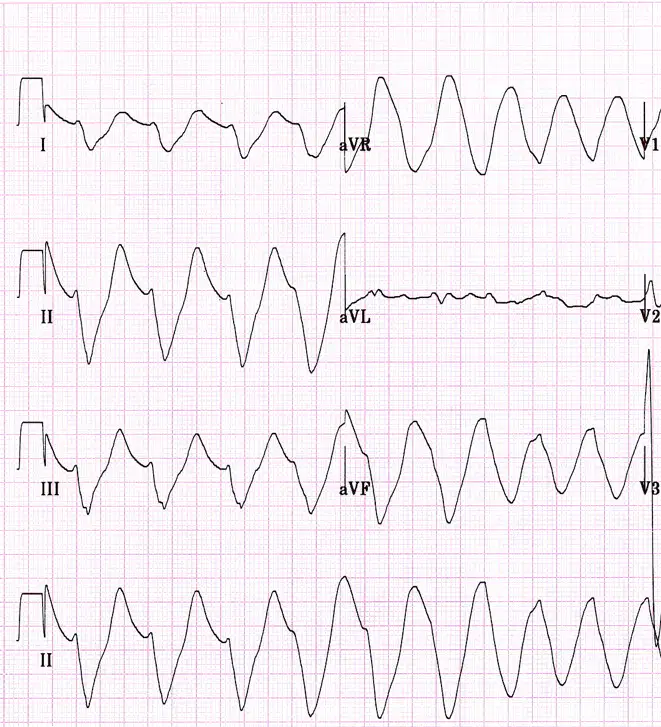
You see wide QRS and sine-wave morphology. What should you anticipate?
Hyperkalemia → prepare calcium + insulin/dextrose
Hypokalemia → prepare IV magnesium
Hypocalcemia → give calcium gluconate
Hypermagnesemia → give calcium chloride
Patient: BP 80/40, HR 140, febrile, lactate 6. What’s the critical escalation step?
Hang maintenance fluids and call pharmacy for vancomycin levels
Check urine output and wait for lactate to trend
Consult GI for possible source
Suspect Sepsis: draw cultures, start antibiotics, administer fluids (30ml/kg)
Which SBAR is most effective to escalate hypotension?
“The patient’s pressure is low, can you come?”
“Septic patient, norepi 0.4 mcg/kg/min, MAP 54, lactate rising—requesting vasopressin order now.”
“He’s not looking good; we’ve given some fluids.”
“Patient hypotensive, we think maybe antibiotics?”
Labs: K⁺ 4.9 → 5.6 → 6.2, ECG normal. What should you anticipate now?
Administer insulin/dextrose. Have calcium on standby in case of EKG changes.
Wait for ECG changes before intervening
Give Kayexalate only
Order dialysis immediately
ARDS patient: FiO₂ 0.6, PEEP 10, PaO₂ 55, pH 7.22. MAP 58 on norepi 0.2 mcg/kg/min. What’s the safest next step?
Increase FiO₂ to 0.7
Increase PEEP to 15
Increase tidal volume to 8 mL/kg
Switch to APRV without optimizing other factors
Patient with severe metabolic acidosis (pH 7.01, CO₂ 49, HCO₃⁻ 9) is sedated and paralyzed. Provider orders sodium bicarbonate 100 mEq push. What should you anticipate?
Potassium will rise as pH increases
Monitor for increased CO₂ and need for respiratory intervention
Ventilation will improve oxygenation immediately
Lactic acid will rapidly normalize
Patient presents with left hemiplegia, aphasia, NIHSS 16. BP 198/108, glucose 110, INR 1.0. CT: no bleed. Patient is a candidate for tPA. What must occur before tPA is administered?
Start IV heparin
Lower BP <185/110 with labetalol/nicardipine
Insert NG tube for feeding access
Begin aspirin 325 mg
Patient desaturates to 82% on vent. Your resources are: suction catheter, bag-valve mask, spare ETT. What do you do first?
Suction ETT to clear possible obstruction
Extubate and reintubate with spare tube
Disconnect and bag with BVM immediately
Call RT to change the circuit
Patient with cirrhosis and variceal bleed is on octreotide. Next labs: INR 2.6, platelets 38k, Hgb 6.9. What should you anticipate?
Vitamin K, FFP, and platelets
Heparin drip for DVT prophylaxis
Protonix infusion only
tPA for portal clot dissolution
You call a stroke code on your intubated patient with unequal pupils. CT is concerning for "imminent herniation”. Last ABG demonstrated PaCO₂ 60. Immediate interventions are 1) Elevate HOB 2) maintain head midline and 3) Increase the RR to hyperventilate the patient. Why does the provider request hyperventilation?
Cerebral vasodilation, increase cerebral perfusion
Cerebral vasoconstriction, reduce ICP
ICP unchanged, PaCO₂ doesn’t affect brain blood flow
ICP falls permanently, no rebound
ABG: pH 7.52, PaCO₂ 28, HCO₃⁻ 22. Which condition should you anticipate?
Metabolic alkalosis from vomiting
Respiratory alkalosis from hyperventilation (anxiety, pain, early sepsis)
Respiratory acidosis from hypoventilation
Metabolic acidosis from DKA
You suspect GI bleed will require MTP. Which call is best?
“Can you come see this patient? They’re bleeding a lot.”
“Patient with variceal bleed, MAP 50, HR 140, transfusing PRBCs—requesting MTP activation.”
“Please prepare endoscopy; we’re giving fluids.”
“We think the hemoglobin will drop, can you preemptively order some blood?”
Lactate trending: 2.8 → 4.2 → 6.1 over 2 hours, MAP 68 on norepi 0.25 mcg/kg/min. What should you anticipate?
Worsening perfusion → need for vasopressin, steroids, escalation of care
Stable course, continue same management
Switch to dopamine infusion
Stop norepinephrine due to lactate rise
ARDS patient: FiO₂ 0.9, PEEP 14, PaO₂ 58, MAP 55 despite norepi 0.3 mcg/kg/min. What’s the safest adjustment?
Add vasopressin and cautiously increase PEEP
Increase FiO₂ to 1.0 as first move
Drop PEEP to improve preload
Increase tidal volume 8 → 10 mL/kg
During DKA treatment, insulin is given while K⁺ = 3.1. What should you anticipate?
Further K⁺ drop → arrhythmias
K⁺ rise as glucose falls
No effect until dialysis
Calcium normalization
Your RRT admission is breathing 43bpm on 15L NRB. ABG: pH 7.22, CO₂ 21, O₂ 68, HCO₃⁻ 9. The fellow decides to intubate (with Etomidate and Roccuronium) and you sedate with Propofol and Fentanyl. RT puts the patient on the following settings: Vol/AC 50% TV-420, Peep-8, RR-16.
Which ABG results do you anticipate 30 min post intubation?
pH 7.14, CO₂ 47, O₂ 78, HCO₃⁻ 9
pH 7.52, CO₂ 20, O₂ 70, HCO₃⁻ 26
pH 7.33, CO₂ 37, O₂ 98, HCO₃⁻ 9
pH 7.21, CO₂ 29, O₂ 68, HCO₃⁻ 8
Septic patient with a triple lumen central line in use:
Brown Lumen: Cefepime
Blue Lumen: Norepinephrine & Vaso
White Lumen: Propofol
Order received: IV amiodarone for unstable VT. No additional access yet. What do you prioritize?
Temporarily stop antibiotics, run amiodarone there
Wait until antibiotics are finished before initiating Amio
Y-site Amio with Levo/Vaso
Y-site Propofol with Levo/Vaso
Pt has repeated alarms on the vent indicating high peak pressure, plateau unchanged. What’s the first action?
Increase tidal volume
Order paralytics
Suction ET tube for obstruction
Call RT for circuit change
MTP patient: 6 PRBC, 2 FFP, no platelets yet available. Which product should you request urgently?
Platelets
More PRBCs
Cryoprecipitate
More crystalloids
Your patient is noted to be more lethargic than previously with sluggish pupils. Team is at bedside discussing initiating a Stroke Code. What nursing intervention is a priority?
Put the patient on a hovermat and prepare for transport
Obtain a POC blood sugar
Lay the patient flat
Pull the hypertonic saline from the pyxis
DKA patient is on the “2 bag method”. Currently on insulin at 0.1u/kg/hr and 0.45% NS with 20KCl at 250ml/hr; last hour’s glucose was 325. This hour your glucose is 287. What is your next action?
Initiate 2nd bag: D10 0.45%NS with 20KCl at 125ml/hr and Decrease bag 1 to 125ml/hr
Stop insulin immediately; the glucose is dropping too quickly
Nothing, this is the expected rate for decrease in glucose
Decrease the insulin infusion
ECG shows prolonged QTc and positive Trousseau’s sign. What should you anticipate?
Hypocalcemia → calcium replacement
Hyperkalemia → insulin/dextrose
Hypokalemia → potassium
Hypermagnesemia → calcium antagonist
Patient seizing >10 minutes despite benzodiazepine. What’s the next escalation?
Load with IV levetiracetam or fosphenytoin
Intubate and sedate immediately
Order stat MRI
Call psychiatry for non-epileptic event
Which anticipatory step should the nurse communicate to the team before a planned intubation?
“Should we stop all pressors before intubation?”
“We should place an NG tube first.”
“Let’s have the code cart at bedside.”
“Let’s confirm Phenyl is at the bedside and sedation drips are programed and hooked up to the patient.”
Patient developed AMS and sluggish pupils; Head CT was positive for an Ischemic Stroke. Vital signs: HR-94, BP: 92/52 (65), SpO2 98% on the vent. Which intervention should you anticipate first?
Give mannitol
Increase MAP with norepinephrine
Increase sedation
Hyperventilate immediately
ABG: pH 7.10, PaCO₂ 60, HCO₃⁻ 14. What’s the interpretation?
Metabolic acidosis with partial respiratory compensation
Respiratory acidosis with partial metabolic compensation
Mixed metabolic + respiratory acidosis
Fully compensated metabolic acidosis
Patient with respiratory failure due to severe asthma is intubated with continuous albuterol 10mg/hr. What electrolyte should you monitor closely?
Magnesium
Potassium
Phosphate
Calcium
Patient actively seizing, glucose returns at 32. What’s first?
Give IV dextrose immediately
Give IV Ativan
Intubate first
Call neurology
The Fellow evaluated 4 patients down in EC3. Which patient is expected to be the priority admission?
Septic shock on norepi 0.25 mcg/kg/min, stable after fluids, in EC3 for 3 hours
DKA with glucose 450, alert, gap open, in EC3 for 14 hours
GI bleed with 6th PRBC running and MAP 52, in EC3 for 26 hours
Stroke post-tPA, stable, in EC3 for 30 hours.
ABG: pH 7.49, PaCO₂ 46, HCO₃⁻ 34. What’s the interpretation?
Metabolic alkalosis with partial respiratory compensation
Respiratory acidosis
Mixed alkalosis and acidosis
Fully compensated metabolic alkalosis
Patient intubated for ARDS; immediately post-intubation BP 62/38. What should you anticipate next?
Push-dose pressor + start vasopressor infusion
Large crystalloid bolus first
Trend troponin for MI
Extubate immediately
ABG: pH 7.25, PaCO₂ 30, HCO₃⁻ 14. What’s the pattern?
Mixed metabolic + respiratory acidosis
Metabolic acidosis with partial respiratory compensation
Respiratory alkalosis
Fully compensated metabolic acidosis
Patient with massive PE: BP 70/40, SpO₂ 78% on NRB. What type of shock are they in?
Hypovolemic
Septic
Cardiogenic
Obstructive
GI bleed: Hgb trend on ABGs: 7.8 → 6.5 → 5.2 within 2 hours, HR 142, MAP 60. What’s the next best escalation?
Order iron studies
Check occult stool
Send a ROTEM
Recheck Hgb on CBC
Patient with COPD exacerbation on 4L NC: pH 7.15, PaCO₂ 85, HCO₃⁻ 29, K⁺ 6.1. What’s the next priority?
Give Kayexalate
Non-invasive or invasive ventilation support
Bicarbonate infusion
Large saline bolus

