
 Worksheets
Revolutions and Nationalism Test
Total questions: 52
Worksheet time: 26mins
Problems that existed in nations and colonies that led to revolutions included:
Social inequality and lack of political representation
Abundant resources and equal rights for all
Strong central governments and stable economies
Widespread satisfaction with colonial rule
The French Revolution was caused by which combination of political, economic, religious, social, and intellectual factors?
A combination of political, economic, religious, social, and intellectual factors
Only economic and social factors
Only religious and intellectual factors
Only political and economic factors
The causes and effects of each phase of the French Revolution were:
Social inequality, economic hardship, and political conflict led to revolution; effects included the end of monarchy, rise of Napoleon, and spread of revolutionary ideas.
The French Revolution was caused by foreign invasions and resulted in the expansion of the British Empire.
Religious disputes and the discovery of new lands were the main causes, leading to the Industrial Revolution.
The French Revolution was caused by technological advancements and resulted in the unification of Germany.
The Terror occurred due to which reasons and what were its consequences?
It occurred due to political instability and fear of counter-revolution, resulting in mass executions and increased radicalization.
It occurred due to economic prosperity and peace, resulting in social harmony and stability.
It occurred due to foreign invasion and resulted in the expansion of French territory without any internal conflict.
It occurred due to scientific advancements and resulted in the improvement of education and healthcare.
The ideals of the French Revolution were lost during Napoleon’s reign.
Yes, the ideals were lost during Napoleon’s reign.
No, the ideals were fully preserved under Napoleon.
Napoleon expanded the ideals to all of Europe.
The ideals were never part of the French Revolution.
The leaders of the Latin American independence movements were considered revolutionaries.
True
False
Only some were revolutionaries
None were revolutionaries
Nationalism can act as both a unifying and dividing force because:
It brings people together within a nation but can create conflict with others.
It always leads to peace and harmony among all nations.
It only causes division within a country and never unity.
It has no impact on society or politics.
Revolutions create social change.
Yes
No
Only sometimes
Never
Revolutions need to be violent to be effective.
True
False
Only in some cases
Never
Define: Estate System
A social and political system in pre-revolutionary France divided into three estates: clergy, nobility, and commoners.
A system of land ownership in modern democracies.
A method of organizing industrial production.
A type of economic policy used in ancient Rome.
Define: The Bastille
A fortress in Paris used as a prison; its storming in 1789 marked the start of the French Revolution.
A famous French cathedral known for its architecture.
A royal palace where the French kings lived.
A French holiday celebrated with fireworks.
Define: The Reign of Terror
A period during the French Revolution when thousands were executed for being 'enemies of the revolution.'
A time when Napoleon Bonaparte ruled France as emperor.
A period of peace and prosperity in France during the 18th century.
The era when the monarchy was restored in France after the revolution.
Define: Tennis Court Oath
A pledge made by members of France's National Assembly in 1789, vowing not to separate until a new constitution was established.
A treaty signed between France and Britain ending the Seven Years' War.
A law passed by the French monarchy restricting public gatherings.
A famous speech delivered by Napoleon before the Battle of Waterloo.
Define: Congress of Vienna
A meeting of European leaders after the defeat of Napoleon to restore order and balance of power in Europe.
A treaty signed between France and Britain to end the Hundred Years' War.
A revolution that led to the unification of Germany.
A military alliance formed to defeat the Ottoman Empire.
Define: Grito de Dolores
A speech by Miguel Hidalgo in 1810 that called for Mexican independence from Spain.
A treaty signed between Mexico and Spain ending the war.
A traditional Mexican festival celebrating independence.
A law passed by the Spanish government to control the colonies.
Define: Realpolitik
A system of politics based on practical and material factors rather than ethical or ideological considerations.
A political philosophy that prioritizes religious values above all else.
A system of governance based solely on democratic ideals and public opinion.
A theory advocating for the elimination of all forms of government.
Define: Liberal
A person or political philosophy that advocates for reform, open to new ideas, and supports individual freedoms.
A person who strictly opposes any change in society and prefers traditional values.
A political philosophy that supports absolute monarchy and centralized power.
A person who believes in limiting individual freedoms to maintain order.
Define: Conservative
A person or political philosophy that favors traditional values and is cautious about change or innovation.
A person who always supports rapid technological advancements regardless of consequences.
A philosophy that encourages breaking away from all traditions and customs.
A person who believes in complete government control over all aspects of life.
Name: Marie Antoinette Category: __________ Contributions: __________
Category: French Revolution Contributions: Last Queen of France before the French Revolution, symbol of the excesses of the monarchy, executed during the Revolution.
Category: Industrial Revolution Contributions: Invented the steam engine and improved factory production.
Category: American Revolution Contributions: Wrote the Declaration of Independence and became the third President of the United States.
Category: Scientific Revolution Contributions: Developed the theory of gravity and the laws of motion.
Name: Napoleon Bonaparte Category: __________ Contributions: __________
Category: French Revolution Contributions: Military leader who rose to prominence during the French Revolution, became Emperor of France, expanded French territory, and implemented Napoleonic Code.
Category: Industrial Revolution Contributions: Invented the steam engine and revolutionized transportation.
Category: American Revolution Contributions: Led the Continental Army and became the first President of the United States.
Category: Scientific Revolution Contributions: Developed the theory of gravity and laws of motion.
Name: Miguel Hidalgo Category: __________ Contributions: __________
Category: Caribbean & Latin America Contributions: Mexican priest and revolutionary leader who is called the father of Mexican independence.
Category: Europe Contributions: Led the French Revolution and became Emperor of France.
Category: Asia Contributions: Unified Japan and established the Tokugawa shogunate.
Category: Africa Contributions: Fought against apartheid and became the first Black president of South Africa.
Name: Toussaint L’Ouverture Category: __________ Contributions: __________
Category: Caribbean & Latin America Contributions: Leader of the Haitian Revolution, helped Haiti become the first independent black republic and abolish slavery.
Category: Europe Contributions: Led the French Revolution and established the Napoleonic Code.
Category: United States Contributions: Wrote the Declaration of Independence and became the third President of the United States.
Category: Asia Contributions: Led the Indian independence movement against British rule.
Name: Simon Bolivar
Category: Caribbean & Latin America Contributions: Led independence movements in South America, known as 'The Liberator' for his role in freeing several countries from Spanish rule.
Category: Europe Contributions: Led the unification of Germany and served as its first Chancellor.
Category: Asia Contributions: Founded the Mongol Empire and conquered large parts of Eurasia.
Category: North America Contributions: Wrote the Declaration of Independence and served as the third President of the United States.
Name: Maximilien Robespierre Category: __________ Contributions: __________
Category: French Revolution Contributions: Influential leader during the French Revolution, led the Committee of Public Safety, associated with the Reign of Terror.
Category: Industrial Revolution Contributions: Invented the steam engine and improved factory production.
Category: American Revolution Contributions: Wrote the Declaration of Independence and served as the third President of the United States.
Category: Scientific Revolution Contributions: Developed the theory of gravity and made significant advances in physics.
Name: Klemens von Metternich Category: __________ Contributions: __________
Category: European Leaders Contributions: Austrian diplomat, key figure at the Congress of Vienna, helped reshape Europe after the defeat of Napoleon.
Category: American Presidents Contributions: Led the United States during the Civil War, issued the Emancipation Proclamation.
Category: French Revolutionaries Contributions: Led the Reign of Terror, radical leader during the French Revolution.
Category: Russian Tsars Contributions: Modernized Russia, expanded its territory, and implemented significant reforms.
Name: Otto von Bismarck Category: __________ Contributions: __________
Category: European Leaders Contributions: Prussian statesman, unified Germany, served as its first Chancellor.
Category: Renaissance Artists Contributions: Painted the Mona Lisa and The Last Supper.
Category: American Inventors Contributions: Invented the light bulb and phonograph.
Category: Ancient Philosophers Contributions: Developed the Socratic method of questioning.
Name: Giuseppe Garibaldi
Category: __________
Contributions: __________
Category: European Leaders Contributions: Italian general and nationalist, played a key role in the unification of Italy.
Category: American Inventors Contributions: Developed the light bulb and phonograph.
Category: Asian Philosophers Contributions: Founded Confucianism and wrote the Analects.
Category: African Explorers Contributions: Explored the Congo River and mapped central Africa.
'Storming of the Bastille' and fill in the year(s) it occurred and its significance.
Year: 1789; Significance: Marked the beginning of the French Revolution.
Year: 1815; Significance: Ended the Napoleonic Wars.
Year: 1492; Significance: Discovery of America by Columbus.
Year: 1917; Significance: Start of the Russian Revolution.
'Napoleon Crowned Emperor' and fill in the year(s) it occurred and its significance.
Year: 1804; Significance: Napoleon declared himself Emperor of France, consolidating his power.
Year: 1812; Significance: Napoleon was exiled to Elba after losing power.
Year: 1799; Significance: Napoleon led the coup of 18 Brumaire, ending the French Revolution.
Year: 1815; Significance: Napoleon was defeated at Waterloo, ending his rule.
'The Battle of Waterloo' and fill in the year(s) it occurred and its significance.
Year: 1815; Significance: Napoleon was defeated, ending his rule and the Napoleonic Wars.
Year: 1812; Significance: Napoleon expanded his empire into Russia, marking his greatest victory.
Year: 1805; Significance: The British navy defeated the French fleet, ending Napoleon's naval ambitions.
Year: 1821; Significance: Napoleon returned to power in France, starting a new era of wars.
'Haiti Wins Independence' and fill in the year(s) it occurred and its significance.
Year: 1804; Significance: Haiti became the first independent black republic and the first country in Latin America to gain independence.
Year: 1821; Significance: Haiti became a French colony again after a brief period of independence.
Year: 1791; Significance: Haiti declared independence but remained under Spanish control.
Year: 1810; Significance: Haiti joined with neighboring countries to form a federation.
'Congress of Vienna' and fill in the year(s) it occurred and its significance.
Year: 1814-1815; Significance: Redrew the map of Europe after the defeat of Napoleon and restored monarchies.
Year: 1919-1920; Significance: Established the League of Nations after World War I.
Year: 1789-1791; Significance: Marked the beginning of the French Revolution and the end of absolute monarchy in France.
Year: 1945; Significance: Led to the founding of the United Nations after World War II.
'Grito de Dolores Issued' and fill in the year(s) it occurred and its significance.
Year: 1810; Significance: Marked the beginning of the Mexican War of Independence.
Year: 1821; Significance: Ended the Spanish rule in Mexico.
Year: 1776; Significance: Marked the beginning of the American Revolution.
Year: 1492; Significance: Christopher Columbus discovered America.
'Monroe Doctrine Issued' and fill in the year(s) it occurred and its significance.
Year: 1823; Significance: U.S. policy opposing European colonialism in the Americas.
Year: 1865; Significance: End of the American Civil War and abolition of slavery.
Year: 1776; Significance: Declaration of Independence signed, founding the United States.
Year: 1914; Significance: Start of World War I, major global conflict.
'Battle of Ayacucho' and fill in the year(s) it occurred and its significance.
Year: 1824; Significance: Decisive battle that secured independence for Peru and South America from Spanish rule.
Year: 1810; Significance: Marked the beginning of the Mexican War of Independence.
Year: 1805; Significance: Ended the Napoleonic Wars in Europe.
Year: 1836; Significance: Led to the independence of Texas from Mexico.
'Revolutions of 1848' and fill in the year(s) it occurred and its significance.
Year: 1848; Significance: Series of political upheavals throughout Europe, also known as the Springtime of Nations.
Year: 1917; Significance: The start of the Russian Revolution, leading to the rise of the Soviet Union.
Year: 1789; Significance: The beginning of the French Revolution, which ended absolute monarchy in France.
Year: 1871; Significance: The unification of Germany under Prussian leadership.
'The Crimean War' and fill in the year(s) it occurred and its significance.
Year: 1853-1856; Significance: Conflict between Russia and an alliance of the Ottoman Empire, France, Britain, and Sardinia.
Year: 1914-1918; Significance: Start of World War I between the Allies and Central Powers.
Year: 1775-1783; Significance: American colonies fought for independence from Britain.
Year: 1939-1945; Significance: Global conflict involving the Axis and Allied powers.
'Franco-Prussian War' and fill in the year(s) it occurred and its significance.
Year: 1870-1871; Significance: Led to the unification of Germany and the downfall of Napoleon III.
Year: 1812-1814; Significance: Marked the end of the Napoleonic Wars and the rise of the British Empire.
Year: 1914-1918; Significance: Initiated the collapse of the Ottoman Empire and the start of World War II.
Year: 1861-1865; Significance: Resulted in the abolition of slavery and the preservation of the United States.
'Unification of Italy' and fill in the year(s) it occurred and its significance.
Year: 1861 (completed in 1871); Significance: The various states of the Italian Peninsula were unified into the Kingdom of Italy.
Year: 1789; Significance: The Italian Peninsula was divided into several independent republics.
Year: 1914; Significance: Italy joined the Allied Powers in World War I, leading to unification.
Year: 1492; Significance: The Italian Peninsula was unified under the rule of the Spanish Empire.
According to the Declaration of the Rights of Man and Citizen (1789), what is the definition of liberty?
Liberty consists in the freedom to do everything which injures no one else.
Liberty is the right to do anything one wishes without restriction.
Liberty is the absence of all laws and regulations.
Liberty is the power of the government to control individual actions.
Toussaint L’Ouverture wants the following for his citizens:
Freedom and equality
Colonial rule
Oppression and slavery
Foreign domination
Toussaint Louverture promoted goodwill among nations by:
negotiating treaties and alliances
leading a slave revolt in Haiti
invading neighboring countries
establishing trade monopolies
Hidalgo uses which of the following to inspire people to arms against Spain?
A call for independence
Promises of wealth
Foreign support
Religious conversion
Cavour’s biggest motivator for Italian independence was:
the desire to strengthen and unify Italy
the wish to expand the French Empire
the goal of spreading socialism
the ambition to restore the Papal States
The United States may have inspired Camillo di Cavour in which of the following ways?
By demonstrating successful unification of states under a federal system
By maintaining a monarchy as a form of government
By remaining isolated from European affairs
By discouraging the idea of national unity
“Iron and blood” implies that German unification would be achieved through:
military force and warfare
peaceful negotiations
economic reforms
diplomatic alliances
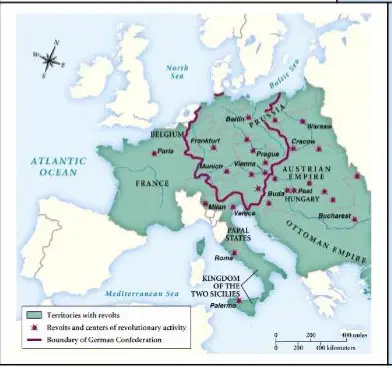
This map shows the Revolutions of 1848 that took place across Europe and are sometimes called Springtime of the Peoples. Major revolts broke out in which of the following countries?
France, Germany, Italy, Austria
Spain, Portugal, Norway, Sweden
Russia, Greece, Turkey, Ireland
Switzerland, Denmark, Finland, Poland
The goal of most of these revolutions was:
to achieve greater political and social equality
to expand colonial empires
to maintain absolute monarchies
to increase trade with other nations
This kingdom united the north of Italy and drove out the Austrians.
Sardinia
Rome
Sicily
Farfalle
Who was proclaimed the King of United Italy, in 1861?
Giuseppe Garibaldi
Victor Emmanuel II
Giuseppe Mazzini
Cavour

